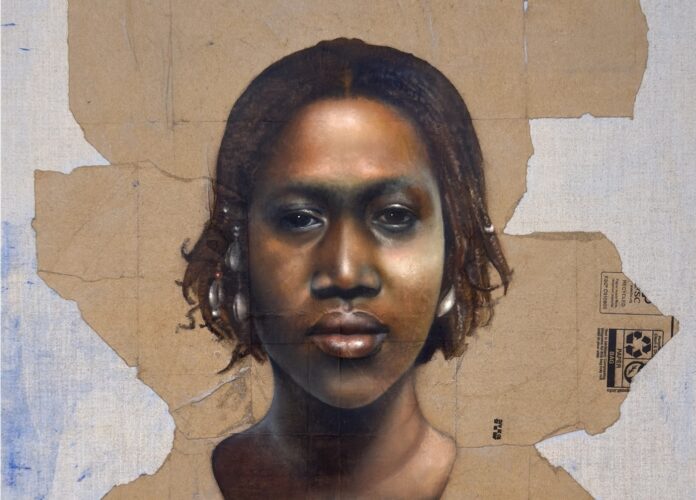
As an artist exploring heritage, Mary W.D. Graham is highly interested in the painted portrait. Using traditional techniques, she finds a certain depth of color and texture through the use of oils and other media that lend themselves to her method of portraying faces. Graham says that across her performance and visual work, she is wedded to character as the point of entry into an open-ended inquiry into our shared histories. Through layering, Graham achieves what she calls a kind of archaeology of expression.
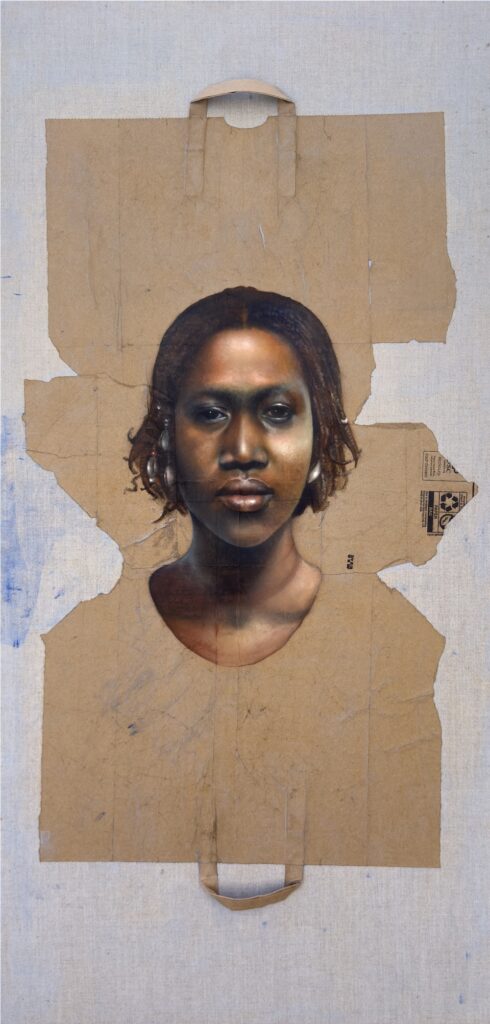
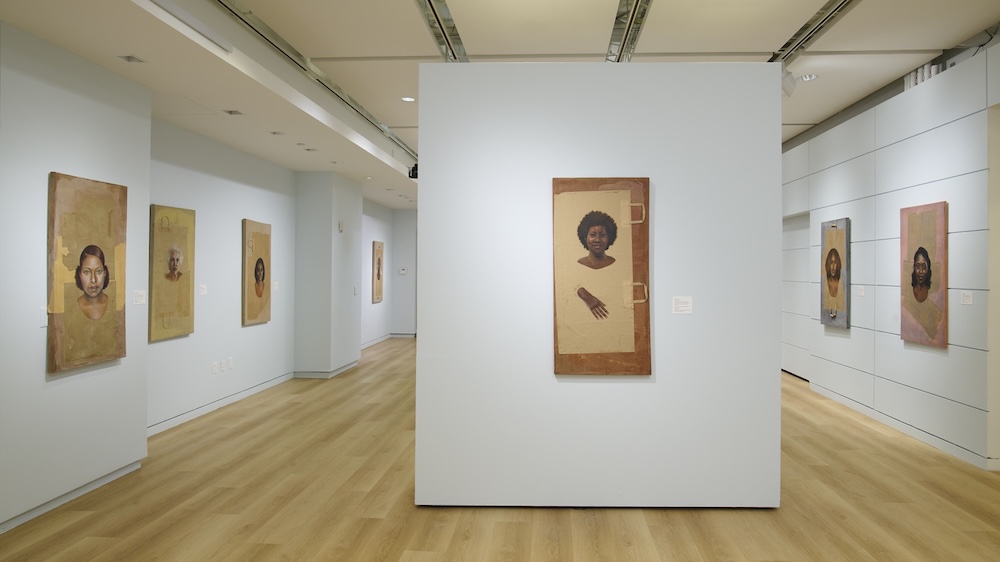
“In my series Value Test: Brown Paper, I’m dealing with colorism, both in its present manifestation and its historic context,” Graham told 48hills of the work she brought to EXPO Chicago and to the Atlanta Art Fair with Jonathan Carver Moore Gallery.
“It references ‘the paper bag test,’ which was conducted among the Black upper class from the turn of the century up until the 1980s and would exclude those darker than the paper from admission into social clubs, colleges, parties etc. Contemporary colorism is still systemic and carries a material impact. I created the series as an opportunity for introspection, discussion, and reconciliation. I want the portraits to act as portals into the history of Black womanhood, our beauty and our possibility.”
“Research for my work has helped me understand that these times are not so ‘unprecedented’ and that every facet of this moment has its historical mirror,” she continued. “I’m lucky to have friends and loved ones in my community who have lived through several historic moments who I can consult about the implications of current events.”
Graham grew up in Philadelphia, and moved to the Bay Area to attend college at California College of the Arts in 2018. She graduated with a BFA in Individualized Studies. A resident of North Beach for the past eight years, Graham says she appreciates the familiarity, openness, and the level of respect people have for one another here.
“Many of us in the arts are working several different jobs that expose us to different resources and opportunities that we’re eager to share with our communities,” she said.
Graham says her parents and the full creative life she was provided in her formative years are her biggest influences.
“My dad Lonnie Graham is a photographer, artist, and social advocate whose philosophy on the artist’s role in community imbued me early on with a sense of purpose. My mother Christina Roberts is a textile artist who has worked at the Fabric Workshop and Museum in Philadelphia for 35 years. Growing up, I spent a lot of time there and had many incredible opportunities to talk to the artists-in-residence,” she said.

Graham recounts having particularly strong memories of encounters with Faith Ringgold’s Tar Beach yardage, Willie Stoke Jr.’s painting studio in the back, and materials tests from Kara Walker’s Fibbergibbet and Mumbo Jumbo.
“Sonya Clark came to the workshop in 2019 to create Monumental Cloth: The Flag We Should Know. Talking to her, I was moved by her deep sense of curiosity, the depth of her research, and her emphasis on illuminating histories that are not taught,” Graham said.
Graham also cites her high school art teacher Deborah Caiola for providing her with valuable technical skills; and the wisdom and breadth of work imparted by CCA professors Kim Anno, Linda Geary, David Huffman, Bryan Keith Thomas, Christine Wang, and Karla Wozniac.
“After graduating CCA, I spent three years as Lava Thomas’s studio assistant and mentee. Witnessing her sense of creative and professional integrity, her care and precision, impacted how seriously I take my own work and research. I remain very grateful for that time with her,” Graham said.
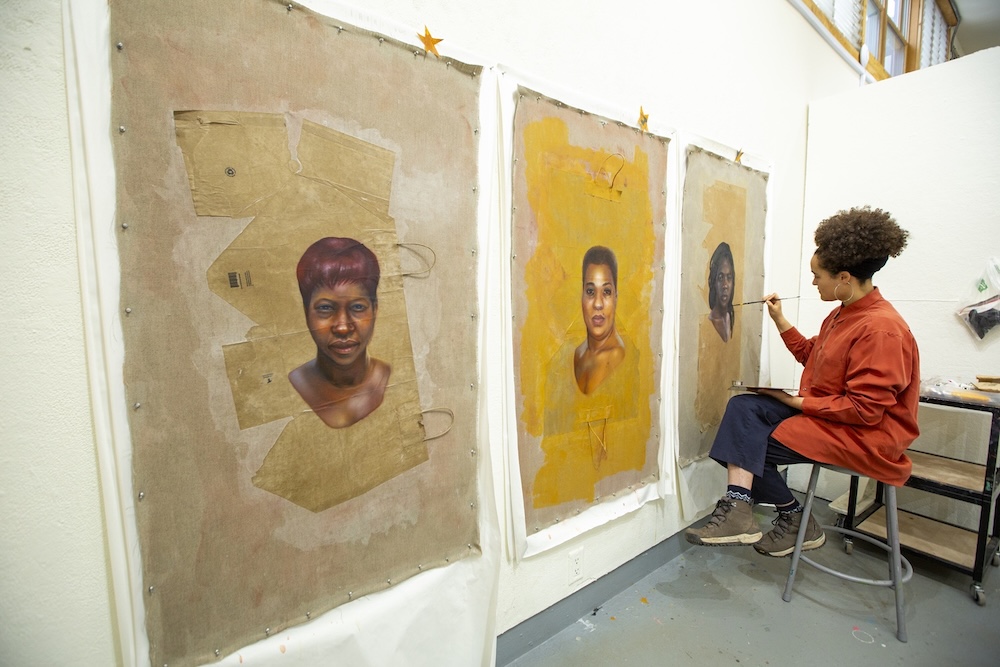
Within a complex process, an important part of Graham’s creative cycle includes what she calls “rest work”—sewing, drawing, and writing.
“During this time, I’m resting my mind but keeping my creative energy flowing. I also do image research, putting together collages and sketching out ideas for new paintings. When I start to feel restless, I build and stretch my canvases and prepare the surfaces and the under-painting,” she said.
Deeper in, Graham describes a phase where she starts to feel as though the painting is calling her home to completion: to resolve a reflection here, correct a shadow there.
“Toward the end, I’m aiming for it to take on deep dimensions, transform in interesting ways depending on the light, and for the figure in the painting to look out at me. Once I see her, the painting is finished,” Graham said.
Graham says she considers herself to be in the nascent stage of her professional career, with current bodies of work having originated from ideas developed during undergrad studies, including the original sketches for Value Test.
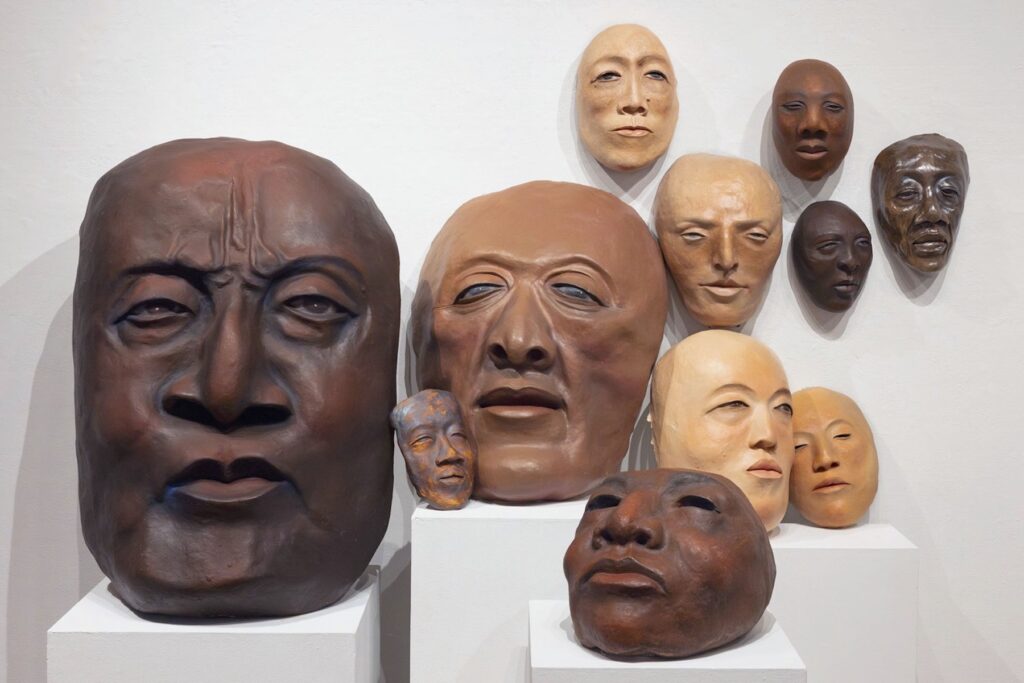
“It was in my first year while I was encountering the issues that arise being young, earnest, Black, and female in a new, predominantly White, and quite vulnerable art school environment. I revisited the work after graduating, deciding to increase the scale and work from reference photos to improve my technique. I developed Kin in my final year working with papier-mâché clay and, after having the opportunity to be in residence at Haystack Mountain School of Crafts in Maine, I was able to expand this body of work into ceramics as well,” she said.
During COVID, Graham honed her performance practice, singing around the streets of San Francisco to neighbors sheltering-in-place as a shared acknowledgement of a strange time. She also created some short films and worked on Serenade, a project involving live vocal improvisation in public spaces.
“I’m very interested in creating an interdisciplinary ethos around my work. For my artist activation accompanying my solo exhibition at the Museum of the African Diaspora in San Francisco in 2024, I wanted to translate the discussion and storytelling aspect of the work into a performance piece.
“I wrote a poem and invited artists Dr. Tonya M. Foster, Rhodessa Jones, devorah major, and Tureeda Mikell to create spoken word works in response to the Value Test paintings. Mingling with the crowd, we shared our poems interwoven with conversation,” she said.
Graham chose the writers based on their ability to take family stories, emotion, and memory, and draw a direct line to history.
“In the future, I’d love to continue inviting more voices to illuminate new stories and unfold the performance potential of this series.”
In 2016, Graham worked with artist and family friend John Stone to create The 9, a collection of portraits of the victims of the Charleston Church shooting. Between 2020 and 2022, Graham engaged BIPOC students, alumni of CCA, and faculty and staff unions to draft a list of demands for racial and socio-economic equity at the school, working with the administration to operationalize the project.
“This project, along with the works in Value Test, have the same impetus having emerged in the midst of, and then in reflection upon, the Black Lives Matter movement,” she said.
Her exhibitions in 2026 include group show Drawn From Life at Sausalito Center for the Arts (Jan/Feb); and Value Test: Brown Bag, currently on exhibit at the Zora Neale Hurston National Museum of Fine Art in Eatonville, Florida, until January 2027. Graham also held two artist residencies at the Vermont Studio Center and the Art & History Museums of Maitland in Central Florida, which culminated in the exhibition US.
In San Francisco, as part of NEXUS SF/Bay Area Black Art Week, Graham is participating in Black Interiors at Black (Space) Residency through October 31, and had art shown in Meet the Moment: Art for Action Benefit Exhibition, at TnT Art Lab.
For the next two years, Graham will be in graduate school at Columbia University School of the Arts working on a thesis project considering African diasporic dance, music, and gathering, along with stories recorded during the Federal Writers’ Project in the late 1930s, including those from Stephanie M. Camp’s seminal book Closer to Freedom: Enslaved Women and Everyday Resistance in the Plantation South.
Outside of making art, when Graham is in the Bay Area she enjoys cooking for friends, taking long quiet walks through San Francisco at night, and hiking at the Headlands or Redwood Regional Park in Oakland.
“And I have been re-igniting my love of reading. Octavia Butler stays on audio book rotation and I’m heavily annotating The Dawn of Everything by David Graeber,” she said.
Mary W.D. Graham’s philosophy about making art is to construct and contribute in a small way to a meaningful line of inquiry. Her success lies in the ability to create work which will stay with the audience long enough to inspire a journey into memory, introspection, and deeper interpretation.
“I find myself moved by a long-term imperative,” she said. “As a creative descendent of social practice artists, cultural activists, and educators, I believe my job is to provide people with context for our present conditions, illustrate what our ancestors have been through, and thus illuminate a way forward.
“And as an artist of my time, I’m trying to respond to a growing sense of urgency with a sense of conceptual urgency. These are the histories we can’t forget. Here we are, as Black people, as women, as queer people, as immigrants. Here are our dreams, here is how we have gotten free, and this is how to get free,” Graham said.
For more information, visit her website at marydgraham.com and on Instagram.