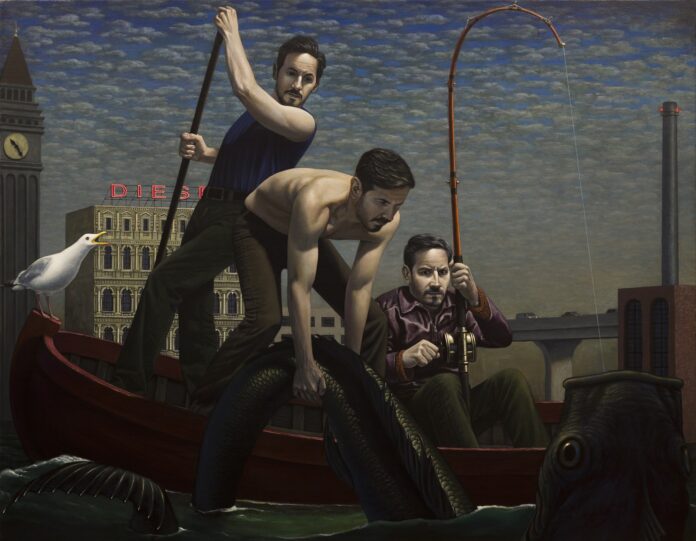
The figurative paintings of Sacramento-based artist John Tarahteeff may be classically rendered, but their innate mystery is what captures the attention. Youthful characters suspended in an enigmatic moment or in curious relational contrast to each other emit a surreal quality. Through a mastery of luxuriously rich color and composition, there always appears to be much more to the story.
Tarahteeff graduated from UC Davis with a BS in Landscape Architecture (1994); a minor in Studio Art is his only formal training. Primarily self-taught, Tarahteeff has developed a unique style through emulation and imagination.
Born and raised in the South Bay cities of San Jose and Mountain View, the artist has made his home in East Sacramento for the past 25 years. He says that it was in a high school humanities class that he first began to make some of the connections between what he was curious about and translating it through drawing.
“From a young age I was drawn to and curious about images—how they are made and operate. Going through H.W. Janson’s History of Art, I marveled at the feats of the Old Master painters, but Giorgio DeChirico was one of the first artists that I felt like I could emulate,” Tarahteeff told 48 hills.
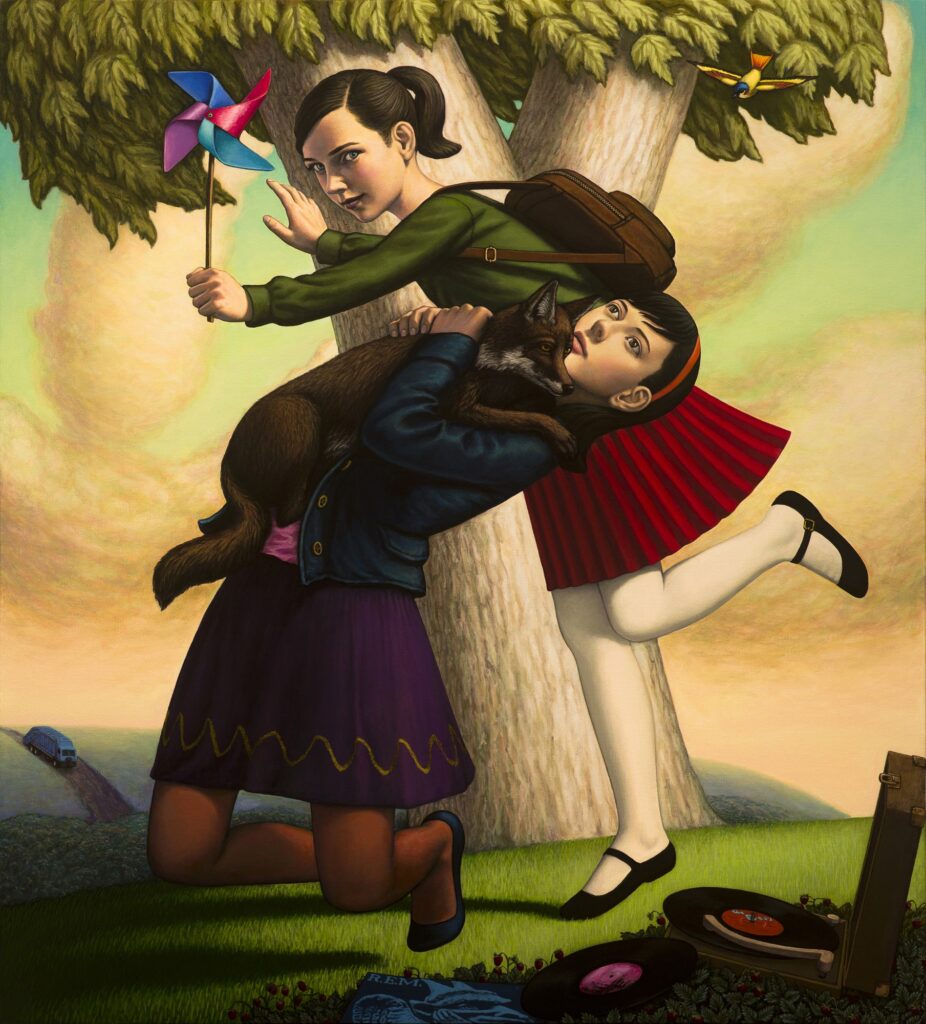
During his college years at UC Davis, he was particularly drawn to the High Renaissance painters, such as Van Eyck and Hans Memling, even though he didn’t feel he had the painting skills to mirror them precisely.
Not surprisingly, Tarahteeff also discovered the paintings of Polish-French artist Balthasar Klossowski de Rola, popularly known as Balthus (1908-2001), who would become a major influence in the development of his own figurative work. It was during these years and immediately after college that a deeper exploration of painting began and the pursuit of a signature methodology took on stronger significance, eventually becoming the artist’s oeuvre.
“I experimented with abstraction but ultimately I found a more satisfying place in the representational picture-making that fascinated me as a child. I was considering paintings by Alex Katz and David Hockney then and looking at even more contemporary painters like Kerry James Marshall and John Curin,” he said.
Tarahteeff says that though he has been inspired by contemporary artists, he remains more swayed by a range of figurative painting from the deeper archives of history.

“I’ve been simultaneously drawn to the melancholic austerity of Swiss Symbolist artist Arnold Böcklin’s work; the tendency towards artifice over naturalism of the Mannerists and their manifestation in the bendy swooshiness of American Regionalist painters like Thomas Hart Benton; and the Pre-Raphaelite paintings with their sometimes-lush color and attention to surface detail. All have had their influences on my work, though at times seem to be competing forces,” Tarahteeff said.
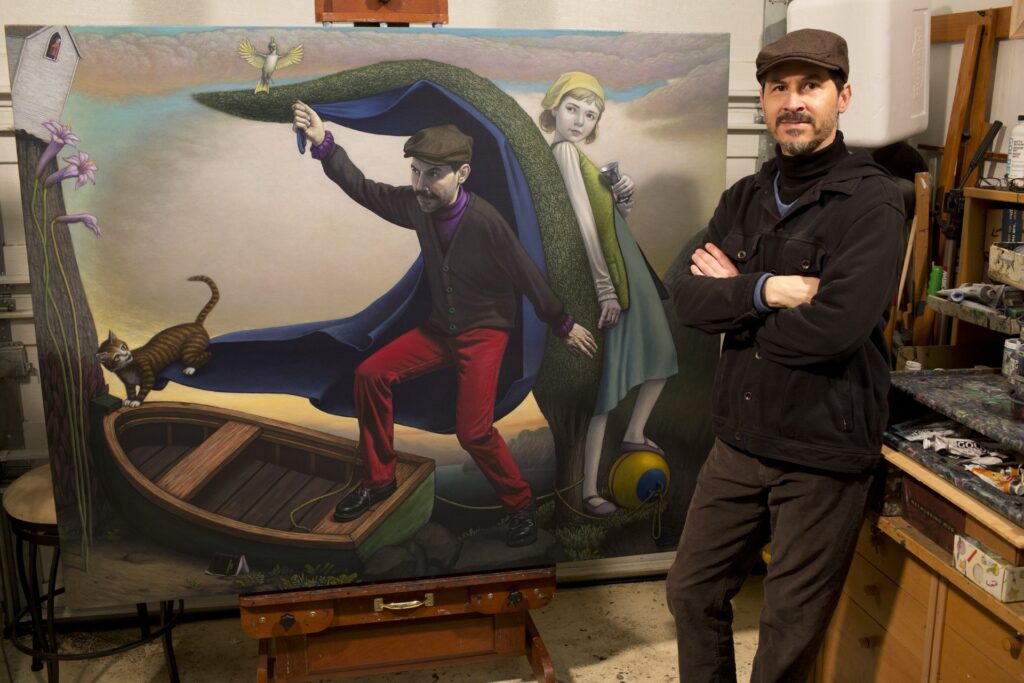
In evocative works, Tarahteeff strives for a sense of yearning within curious, imaginative narratives. Capturing a single figure, or figures, involved in some activity that hides or just begins to reveal a story is the basis of his subject matter.
“Even when that activity is relatively calm, there is a sense that there is some sort of story in process that supports the condition we are seeing,” he said.
Tarahteeff doesn’t set out with a particular intent most of the time, rather the narrative emerges out of impulsive choices. He described how a composition can develop from a simple sketch of a figure’s head to a whole scene with other figures and a setting, all of which emerges intuitively.
“I just sort of infer the next thing to do with an image based on what is there and where it takes my imagination,” he said.
He adds that flexibility is critical to his process in this act of discovery, though somewhat contradictory is his chosen medium of acrylic paint—what some would consider antithetical to the more pliable manner of oils.
“Acrylics are fast drying when compared to oils so it isn’t malleable in a material sense and it makes soft transitions and edge variations challenging, but it does facilitate trying many things out and quickly altering them, even in a drastic way by painting over,” he said.
Tarahteeff admits that for years he has actually complained about the fast-drying aspect of acrylic paint and considered that he would eventually transition to oil painting.
“I like oils for the buttery smooth, wet-in-wet blends they offer, but here I am still using acrylic paint. I suppose I am a creature of habit and have been using acrylics so long that I like knowing what to expect with it in a kind of reflexive way,” he said.
That said, he has adapted his process somewhat by gradually incorporating the application of digital tools.
“I have transitioned more of my settling on the composition’s design in the digital realm because of the ease of iterating with cutting and pasting to move elements around, and the ability to quickly visualize changes in combinations of color and scale,” he said.
Tarahteeff is engaged in some aspect of his art practice every day. He usually addresses a work in-progress or preps for a new painting after waking up, then heads to a coffee shop in the afternoon to work out sketches on his computer.
Using an old laptop, Tarahteeff has worked up most of the compositions for his paintings of the last 15 years through images that are spliced, diced, and reconstituted into thousands of digital iterations in a process he refers to as “chasing surprise.” Some figures may require that he pose to provide additional reference material, but he does so in a measured way.
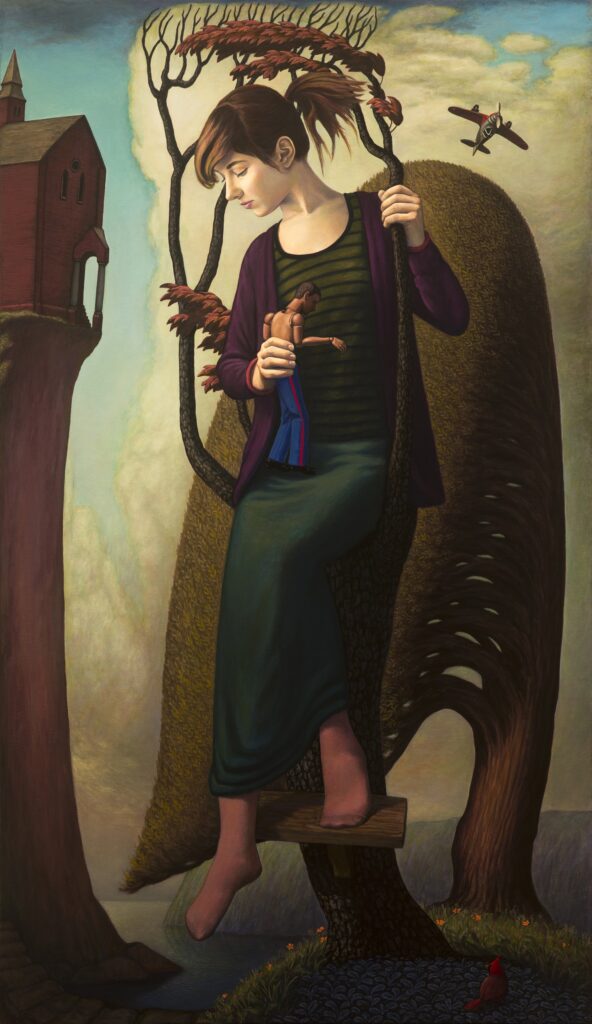
“In this stage, I copiously combine imagery that I have generated from scanned pencil sketches, parts of photos, and touchpad drawn images. It really facilitates things as I can try out so many possibilities and visualize them fairly reliably,” he said.
Tarahteeff says the composition must have a succinct yet non-arbitrary design that carries the narrative and figurative elements in a story with “lasting, albeit mysterious, resonance” before he moves onto canvas.
“When I start the actual painting there is usually a fair amount of course correction necessitated by my visceral response to the burgeoning painting worked on at scale. After all, my digital sketches created at decidedly low resolution on an almost two-decade old laptop’s touchpad are quite crude,” he said.
Tarahteeff says that he has recently become more conscious of his play with stylization and artificiality vs. specificity and naturalism within the same piece.
“While I often struggle to find references to contribute realistic aspects to my made-up worlds, I like the way toys and other objects add to the dreamy atmosphere of play I am engaged in. It is as though at times I feel like I am using degrees of artificiality almost as a formal parameter like degrees of value, texture, saturation etc., that needs to be balanced across the composition,” he said.
He has also come to realize that most people don’t see what he sees in his digital compositions. The story becomes something different for everyone. As for knowing when and where to stop, he says it occurs when he arrives at a place where there is no more room for additions that wouldn’t come at an intolerable expense to the whole of the piece.
“It may seem dismissively cliche but I find myself saying the refrain ‘it is what it is’ pretty regularly,” he said.
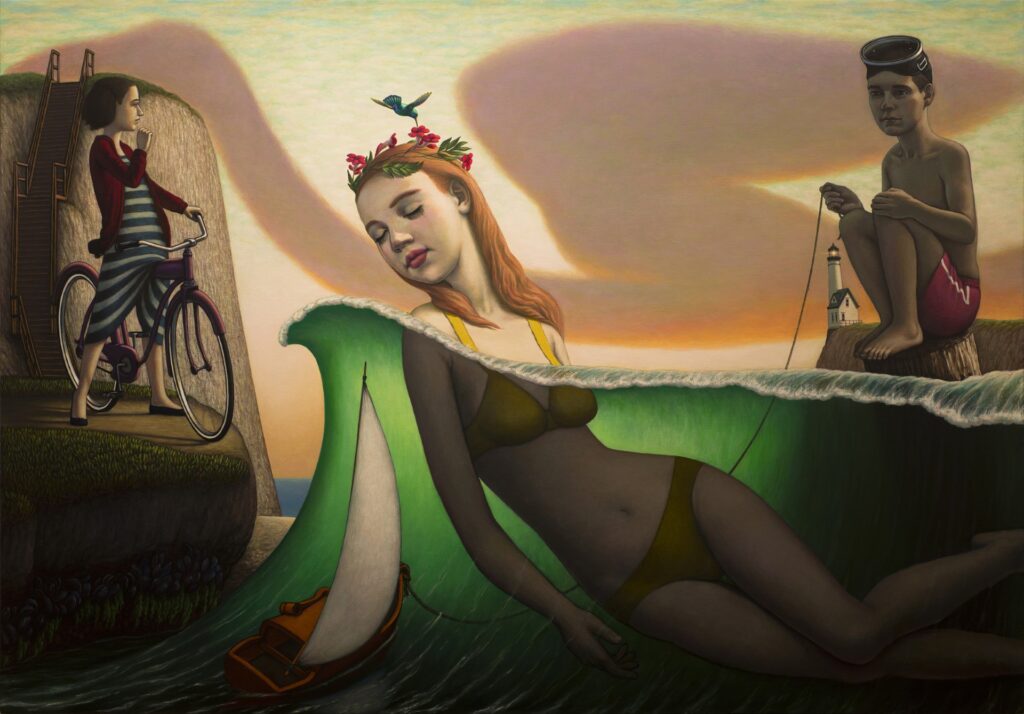
In the fall of 2022, Tarahteeff started experimenting with an AI image generator and was blown away by what it was capable of, which has impacted how he thinks about his work.
“I recognized an analog in it with the accretive manner of how my compositions are constructed, being that a major aspect of my imagery is made up, which AI can do quite well, quickly and abundantly now. But it is still the very self-revelatory aspect of my work that motivates me to ultimately conceive it,” he said.
Tarahteeff said that he loses interest in painting if it doesn’t feel like he is figuring something out both in terms of formal and narrative discovery and problem solving. There exists for him a critical need for exploration that AI simply can’t satisfy. He sees AI as a potentially useful tool for artists but also understands the anxiety of what it portends for the world in general.
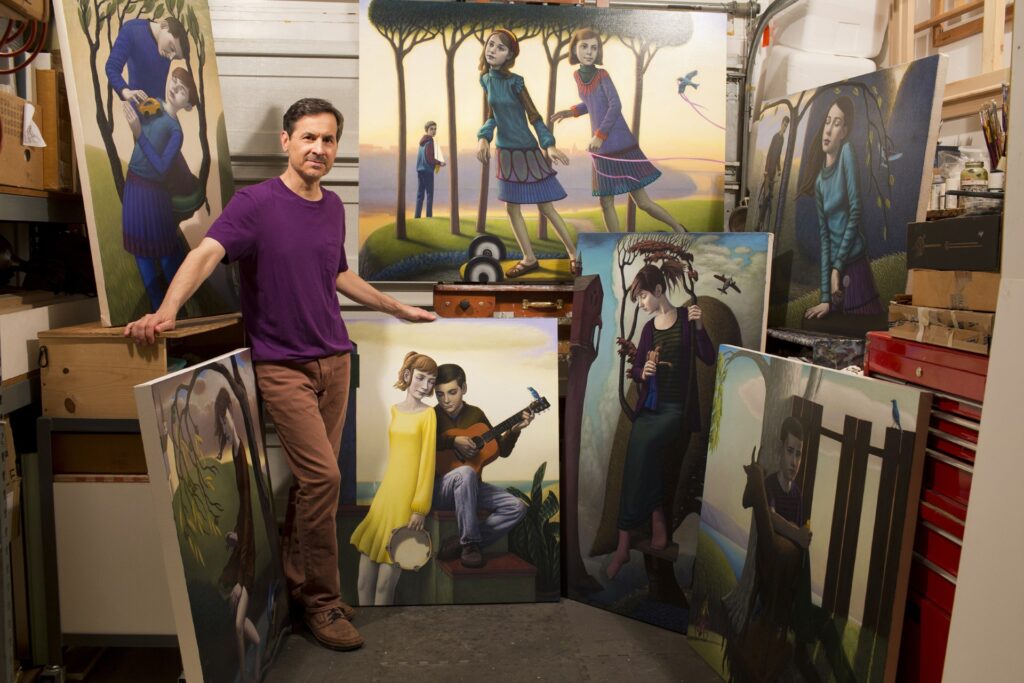
Tarahteeff’s studio for the past 25 years has been the single car garage space of his home where he says he draws some inspiration from the “nostalgia inherent in the vernacular” of his East Sacramento neighborhood.
Represented by Nüart Gallery on Canyon Road in Santa Fe, New Mexico with a second space in Bergamot Station in Santa Monica, California, Tarahteeff shows in both spaces. His most recent solo exhibition, Yearn, ran through September at Nüart’s Santa Fe location. As is typical with his work, Tarahteeff didn’t have a specific concept in mind for the exhibition.
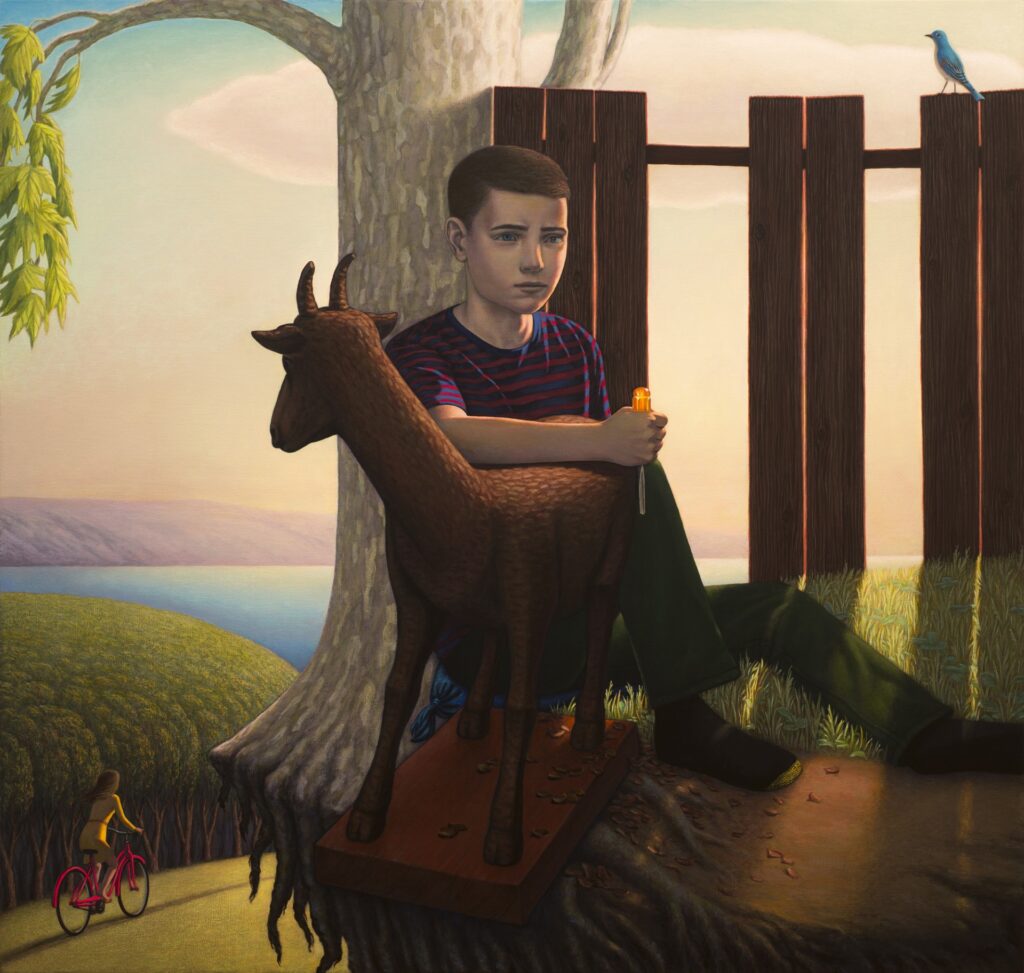
“It seems like these latest paintings manifest a yearning for a world just out of reach, like dreams with archetypes or versions of familiar people or places that have the bittersweet residue of aspirations partially fulfilled,” he said.
With a deepened commitment to time in the studio in the past couple years, John Tarahteeff is busy building supports, sketching, and reviewing new ideas without attaching to a specific theme or agenda going forward. Future works await our curious eyes, in narratives that will no doubt continue to hint at the mysteries of life, as Tarahteeff visualizes them.
“Though my paintings are introspective, I hope there is a sense of a shared human experience in them,” Tarahteeff said. “I hope there is an identification with a reverence for beauty and that the paintings surprise and inspire curiosity and stimulate the creative imagination.”
For more information, visit him on Facebook and his page at Nüart Gallery.