After the dismal results for San Francisco progressives from the Nov. 3 election, one small bright spot shines through: Prop. B is poised to pass.
As of Nov. 9, the Yes campaign is ahead by roughly 15,000 votes. With its likely passage, San Francisco would become the first city in the country to have a municipally owned bank. The proposition, put forward by a grassroots coalition that includes Sup. Jackie Fielder as a co-founder, is the culmination of a decade of work.
“Prop B is an important first step in establishing our public bank. I’m especially excited because with Democrats in control of the House and Senate, there may be new avenues available to fund the bank, so that we can get work financing the things we need,” Sup. Chyanne Chen, whose legislation put Prop. B on the ballot, said in a statement.
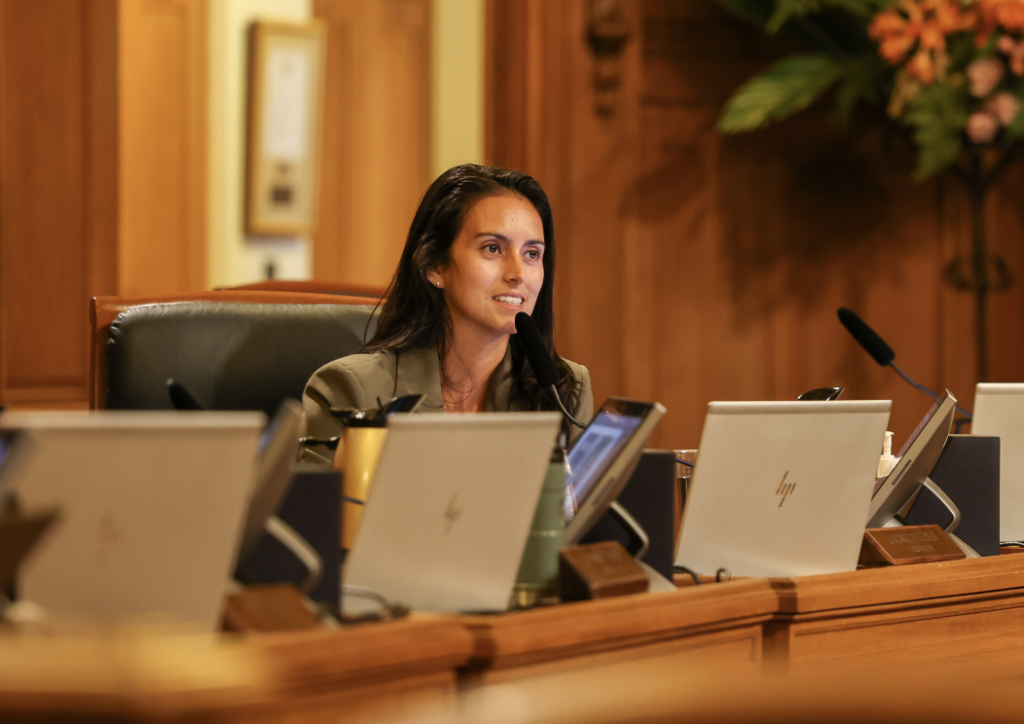
The San Francisco Public Bank Coalition was birthed in 2017 following Fielder’s experience protesting with Indigenous leaders against the Dakota Access Pipeline. When she returned to the city she focused on reclaiming and reallocating San Francisco’s billions of dollars in its municipal general fund. With the dedicated help of a slew of organizers and a couple supervisors, the SFBPC was eventually able to get Proposition B on the ballot.
“The San Francisco Public Bank Coalition has been at the forefront of this movement for a decade, and the credit for this victory goes to the thousands of volunteers who have contributed their time and trust to this plan for a better future,” said Misha Steier, SFPBC Spokesperson.
According to a recent study from the Climate and Community Institute, a public bank would provide a monumental lift for the city’s working class with the creation of thousands more affordable housing units and roughly $60 million in small businesses loans. It could provide the capital for the city to meet its climate goals. And those numbers are merely within the first decade.
The ceiling for a public bank far exceeds what those projections indicate. Not only would a public bank be financially sustainable, but it would generate far more for working San Franciscans than the current municipal investing model.
One of the only available American models for a public bank comes from the agrarian oriented Bank of North Dakota. That bank, founded in 1919 and owned by the state, was a critical lifeline to farmers in a time of widespread destitution. Last year, BND generated $231 million in profit and has profits of over $1.5 billion in the past decade.
As highlighted in the piece prior to the election, the first step following Prop. B’s passage will be to establish a Municipal Finance Corporation. After the MFC demonstrates financial solvency, it will eventually transition to a fully-fledged public bank. The MFC would be staffed with banking experts and community advocates, with funding coming from the federal government, state grants, and private philanthropy.
To transition to a public bank, the MFC would need to demonstrate financial viability within the first three years. After that, it will need to apply for state banking charter, secure licensing from the California Department of Financial Protection and Innovation as well as traditional deposit insurance through the FDIC.
Mayor Lurie and GrowSF were among the critics of Prop. B. Lurie did not actively campaign against the measure but opposed it and GrowSF offered a “No” on its voter guide. Both opponents cited the capitalization and logistics as a key concern.
Fiscal responsibility extends not just to municipal penny-pinching but requires a positive alternative for San Franciscans that continue to struggle under ballooning costs. Real financial responsibility necessitates investment in the city, and Prop. B serves as a huge leap forward.
“As working San Franciscans struggle with the rising cost of living and the growing threat of climate crisis, we need public institutions that aspire to reimagine how we can invest in our communities and in solutions that address climate change,” Fielder said.