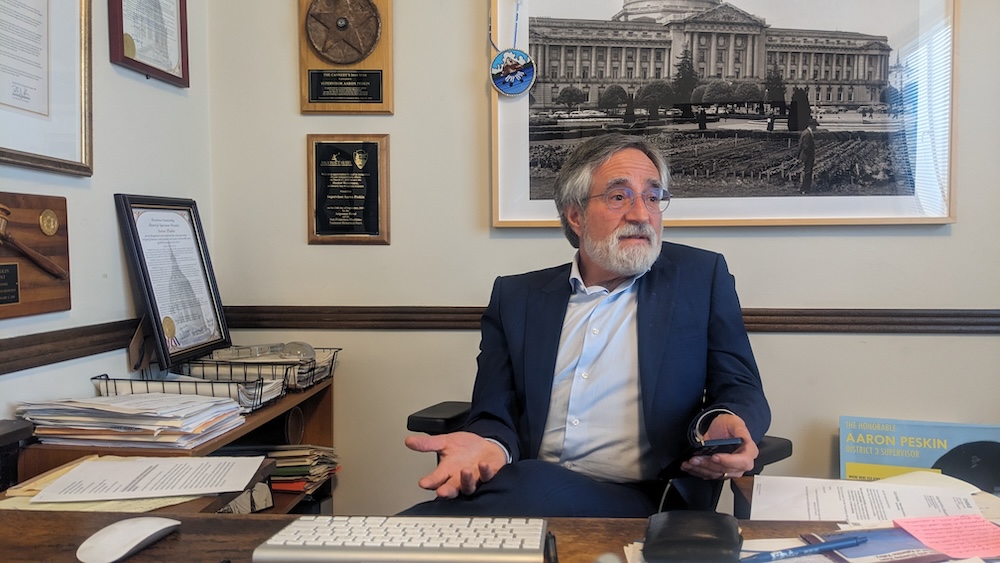
A six-vote conservative majority on the Board of Supes wants to change the rules to make sure someone like Aaron Peskin can no longer have a lengthy career at City Hall.
The measure would remove the current term-limit language, which prevents anyone from serving more than two consecutive terms as a supervisor or mayor, to a lifetime ban after two terms.
The measure would not impact other offices, like the city attorney and the district attorney, or the School Board or Community College Board.
Just the supervisors.
This is the work of Yimby groups who want to make sure someone like Peskin (or former D11 Sup. John Avalos) can never make a return to public office.
The Mayor’s Office isn’t an issue. Nobody who served two terms as mayor ever tried, or ever will try, to come back after a four-year hiatus. It’s all about the supes. (Memo to Ruth Ferguson, who is pushing this: Peskin seems quite happy in retirement.)
Term limits for legislators by definition empower the executive—and the lobbying sector. When the legislative branch turns over quickly, the people who hold those offices lack the time to get experience with the details of making laws.
(Oh, and why does this only apply to the supes, not the treasurer, assessor, district attorney, etc?)

But you want to reform the Charter and the role of the executive and the legislative branches? There’s a far more importance change that’s not on the agenda.
I know of very, very few jurisdictions where the executive gets to appoint members of the legislature.
The president of the US can’t fill a vacancy in Congress. The governor of California can’t appoint a vacancy in the State Legislature. The mayor of Oakland can’t appoint members of the Oakland City Council. So why does the mayor of San Francisco get to appoint people to vacant seats on the Board of Supes?
It’s a terrible policy, ripe for abuse. At one point, Mayor Willie Brown had appointed a majority of the supes, who did whatever he said; he even referred to them as “my mistresses who need to be serviced.”
Forget term limits; this is the real issue. A vacancy on the board should be filled by a special election; that’s what the state Legislature or Congress.
The mayor of San Francisco already has too much power. All this proposal does is give that person more.
That measure comes up at the Rules Committee Monday/26. That meeting starts at 10am.
The Land Use and Transportation Committee will consider Monday legislation that would allow people to park their cars in their driveways.
I didn’t even know that was illegal.
Apparently it is: The City Planning Code bans parking in driveways that are in front of a house, even if the car isn’t blocking the sidewalk, unless the driveway is “screened from view and confined by solid building walls.”
Nobody on the West Side, the Ingleside, Bayview, or a lot of other single-family housing neighborhoods obeys that rule anyway. That’s because almost nobody parks a car in their garage; they use the garage for storage, or a workshop, or an ADU, and they park on the street, or in the driveway (or in parts of Bayview, on the sidewalk).
At first glance, it seems to make perfect sense to let people park in their driveways (or at least, park “up to two operable vehicles, not including boats, trailers, recreational vehicles, mobile homes, or buses, in driveways located in required front setbacks, side yards, or rear yards.”
But the San Francisco Bicycle Coalition is opposed to the bill because it would encourage more cars in the city. The data has been clear for years: Open more lanes on the freeways, allow more free parking, and more people are encouraged to drive:
At the October 23, 2025 Planning Commission hearing, Commissioner Campell expressed concerns about the ordinance encouraging more people to drive and incentivizing car ownership because more parking will be available. The impacts this ordinance will have on air pollution and our climate goals should be studied by an environmental impact report. Most concering to us are the potential impacts this ordinance will have on future bike projects. Active driveways and curb cuts are not only hazardous to pedestrians, seniors, and people with disabilities but they also make it difficult to upgrade unprotected bicycle facilities to protected facilities. Under this ordinance, garage to ADU conversions would keep curb cuts active and remove one of our few tools to remove driveways. For corridors like Alemany Boulevard in District 11 that have remained on the City’s High-Injury Network for years and have a surplus of curb cuts, this ordinance potentially hinders our ability to improve safety for pedestrians and active transportation users.
Sups. Myrna Melgar, Chyanne Chen and Alan Wong, all representing areas where people like to park in their driveways, are the sponsors. The hearing starts at 1:30pm.
Meanwhile: Yimby Law is now planning to sue San Francisco, saying that the mayor’s Rich Family Zoning Plan doesn’t allow enough new density to meet the state’s mandates. From the Standard:
The pro-development advocates at YIMBY Law plan to file suit against San Francisco next month, claiming Mayor Daniel Lurie’s upzoning scheme fails to fulfill the city’s state-mandated allowance of housing, the organization’s executive director, Sonja Trauss, told The Standard.
In response to the decades-long housing crisis, California officials have in recent years been pressuring local governments to loosen zoning requirements or risk losing state funding or land-use control.
San Francisco is mandated by state officials to plan for 82,000 new homes by 2031. Of that, the city must rezone to reasonably allow for about 36,000 homes in the next six years.
But there’s a bit of an issue here: Of those 82,000 units, the state mandate says 46,000—more than half—must be affordable. Upzoning does very little to help affordable housing; the main obstacle is not zoning, it’s money.
The price tag for those 46,000 units is $19 billion. The state, which mandates those units, and the city, which is responsible for them, have no idea where that money might come from. None. It’s just not going to happen.
So the Yimby Law folks want the city to zone for even more market-rate housing, which won’t solve the affordability crisis, and say nothing about the need for funding for affordable housing.
It’s as if everyone will be happy if we just allow luxury developers to build more housing for the very rich, and we just ignore the state affordable housing mandates.
It’s not about zoning, folks. It’s about money, about economic inequality, tax cuts for the rich, and federal, state, and local officials ignoring those issues.