Can you imagine—just for a moment—a future where urban spaces, like a street, a corridor, or a plaza, celebrate and affirm the existence of Native people? Places that display public art produced by Native artists, encouraging sober reflection on the tragic and violent history of the genocide of Native peoples? Sites that could appeal to authentic aspirations for communal healing as well as support a sense of pride among the multitude of First Nations peoples in the city and the Bay Area?
Good news: a project like this actually exists. The Indigenize SF initiative was developed by the American Indian Cultural District with the goal of ensuring a visible and vibrant Native presence in the City of San Francisco. It aims to create a living cityscape that allows Ramaytush Ohlone people to walk through any neighborhood and experience a Native presence that advances pride in who they were in the past, who they are in the present, and who they will be in the future.
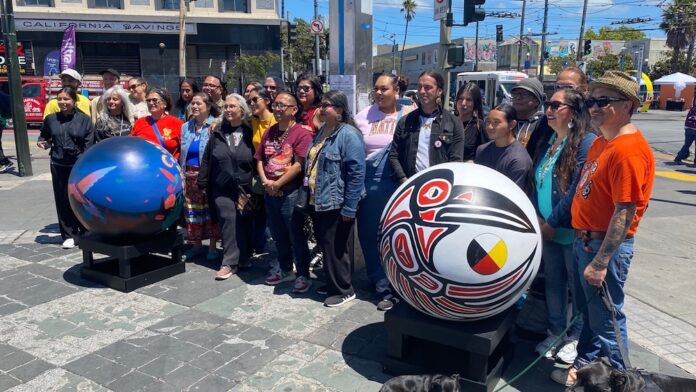
On June 20, at the 16th Street BART Plaza, the AICD unveiled two spherical works, each painted by an American Indian artist. On a warm and sunny morning, as Mission residents went about their business and a stream of buses, cars, bikes, and scooters flowed by, the city was being reimagined.
The AICD was founded on March 31, 2020 and officially recognized as a state-designated cultural district by the California Arts Council soon after, on December 12 of the same year. San Francisco’s AICD is the only recognized American Indian cultural district of its kind in California and the United States dedicated to recognizing, honoring, and celebrating American Indian legacy, culture, people, and contributions throughout the lands of the Yelamu (an area later dubbed San Francisco by the Spanish).
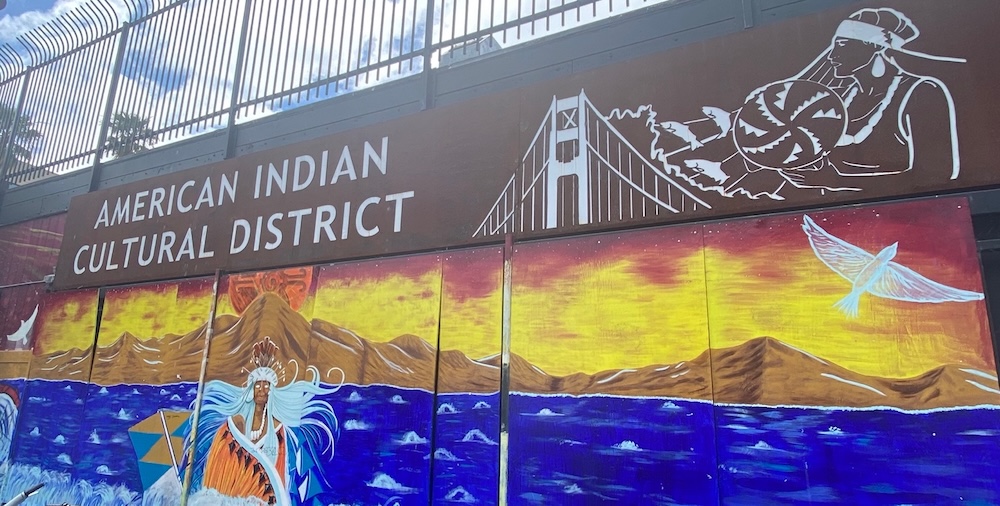
Located in the Mission District, the AICD serves as a homebase for the local intertribal American Indian community, rooted in the ancestral homeland of the Ramaytush Ohlone peoples. Within it are found significant historical sites, Native-led organizations, cultural resources, educational programs, and gathering spaces that have shaped Native life in the Bay Area for generations.
“The purpose of us advocating for an American Indian cultural district was to engrave our presence in a place where not only will Native people feel they belong, but to remind the city that American Indians have a relationship to this land going back thousands of years, and we are still here. Our people and our culture are not to be forgotten,” said April McGill (Yuki/Littke Lake/Wailaki/Mishewal Wappo), executive director of the American Indian Cultural Center.
Installing American Indian-centered public art is in keeping with the Mapping Genocide Project, a collaboration between the AICD and the San Francisco Museum of Modern Art. Artist Jackie Fawn (Yurok/Washoe/Surigaonon) produced eight illustrations for the SFMOMA show, which prompted reflection on the untold brutality imposed on Native peoples, as well as serving as a celebration of the strength and resilience of survivors, both historically and today. It focused on identifying 35 San Francisco city street names and 10 statues and/or monuments named after historical figures who have contributed to the direct violence and attempted erasure of American Indian people.
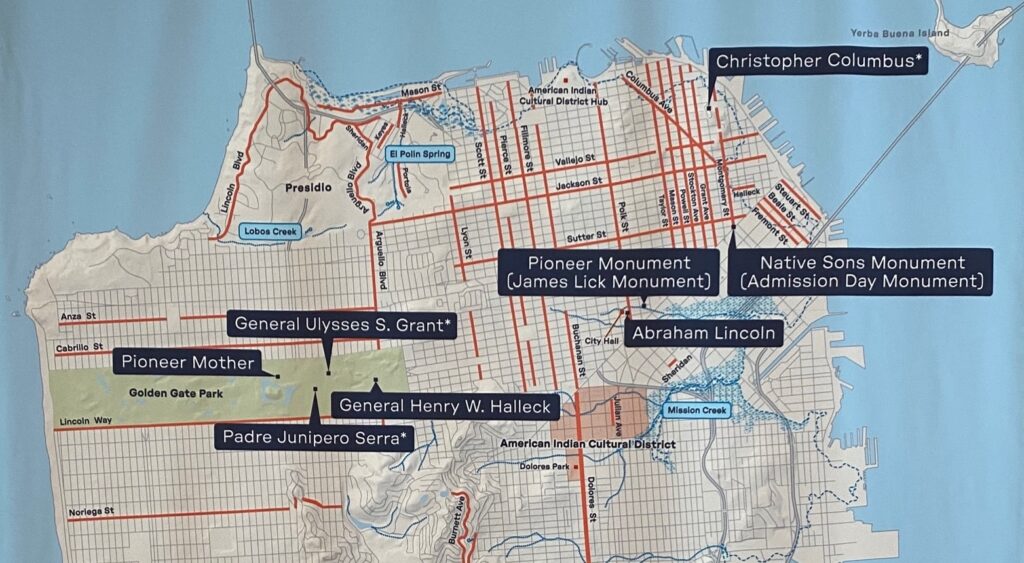
According to McGill, “The historical narrative is that American Indian people aren’t here anymore, which dismisses the history of this land and this neighborhood by not acknowledging the genocide and violence on this land.”
McGill continued, “You know that a few blocks from 16th and Mission, there is Mission Dolores, where several bands of Ohlone relatives were enslaved and trafficked, from the Ramaytush to the Tuchayinio to my people, the Mishewal Wappo people. The historical narrative talks of the Gold Rush as an amazing thing, but it leaves out the real truth that it brought genocide to the California Indian people and wiped out and displaced several bands of the Ramaytush people.”
Creating public art that honors Native life is the next aspect of the IndigenizeSF initiative, a proactive step to rebuild community through culture and healing.
“We are on Indigenous land, so we must bring back the memory of our Native peoples through art, through murals, sculptures, whatever—even the sidewalks,” said McGill.
The project was brought to life thanks to the AICD’s local Native partner organizations, such as the Bay Area American Indian Two-Spirits, the American Indian Cultural Center, Native American Health Center, and Friendship House, as well as Mission district organizations and small businesses, and with support from the City’s Office of Economic and Workforce Development.
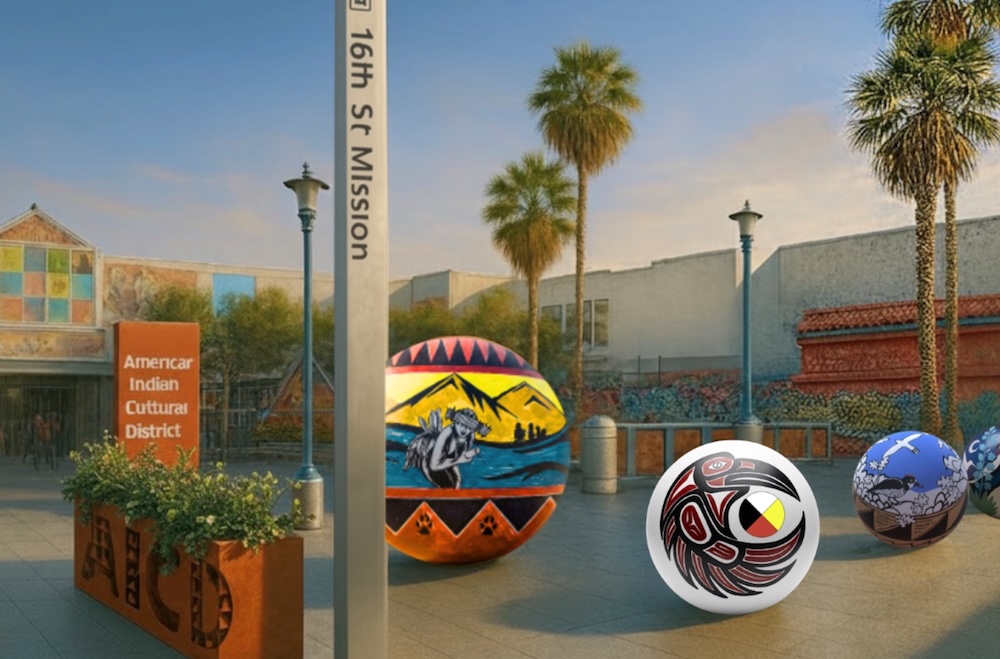
In a statement to the press, executive director of AICD Sharaya Souza (Taos Pueblo, Ute, Kiowa) said, “These installations serve as an invitation to imagine a future where Native American stories, art, and cultures are permanent and visible in San Francisco’s public spaces.”
At the unveiling, opening remarks were made by McGill, following by Souza and the AICD’s Jade Fong, along with representatives from various community organizations who helped bring together the resources that made the event possible.
Then the two Native sculptures were unveiled. Raven is a culturally specific public art work created by Bay Area Native American artist, Maize Black (Mohawk) that draws on the aesthetic lineages of the Haida, Tlingit, and Haudenosaunee peoples.
“The Raven is very widespread though most First Nations people,” said Black, calling it, “a pretty powerful symbol, and a very powerful animal, as we all know, even in modern times.”
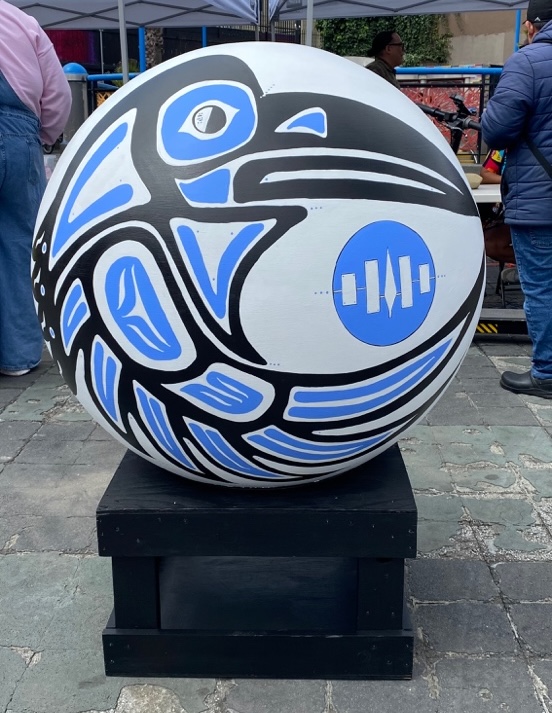
“In Haudenosaunee (Iroquois) history, the Raven represents the bringer of life and is the direct speaker for the Creator. The very first Raven was sent by the Creator,” Black continued. “The bird came to us with the very first seed, corn, so that humanity would exist. “My piece symbolizes resilience, protection, and perseverance across Turtle Island.”
Black’s piece features two, slightly different ravens, with each emblem flush with symbolism.
“The blue and black Raven color scheme is linked to the symbol of the Akwesasne flag, the symbol of the oldest democracy on planet Earth,” said Black. “A lot of people do not know it, but that is how the United States built a democracy.”
The four squares and the tree shape each represent one of the original five nations of the Haudenosaunee: (from left to right) Seneca, Cayuga, Onondaga (the tree), Oneida, and Mohawk. Their position on the flag mirrors their geographic placement.
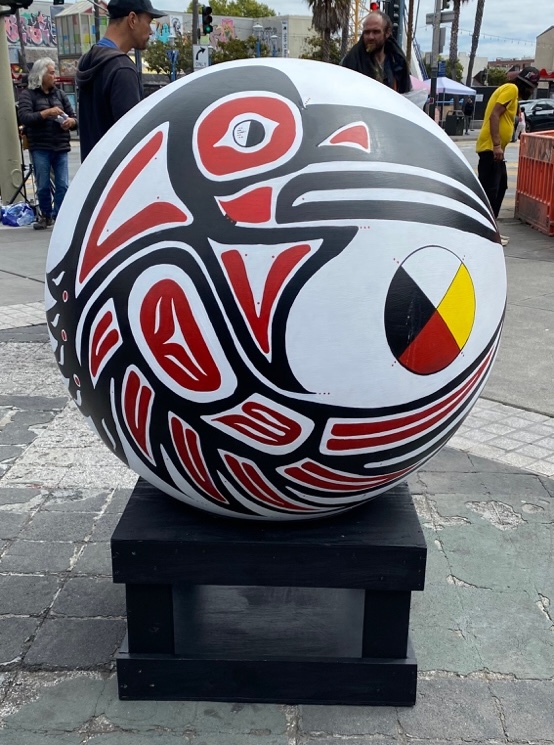
“The red and black Raven is linked to a familiar four-colored circle,” said Black “This circle is made of Native colors, red obviously, traditionally a very Native color. The circle is the medicine wheel, the four corners of all Nations and the four directions.”
Black added, “While it is true that the most common colors of the Medicine Wheel in Native America are red, yellow, black and white, the main characteristic design of the Native American Medicine Wheel is the most basic yet most perfect form–the circle. This is one absolute, not only in Native America for sacred hoops, but also for most cultures that have some kind of circle of life symbol.”
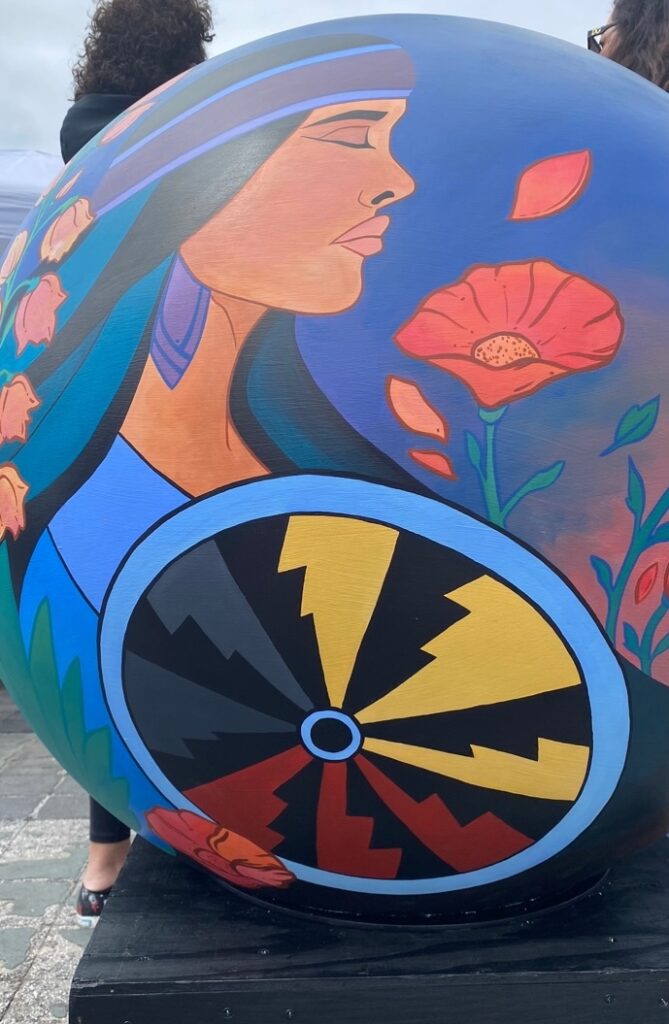
“Seeds is about the teachings, stories, and cultural knowledge we carry forward through generations,” said artist Felicia Gabaldon (Choctaw) in introducing what she called “a meditation on continuity, resilience, and cultural transmission.” “Just as seeds hold the potential for future growth, our communities continue to survive and flourish through care, renewal, and connection,” she continued.”
“At its center is an Indigenous woman holding a basket-inspired Medicine Wheel, surrounded by hummingbirds, blooming yucca, California poppies, the crescent moon, and flowing strands of hair that merge into the landscape,” said Gabaldon. “Together, these elements speak to the passing of knowledge, language, tradition, and care from one generation to the next.”
“The title refers,” according to Gabaldon, “not only to literal seeds, but to the teachings, stories, and values Indigenous people inherit and carry forward. Just as a seed contains the potential for future growth, culture survives through stewardship, community, and renewal. The hope is that viewers see themselves reflected in that responsibility—to nurture what has been entrusted to Natives and leave something meaningful for those who come after.”
“Producing the sphere was both rewarding and challenging,” added Gabaldon. “It was my first time painting directly on fiberglass, and the process demanded constant adaptation, not only technically, but logistically. Public art often asks artists to be resilient, and this project certainly reinforced that.”
In early August, another Native sculpture was unveiled by AICD. Balance is the culturally specific public art work created by Bay Area Native American artist Drew Valencia (Kashaya Pomo). While he lives in the City, his reservation is located in the Bodega Bay area.
According to Valencia, “Balance is about the four seasons, the four directions, the four colors, the four elements, the four stages of life, and paying homage to our animal relatives. Balance is not a goal; it is a way of life and an ongoing journey.”
Valencia credits AICD for inspiring him to give back to Native peoples through visual art, calling San Francisco “one of the biggest inner tribal communities, still to this day.”
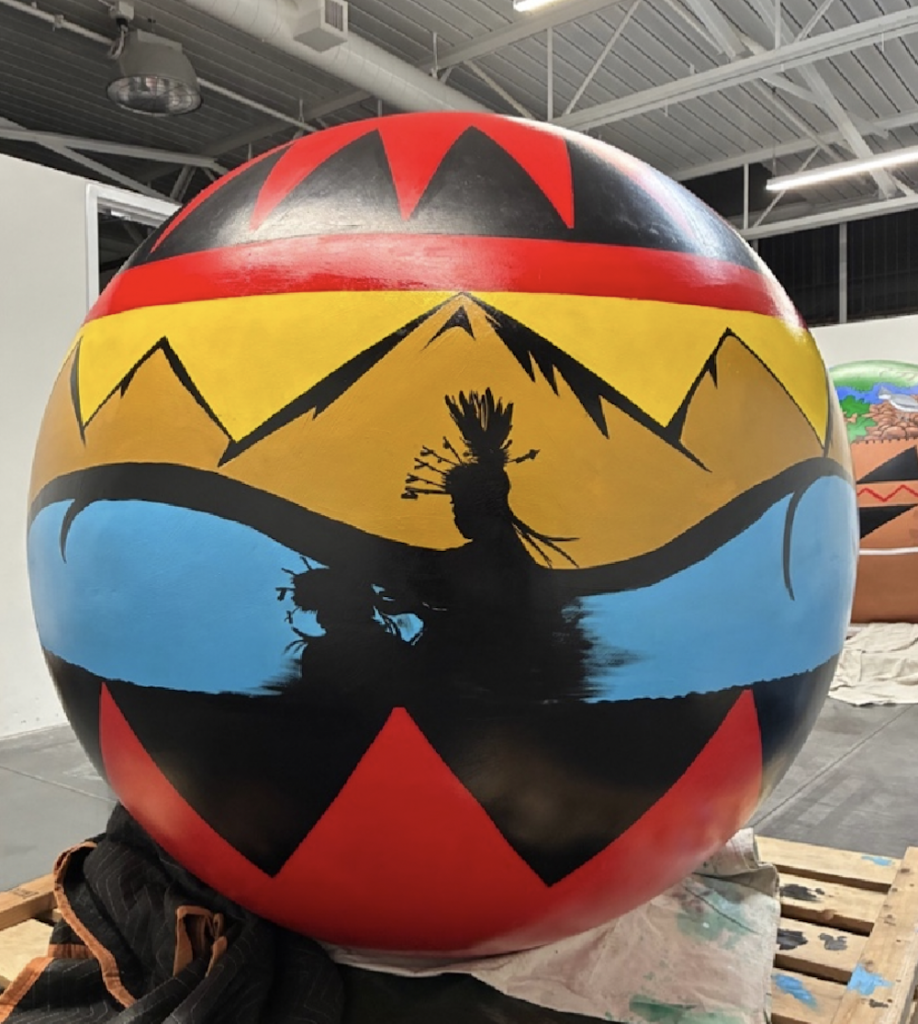
“One of the four main images is an Elder woman braiding a little girl’s hair,” said Valencia. “You know the strength of the people come from our grandmothers or mothers or aunties or sisters, and so that’s why I made a point to make that image like the biggest one.”
A respected muralist, Valencia commented that, “Before I began to work on [Balance], I actually went and bought a little sphere to try to understand how I was gonna put the images on it. It’s not like a wall—there was a lot of measuring going on, and just trying to keep it as symmetrical as possible.”
“I’m just here to help the people and whenever I can be of service, I’m always down,” Valencia continued. “It’s an actual honor for me to use something that I love to do to help people and make people proud.”
The next step for the American Indian Cultural District is the Mapping Genocide exhibition, on view September 4 through January 21 at the San Francisco Main Library. An opening reception and screening of the film Elevating Untold Stories & Native Resilience Through Art & Placekeeping in Yelamu will take place September 9, 5-7pm.
The interactive exhibition will examine San Francisco’s legacy of commemorating the ideologies and individuals who spearheaded the genocide and displacement of American Indians through public art in the San Francisco Civic Art Collection, as well as through street and place names throughout San Francisco. With visual art by Jackie Fawn and Edward “Redbird” Willie, physical mapping, and oral histories, the exhibition will examine whose histories have been celebrated and memorialized in San Francisco’s public realm—and whose have been the subject of erasure.
MAPPING GENOCIDE runs September 4-January 21. Opening reception: September 9, 5-7pm. San Francisco Main Library. More info here. For more info on Indigenize SF, go here.