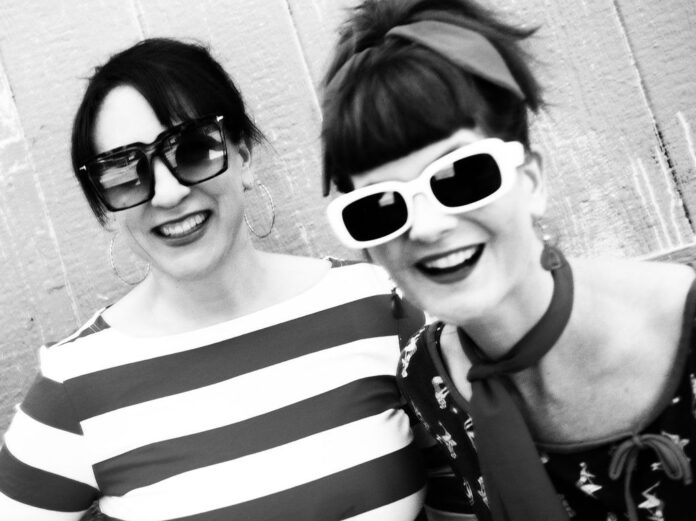
For 35 years, Bratmobile, along with cohorts such as Bikini Kill and Sleater-Kinney, has been revered as riot grrrl trailblazers.
As Bratmobile drummer Molly Neuman sees it, the story of riot grrrl was never as neat as history has implied. The underground feminist punk movement emerged from a network of musicians, zine-makers, and DIYers stretching across the Pacific Northwest and later all the way to Washington, DC. The motivation was simple: a recognition that local punk scenes needed more women, and that women needed more equity in punk. But first, they needed a protective sisterhood and safe spaces to encourage them in a very aggressive, male-dominated milieu.
Neuman and Bratmobile singer Allison Wolfe helped give that need a voice with Girl Germs, their foundational feminist punk zine and a blueprint for both the band and the movement taking shape around them. Today, the zine is preserved at institutions across the country, including San Francisco’s GLBT Historical Society. The band followed with the 1992 single “Kiss & Ride” and its breakthrough LP, Pottymouth, the next year. Two 1994 releases, the EP The Real Janelle and the live album The Peel Session, were recently reissued on vinyl.
However, that’s only a part of the larger history that encompasses how riot grrrl came to be and the legacy that keeps that angst alive today.
Ahead of the band’s San Francisco Bottom of the Hill performances on Fri/11 and Sat/12, Neuman spoke to 48 Hills about riot grrrl’s origins, the band’s connection to the Bay Area, and why making space for women in punk still matters.
48 HILLS The Bay Area has played a recurring role in Bratmobile’s history, from the band’s reunions to your time running Berkeley’s Lookout! Records. Why has it become such a natural place for the band to come back together?
MOLLY NEUMAN We didn’t start in the Bay Area, but I moved there shortly after I finished college. My dad is originally from Oakland, and I lived there for 11 years, too, so I basically feel like it’s one of my homes.
We were living there when we did our first reunion playing at Thee Stork Club back in the day, and because we were in our most active time based there, it made sense.

When Mosswood Meltdown asked us about playing—the team had asked us a few years earlier—but when they asked again, it really just made a lot of sense, because it always feels like the most comfortable place for us to be.
48 HILLS Bratmobile has been connected to punk scenes in Olympia, Eugene, the Bay Area, Los Angeles, and beyond. How did moving between those communities shape your idea of punk?
MOLLY NEUMAN We used to call it the West Coast drag, and it included San Diego, LA, and the Bay Area.
Obviously, Sacramento has its own scene, too, which wasn’t precisely part of our history, but now that we have Rose Melberg playing with us—who’s from Sacramento—I think we can make a bit of a claim to it.
Then Allison and I met in Eugene. We ended up moving to Olympia. Seattle and Vancouver, you could even include. There are so many small communities on the West Coast that have really powerful, interesting bands come out of them. That was really how we started. Someone from a different town had a band, and you would ask if you could play, or if you were getting bigger, they would ask if they could play it with you.
48 HILLS What made the Bay Area scene distinct?
MOLLY NEUMAN I don’t think you can homogenize it. San Francisco, the East Bay, and even the South Bay—each has its own distinct characteristics.
When I moved there, I looked at [punk zine] Maximum Rocknroll and [venue] 924 Gilman St. as sort of the pillars. There is something unique about the Bay Area’s accessibility.
48 HILLS The story of riot grrrl has now been told for more than three decades. What gets left out when people tell that story today?
MOLLY NEUMAN Fundamentally, I don’t think there was a leader or a power dynamic around it. It was more about recognizing that there’s a lack of representation in our community—specifically punk—which wasn’t the only lack of representation, by any means.
The fact that it was primarily a group of young white women claiming space in an atmosphere that wasn’t necessarily inclusive or welcoming was, in itself, a powerful act, but it wasn’t driven by a commercial objective.
I think we were all inspired by iconic figures in history who were taking action and asking for or demanding more space, more representation, and more inclusion.
48 HILLS There are different stories about where the term “riot grrrl” came from. What do you remember?
MOLLY NEUMAN The way we generally recall it is that a friend named Jen Smith—who actually played with Bratmobile at one point—sent us a letter.
It said something like, “There’s gonna be a girl riot this summer,” and that was about us all coming into Washington, DC, and being together. It was a sort of poetic phrase, really.
Then I think we just flipped it into making a fanzine called Riot Grrrl. I don’t think any of us takes absolute credit for it, but I think any of us could.
48 HILLS What could a handmade zine do in 1990 that Instagram, TikTok, and the rest of the internet can’t replicate today?
MOLLY NEUMAN We were a lot younger, processing life and ideas in real time, using those zines as documents of the artists or bands we wanted to talk to and share our passion for—or just synthesizing how we were experiencing the world and having a safe place to write and share.
I don’t think social channels—unfortunately—are as thoughtful about specific messages or themes.
48 HILLS Did working on the business side of music at Lookout! Records, eMusic, Rhapsody, or Kickstarter, or even managing the Locust or the Donnas, change any of your romantic ideas about DIY? Did you ever catch yourself becoming the music-industry authority figure your younger punk-rock self would have rebelled against?
MOLLY NEUMAN I hope my younger self would be stoked to see someone in my role now, because I’ve been fortunate to work in areas that prioritize artists controlling their careers and making their own decisions. I hope younger me might be OK with me now.
48 HILLS More than three decades after riot grrrl, younger musicians and organizers are building their own communities. What excites you about what’s happening now?
MOLLY NEUMAN One of the bands we’re playing with in LA is called Kim Theory, and I think all of them are still in high school. I found out about them because they were playing a show at their high school and did a cover of one of our songs. Then they came and sang on “Gimme Brains” last year when we played in LA.
Things are different now. The underground is still critical, but I think there’s something about knowing what’s possible in ways we didn’t really have before.
48 HILLS You’re bringing The Real Janelle and the Peel Session back into circulation. When you listen to those recordings now, what do you hear that you couldn’t hear at the time, and what’s it like watching something so DIY become part of the historical record?
MOLLY NEUMAN Sadly, I hear the mistakes. It was immediate and reflected exactly what we were doing, who we were, and what we are, so you have to celebrate that. We’re fortunate that there’s still interest in those songs and recordings, too.
48 HILLS Bratmobile has described this return as being about creating “joy, community, and space for more of us to use our voices.” Is that ultimately what keeps Bratmobile meaningful to you now?
MOLLY NEUMAN Now that we’re older, it is a decision, in a lot of ways, for us to put in the effort.
We’re adapting, and we’re showing that there isn’t a finite moment when things have to be over for any reason necessarily. Our motivation is as long as we’re enjoying it and there’s interest. Those things motivate us to keep going. It’s a real reminder of how important music is, how important community is, and that we have that as a unit ourselves.
48 HILLS Bay Area fans in recent times have mostly seen you at festivals, and now you’re playing a club like Bottom of the Hill for two shows. What changes when you put Bratmobile back into an intimate club setting?
MOLLY NEUMAN It’s just awesome. We did a warm-up show in Kingston, New York, at a tiny place called Tubby’s. Maybe we’re more diva-like; we need our space, but it’s nice.
I’ve spent so much time in the Bay Area, both in my bands and as a show attendee. It’s a very comfortable place. I can only imagine that when we walk into Bottom of the Hill, the smell, the space, and the relationship will be familiar. I’m really grateful that we get to be there before it closes.
It’s really awesome to be a part of everybody saying goodbye, and I think it’s really amazing that they’ve been able to give it this long goodbye.
48 HILLS What do you hope someone who saw you 30 years ago takes away from a Bratmobile show today?
MOLLY NEUMAN For our peers in age, whether it’s playing music or any other form of expression or creativity, it doesn’t have to end at any predetermined point in one’s lifespan. Allison does cartwheels onstage. The fact that she can do that should be an inspiration in and of itself.
BRATMOBILE Fri/11-Sat/12. Bottom of the Hill, SF. More info here.