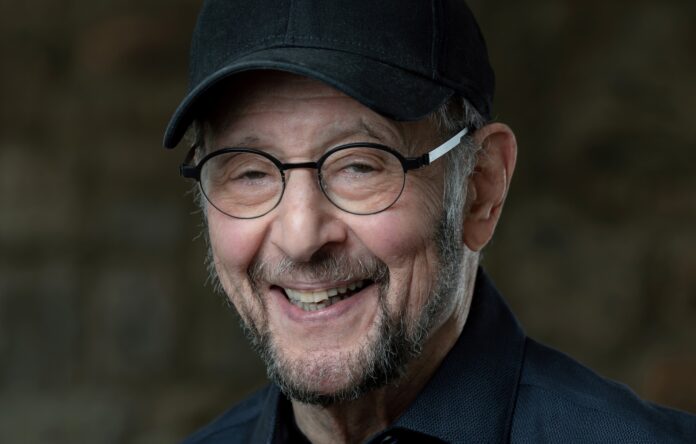
Never let it be said that the power of minimalist music cannot change lives. Follow the esoteric trail of those chiming, ever-revolving, ever-evolving singular notes and you might just face your own Damascus moment—or at least a ringing epiphany. In the case of renowned conductor Brad Lubman, in fact, minimalism created an entirely new life, which has placed him in the top tier of interpreters of one of the genre’s giants.
On Sat/24, Lubman will conduct mini-festival “Steve Reich at 90: A Birthday Celebration” for Cal Performances at Zellerbach Hall, paying tribute to the pioneering composer, who is still pumping out fascinating work that transmutes the deceptively simple into soul-affirming works of great and hypnotic beauty. (A new piece, In All Your Ways, inspired by a passage in the Book of Proverbs, will have its West Coast debut at the performance.) But Lubner’s musical path to Reich and minimalism was anything but conventional.
“I started out in music as a young kid playing drums, loving the Beatles and Led Zeppelin and a little bit of jazz—I wanted to be a rock and roll drummer,” the jovial Lubman told me from a London hotel room, on the way to Stuttgart’s legendary Donaueschingen Festival of contemporary music to lead the Südwestrundfunk SWR Symphonieorchester. “Then when I was 13, a friend introduced me to Mahler’s First Symphony, you know, as friends at that age do,” he laughed.
“After that I wanted to become an orchestra conductor, and I became devoted to all the old greats—Beethoven and Mahler and Ravel and Debussy. I also loved the Stravinsky and Varese, so there was always new music in there. I did my Master’s as a percussionist, and began composing music in the mid-’80s, heavily influenced by Boulez, Carter, Wuorinen. But it was never about minimalism for me. That just wasn’t for me, for whatever reason, I pushed that all aside.”
Minimalism in the ’80s was still considered avant-lite, outsider, “downtown” music which hadn’t yet made its way into the academic canon—”I remember my professors saying that people like Philip Glass just wanted to sell out at the box office”—but was that was changing. “At some point I just hit a brick wall with my composing, I was questioning everything,” Lubman said. “And, in all honesty, it was my first wife, also a musician, who told me straight out, ‘Why are you so close-minded about these things?’
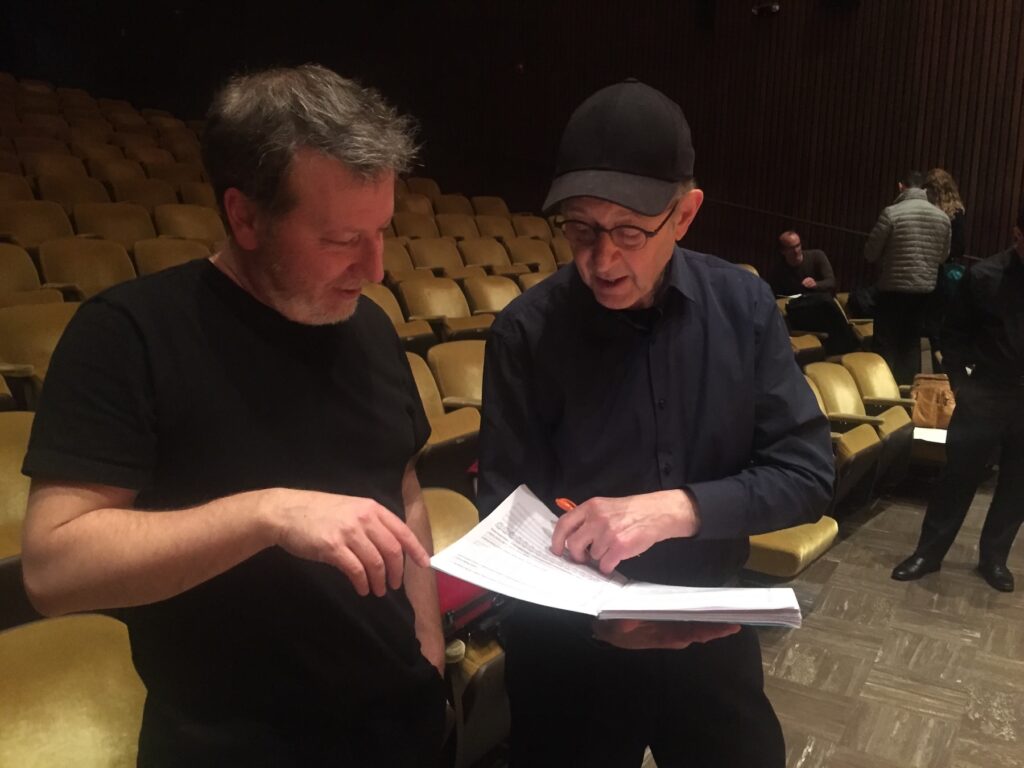
“I had been working for six years at Tanglewood (Festival) as an assistant to Oliver Knussen, and she pointed out that the composers coming in were from all different backgrounds and points of view. Nobody was writing this kind of austere, 12-tone music anymore. So I thought to myself, why not? And I started listening to all the composers I had ignored: Reich, Glass, Adams, Xenakis, Feldman, Ligeti…
“And it was like this great awakening for me. I was about 29, 30 and this was the ’90s, and it felt like a major discovery. And the one piece that really had my jaw on the floor was Reich’s Music for 18 Musicians. It was a revelation. I played it all day throughout the house that I lived in. It’s funny because I can remember seeing that album cover for years in the record store and just passing on it. But once I listened to it, I became obsessed with what Reich was doing.”
That was just the beginning of an avalanche of kismet. Super-hot avant-garde ensemble Bang on a Can were invited to Tanglewood for its Festival of Contemporary Music in 1994; its directors Julia Wolfe and Michael Gordon saw Lubman conducting Integrales by Varèse and an early David Lang work called Spud and were so impressed that they approached him at intermission to conduct their new chamber ensemble (called Spit, as in “spit out of the museum and into your face.”)

The next year, at a Spit performance in New York City, after conducting one of Reich’s works, Lubman was informed that Reich himself was in the audience and wanted to meet him. “The next morning he called me up. I think he may have woken me up, the whole thing was like a dream,” Lubman told me. “He said something along the lines of, ‘I was so impressed by your conducting, would you like to do the US premiere of this new piece of mine called City Life?
“So that happens, and we get to the first coffee break, and he asks, ‘How would you like to record this for Nonesuch?’ I’ve just really become accustomed to all of these amazing things happening very quickly and directly when you’re around Steve.” That includes the creation of Ensemble Signal, founded by powerhouse Lauren Radnofsky and which Lubner helped put together and now co-directs—and which will play alongside Bang on a Can All-Stars at Steve Reich at 90. Of course, Reich not only introduced Signal’s debut performance but gave it its name. “He said he just liked the word ‘signal’ and it stuck, just like that,” Lubner laughed.
Reich, who also started out as a drummer, is about the same age as Lubner’s father, and also studied with one of Lubner’s mentors, Roland Kohloff, principal timpanist of the New York Philharmonic. “There are a lot of commonalities, and as a fellow New Yorker you have to love how direct and no nonsense he is.
“But what I really admire is Steve’s integrity when it comes to music, his continuity. Of course there’s the huge legacy, he’s given us some of the most transcendent music ever written—The Desert Music, Tehillim… These gorgeous ensemble and choral works that literally change peoples’ lives when they hear them.
“And the fact that we’re doing this piece [In All Your Ways] that he wrote when he was, like, 89! I remember talking to him when he was first just working on the piece, he sounded as youthful as ever, it’s just inspiring. He never stops evolving. I’ve noticed some small phrase or interlude from a piece decades ago can come to full flower in a composition much later on.
“One of the great pleasures of my life has been working with Steve and watching the new direction his music takes over so much time. It’s been a source of continuous joy. So it’s a complete honor to be part of this celebration—and to see what he does next.”
CAL PERFORMANCES PRESENTS ‘STEVE REICH AT 90: A BIRTHDAY CELEBRATION WITH BANG ON A CAN ALL-STARS AND ENSEMBLE SIGNAL‘ Sat/24, 7:30pm, Zellerbach Hall, Berkeley. More info here.