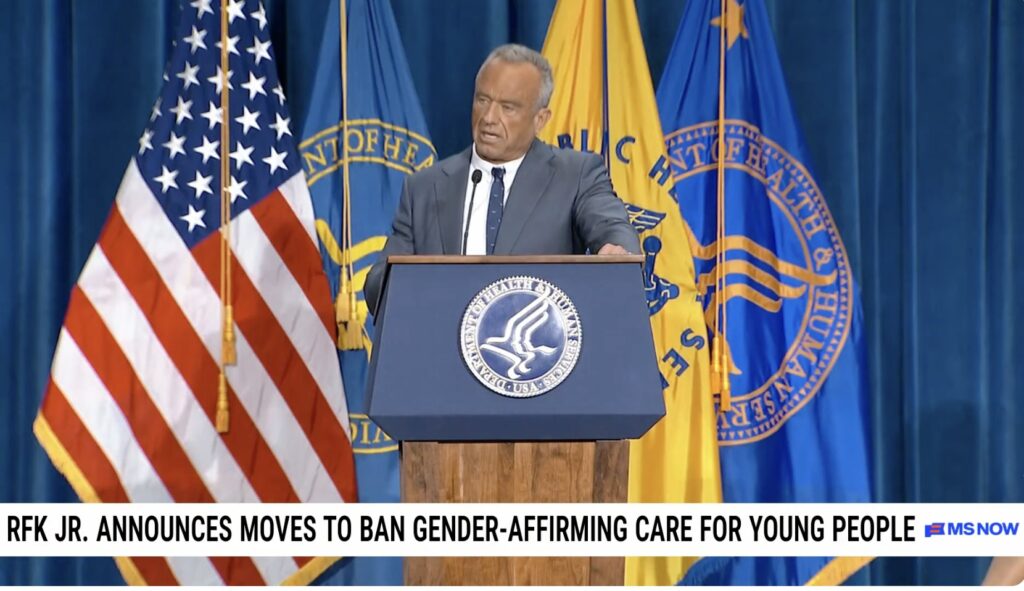
UPDATE: Yesterday, health officials from the Trump administration announced it will move toward banning gender-affirming care for transgender young people and possibly imprison doctors for providing life-saving care, even in states where it is legal.
In its first year in office, the Trump administration has waged what can only be called a war on US public health efforts, degrading research and disease prevention while replacing accurate information with misleading, often wildly unscientific, propaganda. Much of this wreckage has been orchestrated by Health and Human Services Secretary Robert F. Kennedy Jr., although he’s had plenty of help.
Regular readers know that I’m not shy about sharing my views on any of this, but for an end-of-the-year assessment, it seems more appropriate to step back and let some actual experts have the microphone. I sent a series of questions to a variety of health care providers, researchers, and others with specialized expertise – including many I’d met through my ongoing work with Defend Public Health.
I received so many lengthy, detailed responses that space won’t allow us to include every word they sent (apparently, my editors would prefer that this not rival War and Peace in length), so what’s presented here is a hopefully representative sampling of the responses. The experts who responded were:
Perry N. Halkitis, PhD, MS, MPH, Dean, Rutgers University School of Public Health
Michelle Orengo-McFarlane, MD, family medicine doctor in the San Francisco Bay Area
Jeoffry Gordon, MD, MPH, retired family medicine physician in Santa Cruz
Jay Varma, MD, primary care physician, epidemiologist, public health expert and former health advisor to New York City Mayor Bill DeBlasio

Oni Blackstock, MD, MHS, HIV and primary care physician and founder/executive director of HealthJustice
Shelley N. Facente, PhD, MPH, Bay Area public health consultant, infectious disease epidemiologist, and author of the Substack What in the Health?!
Mark Harrington, Executive Director, Treatment Action Group
Miranda Worthen) MPhil, PhD, epidemiologist, researcher and professor in the Department of Public Health at San José State University
Sinéad Murano-Kinney, Health Policy Analyst, Advocates for Trans Equality Gabriel San Emeterio, LMSW, Senior Health Fellow, Long COVID Justice/Strategies for High Impact
Gabriel San Emeterio, LMSW, Senior Health Fellow, Long COVID Justice/Strategies for High Impact
48 HILLS What would you say are the most important or worrisome developments in public health this year?
PERRY N. HALKITIS I would say these worrisome conditions have been brewing for years with roots in the Bush administration and catalyzed by MAGA and COVID. The demeaning and destruction of science that has undermined the foundation of knowledge and discovery on which the field is based. The inability of many Americans to understand the scientific process—not facts, but how scientific discovery operates. The erosion of the social covenant in which we demonstrate empathy to others.
The way too late response of public health to recognize and reach the extremists in our society, i.e. antivaxxers, QANON etc. These groups have been ignored and dismissed, ultimately undermining the humanity that public health must espouse. The specific public health realities (cuts to science, denial of vaccines) are less important than understanding their roots. But if there is truly evil genius, it is RFK Jr., as his appointment realizes the worst possible reality for public health.
JAY VARMA 2025 is the year the federal government began making America unhealthy again. Almost every major action taken by the federal government will harm public health in both the short term and long term. Because my primary focus is infectious diseases, I am deeply concerned that we are removing our defenses at a time when global threats are rising. This includes reducing federal support for vaccines from the lab to the jab, whether it is defunding research, reducing procurement of both pandemic and endemic disease vaccines, altering FDA and CDC approaches to approved vaccines, and dismantling the infrastructure to deliver routine immunizations at the federal, state, and local level.
It includes withdrawing from global health program implementation, collaboration with WHO and other multilateral institutions, and funding to countries, multi-lateral organizations, and entities that prevent and treat diseases globally. And, finally, most irreparably, political leaders have sown extensive distrust of public health professionals and institutions, including CDC. Of all of the damage that has been done, these efforts may be the most devastating, because they cannot be restored with funding.
SINÉAD MURANO-KINNEY Currently, 27 states have restricted or outright banned access to medically necessary healthcare for transgender. gender-diverse and intersex adolescents. Legislatively, at least 32 federal bills have been introduced in Congress (across the House and Senate) that would restrict or otherwise severely negatively impact access to medically necessary healthcare for TGDI adults. This doesn’t even include attempts to insert policy riders into appropriations and spending bills that would prohibit the provision or study of this care. A significant portion of this legislation makes explicit carve outs to permit the performance of non-consensual surgical procedures on intersex infants and children—an exception present in many of the state-level restrictions mentioned above…
Looking at the executive branch, I’m particularly worried about rulemaking that would severely restrict access to medically necessary transition-related healthcare for TGDI adolescents. On June 25th of 2025, the Centers for Medicare and Medicaid Services (CMS) published a final rule that prohibited states from requiring that transition-related healthcare be included as an essential health benefit (EHB) on Affordable Care Act marketplace plans as of plan year 2026. EHBs are one critical mechanism, established by the Affordable Care Act, to ensure enrollees have access to comprehensive healthcare coverage. Excluding transition-related healthcare from such classification drives up costs for these services and removes maximum out-of-pocket cost protections that EHBs are granted. This rule makes it harder for states to develop comprehensive and inclusive coverage packages and limits access to medically necessary transition-related healthcare by both imposing economic barriers on individuals and logistical barriers on plans that wish to offer coverage for these medically necessary services.
Currently, (as of December 2025) two proposed rules are set to be published by CMS that will severely restrict access to transition-related healthcare for adolescents. While neither rule is a true “national ban.” both will function as a ban for many. In particular, the proposed Conditions of Participation rule, if allowed to go into effect, would have a widescale effect because of how providers rely on these funds. Neither rule is consistent with the goals and values of the Medicaid statute or with scientific and medical consensus – and both rules will expose tens of thousands of TDGI people to immense suffering and psychological harm.
Conditions of Participation Rule: This proposed regulation would prohibit hospitals and providers that offer transition-related care for transgender youth from participating in Medicare and Medicaid and cut them off from this stream of federal funding. Because providers rely heavily on these funds, the consequences of this proposed rule, if finalized and allowed to take effect, would restrict access to medically necessary care for hundreds of thousands of TGDI people.
Medicaid Coverage Rule: This proposed regulation would prohibit the use of federal Medicaid and CHIP funding to cover medically necessary care for transgender youth. If allowed to go into effect, this rule would severely restrict access to medically necessary healthcare for TGDI youth, and for many, may function like a ban.
48 HILLS Are there important health issues that have not gotten sufficient public and media attention? Please describe.
MICHELLE ORENGO-MCFARLANE From my perspective as a clinician/medical provider, I see the slow-motion evisceration of the CDC as incredibly important and incredibly worrisome. I work in a setting where I care for adults, pregnant people, and children; in the past, I found the CDC vaccine information, sexually transmitted infection guidelines and travel health guidelines to be particularly invaluable in my work. This year, we’ve watched as the vaccine pages are subverted with antivaccine/autism misinformation. Earlier this year, the STI/STD guidelines were removed from the Internet. Now the guidelines are back (I believe due to a court order) and seem pretty complete, but who knows what will happen next?
ONI BLACKSTOCK On the coasts, people may not be hearing about this, but there is a huge congenital syphilis epidemic that has been hitting Indigenous communities hardest. Rates among Indigenous communities have increased 5,250% from 2014 to 2023 due mainly to lack of access to prenatal and obstetric care and federal divestment in STI prevention services. Congenital syphilis can cause miscarriages, stillbirths, death shortly after birth, or lifelong health complications. This epidemic is even more concerning given the cuts to STI prevention at the CDC. It’s truly a profound failure because syphilis can be easily cured with medication. States are trying to provide more touchpoints for screening for pregnant people.
Another worrisome trend is the increasing number of people under 50 who are being diagnosed with cancer. They are less likely to have known risk factors, which implicate environmental exposures. This is concerning because certain traditional screening programs are not designed to detect cancers in younger populations, so these cases are often diagnosed late or incidentally.
MIRANDA WORTHEN I think the effect on the public health and scientific research pipeline has been devastating. As someone who works at a university where around 37% of students are Pell Grant eligible, I can see how the future of financial aid, philanthropic aid, and student support, especially through pipeline diversity programs, will have a long-term impact on the diversity of scientific and public health research long into the future. Starting by eliminating funding for diverse undergraduates to be involved in research (e.g. NSF and NIH), which will make them less competitive for graduate programs than students who can afford to volunteer in labs or who work under faculty at more elite universities that may still have funding for undergraduate research assistants.
Then, add into that the decision by philanthropies like Howard Hughes to focus on existing principal investigators rather than undergraduate students and the upcoming regulation from DOE to designate degree types non-professional and thus eliminate sources of student loans and we are looking at a long term generational impact.
48 HILLS A lot of studies and other public health efforts have been quashed in the name of the administration’s attack on so-called DEI. What will be the consequences of this? Are particular groups within the population at special risk?
SHELLEY FACENTE The consequences of this are pretty obvious: We’re no longer going to have sufficient high-quality data to see health disparities—whether gaps in health outcomes by race, gender, and other demographics are getting better or worse. Since we know that until now Black Americans, American Indians, and trans people tend to experience the biggest disparities in health outcomes compared to almost all other groups, they are the groups most likely to be harmed by the administration’s actions—and that certainly doesn’t feel like an accident.
ONI BLACKSTOCK We’ll undoubtedly see worsening health disparities. But I’m confident that we’ll see more grassroots efforts. The reality is that much of this work in marginalized communities has always been community-led, and we have never really had a true safety net in this country.
The public may not be aware of this, but Black researchers have been disproportionately affected by DEI executive orders in terms of losing grants. This may reverberate for generations. Black scientists already represent only 1% of R01 researchers (the largest NIH-funded independent research grant). Research focused on racialized disparities and disparities among queer, trans, and gender expansive people has been defunded, which means knowledge that could address existing disparities isn’t being generated. It’s also impacting researchers from these same groups. It’s changing the landscape of research, of what is known, what is not known. I was at a meeting of Black HIV researchers last May, and the vast majority had lost their NIH grant because they were more likely to do health disparities research focused on racially marginalized and LGBTQ+ communities.
48 HILLS The entire MAHA movement could be seen as a rebellion against medicine and public health as they have long been practiced, and it’s having some success. Were there failures of the health establishment that enabled this?
JEOFFRY GORDON This is a wrongly formulated question. The MAHA movement is an exploitative propaganda and guerilla effort to destroy foundational, competent societal resources to allow a fascist government to emerge. There has been a positive cultural transformative evolution over the past 75 years in reaction to the strict medical model of the “authoritative doctor” to incorporate more patient autonomy, more patient education, more available information to make the medical encounter more collaborative. Side effects have included accepting “complementary medicine” therapies, naturalistic philosophies, and idiosyncratic personal judgements about care. These “advances,” now deeply culturally ingrained, have been perverted and exploited for profit by the MAGA movement. The idea that medicine or science did something wrong or failed is inappropriately buying into their point of view.
PERRY N. HALKITIS In part, yes. The public health establishment has not always been effective at communicating with humility, empathy, and cultural sensitivity. Too often, our messaging has emphasized expertise without listening, data without dialogue. This has created openings for movements that exploit distrust and misinformation.
At the same time, the MAHA phenomenon is not merely a rejection of public health—it is a reflection of deeper cultural alienation. When people feel unseen or dismissed by systems of power, they turn to narratives that restore their sense of agency, even if those narratives are scientifically unsound. Our responsibility now is to rebuild trust by rehumanizing our practice: to engage communities as partners, not subjects; to admit when we have fallen short; and to reimagine public health as something we do with people, not to them. These are the ideas I examine in my upcoming book Humanizing Public Health: How Disease Centered Approaches Have Failed Us.
48 HILLS A great many health professionals, scientists and lay people have tried to push back against some administration policies, often through either existing professional societies or new activist organizations. What tactics seem to have been most effective? Are there any approaches which need to be rethought?
MARK HARRINGTON More public and focused, granular, specific demonstrations and campaigns are needed, along with direct and political action at all levels (local, state, regional, national, international); engagement of new, younger, more diverse communities and voters (e.g., the NYC mayoral election).
JAY VARMA I think the most important change that could happen in the future is for health-related people to use social media far more aggressively. We need to stop talking as if we are delivering a lecture or publishing a manuscript. We need to shift to using social media compulsively and our messages need to be delivered with urgency, authenticity, and emotion.
ONI BLACKSTOCK Organizational medicine tends to be more traditional. Coalitions of health workers – like NYC Docs – operating outside of institutions have been more effective. A lot of advocacy is still focused on influencing elected officials, but we need to build and organize our institutions, or we will remain at the whim of whoever is in government.
We need to create our own care systems. We saw this in the early days of the AIDS epidemic with mutual aid networks and informal support networks that became the backbone of the response when the federal government failed to act. Organizations led by and serving trans people and disabled people, for instance, have been doing this work and should be an example to us all. Around the country, people’s assemblies, organizing free mental health clinics, cooking free meals, hotline connecting community members to legal and other needed services.
48 HILLS What do you see happening in 2026, and what should the public health community be focusing on in the new year?
GABRIEL SAN EMETERIO As 2026 approaches, I see a growing recognition that public health cannot keep relying on frameworks that treat people as passive recipients of care. Communities most impacted by HIV, Long COVID, housing instability, criminalization, and environmental injustice have already built the practices that keep people alive. Public health needs to shift its center of gravity toward these community-generated strategies.
The public health community should focus on three priorities for the new year:
Strengthening disability-centered and infection-associated chronic illness responses.We’re still living in overlapping pandemics: COVID, HIV, and Long COVID and associated conditions. These are not disconnected crises—all are shaped by interlocking systems of racism, poverty, criminalization, and medical neglect. Public health must integrate disability justice principles, not as an add-on, but as the foundation: flexibility, access, intersectionality, collective care, and trust in lived expertise.
Resourcing community organizations as co-equal partners. The people most affected by systemic inequities—trans communities, people living with HIV, disabled and chronically ill people, people who use drugs, LGBTQ+ youth, migrants, and Black, Indigenous and people of color (BIPOC)—already have the knowledge to protect one another. Instead of parachuting in with predetermined interventions, public health institutions should ask, “What solutions are you already building, and how can we support them?”
Protecting and expanding harm reduction and anti-criminalization work. We need to confront the political backlash against evidence-based harm reduction, gender-affirming care, and the rights of disabled and chronically ill people. Public health must be explicit in fighting criminalization—because whether we’re talking about drug use, HIV exposure, or organizing for care, criminalization is a public health crisis.
If we take seriously the leadership of disabled people, long-term and lifetime survivors, movement organizers, and people living with the direct consequences of policy decisions, 2026 could be a year where public health moves closer to justice. Public health has to stop asking communities to prove their worthiness and start aligning itself with the people who have kept each other alive long before institutions paid attention.
SHELLEY N. FACENTE I see 2026 getting harder, as people tire and become numb to the administration’s hateful and harmful actions. We should be focusing on ways to sustain our efforts and stand together to protect the institutions that matter most to us–my pick would be the CDC. I also think we need to focus on the local level. There have been numerous instances in 2025 when policies or commentary by politicians where I live have looked much too much like the federal pattern for my taste.
I live in California and work primarily in San Francisco, two places you’d expect to be a bastion of resistance against the feds. But in practice, it hasn’t always been like that. Governor Newsom has gotten praise and attention for his (admittedly fabulous) anti-Trump social media, but he’s also done things to undermine the safety and health of trans Californians, and he’s changed the policy so California’s Medicaid (Medi-Cal) is about to be no longer available to undocumented people. In San Francisco, the new mayor has put restrictions on harm reduction services, and taken steps to re-criminalize drug use and homelessness—there are more people in San Francisco jails now thanks to changing arrest policies than was true even before COVID.
The public health community may be somewhat powerless against many of the changes being made at the federal level, but we should have more influence at the state and local levels, if we don’t overlook those issues while focusing solely on Trump and RFK Jr.
MIRANDA WORTHEN Building power.