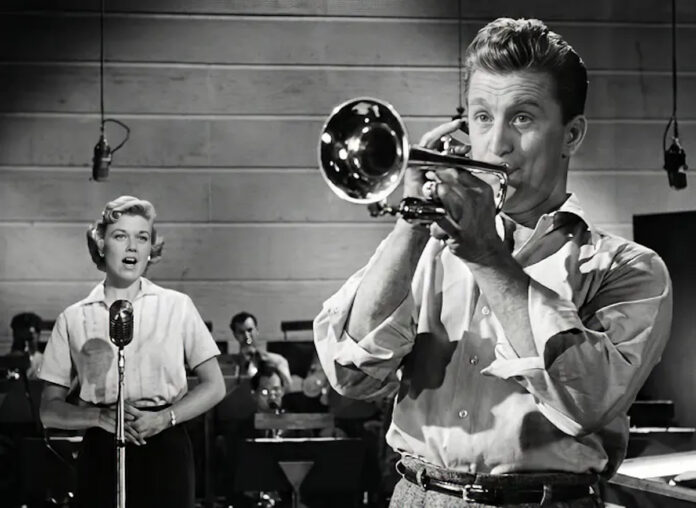
It’s a big week for revivals, with three major showcases for cinema of yesteryear commencing this weekend. One is the annual return of Noir City, again taking place at Oakland’s Grand Lake Theater. (Other film festivals like SFFILM and Frameline have announced their return to the newly reopening Castro Theater, although economic challenges and scheduling may still keep some in exile.) This year’s event, running Fri/16 through January 25, has as its theme “Face the Music!” Meaning that the 24 features being shown over that 10-day span all lean heavily on the melodic arts, whether featuring real-life star players, casting actors as musician protagonists, or being set primarily in your classic smoky nightclubs.
As usual, there will be some titles familiar to even the most casual noir aficionado, like Howard Hawks’ 1944 To Have and Have Not, which introduced Lauren Bacall as the chanteuse who teaches Humphrey Bogart how to whistle, or Charles Vidor’s 1946 Gilda, with Rita Hayworth at her apex as another singing siren who wraps multiple men around her little finger. Lesser-known jewels include the 1941 Blues in the Night, chronicling a fictive jazz ensemble’s turbulent history, and 1962’s British All Night Long, a modern club-scene version of Othello featuring jazz superstars Dave Brubeck and Charles Mingus.
Most likely to be a discovery even to noir fans are obscurities like another UK thriller, Face the Music aka The Black Glove (1954); 1951’s The Strip, with Mickey Rooney as a PTSD-afflicted veteran and jazz drummer caught up in a would-be starlet’s murder case; and 1945’s The Crimson Canary, a brisk little “B” in which all the members of a jazz combo become homicide suspects.
Some of the movies programmed this time around aren’t exactly crime dramas, but moody melodramas whose stars play troubled musicians. In Young Man With a Horn and The Man With the Golden Arm, Kirk Douglas and Frank Sinatra respectively portray star instrumentalists with mile-wide destructive streaks. In Love Me Or Leave Me, Doris Day is 1920s torch singer Ruth Etting, James Cagney her violently jealous husband-manager. Elvis Presley had probably his best screen vehicle in the 1958 King Creole, as a nightclub performer who can’t escape his underworld connections.
A Man Called Adam (1966) has Sammy Davis Jr. as another doomed musician, his fall surrounded by an incredible cast that includes Louis Armstrong, Cicely Tyson, Ossie Davis, Peter Lawford, Johnny Brown, Mel Torme, Frank Sinatra Jr., George Rhodes, Kai Winding and Lola Falana. Historical jazz milieus are meticulously recreated in Robert Altman’s 1930s-set Kansas City (1996), and Bertrand Tavernier’s 1950s Paris-set Round Midnight (1986).
There’s still more, including vehicles for George Raft, Joan Crawford, Burt Lancaster, Ida Lupino, Henry Fonda, Robert Mitchum and Ann Sheridan. There will be some live music courtesy of special guests Elizabeth Bougerol and Nick Rossi. For full program/ticket info on Noir City 23, go to www.noircity.com
The Pacific Film Archive is looking towards Europe for two series that begin this weekend, highlighting the work of three influential late directors. “Swedish Silent Cinema: Victor Sjostrom & Mauritz Stiller” commemorates a pair of brilliant talents that did much to raise up the art form in its infancy, starting Fri/16 with the 1920 comedy Erotikon. Stiller (who made it) and Sjostrom (an actor turned director whose screen debut was a now-lost 1912 film of Stiller’s) were both innovators in the 1910s whose reputations ultimately led them to Hollywood in the Roaring Twenties. Stiller brought along his protege Greta Garbo, whose surprise fame would overshadow him even before his death from pleurisy at age 45 in 1928. Sjostrom was imported at the request of established diva Lillian Gish, for whom he made memorable late silent The Wind.
Both men were sophisticated stylists with a penchant for poetic effects and complex emotional impact. Sjostrom lost interest in directing with the arrival of sound, but was paid fit homage by Ingmar Bergman, who cast him as the lead in 1957 classic Wild Strawberries—which ends this six-week series on February 28. It also includes his Swedish cinema milestones The Outlaw and His Wife (1918) and The Phantom Carriage (1921), as well as 1913’s impressive Ingeborg Holm (an indictment of social systems that reduce a widow to penury, then madness) and 1917’s A Man There Was, based on an epic Henrik Ibsen poem. Stiller’s contributions encompass the fragments that remain of 1916’s The Wings, a daring if discreet treatment of gay desire; expansive 1919 period adventure Sir Arne’s Treasure; and the full 3.5-hour version of 1924 epic Gosta Berling’s Saga, featuring a not-yet-fully-glammed-up Garbo as one of the title figure’s paramours. Full series info is here.

From the time of his 1959 directorial debut The 400 Blows through his premature demise at age 52 (from a brain tumor) a quarter century later, Francois Truffaut was considered not just a leading figure in the French nouvelle vague, but one of the world’s leading auteurs. Yet somehow that reputation has faded in the four decades since; a few oft-revived works aside, he has largely fallen out of fashion. Thus it’s welcome that BAMPFA is hosting “Laura Truffaut on Francois Truffaut,” in which his daughter (who’s lived in Berkeley since 1979) will introduce and discuss 10 of her father’s features—some of whose sets she visited as a child, or worked on as a young woman.
Blows starts things off this Sat/17, with its memorably raw yet tender portrait of young Antoine Doinel, played by the director’s discovery Jean-Pierre Leaud. That character and actor returned several times, including in 1968’s Stolen Kisses. Other titles being shown include famous ones (Jules and Jim, Day For Night, Small Change), plus relatively neglected films like 1964’s The Soft Skin, the 1971 Two English Girls, and Truffaut’s final feature Confidentially Yours (1983)—a playful B&W murder mystery starring Jean-Louis Trintignant and the director’s companion of later years, Fanny Ardant. The entire series will be shown on 35mm prints. Full info here.
A filmmaker who frequently incorporates archival elements will be visiting the Bay Area this week for a two-day event co-hosted by San Francisco Cinematheque and Oakland’s Shapeshifters Cinema. On Wed/14 the latter will have New York-based Jennifer Reeves in person to celebrate the new blu-ray release of When It Was Blue: Selected Works 1992-2022. She’ll show films from that collection and beyond, including 1995’s high-energy mashup The Girl’s Nervy and 2001’s Fear of Blushing, a richly colored abstraction that makes similar use of emulsified frames and other elements.
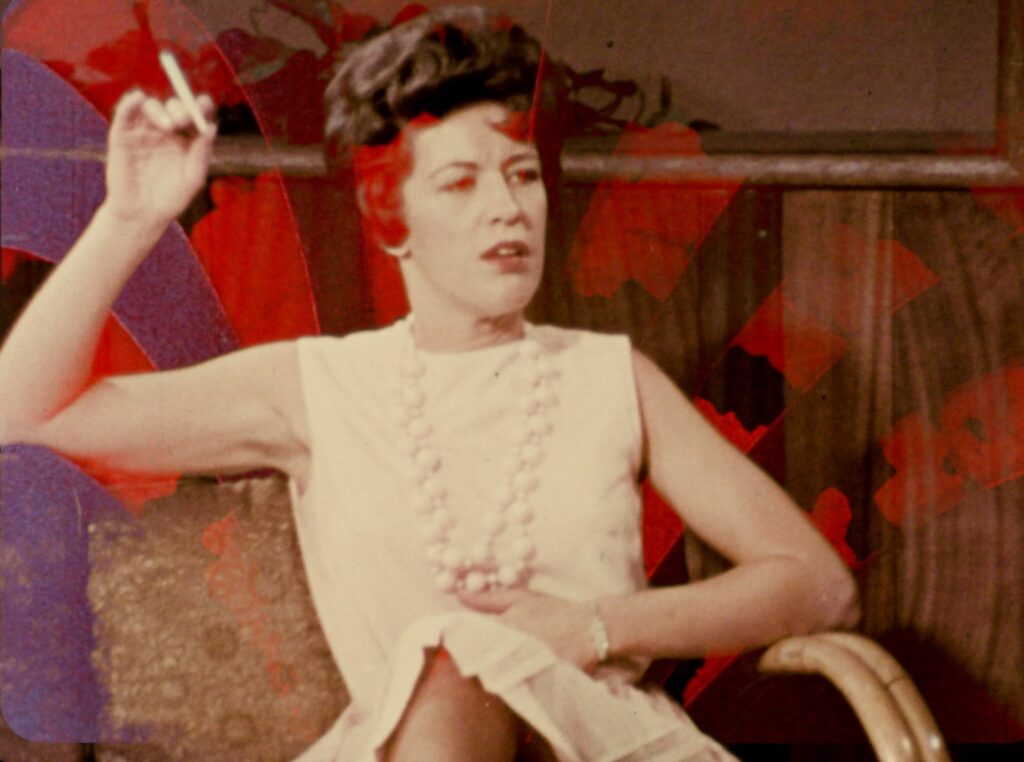
The next night at SF’s Gray Area, Reeves will present The Gloria of Your Imagination, a recent feature-length, double-projection opus probing an unusual artifact: Three Approaches to Psychotherapy, a 1965 record of sessions in which a volunteer patient interacted with three prominent therapists practicing very different methodologies. She was Gloria, a recently divorced single mother dealing with conflicted feelings over her sexual desires and dating life versus parenting—a prior era’s guilty morality trying to transition towards the Sexual Revolution’s freedoms.
Gloria is defensive and adversarial with one doctor, more open with the others. But she did not consent to these sessions’ eventual, fairly wide public exposure, which left her feeling exploited. Reeves uses that 60-year-old original footage, plus a range of other interpolated materials and techniques, to call into question Gloria’s status as a sort of psychiatric guinea pig—which indeed she sometimes bridles at, on-camera.
A blast from a more recent past takes place at the 4-Star this Wed/14, with a rare revival of one of the best, most underrated, and least-seen among 1990s US screen dramas. Ulu Grosbard’s 1995 Georgia was written for star Jennifer Jason Leigh by her mother, Barbara Turner, and co-stars the actor’s friend since childhood summer camp, Mare Winningham—who impressed her at the time with her crystalline singing voice.
Here, Winningham plays the eponymous fictive figure, a popular Americana musician. Leigh is her sister Sadie, who desperately seeks the same sort of expressive outlet, but whose own vocal abilities are of a fingernails-on-chalkboard variety. (The star has said this really is about as good as her singing gets.) One sibling is a rather humorless success story, the other a near-constant trainwreck, frequently in trouble with substance abuse and bad relationships.
It’s a poignant, empathetic yet sometimes brutally tough movie—be prepared for something very different from the deceptively warm-and-fuzzy trailer above—with terrific performances, including supporting ones from Ted Levine, Max Perlich, John C. Reilly, X’s John Doe and others. The screening will be hosted by stellar local musician Chuck Prophet, with Patrick Winningham (the co-star’s brother) as special guest. Expect live music, a pre-show DJ set, and “free bourbon while supplies last.”
Inebriates are not advised for sitting through Magellan, which opens at the Roxie this Fri/16. This latest from Filipino director Lav Diaz (his first not in Tagalog) is nearly three hours long. Even so, it’s one of the shorter features by an epic “slow cinema” minimalist whose prior works have stretched up to nine hours. It portrays the last decade in the life of the famed Portuguese explorer, played by Gael Garcia Bernal. He’s introduced participating in the 1511 conquest of Malacca, where he acquires a Malayan slave he dubs Enrique (Armando Arjay Babon). After recovering from a wound and marrying the Spanish Beatrix (Angela Azevedo), Ferdinand Magellan eventually commenced a “Voyage of Circumnavigation” intended to reach the Spice Islands by a western route, purportedly to spread Christianity (and undercut Muslim trade) in addition to further enriching the colonialist crown. That quest would end badly for him in the Philippines of 1521.
Some of Diav’s narrative is speculative. But in any case it helps to know as much about the historical record as possible before going in, because apart from occasional dates and places onscreen, Magellan does not over-trouble itself with explanation. Nor is there a lot of dramatic momentum to the writer-director’s typically meditative, detached approach, which is heavy on lengthy, stationary long-shots. Many scenes are littered with corpses, but few actually depict battle. The title figure himself is regarded at least somewhat sympathetically, yet he too stays at a somewhat cryptic remove.
What it may lack in excitement and character intimacy, however, the film makes up for in sheer beauty—it’s best to let the images cast their hypnotic spell, en route soaking up a creditable amount of insight about the clash between cultures whose religious and moral values are almost entirely alien to one another.