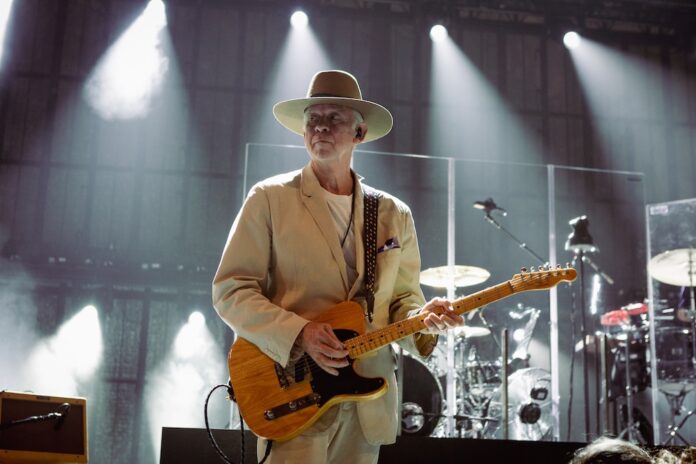
Phil Manzanera has lived a life in motion, across countries, revolutions, and musical eras. Now, more than five decades after Roxy Music’s guitarist helped detonate art-rock’s possibilities, he’s looking back not to fossilize the past, but to make sense of it.
This winter and spring, the iconic musician, producer, and Rock & Roll Hall of Famer returns to the United States with “An Evening of Words and Music with Roxy Music’s Phil Manzanera”, a hybrid performance anchored by his newly released memoir and companion CD, both titled Revolución to Roxy.
His San Francisco date (Thu/19; Great American Music Hall) places Manzanera in conversation with music journalist Anil Prasad, blending live guitar performance with reflection, archival imagery, and stories that stretch far beyond the standard rock autobiography.
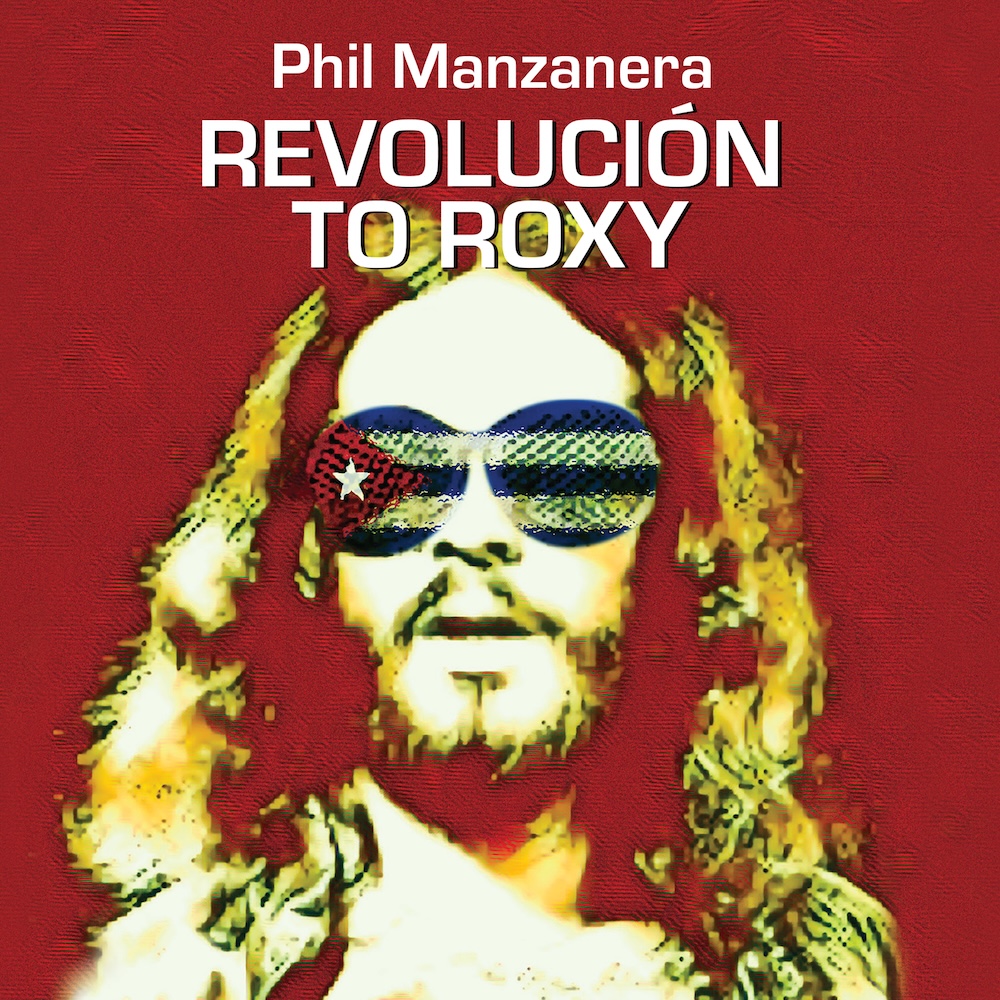
Revolución to Roxy begins long before glam, synthesizers, or LP covers became cultural landmarks. Manzanera’s earliest memories are shaped by upheaval: childhood in Cuba during the revolution, displacement, and an upbringing that crossed Venezuela, Colombia, England, and beyond.
That instability, he says, produced something lasting—understanding. “If you grow up speaking two languages, you are scientifically proven to be more compassionate,” Manzanera says. “You have this kind of duality, and one of those is the power to be empathetic. For a musician, that is such a helpful tool.”
Music, for Manzanera, has always been a form of conversation—sometimes literal, sometimes abstract. Long before he imagined himself as a professional musician, he was absorbing international rhythms, dialects, and genres.
“One of the great things about playing with other musicians is that you have musical conversations,” he says. “It’s a basic call-and-response—but if you’re not speaking, you can talk in music.” That ability to communicate without words became essential as his life unfolded across different scenes and generations of collaborators.
When his parents sent him to boarding school in South London at age nine, the move felt like relief. “After all the turmoil, I craved something really conventional,” he says.

But almost immediately, history intervened. Rock ’n’ roll arrived with seismic force. The Beatles, the Rolling Stones, the Kinks, and The Who appeared on the London scene, and Jimi Hendrix soon joined them.
If revolution had defined his earliest years, music became the stabilizing counterweight, a place where chaos could be shaped into sound.
Music, he insists, remains his answer to power. Not escapism, but engagement. “I know I make a rubbish politician,” he says, “but I can make music—and that’s my way of contributing.”
By the late ’60s, Manzanera found himself at the center of Britain’s music revolution. At 16, he crossed paths with David Gilmour, the very week that legend joined Pink Floyd. “If you meet someone when you’re a teenager, they can act as a mentor,” Manzanera says. “You think, ‘Wow, I met that guy. I could be that guy.’”
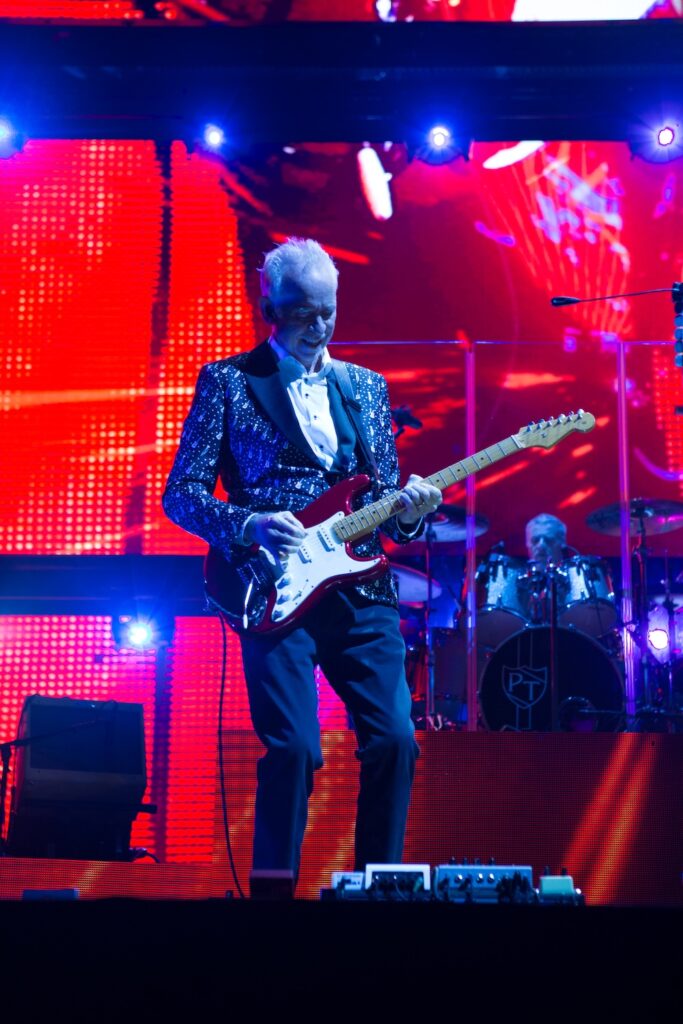
When Roxy Music began to coalesce, he sensed immediately that this wasn’t just another band. Despite his technical fluency, he was surrounded by artists who valued concept, attitude, and imagery over virtuosity. Entry wasn’t smooth—he failed his first audition—but he lingered on the periphery, running into members Bryan Ferry, Brian Eno, and Andy Mackay at shows until the opportunity came again.
He had just turned 21 when he was invited to join. Then everything accelerated: within days, he was playing with the band, signing a management contract less than a week later, and entering the studio only months after that. Their self-titled debut arrived the same day as David Bowie’s groundbreaking LP The Rise and Fall of Ziggy Stardust and the Spiders from Mars.
Roxy Music’s identity—musical and visual—was meticulously constructed. Manzanera describes stepping into a world shaped by fashion designers, photographers, and art-school provocateurs. “I was very willing to be told what to do,” he says. “I was 21 and behind the curve.”
British fashion designer and image-maker Anthony Price proved essential in developing an aesthetic language that made the band instantly recognizable. “Anthony Price was absolutely indispensable to the whole image of Roxy Music,” Manzanera says.
That vision reached its apex on the band’s second album, For Your Pleasure, whose cover conjures a staged nocturnal streetscape lifted from fashion photography and film noir. Model Amanda Lear strides forward in a sleek black dress, her expression cool and unreadable, leading a black panther on a leash that reads as both accessory and weapon.
Manzanera credits Ferry, Price, American photographer Karl Stoecker, and graphic artist Nick de Ville with the cover, emphasizing how deliberately the image was engineered, with the same care as the music itself.
Lear, he says, was never just a face on a sleeve. She was part of a larger art-world constellation—most recognizably, as Salvador Dalí’s girlfriend. Still, Manzanera resists myth-making.
“She was a fantastic person,” he says. “She was very much in demand as a model and later became a big disco star as well.”
While Lear remains an enigma—her background, age, and gender still fodder for speculation—Manzanera keeps his account grounded. “There’s a lot to unpack,” he says, before adding, “You share a dressing room so you see things, but I was 21 and naive.”
That tension—between legend and lived experience—runs through his telling of Roxy Music itself.
Bands like Duran Duran cite Roxy Music as a foundational influence, though Manzanera shrugs off grand narratives. “It’s just luck, really,” he says. “Six people had certain things in common and by chance created a unique sound.”
As the years piled up—albums, tours, side projects—the pace became relentless. “Buckets of albums,” he says, laughing. “It is exhausting just thinking about it.”
Yet what endures isn’t fatigue, but curiosity. Every former member of Roxy Music continues to make unpredictable work.
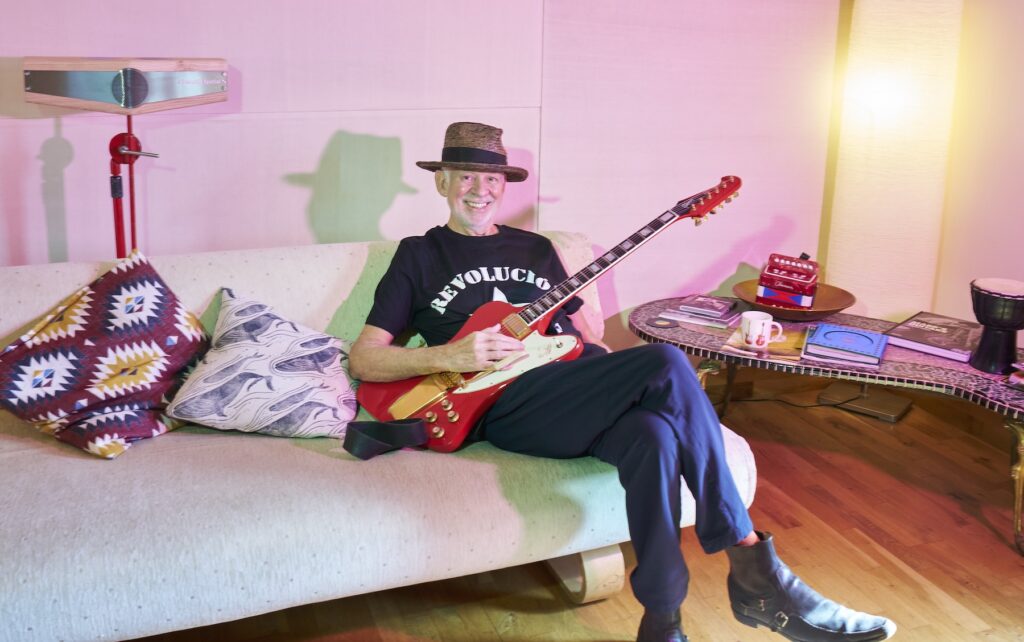
Writing Revolución to Roxy became a way to trace not just a career, but a lineage. His research unearthed Italian musicians from Naples on his father’s side and a Sephardic Jewish pirate in the Caribbean on his mother’s—an ancestor shared with Jamaican rapper-singer Sean Paul. “You just could not make it up,” Manzanera says.
The discoveries even had practical consequences, helping relatives secure European passports post-Brexit.
The lesson? “Talk to your parents while they’re still alive,” he says. “Ask them questions like ‘Where the hell do we come from?’”
Turning 75 last month hasn’t slowed the guitarist down. Between new music, archival projects, live performances, and genealogical research in Curaçao, Manzanera remains in motion.
San Francisco, which he returns to this week, holds particular resonance. His first glimpse of the city came in 1959 when he passed through on the way to Hawaii, after the Cuban Revolution, and it left behind mental images of the Golden Gate Bridge.
In 1972, the city became Roxy Music’s first American foothold. “Our first Christmas and Thanksgiving in the States, actually, were in San Francisco,” he recalls.
What followed was music, chaos, and communion. “When we went with Roxy Music, we always attracted the freaks,” he says. “If there are any freaks in town, they would come back to the hotel. We’d have amazing parties.”
He remembers staying at the hotel tied to one of Frank Zappa’s infamous albums—and quietly filming it all on Super 8, preserving fragments of a city full of “the weirdest, most wonderful, crazy people.”
Those memories echoed decades later during Roxy Music’s 50th anniversary run in 2022. “It was the only time we’ve ever been able to play our music with the proper visual context,” Manzanera says. “It was really emotional to see people singing along.”
The upcoming Great American Music Hall appearance is designed less as a lecture than a shared experience: two 45-minute halves, guitar interludes, projected photographs, and open-ended conversation.
“I’ve told Prasad, ‘Don’t tell me what the questions are going to be,’” Manzanera says. “So who knows where it goes?”
That unpredictability feels fitting for a life shaped by chance encounters, cultural collisions, and music that has never stayed in one place for long. More than nostalgia, “An Evening of Words and Music” offers something rarer: an artist still curious about how it all happened—and what it still means.
AN EVENING OF WORDS & MUSIC WITH ROXY MUSIC’S PHIL MANZANERA Thu/19. Great American Music Hall, SF. Tickets and more info here.