In Ethan and Joel Coen’s Western anthology film The Ballad of Buster Scruggs, Harry Melling played Harrison, the Artist, a man with no limbs but with a gift for declamation. It might seem counterintuitive that writer-director Harry Lighton would remember that performance when seeking a star for his queer erotic feature debut Pillion. Yet that’s where the filmmaker’s mind went when casting Colin, a shy traffic warden who discovers a very kinky side of himself.
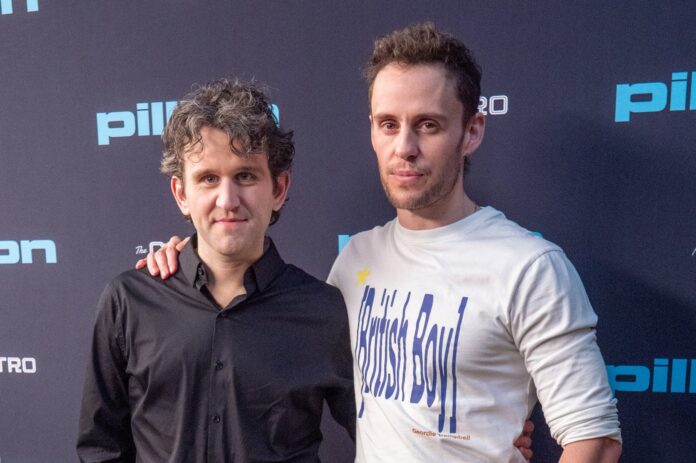
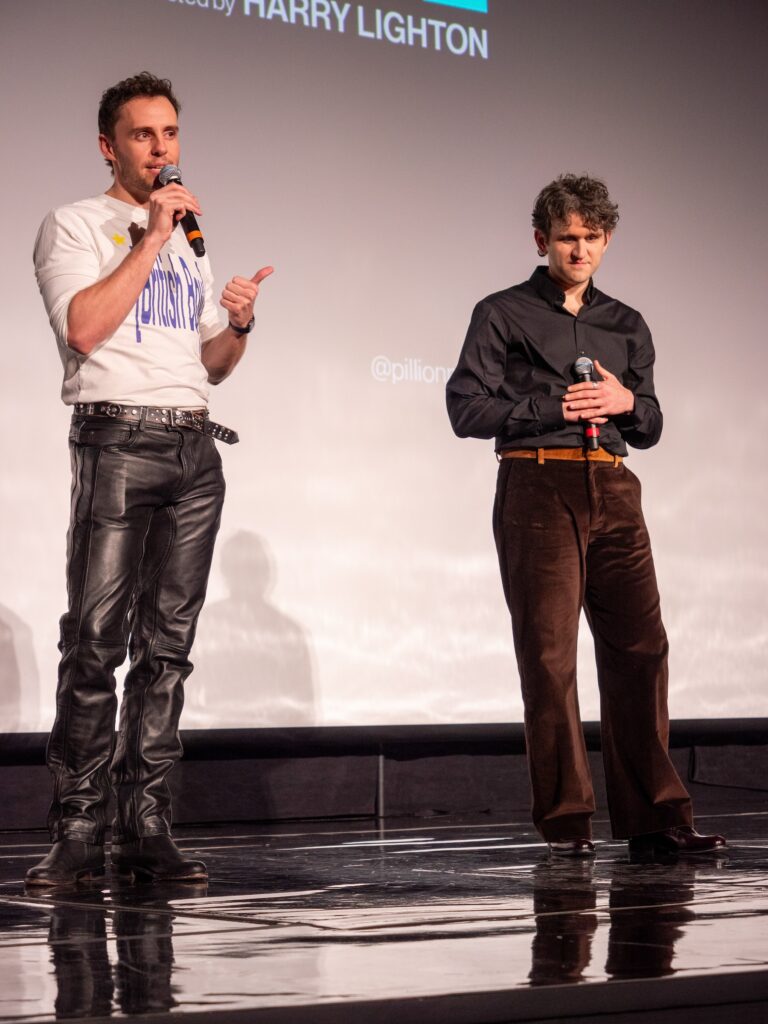
“He blew me away in Buster Scruggs and then I looked at all his work, and it was very varied,” Lighton says during a trip to San Francisco with Melling for a screening of Pillion that would christen the return of movies to the Castro Theatre.
“Harry has an interesting kind of magnetism that flew against the classic alpha male magnetism but was still totally compelling. Harry’s version of Colin would be a contradiction in a way, because he would dominate the screen, but he would be playing a submissive.”
Cast opposite Melling is Alexander Skarsgård as Ray, an enigmatic biker who initiates Colin into a relationship in which he demands complete obedience from his partner—while withholding much of himself. There were no chem tests; Lighton doesn’t believe in them. He had an instinct about Skarsgård and how the towering actor would play against the diminutive Melling.
“I wanted someone who also had a kind of contradictory capacity as Ray, and Alex has the surface, kind of six-foot-six, blonde Hollywood leading man looks, but he also has a kind of psychological depth to a lot of his performances and kind of mischief,” Lighton says.
“He knows when to play against his looks and I thought that the combination of him and Harry, it was just delicious to me.”
“Pillion” is an adaptation of Box Hill, Adam Mars-Jones’s slim 2020 novel in which a middle-aged Colin recalls his relationship with Ray that began when Colin was just 18. The author gave his blessing to Lighton to do what he would do with it, which sparked Lighton’s imagination.
For a while, he considered moving the story to ancient Rome. (“That was a bad idea,” he laughs. “A hot idea, but a bad idea.”) Then he considered relocating it to a cruise ship, because of both the hierarchies involved in that setting, as well as the group dynamics. Eventually, though, he went back to Mars-Jones’ original idea of the milieu of the biker gang, but whereas the book was set in the 1970s, the film would be set in the here and now.

“I found that the 1970s British context made Ray less interesting because there was an easy explanation for him being mysterious; he would be in the closet,” Lighton says. “Once I realized I wanted to keep it in the gay bike world but update it to the present, that unlocked the adaptation.
“What initially grabbed me about the novel was two things, really, and they work in combination,” he adds. “It was the tone, where it would move between comedy and sincerity in brutality and tenderness, often within a sentence. It’s quite jolting, but that cocktail was really delicious, and I thought applied to a sort of coming-of-age story of sexual transgression. It felt kind of radical in that it wasn’t treating it with silk glass, but it also wasn’t laughing at the expense of it.”
It remains a coming-of-age tale but instead of a teenager experiencing his first sexual relationship, Colin is portrayed as a painfully timid man approaching middle age. He still lives with his parents and spends his days in dull routine with his brightest moments coming when he performs in a barbershop quartet with his father and friends. Meeting Ray is a jolt and not just because of the nature of Ray’s sexual demands.
“Colin’s journey is about understanding what love means to him and how he wants to experience it,” says Melling.
“He knows he wants to be in this, but he doesn’t yet know how it entirely operates, how it works. Then, of course, once he sort of is further into the relationship and starts to sort of understand desires that maybe Ray hasn’t presented within his rules and regulations of how the relationship dynamic is going to work. These sort of steppingstones in terms of Colin’s journey were always fascinating things to play with, and playing them alongside Alex, who’s such a receptive scene partner, it was always exciting to see what he how he’d react to Colin.”
Making Pillion was a learning experience for Melling, and not just in immersing himself in the world of British bikers and a dom/submissive relationship but he also had to learn to operate a motorcycle. He took a course in that. A bigger challenge might have been learning to ride pillion, as Melling spends most of his time on the bike at Skarsgård’s back, holding on for dear life. That he found daunting.
Riding pillion involves a lot of trust, the very thing Colin is negotiating with Ray. But the trust between Melling and Skarsgård was established from the first time they met, when their collaboration began as they blocked a scene where Colin and Ray wrestle.
“I don’t think it was done by design,” Melling says. “It was just done for practical reasons. We had to make sure we got the stunt rehearsal in, but it’s a great way of getting to know someone very quickly, wrestling them.”
Together the actors make a striking physical contrast with the dark-haired, slight, and shorter Melling set against blond Skarsgård, a tree of a man. But as Pillion unfolds, the physical differences between the two act almost like a red herring, their looks playing into stereotypes of the dom and the submissive. But as the relationship unfolds, is that the truth of the matter?
“In the beginning, Ray seems like he has total self-knowledge and total control, and he seems like a strong character in every sense of the word,” says Lighton. “And then over the course of the film, you start to question, which one is which? Who actually has more strength? We never discover what’s beneath Ray’s curated armor.”
Pillion is playing in Bay Area theaters.