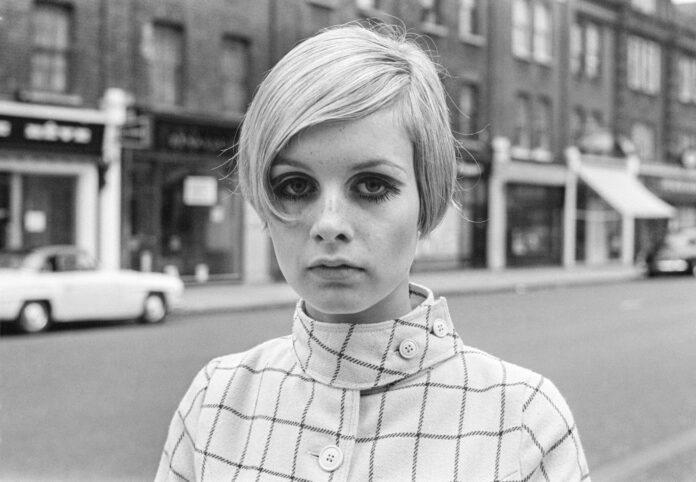
Dame Lesley Lawson, better known as Twiggy, vividly remembers the premiere of Twiggy, a cinematic self-portrait, at the 2024 BFI London Film Festival.
What stands out most in the English model, actress, and singer’s recollection is not the red carpet beforehand nor the applause afterward, but the experience of watching her life unfold on a screen so large it felt almost intrusive.
Seeing decades collapse into images she hadn’t revisited in years—particularly old footage of her late parents and her daughter, Carly, as a toddler—she couldn’t hold back the tears.
It reminded her of flipping through family photo albums, only magnified both emotionally and literally. “And then you see it all 10 feet high on the screen,” says Twiggy. “It’s doubly emotional.”
That reckoning sits at the heart of Twiggy, premiering stateside at San Francisco’s week-long Mostly British Film Festival (Fri/6; Vogue Theater).
Directed by Sadie Frost and featuring longtime friends and collaborators Paul McCartney, Dustin Hoffman, and Joanna Lumley, the documentary traces the rise and reinvention of then Lesley Hornby from working-class North London to one of the most influential figures in fashion and popular culture, not through nostalgia nor canonization, but through reflection.
The film resists turning Twiggy into an untouchable icon and instead allows her to be vulnerable, self-aware, and occasionally stunned by the speed with which her life unfolded. For someone whose image—defined by a narrow heart-shaped face with pronounced cheekbones and huge, heavily made-up eyes—once seemed to belong to the entire world, reclaiming her own story feels both overdue and quietly radical.
The documentary feature did not emerge from a studio pitch or a long-planned retrospective. Instead, it began with a conversation. During the early days of the pandemic, Twiggy started a podcast called “Tea with Twiggy,” initially as a way to stay connected.

“They were friendly chats with mates that started during COVID because there was nothing else to do,” she says. Over time, those informal conversations grew into something more substantial.
About a year or two in, she was asked to interview Sadie Frost, who had recently completed Quant, a documentary about British fashion designer Mary Quant. Twiggy admired Frost not just for the film itself, but for the transition it represented. “It’s hard for a woman of a certain age to get out of one career and into another,” she says, as firmly as one who’s experienced this firsthand.
During their conversation, Frost spoke about her fascination with the ‘60s. Almost offhandedly, the idea surfaced that Twiggy should be her next subject.
It wasn’t a project the fashion icon took lightly. She had been approached to do this before, but this felt different. “It’s one thing to tell your story in a book,” says Twiggy, “but it’s another thing to know it’s going to be on a big screen, telling your life and your loved ones’ lives.”
Trust mattered, and so did understanding. When the two met for lunch to discuss the possibility, Twiggy realized they shared more than an interest in London’s Mod years. Frost had grown up in the public eye, too, moving between acting, modeling, and design. Confident that Frost would understand where she was coming from, Twiggy gave her the green light.
What followed was a long, deliberate process. Nearly a year was spent gathering archival material—there was, as Twiggy notes, “a lot of old footage”—followed by interviews and editorial decisions she largely stepped back from.
Frost brought the project to Film Soho, which financed the film, and from there the documentary took shape over two-and-a-half years. After premiering at the BFI London Film Festival, the movie enjoyed a UK theatrical release and a year-long festival run across Europe.
“We’ve had such lovely feedback and reactions from the people who’ve seen it,” says Twiggy. “So it’s been a very happy project.”
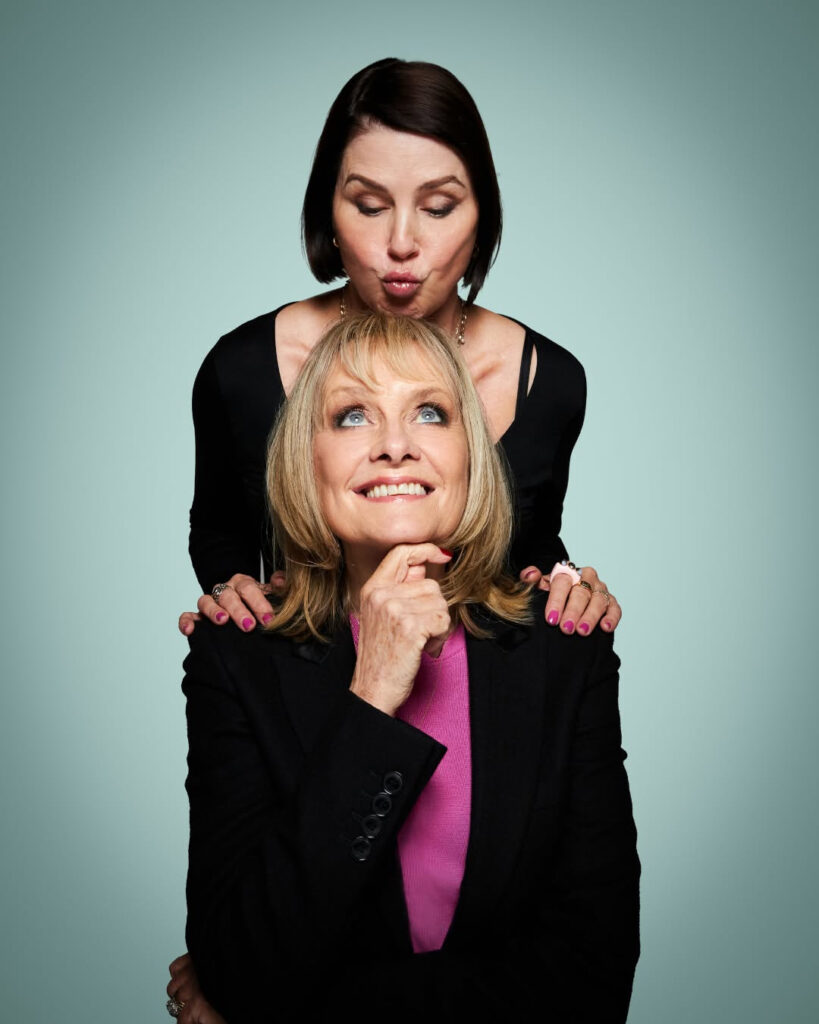
That happiness, however, is layered with perspective. Watching the film underscores just how quickly everything happened at the beginning. Twiggy was still a teenager when her life changed completely. “It happened so fast,” she says. “And I was so young.”
The ’60s existed without social media, without the internet, without the machinery that now manufactures fame at scale. What happened to her felt unexpected.“If you look at models before me, I didn’t look anything like them,” she says. “I was too small. I was too thin.”
Twiggy was never chasing stardom. She was a shy kid, content at home and at school. When the modeling work arrived, it shocked her as much as anyone else. But it was also exhilarating.
“Suddenly, I was going to Paris and wearing very nice clothes, and being paid,” she says. The pivot from schoolgirl to national figure happened almost overnight as she was instantly dubbed the “It Girl” and “The Face of 1966“ (The Daily Express).
One person, she says, altered that trajectory entirely: Vogue’s then editor-in-chief Diana Vreeland. “America has been so good to me,” Twiggy reflects, but it was Vreeland who brought her to New York in 1967 and made her global. Vreeland didn’t just open doors—she removed walls.
“In those days, if she picked a model, photographer, or designer, it was like the word of God,” says Twiggy. “She really changed my life.”
The film also revisits moments from that American trip that have since become legend, including Twiggy’s famously nervous exchange with an up-and-coming Woody Allen on a TV special dubbed “Twiggy in New York.”
Asked by Allen, then 31, to name her favorite philosopher, she froze, silently pleading for help. Allen kept pressuring the 17-year-old in order to belittle her intelligence. But in a stroke of genius, she turned the tables by asking him the same question, which ironically he himself couldn’t answer.
Looking back, she laughs at the mythology surrounding it. “I didn’t plan that,” she says. “I was just panic-stricken.”
When Twiggy reflects on the Swinging ’60s now, she resists nostalgia. Living through it didn’t feel historic; it felt busy. “I was living day to day,” she says. “It was just my life.”
She was traveling constantly, working nonstop. In the middle of it all came another unplanned turn, this time in the form of British filmmaker Ken Russell, already known for Women in Love and The Devils.
“I had no ambition to be an actress, singer, or performer,” she says. Modeling was enough.
But the future Tommy and Altered States director saw something else. He cast her in the musical comedy The Boyfriend, even though she had little formal training.
The experience transformed her. “It felt like entering a secret garden,” says Twiggy. From that film came two Golden Globes, recording deals, TV work, and eventually Broadway.
When actor-dancer Tommy Tune, whom she’d met on the set of The Boyfriend, invited her to star in the 1983 stage musical My One and Only, her instinct was fear. “I can’t do that,” she told him. “Performing live terrifies me.”
Tune’s response was blunt: “There’s no such word as ‘can’t.’” So she packed her bags and flew to New York. “It became a big hit,” says Twiggy, and it taught her discipline, endurance, and confidence she didn’t know she had.
Throughout her life, she insists, very little was planned. She wanted to go to art school and work in fashion design. Modeling happened by chance. Acting happened because someone asked.
Even her return to modeling decades later came from a single phone call asking her to do a 10-page spread for Italian Vogue with famed photographer Steven Meisel. “I couldn’t say no, could I?” says Twiggy.
Body image controversies followed her throughout her career. She remembers being blamed for anorexia in the ’60s.
“I used to come out and say, ‘I’m healthy, I eat like a horse,’ which I did,” she says. “I used to eat anything and everything. I just happened to be a skinny kid—like my dad, who was very tiny and small-boned. That’s what I looked like.”
Some of those same criticisms resurfaced during the early ’90s “heroin chic” era, dominated by waifish Kate Moss. “I think there’s room for everyone, quite honestly,” she says.
That clarity extends to her personal life. Reflecting on her marriage to actor and director Leigh Lawson, who is interviewed in the doc, she notes, “We’ve been together 40 years.”
The difference, she says, from her previous relationships with longtime boyfriend-manager Justin de Villeneuve and late husband Michael Witney, is experience. “Once you’ve been through a breakup or two, you are much more cautious and a bit wiser as you get older.”
Joy threads through the memories, too, particularly when she talks about appearing on the British series “Absolutely Fabulous.”
“Oh, I love her to bits,” she says of series costar Joanna Lumley, whom she previously knew from their modeling days. “The hardest part was not laughing because Joanna and [series creator and costar] Jennifer Saunders are hilarious. I think we had to stop a few tapes because we’d all get hysterical. Once I start giggling, it’s hard to stop.”
As the Twiggy film reaches new audiences—some encountering her phenomenon for the first time—she hopes viewers see more than an image and learn something from her career path.
“Take all the chances you’re offered,” she says. “The worst that can happen is it doesn’t work. I’m still here. It didn’t kill me. It’s not the end of the world. That’s life, isn’t it?”
More than cheekbones and eyelashes, that may be the film’s most enduring image: a woman who kept saying yes, even when she was scared, and built a life not from a plan, but from possibility.
TWIGGY Fri/6. Vogue Theater, SF. Tickets and more info here. More on Mostly British Film Festival (Fri/5- February 12) here.