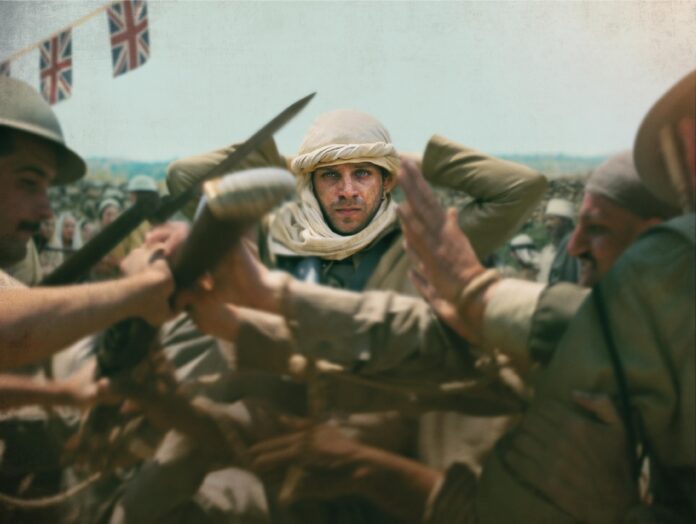
Director Annemarie Jacir’s Palestine 36 tells the story of the Arab revolts against British colonial rule during 1936-39, as Jewish refugees fled Europe and arrived in the region. While this part of Palestinian history is not as well-known as the ethnic cleansing of Palestine, or Nakba, it shaped everything that followed and helps contextualize what’s happening in the region today. The film tells this story though the fictional tale of Yusuf, who is caught between his village home and his work in Jerusalem during the turbulent time.
Palestine 36 was this year’s Palestinian Academy Award-shortlisted selection for Best International Feature, and debuted in the Bay Area last November at the San Francisco Arab Film Festival. Now it is scheduled for wider release, opening March 27 at the Roxie, SF, and other Bay Area cinemas.
Because Jacir is based in Palestine, a live interview was not possible due to the ongoing war. But she was able to answer detailed questions by email about art as a tangible form of anti-colonial resistance, the American audience’s hunger for marginalized voices even amid palpable anti-Palestinian sentiment, and how regular people here in SF today can join the fight against fascism.
48 HILLS How has the film been received in the US so far? Compared to other countries, there is still so much anti-Palestinian sentiment in this country, even in supposedly liberal areas like San Francisco. How has the audience reception differed between regions?
ANNEMARIE JACIR As the theatrical release has not yet begun in the US, I can’t answer just yet. But I do know in the Academy screenings we had, and at the North American fests like Chicago, AFI, Toronto, Palm Springs—the response was tremendous. I was quite overwhelmed in fact. At our gala premiere at TIFF, we had the most incredible standing ovation I’ve witnessed in my life. [TIFF CEO] Cameron Bailey was standing on stage with me and said, I’ve never seen anything like this before, I don’t know what to do, Canadians don’t really do standing ovations.
When I went to Palm Springs fest, we had a morning screening, and the theater was immediately sold out, so they opened up a second screening next door—and the festival director was also amazed by that saying the morning screenings never sell out like that.
So despite the real anti-Palestinian sentiment in the US, we have found the American audience is very hungry for films like this, and have been very touched by the film. I have always known we have an audience in the United States, the gate keepers and distributors who prevent us from reaching it will hopefully see that too. I don’t think they can avoid it for much longer.
It was similar in the UK by the way—no one expected that we would have such a historic theatrical release in the UK, 13 weeks in the cinemas, and especially as the film is quite tough on the British. The reality was, without almost any advertising or promotion, the British audience flooded the theater and gave us a tremendous amount of love.

48 HILLS Making art, especially fiction, in a time of great political strife and human suffering can often feel like a frivolous pursuit. And yet, art is such an important part of political resistance and has the power to shift cultural narratives. To you, what is so compelling about using fictional stories to illuminate history and incite change?
ANNEMARIE JACIR Memory is a form of resistance. Telling our story, with no compromises, is also resistance. Every Palestinian is born into a world which denies them–denies their rights, their freedom, their memories, their stories. We are born into a world which systematically erases us. Us making films, and making art, and writing, is how we refuse to be erased.
I have worked in documentaries but I am personally more drawn to fiction because of the freedom it gives me. I feel free when I write, when I create and think about things. I feel all the borders and all the limitations have disappeared. It is a world we can be free in, our hearts can soar. This may sound emotional to some but it’s really true: Our souls are released and it’s an incredible feeling.
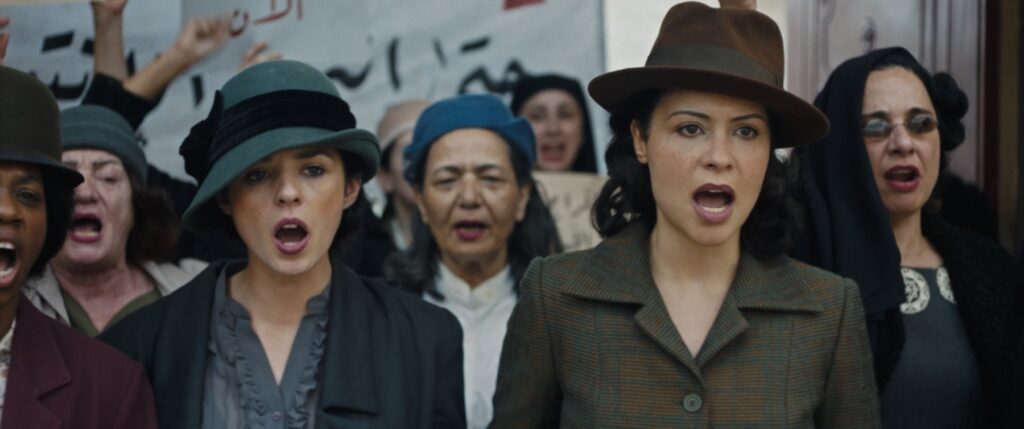
48 HILLS I’m deeply moved by your dedication and attention to historical detail, from the actual 1936 typewriter your team searched for and brought out from Beirut, to restoring a partially destroyed village in the West Bank and replanting all the cotton and tobacco in a historically accurate way. I was so impressed to read in a past interview that you even had actors and extras learn to pick cotton and make bread the traditional way.
Even if a general audience won’t be able to catch all these details, what is the value in going to such great lengths to include them anyway?
ANNEMARIE JACIR Thank you. These details are important to us as creators—not only for me but for the art department, costume department, etc.—because in many ways we felt a tremendous responsibility in making this film, perhaps compounded with the fact that there has never been a Palestinian film about this period, and we wanted to be as authentic and true to our people and our story as we could.
The second way this is important is because they are very important in building the world of our characters. It needs to feel real to them, to feel personal, and all these things help. Aside from the things you mentioned, Yasmine had to learn to use a typewriter, Saleh took horseback riding lessons for 10 months, Ward (who plays little Kareem) went to learn from a priest to be al altar boy for months, and all the extras who played British soldiers in the film were sent to boot camp with a military advisor.
I believe the details are critical in making everything feel not only real but a part of their daily lives. The building of this world is essential, and even if we never see it all on screen, we feel it.
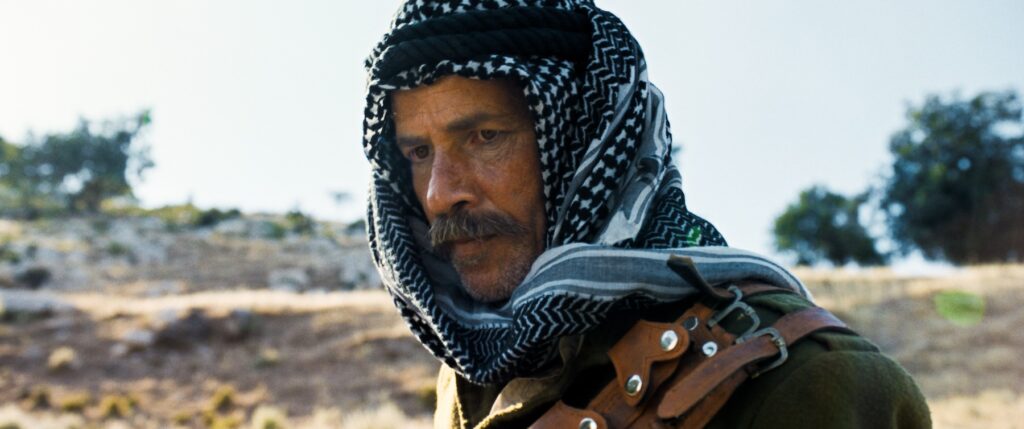
48 HILLS Even though actual pre-production took around a year, you mentioned earlier that this film has been nearly a decade in the making for you, in terms of research and planning. It’s your biggest project to date and the first film to shoot in Palestine for the past two years, after all. How has this process changed you as a filmmaker and a person as a whole?
ANNEMARIE JACIR These past two-plus years of the genocide, of making this film in this dark moment, of watching my parents live through yet another war, and trying to protect my daughter while empowering her has changed me a lot. I also think I don’t know yet how to answer this question, how to express exactly how I have changed. I haven’t even processed fully what our people have gone through with the entire world watching yet.
In regards to the making of the film, I feel this one nearly killed me. The amount of strength, emotion, and will to continue to work on the film over the years, and each time it got shut down, was necessary but not without an emotional and physical toll.
48 HILLS Right before the film’s ending credits, a poem by Gaza poet Saleem Al-Naffar appears on screen. It reads:
From the land, we grew.
Our river birthed creeds and bloodlines
Our rhythm has always been
die standing
In spite of wretched planes
and all that life fractures,
we remain.
Even if skies crush our land
our song sings on
Tell me more about why you chose to end the film with a poem, and why this poem specifically?
ANNEMARIE JACIR Poetry is part of my life, and part of all my films. There are moments in the film which are inspired by poets and literature: We read a line by Ghassan Kanafani, we hear a line from Ibrahim Touqan, and the words of Nuh Ibrahim, the poet of the revolt.
This particular poem ending the film is both a tribute and a memorial, for the Gazan poet Ibrahim al Nafar, who died along with his whole family when the Israelis bombed his apartment building. But it’s a tribute in general to the lives of our people in Gaza and all our martyrs. I also found it a way to bring us to the present day in a very quiet, understated way—Afra running, this little girl in 1936, to where we are today.
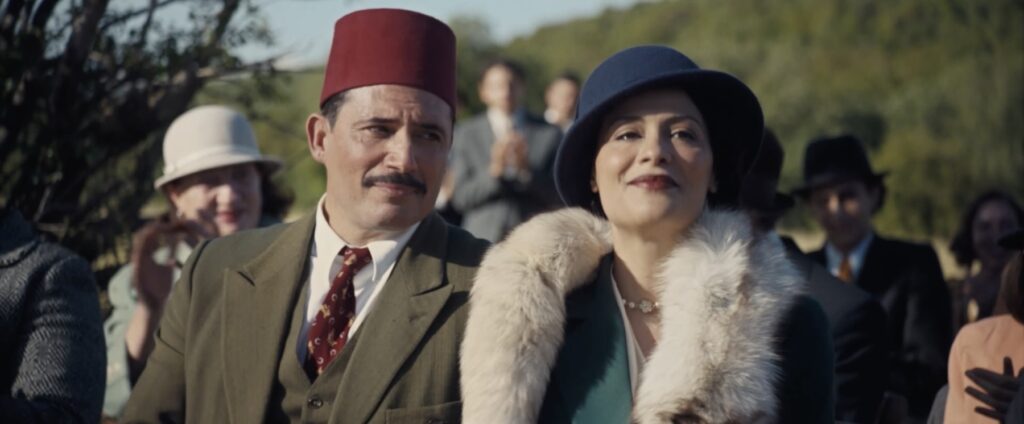
48 HILLS Palestine 36 is a film about the 1936 Arab revolt in Palestine, but it’s also a deeply prescient, universal story about all colonized people and their everyday resistance. What are the main takeaways you hope that viewers can learn from your film?
ANNEMARIE JACIR That no people anywhere should be controlled or abused. I hope people will find themselves in the film and find people they love.
I believe we should celebrate our resilience, honor our people, and critique the mistakes we have made. I know a lot of academics are planning to use the film for teaching and for education, and I love that. But for me, it is the emotional story that means most and is the core that I hope people take with them.
48 HILLS How can people like those here in the San Francisco Bay Area, who are lucky enough not to be as directly impacted by colonial violence, fight against imperialism? As the American government actively funds the Palestinian genocide without our consent, what are some things we can do day-to-day to fight back, even if on a small scale?
ANNEMARIE JACIR: The people of San Francisco have a history of civil disobedience, of confronting power, of being an active part of the civil rights movement and anti-war movement as well as the struggle for liberation of all peoples. This is a legacy to not only be proud of, but to continue. People’s voices have been absolutely critical in speaking out about oppression. It’s the only thing we have sometimes. And it presents a real threat to those in power, otherwise they would not spend so much time trying to control our voices and prevent them from being heard.
It’s important to always remember this. Taking action, and refusing to be silent. Silence is a killer. Those in power not only bank on our silence but they depend on it.
48 HILLS At a time when cinema attendance is at an all-time low and many Americans feel hopeless about standing up to our government, how can we rally the masses here in San Francisco to go see this powerful film in theaters when it opens?
AJ: I think people need to be reminded how incredible the cinema experience is, watching the film on a large screen the way it was intended to be seen. There is truly nothing like it. And with a group of people. The way a community can form in this shared experience even if it’s just two hours. A lot of people are writing to me that they’ve taken their parents or grandparents to see the film and something magical has happened afterwards, that something has been unlocked. This is truly special.
I also think watching the film in the cinema honors the craft of filmmaking but also the cast and crew. We worked harder than we have ever worked on anything in our lives, in the middle of a genocide, and poured every bit of love, and pain, to tell this story. To make it against all odds. With an army standing in our way and trying to stop us, with apartheid and occupation.
So people going to see it, especially when so many have tried to prevent us from making it, and so many have tried to block it from being shown, is truly an act of resistance as well. When audiences go see the film they are saying that art and storytelling is alive and that we will find each other in the world and allow a thread to connect us.
PALESTINE 36 opens March 27 at the Roxie, SF. More info here. Also showing at: Rialto Cinemas 9 in Sebastopol, Rialto Cinemas Elmwood 6 in Berkeley, Marina Theatre in San Francisco, and Sequoia Twin in Mill Valley.