Another week, a bigger clusterfuck. It’s like 2003 all over again, though at least then the POTUS got Congress’ approval (albeit on bogus pretenses, to their shame) to wage war on an oppressive Arab state. This time, same dubious excuse, but apparently Congress didn’t need to be consulted because… well, because this administration doesn’t like that part. So: Hello, new quagmire. But it will all be worthwhile for those precious moments of attention stolen from “the files,” right?!?
With eerie relevance, this week also happens to mark the start of the BAMPFA series Iranian Cinema: From Aesthetics to Politics (Sat/7-April 23), so you have an opportunity to familiarize yourself with the inconveniently human side of the nation we’re now bombing to smithereens. Of course, movies from Iran have had a significant presence on the international festival and arthouse scenes for about 30 years now. Their acclaim is invariably couched in political terms: directors managing to sneak motifs of resistance and criticism into narratives that by cautious necessity became opaque, or eluding censors by focusing on the seemingly apolitical terrain of child protagonists.
Nonetheless, those directors still often find themselves under temporary ban from further work, imprisoned, under house arrest, individual films banned from national exhibition, et al. Some like the late Abbas Kiarostami eventually emigrated, completing foreign-financed films without Big Brother peering over their shoulder. Others, like much-arrested current Oscar nominee Jafar Panahi, infuriated the regime by continuing to make and disseminate projects without authorization, under Big Brother’s nose.
The six-week BAMPFA series avoids familiar titles from such figures already well-known abroad. Instead it focuses on three newly-restored classics not widely seen in the West, plus several works from director and scenarist Rakshan Banietemad, who’s expected to be present for their screenings in late April. The rediscoveries begin this Sat/7 with 1972’s The Postman aka Postchi, a bold mix of fable, black comedy, and social indictment from Dariush Mehrjui. His prior The Cow (1969) is considered the first major achievement of the original “Iranian New Wave”—a rebellion against the then-pervasive climate of cheap, frivolous Filmfarsi genre movies overly imitative of Bollywood and Hollywood.
The B&W Postchi would have been a vivid artistic statement coming from anywhere around the world, even at that aggressively boundary-pushing moment in the medium. It’s loosely inspired by Buchner’s much-adapted 1836 play Woyzeck, the story here given not a military setting but a provincial civilian one. Hapless, nebbishy, bespectacled protagonist Taqi (Ali Nasirian) can barely support himself and his beautiful wife (Jaleh Sam) on a threadbare salary as low-end flunky to everyone on a posh country estate. Worse still, his constant anxieties have rendered him impotent, so he can’t satisfy his neglected spouse’s corporal needs—though others are all too willing to do so in his place.
As a pileup of indignities eventually snap Taqi’s tether, his disintegration drives this restless, inventive film’s progress from raucous satire to tragedy. Mehrjui (who began writing the film during a 1970 trip to Berkeley) remained a major figure in Iranian cinema for another half-century, until three years ago he and his wife were murdered in their home. It was seemingly a robbery gone wrong, committed by a disgruntled former employee. Still, there were suspicions of political motivation—he’d been a prominent lifelong opponent of state censorship.
In an entirely different mode, there’s the post-Iranian Revolution Bashu, the Little Stranger, which at the end of the last century a poll of industry professionals voted as the nation’s best film “of all time.” Its director Bahram Beyzaie, also a hugely esteemed stage talent, eventually left Iran to teach at Stanford, and he passed away in Palo Alto at age 87 just weeks ago.
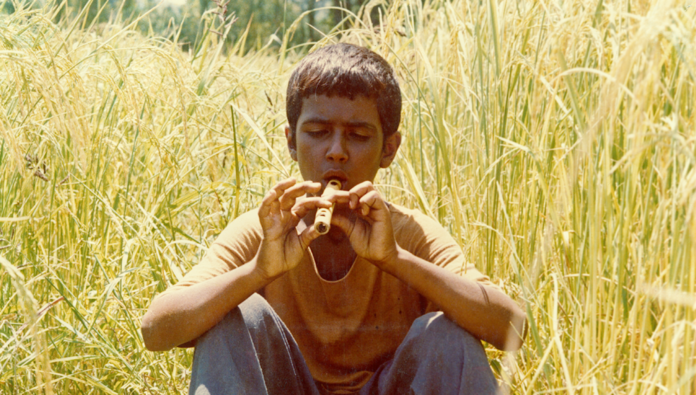
Shot in 1986 (though not released until 1989), his most beloved screen work is set amidst the then-ongoing Iran-Iraq War. The titular figure is an Afro-Iranian boy (Adnan Afravian) of about 10, from the arid southwest. When enemy bombs decimate his town, he hides in a truck bed—only to awaken after that vehicle has traveled to an entirely different, verdant rural agricultural area in the north. Alone, traumatized, unable to speak the local dialect, he is taken in by strong-willed Naii (Susan Taslimi), who’s raising two children alone while a frustratingly non-communicative husband is off somewhere looking for work. The ignorant, superstitious villagers disapprove of this dark-skinned stranger, at least until they realize he has useful skills they lack: He’s literate, and knows arithmetic.

Perhaps compensating for her child co-star’s limited expressiveness (Afravian never seems to have acted again), Taslimi is strenuously theatrical, limning a figure who’s equal parts feminist working-single-mom heroine and Mary Poppins—she imitates the calls of all local birds and beasts. Nor does the film refrain from vigorous excesses of melodrama, emotion, or showy stylistic display. While its family-friendly content is far from Postchi’s dyspeptic adult world, both films sport a kind of maximalist directorial vision far from the quasi-documentary, neutral, poetically austere minimalism associated with the Iranian screen movement’s second and third “waves.”
Much closer to that later approach is a third restoration, of Sohrab Shahid Saless’ 1975 Far From Home. Its 90 minutes compile the daily humiliations ignored or endured by Hussyein, an imported “guest worker” in Berlin who after four years still has acquired no German language, no real friends, and no desperately-desired female companionship. Admittedly, his squat allure is more Danny DeVito than Omar Sharif, but he is duly employed, honest, and amiable.
All he encounters from Germans, however, is a variably thinly-veiled hostility, while even the fellow immigrants in his shared flat are too wrapped up in their own issues to provide much comfort. Everything is like a mirror of his factory job, repetitious and draining—even if the delicate pastels of Ramin Reza Molai’s cinematography lend this international coproduction surprising visual beauty. After it, director Shahid Saless decided to stay in West Germany, where he spent most of a career that ended prematurely in 1998, when colon cancer claimed his life at 54.
The BAMPFA series is being presented by UC Berkeley’s Minoo Moallem, a professor of gender and women’s Studies who’ll be teaching a class in conjunction with it. Other departments will cosponsor the visit by Rakhshan Banietemad, arguably the most prominent female force in the Iranian film world for nearly four decades. The two women will hold post-screening discussions for four films being shown over two days, April 22 and 23. On a single program the first night are two mid-length documentaries about environmental activists, Mahnaz Afzali’s 2017 Mothers of the Earth and Banietemad’s own 2015 All My Trees. The next day brings a late afternoon show of her 2001 drama Under the Skin of the City, charting a working-class Tehran family’s bitter travails, while the evening brings 2005’s Gilaneh (which Banietemad co-directed with Mohsen Abdolvahab), in which another mother struggles to maintain as successive wars rob herself and her children of health and hope.
The same institution is starting two other major spring series this week. Overlapping with the one above is Fassbinder and the New German Cinema, an overview of a separate screen movement that wound up having a considerable international impact, primarily in the 1970s. Its star talents were wildly disparate, yet shared a sense of formal rigor, a certain intellectual detachment, and refusal to cave—save in an occasionally ironical, deconstructive fashion—to commercial genre conventions.
The ten-week lineup includes several by short-lived but insanely prolific Rainer Werner F. himself, starting this Fri/6 with one of his first breakout successes, 1974’s Ali: Fear Eats the Soul. Its tale of an unlikely, frowned-upon romance between a 60-year-old female laborer and younger Moroccan guest worker echoes the aforementioned Far From Home (a dual-series entry). His other contributions here span from 1971’s The Merchant of Four Seasons and Beware of a Holy Whore to 1979’s global hit The Marriage of Maria Braun. Those who think they dislike the director—onscreen as in life, he can resist being loved—might want to check out the 1976 Chinese Roulette, an enjoyably glossy and perverse thriller featuring imported French star Anna Karina.
Elsewhere, there are three of Schlondorff’s ever-impressive literary adaptations (Young Torless, The Tin Drum, and The Lost Honor of Katharina Blum, which he co-directed by Margarethe von Trotta), two assertive early steps by Herzog (1968 debut feature Signs of Life, the indelible Aguirre, the Wrath of God), and one each by two singular, extravagant phantasmagorical fabulists: Ulrike Ottinger’s 1984 Dorian Gray in the Mirror of the Yellow Press, and a rare revival of Hans-Jurgen Syberberg’s seven-hour 1977 Our Hitler.
There’s also Alexander Kluge’s 1966 Yesterday Girl, with the director’s sibling Alexandra as a DDR refugee who finds western society so unwelcoming, she eventually decides she’d prefer prison—for many, the first notable salvo of the whole New German Cinema epoch. Kluge, Fassbinder and Schlondorff were among the many contributors twelve years later to Germany in Autumn, a pulse-taking omnibus. The whole series ends, fittingly, with Wim Wenders’ 1984 Paris, Texas—as by then, most of the movement’s major figures had either receded or gone on to international careers. Info on the entire program is here.
Finally, BAMPFA is also commencing its annual African Film Festival (through May 9), a two-month survey of mostly recent work from across the continent and its diaspora. This year there are contributions from Kenya (Damien Hauser’s After the Long Rains, which opens the series this Sun/8), Democratic Republic of the Congto (Sammy Baloji’s The Tree of Authenticity), Mali (Fatou Cisse’s Furu), Ethiopia (Jessica Beshir’s Faya dayi, also part of the previously-reported “Psychedelia & Cinema” series), French Guiana (Maxime Jean-Bapiste’s Koute vwa), Nigeria (Afolabi Olalekan’s Freedom Way), and Morocco (Orian Barki & Meriem Bennani’s documentary-animation hybrid Bouchra).
A recently restored archival title included is Zeinabu irene Davis’ 1999 Compensation, an adventuresome B&W U.S. indie depicting two African American romances—both between a deaf woman and a hearing man—in Chicago, albeit at nearly a century’s remove from each other. Davis and screenwriter Marc Arthur Chery will be present for its screening on March 12.
The Roxie also has a notable revival on tap Fri/6 in the form of a 4K restoration of Satyajit Ray’s 1970 Days and Nights in the Forest, a special favorite for Wes Anderson (who’s shot a personal introduction for it). Based on a novel by Bengali poet Sunil Gangopadhyay, it’s a light-stepping comedy of manners in which four quarrelsome, jaded upper-class men drive for a restorative weekend in the country.
Never mind that they spend most of their time getting roaring drunk, that they have to bully and bribe their way into accommodations they didn’t bother reserving in advance (and then smirk condescendingly at the “corruption” of the poor that allows them to), that they reflexively blame others for their own stupid errors. Their status means consequences will be minor, and those who ought to chide them (like the respectable family who have a summer house nearby) are too polite to do so.
This is the kind of film that seems more anecdotal than plot-driven. Yet something is always happening, some tension is being pulled a little more taut. It almost casually works its way towards what could well be tragic—but Ray is in too forgiving a mood for that. Even the unthinkingly rude treatment of lower classes that we might find offending here is at once acknowledged, with a kind of rough justice meted out…yet in the end everyone pretty much emerges unscathed. It’s a complex, satisfying two hours that nonetheless pass with the luxuriant harmlessness of a picnic on a sunny day.