I’m a union construction worker. In the 1980s I had steady work building the high rises and luxury hotels that some called the Manhattanization of San Francisco. It was a great gig for a twenty-something, but I was living month-to-month as a renter, dependent on landlords who seemedto evict with impunity, a major inconvenience for a young craftsperson who was accumulating more and more tools to match his growing skills.
One Saturday I walked into a realtor’s office with two paystubs in my wallet and by Sunday afternoon I was the owner of a fucked-up house in a neighborhood I had never heard of. The house had no roof, the toilet didn’t work, and the two flights of entrance stairs were unwalkable.
In those days I thought the city ended at 24th St and Roosevelt’s Tamale Parlor, and Army St. was that goofy road you took to get on the freeway. Now I was living in something called Bernal Heights. It could have been Big Sur for all I knew: breathtaking views from this rocky hill cluttered with cute, ramshackle houses. I’d spent more time picking a head of lettuce than choosing my new house. Now I really had to work.
I became quite skilled at my trade, was soon running jobs and earning foreman wages. One day a company offered to make me superintendent. No damn way! I was union! Never going to be management. Within a year, for reasons to be embellished elsewhere, my co-workers elected me to be their union representative, and soon I was a principal officer of my union.
For the next 30 years, I never lost an election, and for the remainder of my working life I was dependent on union members electing me to leadership jobs. If at any time someone had run against me and won, my life might have played out differently.
In labor unions there are no “term limits.” Like former Assembly Speaker Willie Brown (and half the current US Senators), people usually ran for re-election until the voters got sick of you. (Or, like Diane Feinstein, you died.) I never thought about stuff like term limits. Voters and workers make their choices.
Willie Brown was one of San Francisco’s Sacramento legislators for more than 30 years, and was elected speaker for fifteen of them. He’d be speaker today if corporate-backed republicans hadn’t initiated a term limits referendum—two terms maximum—to pry him from office. “We need new blood!” these reformers shouted as they paid for the billboards, TV ads and mailers for the hand-picked “new blood(s)” they would soon be backing.
An entire generation of experienced leaders was termed out of office. It didn’t take long before folks realized that these new cycles of first years were producing a permanently rookie legislature. Forget about sustaining any legislativeagenda; folks were still trying to find the bathrooms and copy machines by the time they were termed out.

And then these legislators began whining so in 1990 Proposition 140 was placed on the ballot to increase the term limit to “three” (six years), (coupled with the “two” term Senate limit (eight years). As these Assembly rookies became “seasoned” sophomores they began plotting their Senate races while the “older” Senators were now looking back to the Assembly where they could start their term limit clocks all over again. Even less legislation was getting passed.
Our term limit geniuses then introduced another amendment, Proposition 24, which introduced a “12-year” limit for both houses, Senate and Assembly combined, to put some brakes on this election jockeying.
Today that’s the current state of our California term limit disenfranchisement project.
Despite these time-wasting tinkerings, all term limit provisions still preemptively disqualify California voters from selecting their leaders— whether an eager new rookie or that doddering old fool.
The only historic (and mostly accepted) benchmark for term limits is the United States presidency, the executive branch. Two terms max. This started with George Washington, who had violently ousted a king and was obviously sensitive to seeing another one.
Washington was the first executive in America’s new three-branch constitutional republic, but it was never explicitly stated in the Constitution how long these new democratically elected presidents (and Congress members or judges) could serve. But Washington, ultimately, was afraid of setting a precedent and acting like a king. So he resigned. His choice. (His farewell letter has been mandatory reading and boring school children for two centuries.)
Since then, nobody had ever served more than two terms, except for Franklin Roosevelt, who was practically anointed for his third and fourth term because of taking us out of the Depression and, like Washington, guiding us through a major war. That fourth term, in retrospect, was probably why the Constitution was eventually changed. It smelled of monarchy.
In California, terms limits for governor were instituted more recently. Like the presidency, gubernatorial political cycles, careers, and democratic elections are now predicated on that. Eight years in the Executive Office. And then they’re done.
There have been two aberrations to that two-term assumption, folks who were elected twice and then ran again:
1) Jerry Brown, who was first elected governor when I was a teenager and ended his second term about the time I first moved to San Francisco and found work in the construction industry. Jerry completed his fourth term just a few years ago about the same time I was running for my final term (eighth, my choice) as executive director of the San Francisco Labor Council.
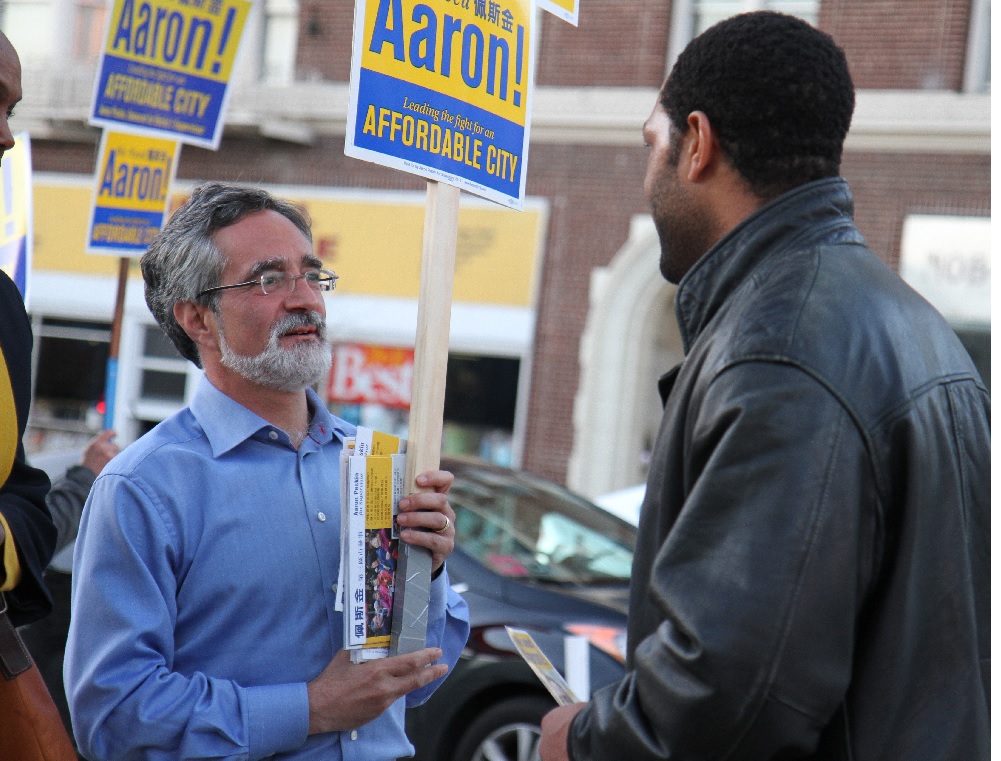
2) Aaron Peskin, who was in his first term as Chinatown/North Beach supervisor when I was elected to my first term, was just completing his fourth term as I was deciding to not run for another term (and retire) almost 20 years later. Aaron had skipped a prohibited third “consecutive” term when David Chiu, his (chosen) successor, was elected to replace him.
But when Chui abandoned his second term and went to Sacramento, Aaron was recruited to run in the next general election against Chiu’s successor, the mayor’s appointee (and clueless sycophant) whom he trounced in the regularly scheduled election. Aaron was instantly the incumbent in the next regularly scheduled election where he won again. And in his fourth term, he was elect board president.
An extra “aberration” from that “two-times-only” tradition was Jerry’s dad, Governor Edmund G. Brown who, in 1966, though twice elected and promising not to run for a third term, decided to run anyway. Whereupon he got his ass handed to him by another “new blood,” Ronald Reagan. But voters made that choice. Not term limits.
The reason I am thinking about this abomination of term limits is that the San Francisco Board of Supervisors introduced yet another initiative, Prop B, that would add an additional amendment to our City Charter that already prohibits supervisors from running for two terms. Today you are “termed out” after a second term—but there is nothing preventing you from, years later, putting your name back before the voters.
Anyone who thinks that Proposition B isn’t solely about keeping Aaron Peskin from running again in District 3 and squashing any threats to San Francisco’s new “moderate” Board of Supervisors, is delusional and ignoring the disenfranchisement associated with the measure’s intent.
As a newly elected union rep., I wasn’t using my physical tools anymore but was quickly learning others: political, legislative, health and safety, negotiating, organizing, speaking, writing, computer, and soft skills as simple as “dressing up” and replacing my beat-up work truck with a new black F-250. I bought a couple sport jackets and two black ties as I moved toward a parody of Animal House peer pressure to at least look like a “boss.” Yikes.
Politics was also a factor in my new job. Like legislators, we need to prove to our members that we’re worthy of our office. I now needed to use and master economic policies and issues as much as I’d learned to use and master my hand tools: I needed to improve my “skills” and “leadership,” not just in terms of economic and health and safety accomplishments but to project even marginal perceptions of competence: “too young/too old; fighter/doesn’t fight enough; too smooth/too crude; smart/idiot/college boy; corrupt/clean as a whistle; kiss ass/sell out/lazy…. “
Every day was now a workday; 40-hour weeks don’t exist if you are a good union representative. And every day includes running for re-election. In construction unions, we don’t have the technology or money to put this stuff onto leaflets or fliers or billboards and TV ads. It was word of mouth on the construction sites and union meetings, apprenticeship schools, ballgames, and bars where members would judge and vote for the best candidates and fighters to represent them. I got shit done when I worked on the job, so my coworkers liked me enough to elect me. I never lost an election, even when challenged.
In my union we had elections every three years, usually linked to the same time the contract, our collective bargaining agreement, expired. And nothingis nastier than a contested union election. It’s always about money and terms of the contract, the bedrock of any union. What was negotiated last time is usually the biggest issue determining your re-election. “We wanted a $10 an hour and you sold us out for $6!”
Within weeks of getting elected to my second term, a huge recession (not the dot-com boom) caused havoc in the building and construction trades industry. This weird downturn in the early 1990s only seemed to effect real estate and development, and within three months more than 50 percent of construction workers in California were out of work, sitting “on the bench,” and looking for work.
Union construction workers don’t receive salaries. They get paid by the hour and if they have the benefits of being in a union they pay union dues determined by the hours they work. The majority of union budgets are designated to cover payroll to hire union representatives, usually fellow members making the same wages in the collective bargaining agreements. Unions were first formed when workers decided to fork up part of their wages to pay a coworker to fight for their rights. Someone had put down the tools to take on the boss.
During this recession many building trades unions experienced significant budget crises and started to lay off their union representatives. Some of us reduced our wages to three- and four-day weeks (though we still worked every day helping out-of-work members.)
In the 1990s my union was the biggest union of 12 California unions (from Sacramento to San Diego) in my international. More than half of us were on the verge of going broke or exhausting any budget reserves. One day we got a call from the big shots in Washington, DC who informed us they were merging all of 12 of us into two big unions, one in San Francisco and the other in Los Angeles. My international president had hired an Ivy League business professor to create this consolidation. Someone to rewrite all 12 union constitutions into two.
In our new San Francisco union, multiple “executive boards” became a single “Management Committee” (of five) which included a “business manager,” the principal officer, who now appointed the (formerly elected) union representatives. The second officer was the “secretary treasurer,” an important sounding but clawless position, who would be “in charge of the books” but not the finances. I was appointed to one of other three slots, “vice chair” of this Management Committee (that I would later be elected to.)
I still served as business representative, but now served at the will of a president who, a month later, would lose his first election to a disgruntled out-of-work member who railed at the loss of democracy in this new constitution. And then he immediately fired everyone including me. Though I’d been appointed and was just (re)elected as vice chair, I was no longer employed by the union I’d been elected to serve. The folks in DC called this Reform.
I looked up this Ivy League professor and realized he was also teaching students and corporate executives the Wall Street-driven strategies of how to buy up companies, merge them, lower wages and lay people off. The same corporate moves I was seeing every day in the news.
I didn’t wait for the change and had packed my desk the night I heard the election results, though the new officers wouldn’t be finalized for another 60 days. Almost immediately I was recruited to be the organizing director for another union where, ironically, (and worth another article) the week I was hired the president of that union was challenged for his reelection.
Well…. I’d had a little experience with that, so I took a “leave of absence” from the organizing job I’d barely started and organized my new boss’s reelection. Which he won. Which guaranteed job security for another three years (if he didn’t fire me), though I took another job before his term ended.
I need to confess two examples of term limit shenanigans that unions introduced to exclude members from running for office. One affected Harry Bridges and the International Union of Longshore and Warehouse Workers (ILWU) and other was introduced by the International Union of Bricklayers and Allied Craftworkers to disqualify me.
Harry Bridges, famous for worker solidarity and the 1934 San Francisco general strike, which produced the hiring hall and groundbreaking racial equality on the docks, was the ILWU president who served during the same time as Vice President Louis Goldblatt, the architect of organizing Hawaiian pineapple and sugar beet plantations, unionizing the warehouses industry, and the planning the “march inland” from the docks.
Toward the end of their careers, this historic duo got on each other’s nerves so badly that Bridges refused to retire if Goldblatt, next in line, was going to succeed him. As they got older, the constitution was amended so that no one would be eligible to run for office if they were 70 years old or became 70 years old during their term of office. When this was adopted in 1984 Harry finally retired. Goldblatt was now “too old.” ILWU members didn’t come up with this policy. Harry did.
Not long after I was “fired” as my union’s business representative (and already working for another union) I took a week’s vacation and attended my International Union’s convention in New Jersey. I was still an elected officer (“Vice-Chair”) as well as a convention delegate, so I decided to fly out and hang with my former colleagues. Little did I know that, prominent among the convention’s business, was a resolution, crafted by the president who’d fired me (with help from the same lawyers at the International Union), that read: “any member of this union who is also a member of another union or works for another union is ineligible to run for election to any office in this union.”
Yikes! Despite being shocked, and with no thoughts of running for office again, I was amazed that they would take such a deliberate step to keep me out. I was still a dues-paying member and part of the labor movement even with this other union that I’d decided to work for (and even joined). I was also a bit honored that folks thought me so powerful that I might storm back into office.
Just as the chairman banged the gavel on the amendment, 15 Hawaiian delegates barreled into the room. They weren’t small either. Their leader grabbed the microphone before the chairman could recognize him.
“Who the fuck introduced this bullshit?” he started.
Chairman: “Please identify yourself.”
“Fuck you. We’re all from Hawaii and this is our union. But we join other unions too! So an injury to one is an injury to all.”
The chair asked him to not curse but the guy continued shouting that in Hawaii members of this union worked in various construction trades and were members of multiple unions.
“We carry cards for two, three or, even, four unions. We’re one brotherhood. We don’t discriminate in Hawaii like you haole assholes here on the mainland.”
And before the chair took control he shouted,
“I make a motion to table this amendment,” and the rest of the Hawaii gang immediately shouted, “Second!” before the chair knew what hit him.
The leader then shouted,
“Are there any objections?!!
There was a stunned silence. And then they all walked out of the conference room.
In less than five minutes the Hawaii guys had killed the “Paulson Amendment.” Like ILWU’s Goldblatt, who’d mapped out multiple industries in Hawaii where sugar and pineapple and other workers were all organized, the BAC Hawaii bricklayers fought for everyone. The rank and file prevailed. (And I was still free to run for office if I desired. Which I never did.)
Terms Limits are never initiated by progressives. It’s usually the same anti-tax, anti-rent control, anti-worker and anti-government conservatives who never have enough votes to elect the politicians who’d carry out their business-first agendas. Their corporate-funded think tanks are very creative and fertile. Good minds not working on good government. Read the official Republican Party platforms over the years; hell, read Project 2025, which is currently guiding the Trump administration (which even adds stuff to install their own generals and admirals….) These guys use the same post civil war Reconstruction Jim Crow/Slavery methods to exclude certain groups from governing and voting. And all these exclusions have their roots in voting rights and disenfranchisement starting with the Constitution framers original decree that African/Americans were only three-fifths of a citizen.
Some of the original disenfranchisement tools included poll taxes, literacy tests, registration deadlines, drivers licenses, impossible postal deadlines for mail-in ballots, picture IDs., and unprovable residency requirements. Term limits is just a fancier breed of the same disenfranchisement industry and is now such an accepted chess game that everyone is Sacramento (and Washington and San Francisco) is looking for his or her next electoral move instead of governing. There are more calendars on the wall for politics than for legislative meeting schedules.
In my last (and longest) union job, I had to run for reelection every two years. After my third term I joked to my executive board that we would save time and money if you guys just fired me when you were sick of me. They laughed and I’m glad; democracy was “forced” upon me. I had run for office eight times before, entering my 60s, I decided to retire on my own terms. And union members got to pick my successor.
In 1789, Ben Franklin, as he walked out of Constitution Hall in Philadelphia, (where the delegates had been debating how to eliminate a king), was asked,
“Ben! What kind of government did we get?”
“A Republic!” he yelled back. “And a voting Democracy?”
Then he turned and added:
“Pretty wonderful, if we can keep it.”