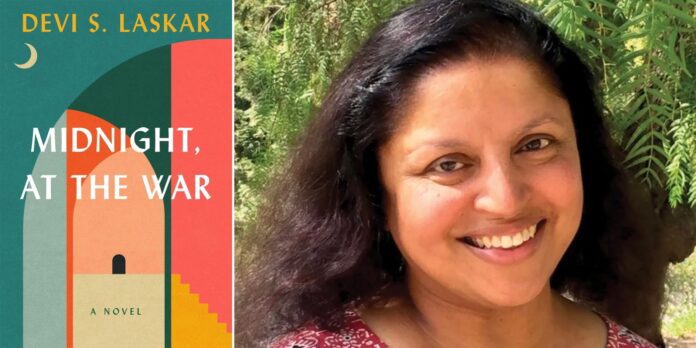
A pessimist encountering Devi S. Laskar’s latest, Midnight, at the War (Mariner Books), might read it as a dystopian novel about ruptured morality, violence, and pervasive misogyny and racism, specifically in the field of journalism. An optimist is likely to say that this contemporary work of historical fiction pays tribute to the brave and noble few who resist humankind’s tilt into total turpitude. The pragmatist might view this sixth book and third novel from Laskar as a fact-based story centered on a fictitious female war correspondent and set in the two-year period just prior to and following the September 11 attacks.
They would all be correct.
The Bay Area-based writer’s novel bounces between 2001 and 2003, with protagonist Rita Das an American print journalist on assignment in an unnamed city-state somewhere in Southwest Asia or North Africa. Back at “home base” in the United States, she has left a husband, a lover, her mother who is ill with cancer, a father she struggles to connect with, a best friend who is also a journalist, and power-wielding editors who increasingly impinge upon her determination to report the truth.
What has not been left behind, what Das takes with her into dangerous streets and alleyways and frustratingly bureaucratic offices in war-ravaged countries, is grief. Grief after witnessing a kidnapping and choosing work over being at her dying mother’s beside, not to mention the turmoil she feels about her philandering husband. There is also identity confusion, as the daughter of a white Midwestern father and Bengali mother. Ah, and she’s completely uncertainty as to who is the father of her unborn child.
Laskar has a knack for introducing timeless themes that haunt a reader’s memory long after a specific plot or character is forgotten. Her descriptions of the streets of the United States as “sterile, paved, unoccupied,” its cities (other than New York) as “ordered, homogenous” are juxtaposed with the streets and cities she encounters in foreign lands. On Ras’ travels, Laskar writes, there is always the odor of something burning to the ground and the threat of unexpected terrorist attack. One might think the incendiary scent of trauma is more obvious in some locations than others, but it seems to exist everywhere for Das.
The character asks herself, “Who set this world on fire, and why?” Soon, she is worried over how many innocent people will be harmed by the destruction she witnesses, how many places of commerce and worship sacrificed in war. “There are always the questions,” Das reflects on her profession. “The reporter merely substitutes the word fire for war, government, police, corruption, racism, misogyny, assault, trafficking, famine, displacement, or drugs.”
Another passage has the character feeling bloated with sorrow over a story about a four-year-old who drowned in a backyard pool. Das bears the weight of tragedy down to the tops of her feet. The cumulative effect of the violent stories she covers and her turbulent life exacts its price, as her determination is ground down, from boulder-sized to pebble.
The cost of conflict on communities and individuals reverberate most profoundly in Midnight. But the book’s ping-pong jump between time periods and locations often feels disjointed and diminishes its momentum. One wonders if its unevenness is intentional, meant to reflect the real-life experience of trauma.

Laskar was a reporter for many years, and knows well the challenges women and people of color face working in the media. Although the novel’s early 2000s newsroom settings and technology wax almost nostalgic compared to today’s megalomania-driven, online “news,” Laskar has us firmly hoping that writers can remain human. “Our eyes may be cameras, but they are cameras that can cry real tears,” Das the character writes. “Sometimes the wind smells and stinks of hot breath or something gone wrong. Often the wind smells of roses because even in war the gardeners have their subterfuge, and they still grow flowers.”
Marvelously, Laskar grants the reader permission to choose to smell the roses, to celebrate mother love and new life—or to simply read a story of humanity groaning under the weight of war, but that still rejoices in those who refuse to remain silent.
Buy Midnight, at the War here.