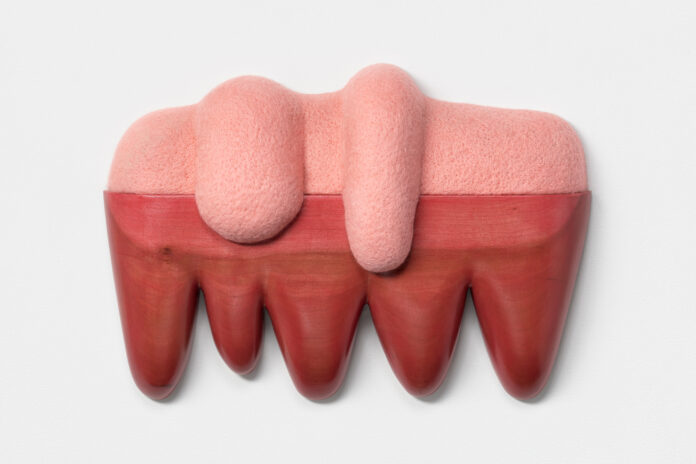
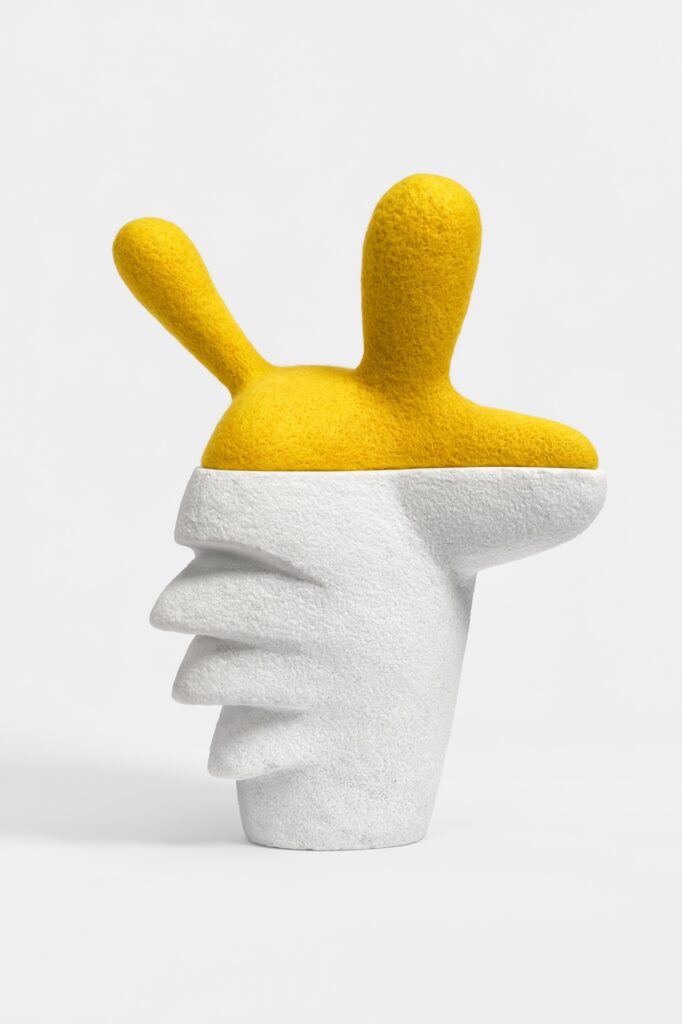
Oakland artist Stephanie Robison’s works of non-objective, mixed media sculpture approach materials in a playful and experimental way, attracting viewers to familiar yet curiously abstract forms. One feels an urge to reach out and squeeze these shapes, which appear mystifyingly soft and tactile despite their being primarily composed of hard materials like alabaster and marble. (Her Instagram handle is appropriately coined: Squishy Stone.)
Robison grew up in Oregon, mostly in the Portland area, and received a BFA (2000) from Marylhurst University and an MFA (2004) from the University of Oregon in sculpture. Her time in grad school was pivotal.
“Learning to carve stone accelerated my personal artistic journey. It helped me understand my work and gave me the confidence I needed to move ever forward,” Robison said.
Robison moved to the Bay Area in 2010 when she accepted a teaching assignment at City College of San Francisco and has lived in Oakland ever since. For Robison, teaching and mentoring artists in the Bay Area is an integral feature to living here. She believes the community is very inclusive, providing an entry point for everyone.
“Connecting students to authentic spaces like Root Division in San Francisco that can help support their growth is key. There is a lot happening in the Bay Area all the time, which is exciting. And of course, the weather is great, the landscape is beautiful, and the people are lovely,” Robison told 48hills.
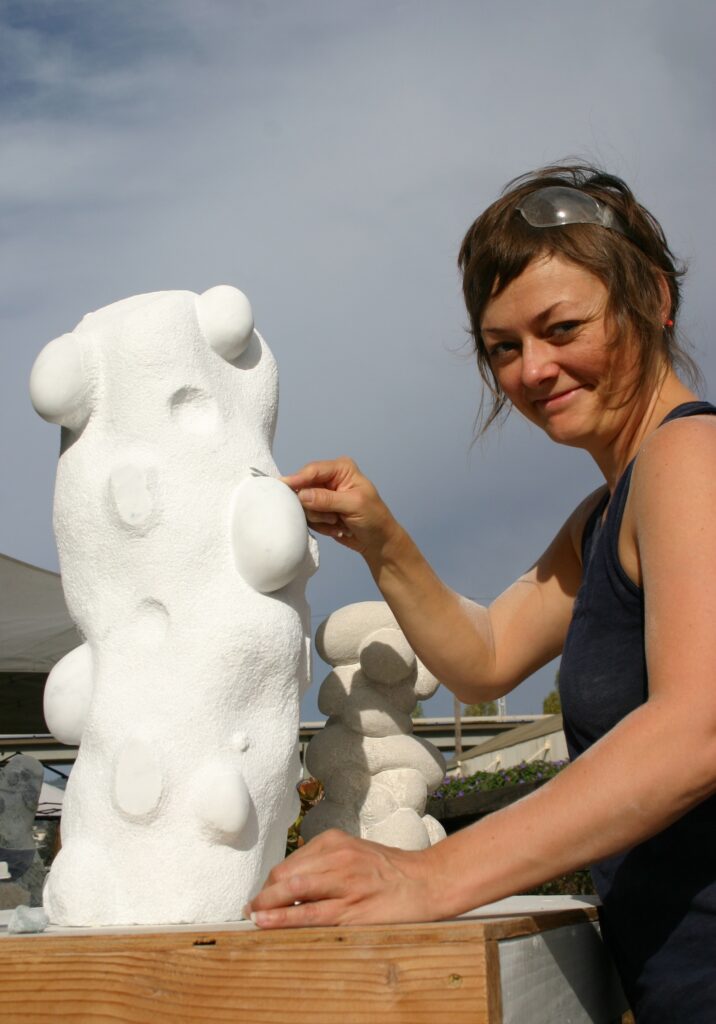
After her move to California, Robison says she found inspiration in the rolling hills and the extraordinary variety of vegetation, but the most significant change was the climate.
“The milder weather allows me to sculpt outdoors year-round, giving me more time to work with stone and refine my technique and skills,” she said.
Her transition to a more exclusive handling of stone has kept Robison’s curiosity alive but it is also exacting on many levels, as she discovered its specific constraints.
“As a sculptor, I love space and find it easy to activate in interesting ways. Working with a solid volume limits the activation of space as does making sculpture that hangs on the wall. It collapses space in a very challenging way,” she said.
Early on, Robison was extremely influenced by Louise Bourgeois and Barbara Hepworth, initially for the ways they used form and materials, but something more emerged with her interest in these artists. “I think I gravitated to them mostly because they were both powerhouse women, carving stone, wood, etc. They both represented the fearlessness that was necessary to become a woman sculptor,” she said.
Later, a retrospective of Eva Hesse’s work at SFMOMA changed how Robison thought about form, space, and materiality. She is also a big fan of Sarah Sze, Jessica Stockholder, Franz West, Richard Deacon, Martin Puryear and Ron Nagel for the way each of them utilize materials in surprising ways. A recent solo exhibition of stone sculptures by Baltimore, Maryland artist Sebastian Martorana, was an inspiration for Robinson.
“His ability to carve amazing texture and tackle subject matter that is both about the human condition and sociopolitical is brave and mind boggling,” Robison said.
Robison’s home/studio for many years was in an open warehouse space and she prefers it that way as it maximizes the time she has available to create. “I enjoy having my work space and my living space merged because it allows me to move fluidly between the two,” Robison said.
Having worked her way through the pandemic years like many artists did, Robison found an increased amount of time to spend on her art, resulting in a sustained and productive approach to her practice.
“I realize that the pandemic was not positive for a lot of people and I was quite lucky that I was able to pour any stress or anxiety into making. I am always thankful for any opportunity for focused, concentrated studio time as it helps me process things,” she said.
Her journey to where she is now has been one of experimentation. Robison spent the early part of her career exploring installation art. She created large-scale works using wood, industrial fabrics, mirrors, and other materials as vehicles to explore various aspects of how bodies relate to a thing in space. An earlier work, Pink Blob, is a large inflatable sculpture Robison says is representative of the body (the Self) or as a stand-in for characteristics of the body that are uncomfortable and uncontrollable.
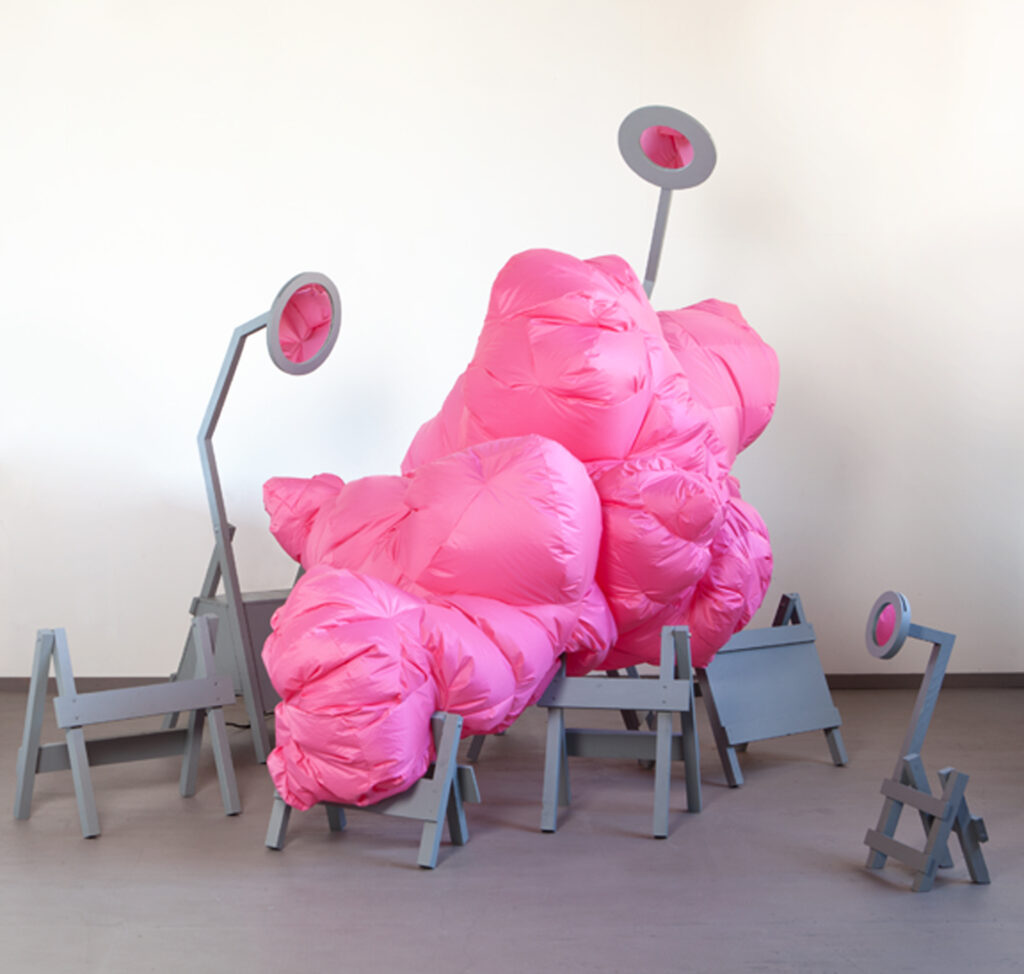
“Pink Blob was made to look soft and pillow-like while simultaneously ominous and revolting; an unstructured blob-like form that resists being fully known or contained, continuously changing and seeking new boundaries,” she said.
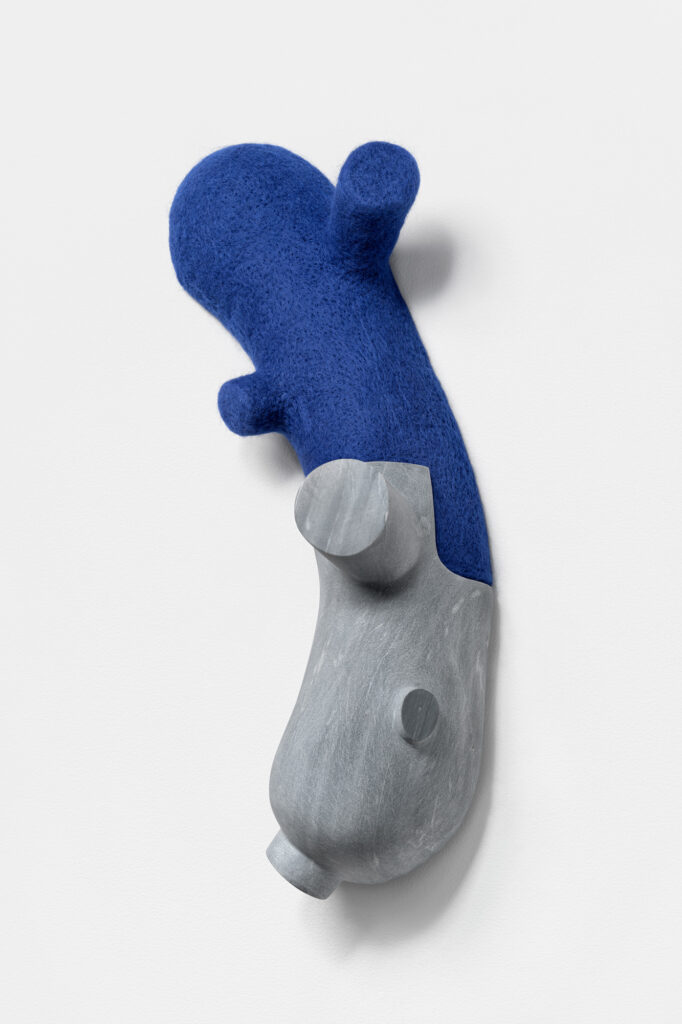
Robison’s primary imperative is to create work that is a response to her environment while using whatever material is available and/or necessary to achieve that goal. In new work, the proverbial nut to crack has become the movement towards combining soft and hard materials together. Two works, Looking the Part and Joy Revolt, are examples of her method of integration.
“Working with stone has taught me many things including patience. In merging stone with wool fiber, I’ve discovered that both materials have extremely different properties but also relate in unexpected ways,” Robison said.
She notes that this recent dedication to combining stone and wool is surprising since she is drawn to so many different materials.
“I love uniting materials, so allowing myself the additional demand of integrating wool just made sense. It was fascinating to discover that needle felting wool is a reductive process, just like carving stone,” she said.
She explains how, at first, the wool is soft and voluminous, but as she works with the needle, the fibers compact and interlock, dramatically reducing in size and becoming firmer while retaining some softness. Robison goes on to share the sensorial response she has with the process.
“I am drawn to art and design that challenge conventional ways of seeing. When I experiment with materials, my goal is to arrive at something that surprises and excites me. I find this tension especially in the juxtaposition of hard and soft elements. I think this is why the stone and wool have kept my attention for a bit,” Robison said.
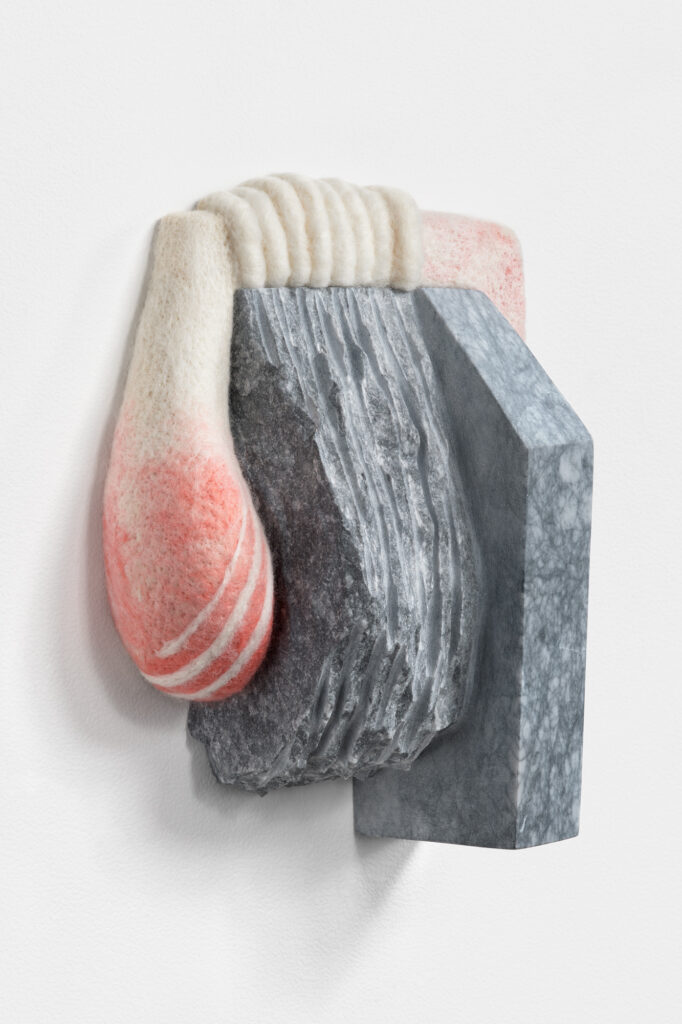
A day in the studio for the artist might begin with sanding stone or digging through her stone pile for inspiration. When carving with power tools, she does the dusty work outside to preserve a clean interior space for needle felting and sewing. Developing both materials simultaneously enables Robison to unite them in a way that feels organic and cohesive.
“I enjoy removing mass from a stone until arriving at a form I find interesting. After deciding that the form has qualities I am looking for, I bring it inside and begin to play with the wool to see how the two materials might meld or complement each other,” she said.
As a rule, Robison works on five or more pieces at once. She says that by doing so, if she gets stuck and doesn’t know what the next step is on one piece, she can go to the next and feel like she is still moving forward. The engagement itself, despite any temporary obstacles, is always one of joy.
“One of the pieces I am working on now is a beautiful honeycomb calcite. The stone just glows and looks so magical in the sunlight,” she said.
A recent decision to move her work to the wall has created a personal provocation, she says, an experience she likens to a gauntlet being thrown down. And while experimenting with carving wood, Robison also has plans to learn glass casting and see how that might develop.
“I am always searching for an interesting form or way of working that feels fresh and new so I engage with my materials in a way that allows discovery,” she said.
Robison is represented by Marrow Gallery in San Francisco, Foster White Gallery in Seattle, Washington, and she is affiliated with Robischon Gallery in Denver, Colorado. Upcoming shows include Made in This Place, a group exhibition featuring artists who have been guests of the Art is Awesome with Emily Wilson podcast. The show, a collaboration between Emily Wilson and artist-curator Shrey Purohit, Ingleside Gallery, and public media station KALW, will be held at KALW’s street-level venue on Montgomery Street in the Financial District in August and September. In July, Robison will participate in the Seattle Art Fair and in a satellite exhibition at West Canal Yards. In 2027, she will have a solo exhibition at Foster/White Gallery in Seattle.
As Robison continues her exploration in contrasting textures and materials, luring us in with seductive forms, she demonstrates how two opposing ideas can peacefully coexist in time and space at once. Beyond such satisfying visuals, we just might glean a useful thing or two for these times, in the metaphorical sense.
“I hope people will find surprise and delight and the ability to think differently.”
For more information, visit her website at stephanierobison.com and on Instagram.