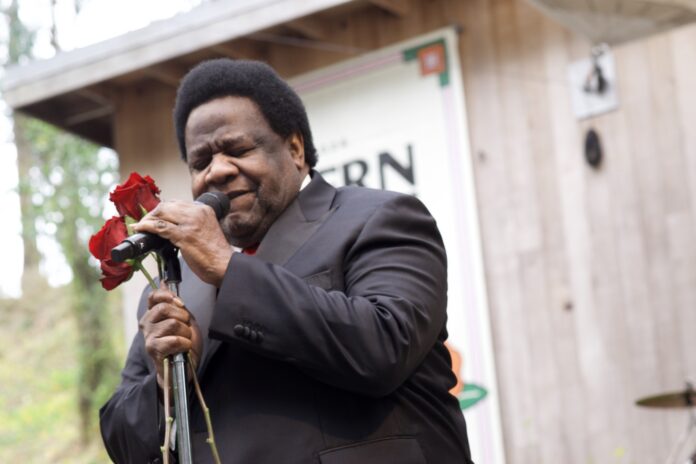
The band was already playing when Al Green walked onto the Stern Grove stage Sunday afternoon. Heavy horn lines filled vast space, while organ, keyboards, drums, and percussion slotted themselves into a dense, unstoppable arrangement.
The still-game soul legend, now 80, greeted the crowd—”Helllooooo San Francisco!—and launched into groovy later-career hit “I Can’t Stop,” the 2003 release that proved his sound was timeless.
He looked happy. Really happy.
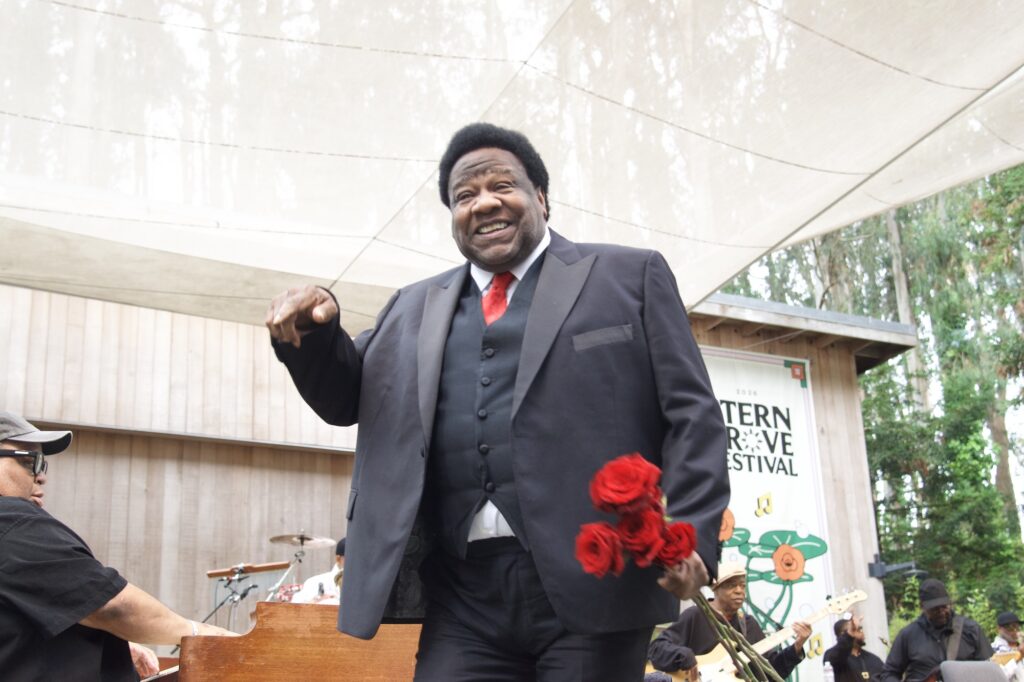
Green carried a bouquet of roses as his performance closed out the free festival’s 89th season, gradually giving them away to people in the audience. At one point, holding the roses and microphone simultaneously in one hand, it looked like he was serenading the blooms directly. The “last of the great soul singers” had his flowers.
The Hammond organ, a familiar presence on the records that made Green famous, was one of the most noticeable parts of the band’s instrumentation. It sat underneath Green’s vocals for much of the performance, sometimes setting alongside another keyboard part, while the horns added sharp accents around him. The trumpet in particular stood out, soaring from the funky thicket.
The arrangements were rooted in the Memphis soul tradition that made Green famous. He became one of the movement’s defining voices through his work with Hi Records producer Willie Mitchell, where his recordings brought together soul, gospel, rhythm and blues, horns, and organ, with a seductive flair that was all his own.
Backing vocalists added a visual element to the performance, positioned on one side of the stage opposite the horn section. At their different posts, the backing singers and horn players swayed together in a coordinated two-step, transforming the setting into an optical call and response. A percussionist played two large hand drums and a tambourine, adding another rhythmic layer to the drummer’s beat. It all added up to a rich, full sound that carried throughout the grove.
The audience responded by dancing in the grass and along the aisles, when Stern Grove staff wasn’t gently shooing them off to keep pathways clear—and even some of those same staff members were dancing along while they worked.
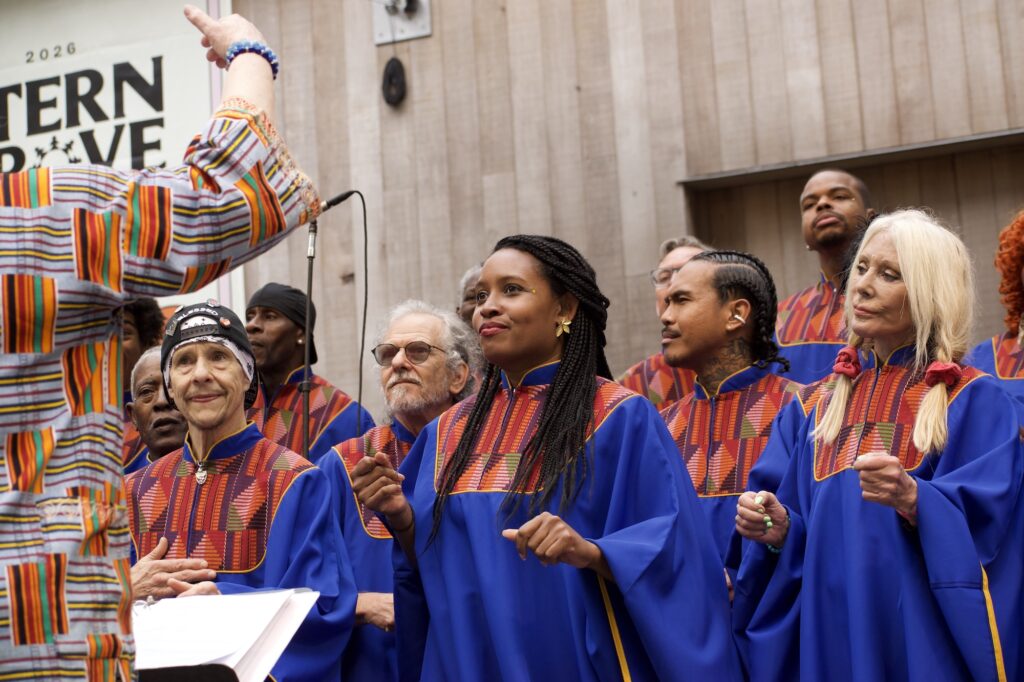
Before Green took the stage, the afternoon had already established the gospel and soul sounds that would carry the afternoon. The Glide Ensemble Choir appeared in blue choir robes, delivering a classic gospel performance built around high-energy vocals, synchronized movement, and audience reciprocity. Every soloist brought a different, passionate voice to the performance.
Demse Faro, an artist and member of the Glide Ensemble, said the group wanted to bring its energy and excitement for music to the stage. “Glide has been such an important part of healing me as a person,” Faro said. “I wanted to show how much I’ve been able to grow and gain over time, in order to give back the way I want to.”
Faro also pointed out that Green was a reverend: “I think the connection to spirit is the most important piece of the work,” Faro said. “Reverend Al Green has been in this community, and has been creating more and more spaces for other artists to follow this path.”
Another member of the choir spoke about radical inclusion and social issues during the performance, before asking people throughout the meadow to fist-bump someone next to them. At one point, the choir leader looked out at the audience and reminded everyone, “It’s Sunday after all!”
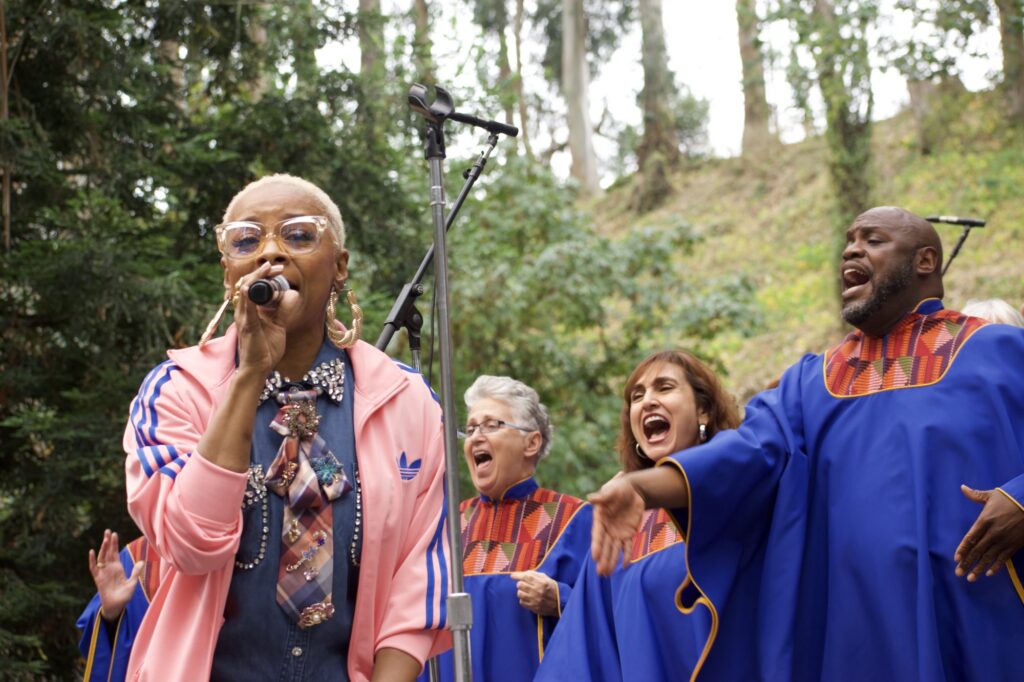
Oakland singer Goapele followed with a slower, more spacious set that still carried a strong soul and R&B influence. She shined in a metallic jacket with pronounced shoulder pads, and was particularly comfortable talking to the audience, speaking between songs, and even addressing the crowd during quieter portions while the music continued underneath her.
The performance leaned heavily on vocal harmony; her backing singer brought a lot of movement to the stage and danced throughout the set. Several guitar solos stood out, at times pushing things into a more rock-influenced direction.
By the time Green took the stage, the sonic foundations of the afternoon had been established by Glide’s rapturous gospel and Goapele’s wide-ranging R&B. The reverend good-humoredly invoked the heavens—asking how everyone on the grounds’ steep incline was doing “in the mountains up there”—and the more earthly, calling out that “somebody in the bushes back there… Somebody’s smoking a joint up there.”
His set included medleys of familiar songs from other artists (The Temptations, Sam Cooke, The Four Tops) which kept things moving and expanded the musical palette. His own classics like “Tired of Being Alone,” “Let’s Stay Together,” and encore “Love and Happiness” more than proved their staying power. The crowd was with him, singing along the whole way, and filling in the moments when he paused before coming back in. At one point Green sustained a note so long you could feel his complete control.
For audience member Steve Moss, part of the appeal was seeing an artist with decades of experience command a crowd. “These performers that are old timers, they know how to put on a show,” Moss said. “They know how to hold an audience.”
That ability to bring different generations together was visible across the grove. Moss described the crowd as mixed in “all ways, age, race,” and said Green’s performance was part of what made the festival’s final weekend feel like a universal experience.
Green was a particularly natural fit for the season’s closing slot. His music carries the history of Memphis soul, but the performance did not feel like he was resting on his laurels. The band played the songs with enough movement and volume to keep the audience engaged, while Green remained loose enough to joke and interact with the crowd.
For many in the audience, the fact that they could see Green for free was part of the experience. Loretta Stanberry, who arrived with her group at 5am to get good seats, said she came because she loved Green’s music and wanted to see him in person. She said the free concert created a rare opportunity for people to spend time together.
“It’s just the fact that it’s free, and that we can bring the community together and socialize without drama. You get to meet new people,” Stanberry said.
Moss similarly described the festival as a civic experience as much as a concert. “I think many people would not have an opportunity to see these artists without these free concerts at all,” he said.
For him, the setting was part of what made the festival special. “It’s San Francisco, right? Here we are in a place that we probably wouldn’t come to otherwise, but it is an integral part of our city and we get to be around our neighbors. It’s a feel-good opportunity to have civic pride while enjoying a lot of music.”
By the end of the set, the roses were gone, the crowd was still dancing, and Green was still smiling. As an artist whose career has stretched across six decades, he looked completely at home on the Stern Grove stage.