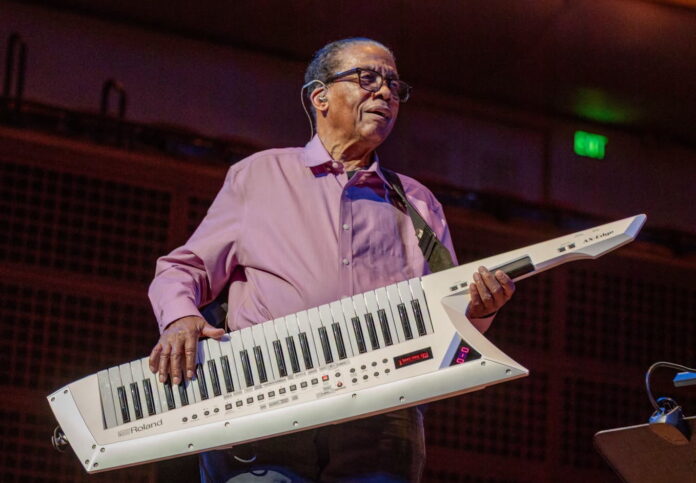
If the 86-year-old Herbie Hancock looked like somebody’s great-uncle on stage at a nearly sold-out Davies Symphony Hall on August 17, I might suggest a reconsideration.
For someone who looks like me, it’s difficult to imagine any point growing up, early or late, when Herbie Hancock’s music wasn’t runnin’ parallel to, well, life. The Miles Davis Quintet took residence in the house previous to my debut on this planet; his Mwandishi phase was in turntable rotation; the Headhunters era hung out for a couple cups of strong coffee.
And then that stretch from ’78 to ’82, when he switched from abstract to contemporary jazz-funk, disco, and boogie arrangements, seeing what Roy Ayers and Patrice Rushen were accomplishing at the time. Hancock leveraged vocoders, synthesizers, and dance-oriented grooves, including “Stars in Your Eyes,” to say, I’m still here, in the dance.
After that came the major Future Shock comeback in ‘83 with the Grammy-winning genre-breaker “Rockit,” the first mainstream hit song to feature a DJ scratching (and one of the first videos from a Black artist to hit MTV) heavy rotation). Scratching had already been featured in numerous proto-hip-hop, freestyle, and electro joints that the Grammy Recording Academy was not listening to at the time. All they had to do was adjust their radio to the left of the terrestrial dial, where Black radio lived, and from which so many once-blank cassette tapes were filled.
So yes, at this performance, the 86-year-old might have looked like somebody’s great-uncle, donning all those accomplishments that hung invisibly above his head like a crown. But Hancock, even with keytar moments included, was playing, swaying, moving, and straight-up jamming with the energy of what he truly is. A Jazz, with a capital J, master.
In a two-hour set that started with “Watermelon Man” and ended with “Chameleon,” both selections from that 1973 Headhunters, recorded here in San Francisco at Wally Heider Studios and Different Fur Trading Co., he chose to begin and end with what was best known.
That project drew from the Miles Davis electric era and tapped into the Afrocentric funk groove emanating from the Bay Area at the time (peep the head nod to Sly Stone on “Sly”) to create an album that resonates as a boundary-breaking opus. Passed down generation to generation, physically and genetically, it continues to be reinvented, explored, discussed, debated, and recontextualized ad infinitum by each new younger generation that identifies with a future/past commingling of sounds.
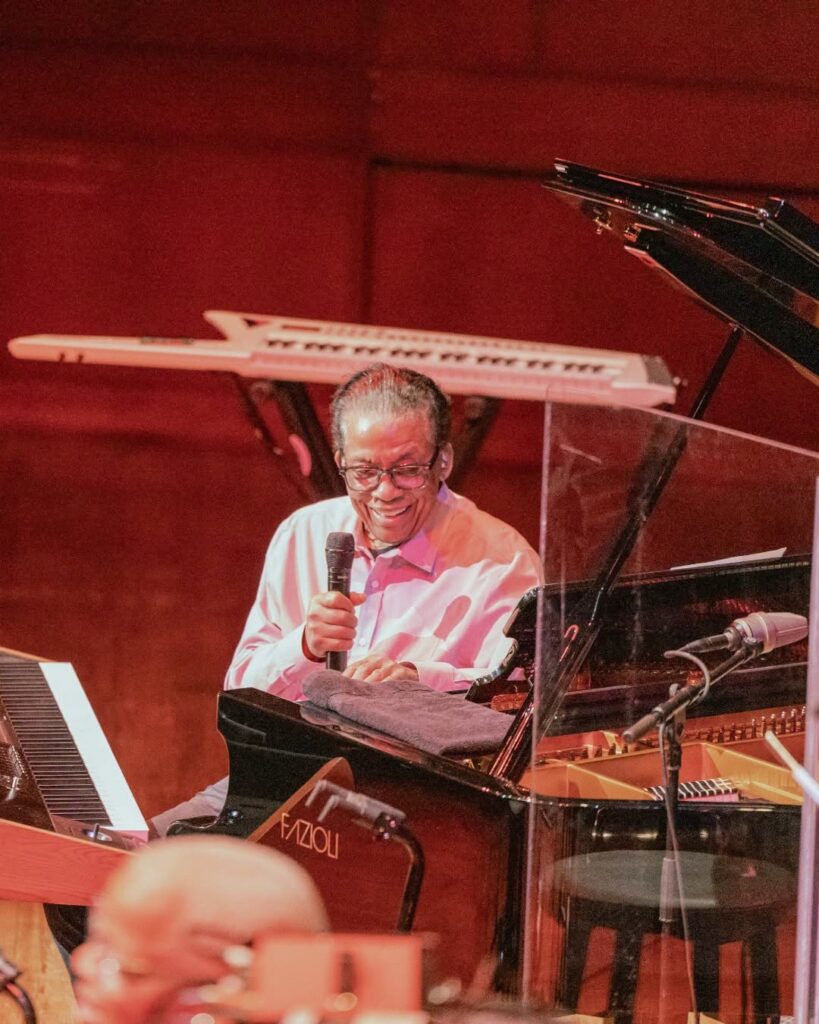
There is a section around 8:31 minutes on “Chameleon” when Hancock displays his solo intellect. He expands those chic gliding runs on the keyboard, wowing you with these slinky-fusiony movements, dressed and swinging in time, making flowing atmospheres simultaneously appear rooted in lyrical R&B and futuristic chord structures, elucidating two different types of philosophies talking, rapping, exchanging ideas.
Herbie’s always been in the present, navigating a path to the future.
It’s my favorite section of this song and album Those types of solos appear throughout Hancock’s career, where he’s elegantly talking to the music, to us, to himself, to society. To those who might be catching hell culturally—he inhabits all these voices in peak runs and does these composed, uptempo turns and stretches. Pointing outside the now and toward what has not yet happened, ringing so clear while acknowledging the strife, as it always is with Black music; there is no rhythm without the blues. Hancock’s acknowledgement of both within this funk standard remains, even today, a career-defining work.
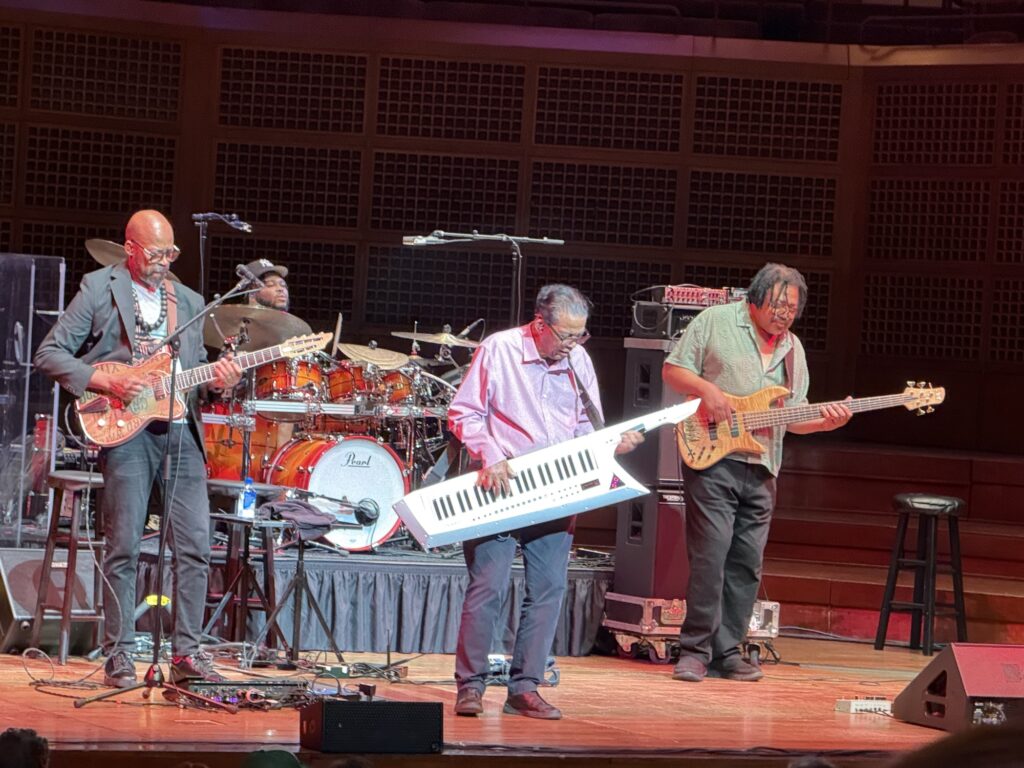
With an impressive line-up of band members to bounce off of—guitarist Lionel Louke; drummer Jaylen Petinaud; bassist James Genus, a member of the Saturday Night Live band; and, on trumpet, SFJAZZ executive artistic director Terrance Blanchard—all members on stage showed homage and respect to the icon and pioneer.
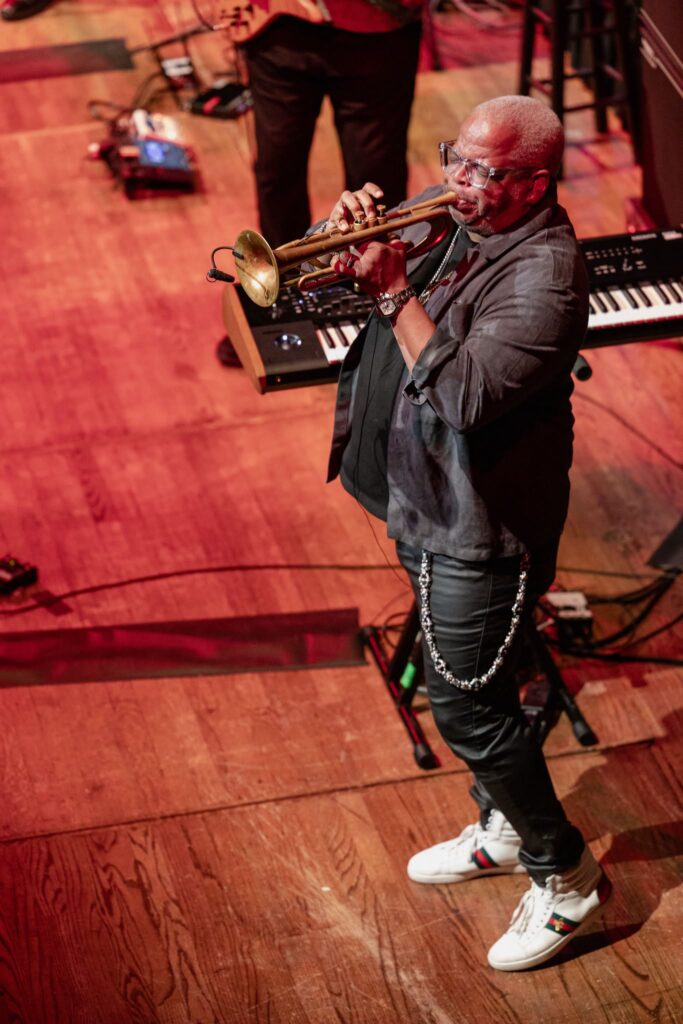
A band that sounded like they’d been touring for a minute, they ran through various moments of Hancock’s repertoire, including the doubled-up groove of “Actual Proof” from his 1974 jazz-funk classic Thrust, recorded again here in SF at Wally Heider Studios. The selection gave the brilliant Blanchard space to range from blaring soar to whisper-quiet, and lead, assist, and follow Hancock, wearing some youthful clothing to boot. It also gave indications that 30-year-old Petinaud might be a cannon-blasting timekeeper we should all look out for.
There was a new version of late sax god Wayne Shorter’s “Footprints,” arranged by Blanchard for his instrument. It brought a fleeting somber moment as Hancock mentioned the name of one of his best friends and collaborators, dating back to their debut in Miles Davis’s band in 1962. Shorter passed in 2003.
Toward the end of the concert, the band combined three songs—“Hang Up Your Hang Ups,” “Spider,” and “Rockit”—into a medley which politely informing the multi-generational crowd of more obscure cuts intermingled with his popular conquest. And they closed with “Chameleon,” with fully activated Hancock jamming on keytar with each band member and getting the crowd up and clapping.
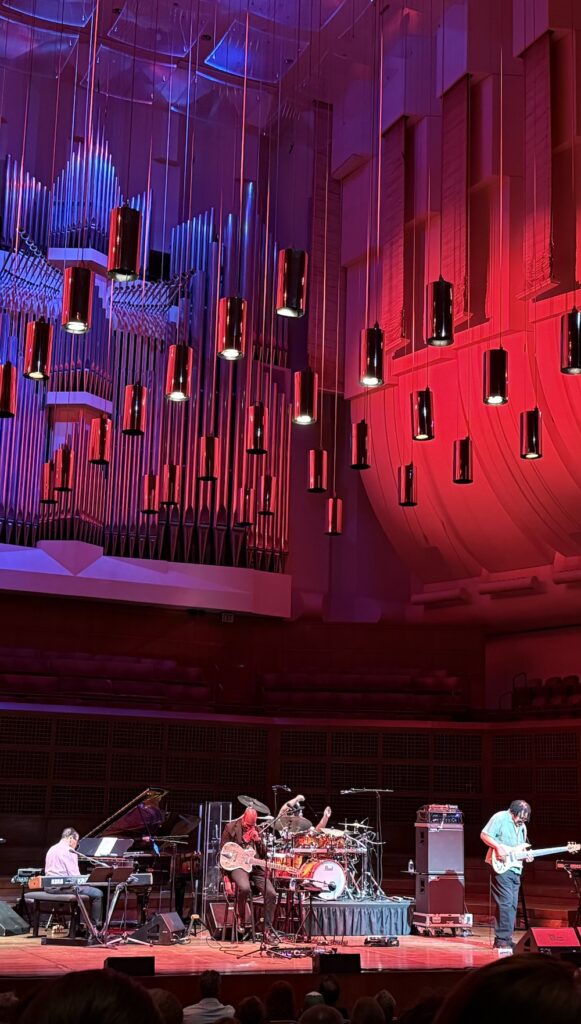
It’s a meal ticket of a groove, but what left me awestruck was, again, those deeply resonating solos. About halfway through the show, they played the mysterious “Butterfly,” also from the Thrust album. As it weaves about, you’re never sure if it’s going to take off or just smolder at the pace it’s at. After a blistering opening from Blanchard, Hancock slowly started to lay down chords, coloring, filling in spots, plinking ideas, and twirling notes.
And then he goes. Building these discussions, forming these conversations, phasing in funk motifs and then breaking them down. I just sank deeper in my orchestra chair, closed my eyes, and lived with every note, every second. This legend still has the Lion’s dialogue, garnering standing ovations at song’s end, persistently pointing to something greater… Herbie has not lost that inquisitive soloing gear at all. Not one step.