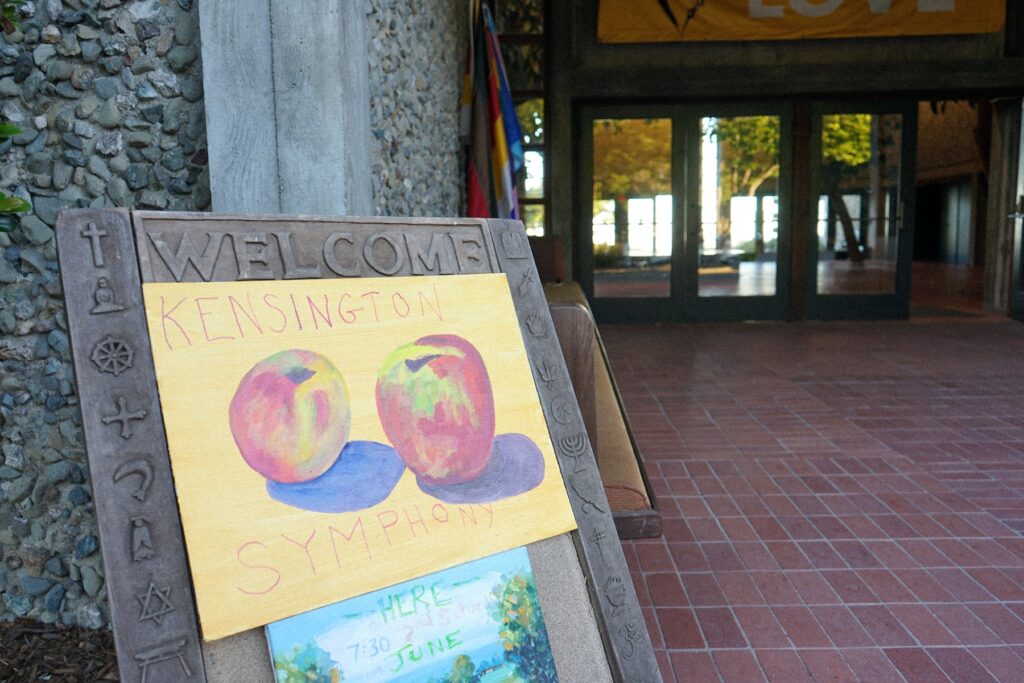
Tucked into the hills above Berkeley, Kensington is a leafy little suburb so insulated it sometimes seems to forget the rest of the world exists. It’s a liberal enclave of professors, scientists, and well-heeled professionals who prize their seclusion as much as their proximity to Whole Foods. The median household income here is roughly twice that of its scrappier neighbor to the south. Hell, the place even has its own symphony.
That detail still surprises people. Kensington is unincorporated, with about 5300 people inhabiting barely a square mile. Smaller than plenty of San Francisco neighborhoods. In the 1940s, Kitty and J. Robert Oppenheimer hosted meetings of the Communist Party in their home on Kenilworth Court, and Oppenheimer was famously approached there about handing over atomic bomb secrets to the Soviets.
The town has never lacked for intrigue. A full symphony orchestra, presenting five programs a year, going on 49 seasons, is a different kind of ambition.
It’s also becoming a rarer one. Federal grant cancellations in 2025 gutted funding for small and midsize arts nonprofits nationwide, and California’s own arts budget cuts have only partly been restored. Arts organizations with real budgets have folded in recent years, and community orchestras haven’t been spared either. That kind of longevity, supported almost entirely by volunteers who pay small annual dues rather than draw a paycheck, is no small thing.
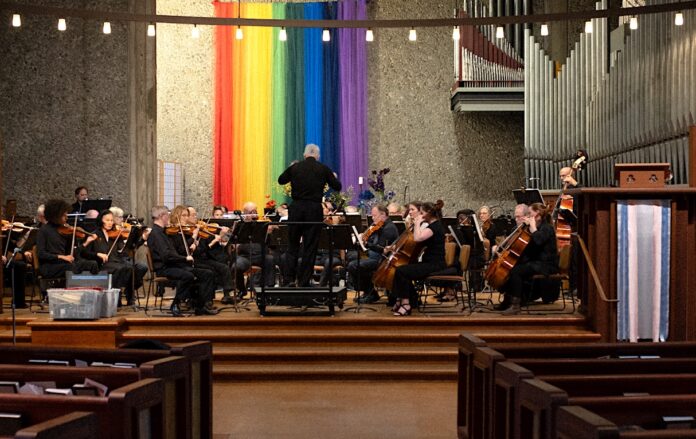
On a sweltering Wednesday evening in early June, the Kensington Symphony Orchestra rehearses in breezy athleisure-wear at the First Unitarian Universalist Church of Berkeley (actually located in Kensington), perched on a hill with expansive views of the Bay. It’s the last full rehearsal before the final performance of the 48th season, Schubert’s “Overture to Rosamunde” and Beethoven’s Eighth Symphony.
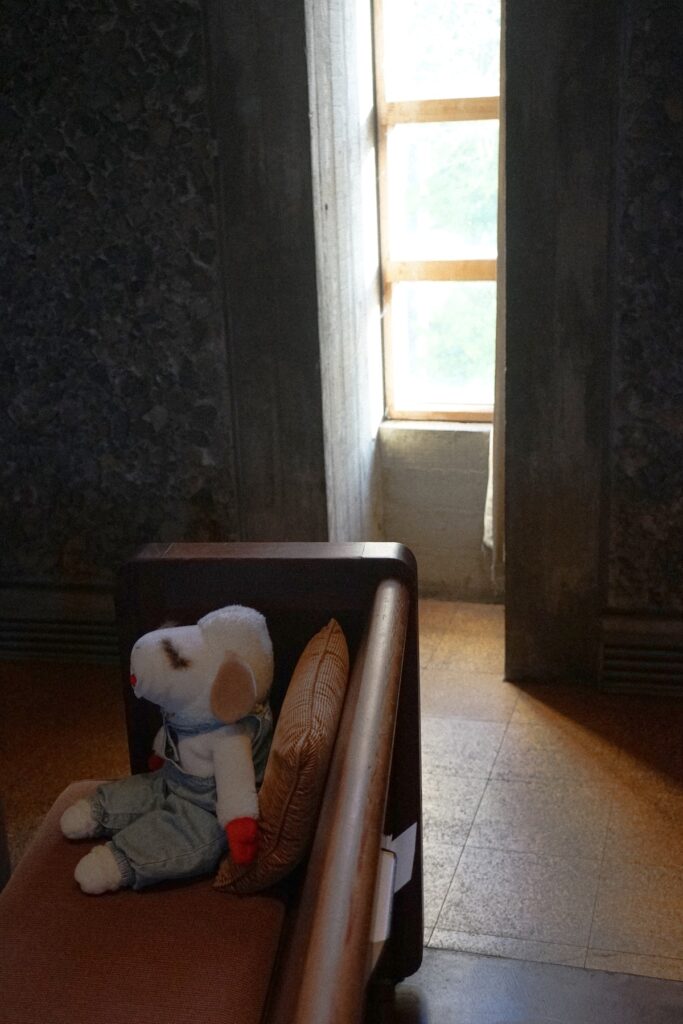
The church is a Bay Region Modern building by Wurster, Bernardi and Emmons, built on land the congregation bought from Bernard Maybeck, and it’s a beautiful room: wood beams overhead, a giant pipe organ, rainbow banners slung across the altar, trees growing up in the cool stone atrium, and a small army of well-loved teddy bears and other stuffed animals watching from the pews.
Music Director Geoffrey Gallegos, in a black polo and khakis, stands on a riser coaxing the violins through a passage that isn’t quite landing. The woodwinds are a little flat. The horns aren’t bouncy enough. A tardy trombonist arches his back during a rest. This is a volunteer orchestra, and for stretches it sounds like one. Then it all clicks: The triumphal moments land exactly right, and something real happens in the room.
Gallegos has run the Kensington Symphony for 22 years, one stop on a schedule that would wear most people out. Most nights he’s rehearsing somewhere: Golden Gate Philharmonic Monday afternoons, straight to West County Winds Monday evenings, Kensington Wednesdays, Contra Costa Chamber Orchestra Thursdays. Bay Area musicians have a name for this life, the “freeway philharmonic,” and Gallegos wears the title comfortably even as a conductor rather than a freelance player.
What he’s built isn’t quite professional and isn’t quite amateur. Keeping things on track is mostly a matter of reading the room week to week, knowing where you can push a section and where you’ve hit a plateau, learning who each player is and what the ensemble is becoming. “Every orchestra has its own unique personality,” he says. Some of the musicians here have been playing in the orchestra longer than he’s been conducting.
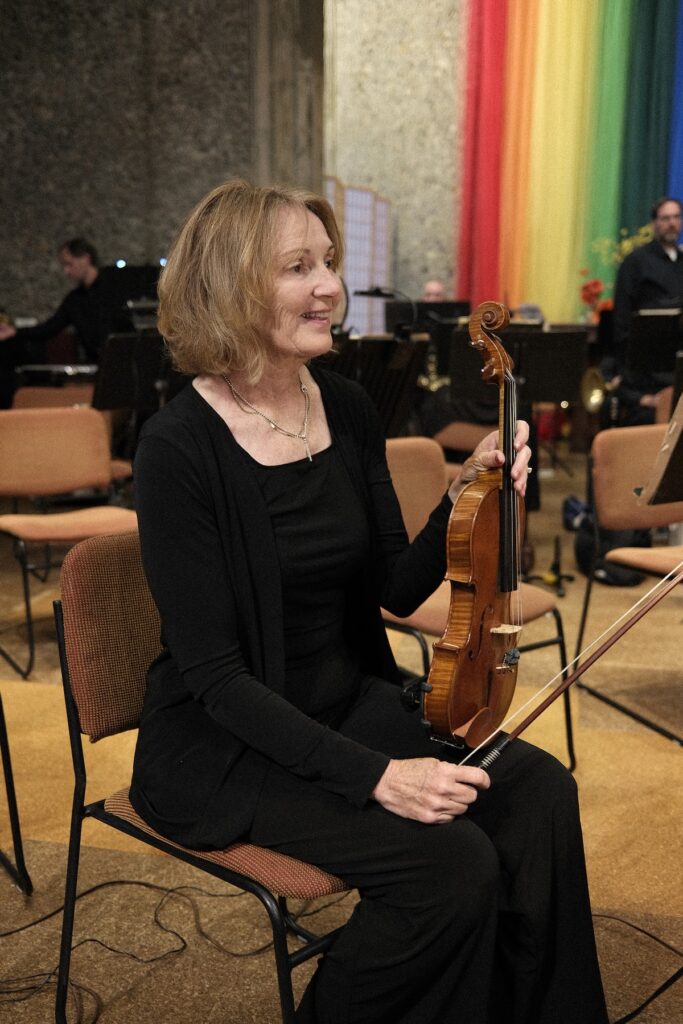
Those musicians are the reason this orchestra works. Dan Faiver, the principal timpanist, is a network engineer by day who studied percussion at Michigan and Yale, detoured for years into West African music and the balafon, and eventually returned to classical music through a temporary gig that turned into 16 years with the KSO. Another player, Christopher Chenoweth, general counsel at Fremont Bank and a second violinist, was part of the first Suzuki violin classes in the country as a kid in Ohio.
Chenoweth drifted away from the KSO for years over a disagreement with a previous conductor, played instead with the Fremont Symphony until it fell apart, and came back three seasons ago at his wife’s suggestion. Fellow violinist Franklin Chang, now semi-retired from a career in sales, has been with the orchestra for some 20 years, with a gap in the middle, and says its weekday schedule is what kept him. His weekends were spoken for.
All three describe roughly the same thing happening to them at rehearsals, in different words. “We are real people with lives, coming together to passionately create the best music that we can,” Faiver says. Chenoweth puts it more bodily: “I can go to rehearsal feeling really tired and worn out, and I come out absolutely wired and energized.” Chang, who was principal second violin for years and only picked the instrument back up seriously in middle age, calls the orchestra a good vehicle for exploring his own musicianship, one of the few places left where that’s still possible at his age.
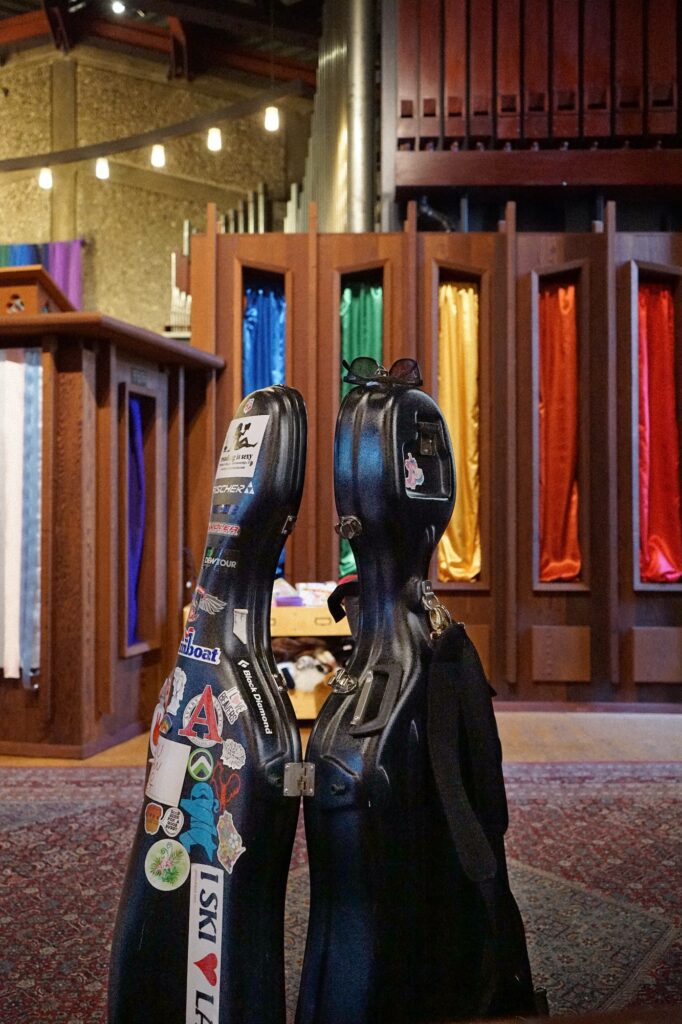
Jason Totzke, the concertmaster, is a different tier: a professional violinist and violist with a doctorate from Eastman who has recorded film and video game soundtracks and played with the Rochester Philharmonic for nearly a decade. He comes to Kensington for what freelance work doesn’t offer: a standing leadership role, the chance to play solos in front of an orchestra rather than just within one. He credits Gallegos for the room he’s given him to shape the ensemble. “He gives me a lot of leeway,” Totzke says, “and that can be very rare.”
None of it runs for free, and the KSO’s finances are as improvised as everything else about it. Before the June 13th finale, Chenoweth presented an oversized ceremonial check from Fremont Bank’s foundation for $10,000, the memo line reading “music stands, lights, and a bass drum.” Marion Hunt, violinist and president of the KSO Board of Directors, remarked that, measured against what Elon Musk is to the wider economy, Fremont Bank is the KSO’s trillionaire.
The line got a laugh, and it wasn’t entirely a joke. Gallegos says grants like this tend to come through connections like Chenoweth’s rather than any formal development effort. The musicians pay small annual dues to keep things afloat, a detail that surprises people every time it comes up, since it runs backward from how most people assume an orchestra works.
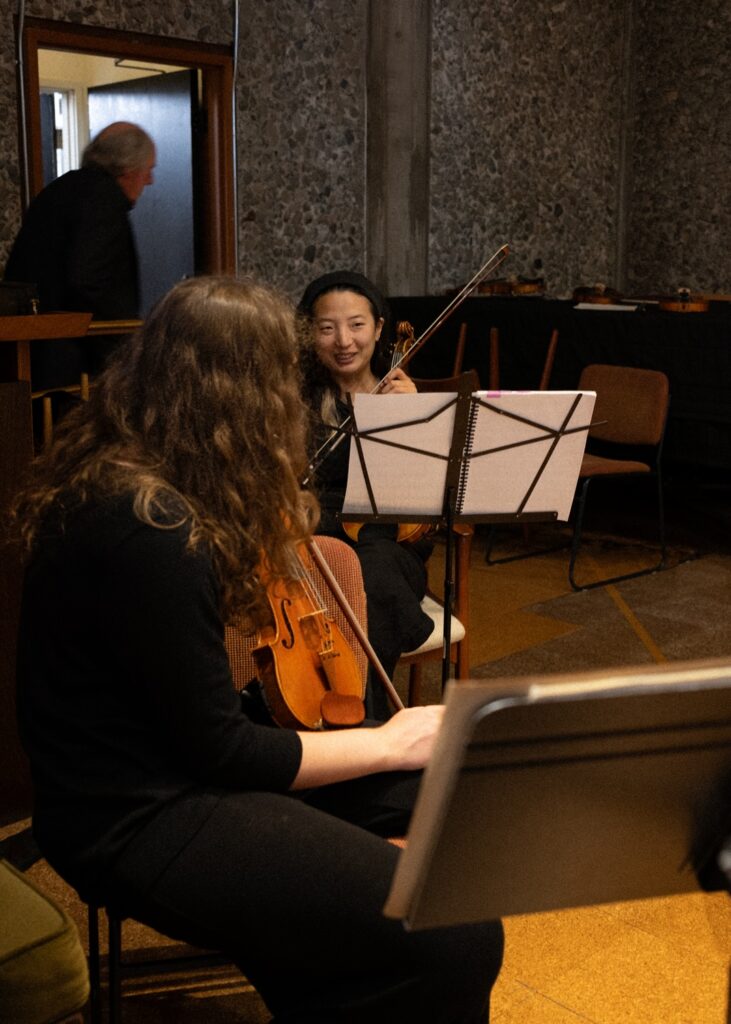
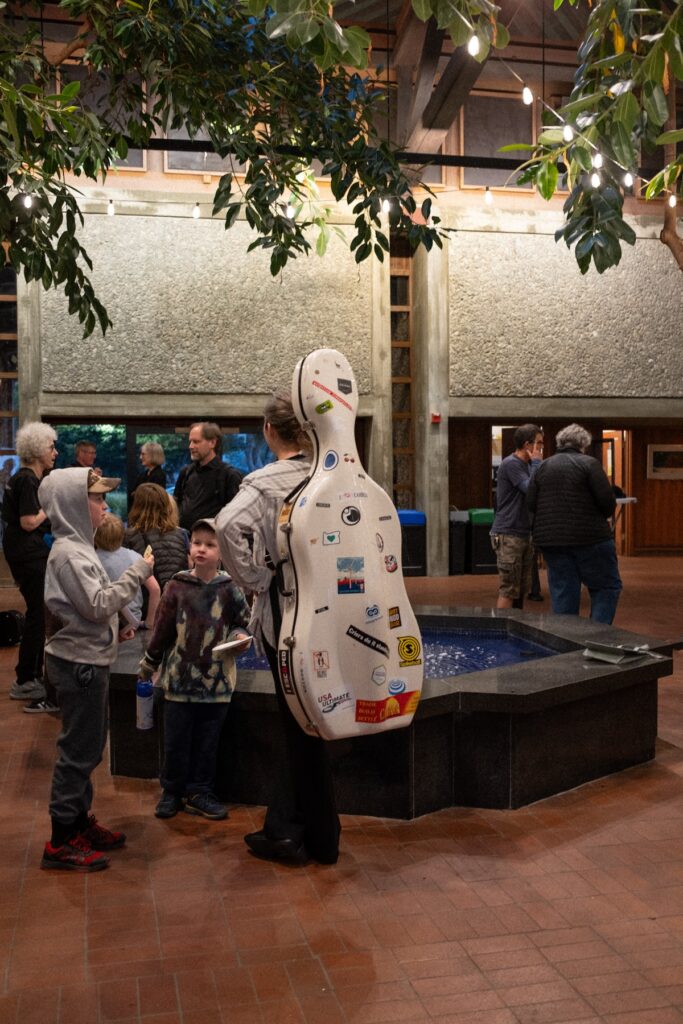
On Saturday night, the night of the finale, people filed slowly into the atrium while the orchestra finished a last rehearsal behind closed doors. Most of the audience seemed to know somebody on stage. David Nelson, who has known Gallegos for 24 years and volunteers at the box office, put the whole enterprise simply: “To play with an orchestra when most of the people have real-life jobs, god, it’s thrilling.” His daughter Maggie Nelson is the orchestra’s co-principal cellist.
The program that night ended with Beethoven’s 8th, mischievous and compact, not the symphony most people know, substituted in at the last minute after the pianist scheduled for Beethoven’s Triple Concerto had a personal issue and withdrew. Gallegos, wearing all black with a Nehru collar, wiped his brow after the allegretto scherzando, and the gesture, intentional or not, added to the performance’s intensity. Faiver, behind the timpani, says there’s a moment near the end of the piece that made him feel like he was flying. “I didn’t hear that in any recordings that I listened to,” he says.
Afterward, people spilled back into the atrium for a potluck of light snacks and coffee. The same friends and family who’d been watching from the pews stood shoulder to shoulder with the musicians who’d just finished playing for them.
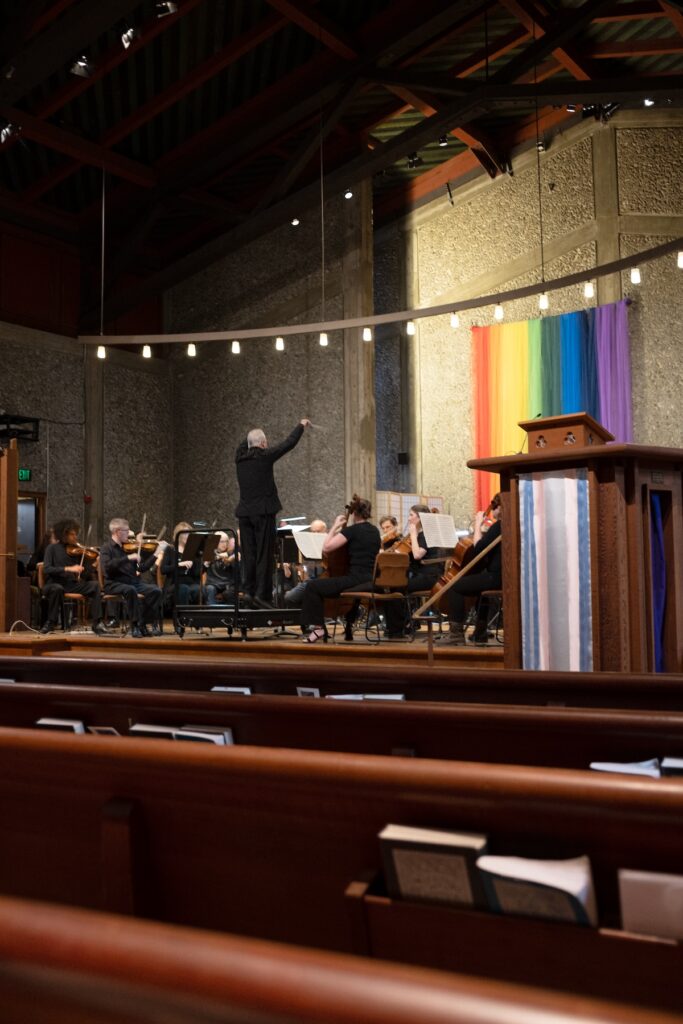
Putting together a single program, Gallegos says, “is kind of like a big puzzle” with more pieces than people realize. He has to consider what the orchestra hasn’t played before, whether the piece fits the resources and skill level of a group that ranges from working professionals to weekend hobbyists, whether it will physically fit on a chancel with real space limitations, and whether the audience will actually want to hear it. Sometimes the puzzle gets rearranged at the last minute anyway, the way the Triple Concerto became the Beethoven 8th.
Multiply that by five programs a season, year after year, and the job starts to look less like conducting and more like architecture. Gallegos also writes the program notes, and if you call to place an ad in that program, he’s probably the one picking up the phone.
Whether an organization like this can keep going when so many better-funded ones cannot is a question Gallegos answers without much anxiety. Big institutions have the reserves to survive a shock. Mid-size professional orchestras with thin margins are the ones actually disappearing. A small volunteer orchestra with almost no overhead, run on dues and goodwill, turns out to be made of sterner stuff than its budget would suggest. The harder problem, he says, isn’t money. “It’s amazing what a challenge it is just to make the community aware that they have an orchestra.”
Gallegos is already sketching next season’s programs. He always is. There’s no real gap between one season ending and the next one taking shape in his head, five more puzzles to solve before anyone’s bought a ticket. Inside the church that final Saturday in June, the audience skewed gray, the same crowd the KSO has been drawing and slowly graying alongside for decades.
Outside in the parking lot, a kid impatiently waiting for the performance to finish, their ride home probably inside playing with the orchestra, bounced a basketball against the pavement, the Beethoven bleeding faintly through the church walls. The 49th season opens this fall.
More info on ihe Kensington Symphony Orchestra’s 2026/2026 season can be found here.