When actor Sam Neill passed away at age 78 last month, it was one of those occasions when a lot of people belatedly realized a performer was among their favorites.
He was not a particularly showy personality, either onscreen or apparently off. His versatility could rise to a flamboyant occasion, like the cult 1981 marital horror freakout Possession (in which he fully matches Isabelle Adjani’s legendarily unhinged turn), the Merlin miniseries, or more recently Taika Waititi’s Hunt for the Wilderpeople, which last seemed almost to exist as an homage to its star. But more often he was the understated glue that held an enterprise together, whether as the paleontologist in the Jurassic Park films, or the patient mate to mercurial women (Judy Davis in My Brilliant Career, Meryl Streep in Plenty, Susan Sarandon in Blackbird, etc.). Not all his diverse film or TV projects were good, but was he ever less than good? It’s hard to recall… or even imagine.
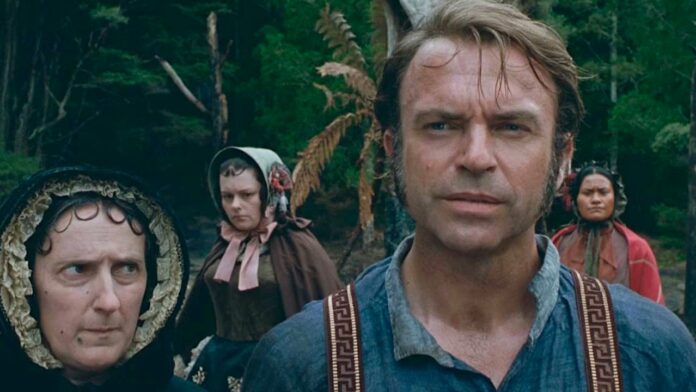
Though he was born in Northern Ireland, Neill’s family moved to New Zealand when he was a child. He played a significant role in that country’s late-blooming movie industry, starring in Roger Donaldson’s 1977 Sleeping Dogs, an ambitious political thriller which was the first Kiwi feature to be a significant success either at home or abroad. It launched him on what would very soon become an international career, but he remained loyal to NZ cinema over the years. A major highlight in that regard was Jane Campion’s The Piano, whose 4K restoration and re-release is opening at SF’s Roxie Theater this Fri/7.
Did The Piano really come out as long ago as 1993? The impression it left feels much more immediate, though in watching for the first time since then, I realize I only remembered the story’s barest bones. Ada (Holly Hunter) is a Scottish woman of the mid-19th century who’s been mute since age six—“No one knows why, not even me” she says in the “mind’s voice” of her infrequent narration.
She’s shipped out to marry a stranger in colonial NZ, presumably because her already having a child whose paternity she won’t identify has created a scandal at home. So she sails with flinty wee daughter-interpreter Flora (Anna Paquin), landing on a desolate beach with their trunks…and a piano, the one thing she has insisted on, as it seems her primary expressive outlet. But it is cumbersome. Settler spouse-to-be Alisdair (Neill) cannot orchestrate its further transport to the house he shares with various female relatives, well inland. This is a deal-breaker for Ada: Even after marriage, she refuses this desperate-to-ingratiate husband access to her heart, or bed. But then she is sternly self-contained in all things, save where music or Flora are concerned.
Living closer to the shore is former sailor George (Harvey Keitel), who’s “gone native” in the sense of adopting some local Maori customs (even getting facial tattoos). Unlike Alisdair, he does not cling to irrelevant notions of Victorian society or “gentlemanly” behavior. He agrees to take the piano into his own abode and let Ada have free access, so long as she provides lessons in return. But he is not truly interested in learning to play that instrument—it is her beauty, body, and sublimated sensuality he seeks to run arpeggios up and down.
As with so many of Campion’s films, The Piano is at core about sexual repression, transgression, and surrender. There are few screen passages sexier than when the two main adult characters finally graduate from their awkward “deal” to mutually consensual lovemaking—which is almost immediately spied upon by poor, frustrated Alisdair, whose voyeurism I’d completely forgotten about.
Hunter, breaking dramatically from her motormouthed-comedienne prior roles, won an Oscar, as did the remarkable child performance by Paquin. Keitel, an actor often attracted to interesting overseas projects he hasn’t always fit comfortably in, is also excellent as an unsophisticated man with earthy but also rarefied yearnings. It’s Neill, though, who in some respects has the knottiest character arc. Alisdair is no tyrant, but a striving compromiser easily overwhelmed by the demands of his neighbors and siblings. He pines for love, yet is too conventional to brave the hedonistic realm where Ada and George find kinship. Their liberation only reinforces his limits. Neill is funny, sympathetic and pathetic in a part that might easily have been played as a shallow wet blanket.

The Piano holds up very well—though she’s never yet made a film that wasn’t at least interesting, it remains Campion’s arguable best. She wouldn’t hit another note so high again until 2021’s The Power of the Dog, a yea-darker tale of sexuality denied (then conditionally supplied) that again viewed the past not as picturesque but adversarial, springing a series of cruel traps that required further cruelty to be escaped.
Another revival opening this weekend at the Roxie is also a sort of romantic triangle. Luchino Visconti’s 1957 White Nights (more info here), based on an early short story by Dostoevsky, has Marcello Mastroianni as a clerk newly posted to an unfamiliar city. Wandering the rain-slicked streets at night, he spies a young woman (Maria Schell) weeping, and can’t help offering his friendship. He also can’t help eventually falling in love, even though he soon learns the cause of her tears—she herself is in love with a mysterious stranger (Jean Marais) who’d boarded with her family. He’s left her waiting for a promised return without the slightest knowledge of his whereabouts or circumstances. Like Sam Neill’s figure in The Piano, Mastroianni’s Mario is the nice guy who ultimately cannot compete with a greater passion that excludes him.
It’s a small tale that Visconti elevated—perhaps overinflated—via elaborate mise-en-scene. Rather than shooting on location, he had the streets of Livorno recreated in exquisite detail on Cinecitta soundstages, allowing cinematographer Giuseppe Rotunno (who subsequently shot movies for everyone from Fellini to Bob Fosse and Terry Gilliam) to create chiaroscuro compositions of studio light, shadow, and mist. That heightened reality gives Nights a ship-in-a-bottle quality as charming as it is artificial. The effect is jarred a bit only by two “action” setpieces (rock ’n’ roll dancing in a cafe, then an outdoor fistfight) that are crowd-pleasers, but also feel like forced concessions to that crowd.
Further gauze-wrapped by Nino Rota’s originals score, White Nights is a mood piece whose contrived premise you just have to accept—like the appeal of Austrian star Schell, whose international vogue was kept brief by her rather one-note brand of dewy, simpering girlishness. It falls to Mastroianni (who himself was not quite a major star yet) to sell this enterprise, which he does. One of those actors seemingly born for the medium, he can wring more character nuance from a couple minutes’ restless, wordless strolling than most could with five pages of dialogue. We may not entirely believe this Mario, a more sociable type here than Dostoyevsky’s sad sack, as a tragic figure. But at the poetic fadeout, performer and director poignantly make a case for it.
In Marin, the Smith Rafael is hosting an already in-progress monthlong retrospective, “Hector Babenco: Poet of the Marginalized.” This Sat/8 they’ll show the Argentina-born, Brazil-based 1981 international breakthrough, the devastating child delinquency drama Pixote. That got him a plum Hollywood assignment, adapting Manuel Puig’s novel Kiss of the Spider Woman (playing Sat/15). It won William Hurt an Oscar for his somewhat strained stunt casting as a “flamboyant homosexual” cellmate to Raul Julia’s political dissident during the military junta.
After two more Hollywood projects that had their virtues but proved expensive flops, Babenco returned to South America. He had a triumph with 2003’s Carandiru (Fri/22), another fact-inspired expose—this one about the chaotic conditions that led to deadly violence at the continent’s largest prison. Last up on Sat/29 is My Hindu Friend (2015), which cast Willem Dafoe as the late director’s alter ego in a tale derived from his own long-term struggle with lymphatic cancer. Info on the entire series is here.
Not exactly a “revival” but not quite a new release either is Jodi Wille’s 2023 Welcome Space Brothers, which provides a delightful look at the most benignly outlandish of California religious cults—the Unarius Academy of Science. Though otherworldly leader Ruth Norman aka Archangel Uriel departed this mortal plane the same year The Piano came out, Unarius remains, based in El Cajon, outside San Diego. We wrote about the documentary when it played SF Docfest in 2024; it returns to the Roxie starting this Sun/9.
Occupying a space some distance from Unarius’ spiritual quest are two new movies driven by hungers respectively carnal and carnivorous:
Drunken Noodles
Yet another Roxie opening on Fri/7 (more info here) is this latest from writer-director Lucio Castro, an NYC-based Argentine who doubles as a fashion designer. His third feature is a sort of erotic reverie that begins with grad student Adnan (Laith Khalifeh) summer-interning at a Manhattan gallery that’s showing an older gay man’s heavily homoerotic needlepoints. He, and they, attract the attention of a Door Dash-type bicycle deliverer (Joel Isaac)—and his friends, to unexpected, sexy results.
But then the episodic narrative keeps rewinding back in time, so that we see Adnan meeting that senior fabric artist (Ezriel Kornel, though the art itself is by Sal Salandra); encountering a Pan-like forest specter (Guillermo Garcia Arriaza); and in a somewhat problematic relationship with the slightly-older Iggie (Matthew Risch). All these vignettes take place primarily outdoors, and have a playful, mysterious, beguiling sexual charge. The sum effect is a bit as if late gay faerie-culture favorite James Broughton had made a full-length screen fiction. Slight, adventurous, whimsical, and naughty, Drunken Noodles is a perfect summer divertissement for those who’d like a little arty esoterica with their erotica.
Ice Cream Man
Few horror directors have sex less on the brain than Eli Roth—he seems to operate in a permanently presexual realm where the lust is strictly for juvenile gross-outs. In the leafy small town of Bayleen Bay, the nameless, speechless titular figure (Ari Millen) appears on the first day of summer, luring kids with his sweet treats’ siren call. But when the ice cream truck rolls by their homes much later, in the middle of the night, those same kiddies rise like grinning zombies to kill their parents in various gruesome ways.
The spell lingers the next day, when they show up en masse for school, still in their homicidal trance. That bodes ill for the faculty, as well as lactose-intolerant child protagonist Jared (Charlie Zeltzer), his teenage sister (Sarah Abbott), and a handful of likewise unaffected youths (Evelyn Chen, Shiloh O’Riley, Dylan Hawco).
As usual, Roth (who also plays the leads’ father) tips hat to prior horror hits in a somewhat tongue-in-cheek fashion. But in the quarter-century since he made his feature debut with Cabin Fever, he hasn’t really honed his skill set. He still has little knack for building character or suspense. His plot mechanics are rote (culminating here in a mountain-of-explication monologue that may be intended as parody), his humor pretty crude. The gore he loves so much is at once over-the-top silly and stubbornly mean-spirited. Opening nationwide this Fri/7, Ice Cream Man is lively and colorful, but falls short even of its lowbrow aspirations. While diverting enough as a splattery time killer for undiscriminating genre fans, it would need to be better just to qualify as a guilty pleasure.