Luis E. Garcia didn’t begin making art until he was 27, when a brief visit to the Bay Area in 1991 changed everything.
“I fell in love with San Francisco! I had the chance to meet an array of creative individuals and felt an immediate connection. I decided then that I needed to move here and pursue a creative path. It took me a while to save enough money, but I made it my goal to accomplish that,” Garcia, who was born in El Salvador and raised by his grandmother before immigrating to the US with his father, told 48hills.
In 1993, he returned, and began to evolve into a visionary interdisciplinary artist and poet. Garcia now calls the Clawson neighborhood of West Oakland bordering Emeryville home. He enjoys the broad diversity of the Bay Area’s creative community, noting that the multitude of styles, voices, ideas, and materials that local artists use in their work energizes him.
“It’s inspirational to be a part of an art community that has many layers, honors many traditions, continues the legacy of historic movements, celebrates cultures, and innovates new directions,” Garcia said.
But it is the artists who work in narratives based on personal experiences, identity, race, and representation that move him most:
“The work of Titus Kaphar addresses these themes by deconstructing and reconstructing Western classical styles and narratives, highlighting social issues of African Americans. The artist and scholar Judy Baca is someone else I truly admire as well. Growing up in Los Angeles, I remember seeing her murals and being touched by them. Her work carries a sense of remembrance, an awareness of the land, and evokes a knowledge of history with a connection to people and places. I am also inspired by the works of Anselm Kiefer and am blown away by his monumental scale, the use of alternative materials, his spiritual concepts, and his focus on depicting the horrors of the Holocaust,” Garcia shared.
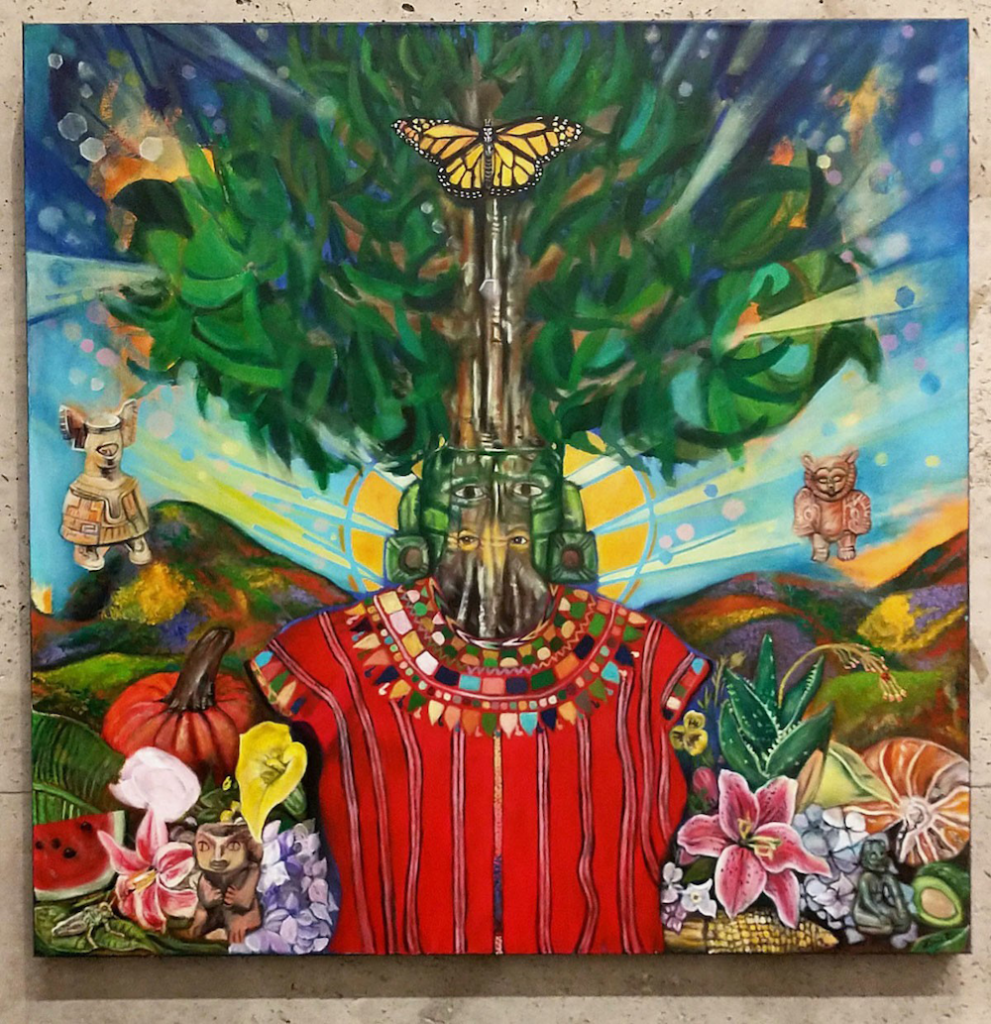
Garcia delves deeply into his Pipil roots, creating work that carries an Indigenous and matriarchal perspective. Many of his pieces revolve around vital connections to nature, reverence for ancient cultures, and representation of underheard, underrepresented voices. His piece Safe Space weaves together the threads of these ideas while conveying a subtle social message.
“I tried to think of a natural sanctuary for all living beings, where the spiritual connection of our ancestors and the wisdom of our elders is echoed by nature. It is in these thoughts that this piece was developed. I think we all just want a safe space, to thrive, to just live,” Garcia said.

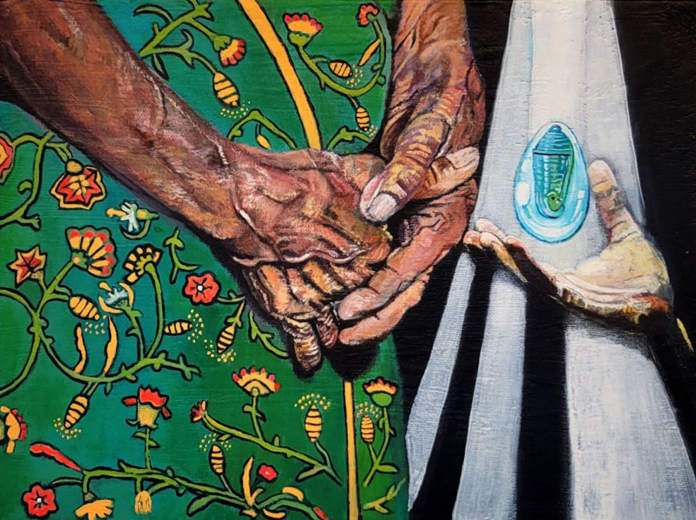
He primarily paints with acrylics on canvas or wood panels, but has been known to incorporate found objects as a base for his paintings for added effect. His triptych Hermanas uses discarded dresser drawers that he found during a walk around his neighborhood. The piece addresses the work done by grassroots movements, such as the National Indigenous Women’s Resource Center, which brings attention to missing and murdered Indigenous women.
“I painted each panel to represent these women, dressed in their regalia and wearing ceremonial masks, from different locations in the Americas that have high concentrations of missing or murdered Indigenous women. These women were considered disposable by Western society. The use of the drawers also highlighted how these atrocities were being overlooked, by keeping them out of sight, sealed, and stored,” Garcia said.
Garcia works early in the morning from his home studio of the past 20 years, where his cats keep him company. Near an open bay window that provides ventilation and natural light, Garcia sets up his work station to include ancillary lighting, an art cart filled with supplies, and a laptop where he stores reference images. Having lived with polio since an early age, Garcia paints sitting on the floor.
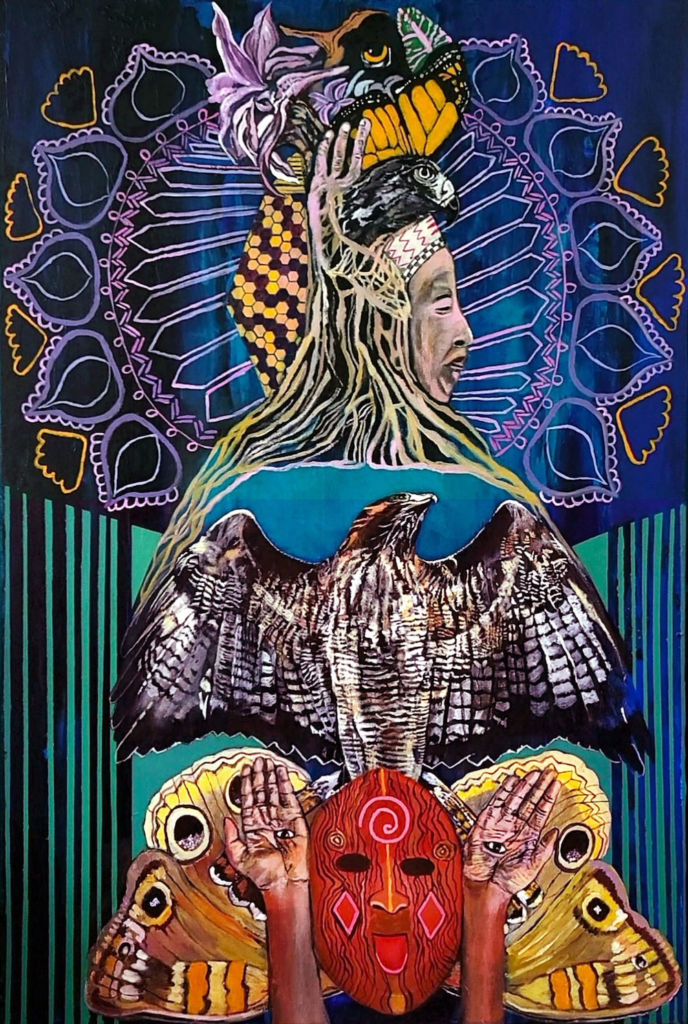
“Most of the time I do not sketch out the composition first, but instead begin with a singular image and go from there. As the painting develops, I begin to see a narrative that becomes the driver of the piece,” he said.
Garcia’s journey as an artist began in 1995 after taking a Mesoamerican art history class at City College of San Francisco, which he says opened his eyes to the Indigenous cultures in Mexico and Central America. It was then that Garcia decided to use the subject as a foundational approach to making art. Eventually transferring to CCA in 1998, Garcia completed his BFA in painting and sculpture in 2002.
“In art school, I felt that courses were being taught from Western ideals of art, that my culture was very underrepresented. Once I was done with school I decided to start creating work that emphasized my culture and helped broaden the spectrum of what contemporary art can be,” he said.
Pivotal moments in his artistic advancement have gained momentum since 2007 when Garcia was included in a group exhibition of the de Young Museum’s Day of the Dead Celebration.
“I was asked to create a piece for the show and I felt so honored to show my work at this amazing venue and be a part of an exhibition that highlighted our culture in such a meaningful event,” he said.
In 2016, Garcia was chosen as artist-in-residence for the Marin Museum of Contemporary Art in San Rafael, where he led two workshops that reflected his cultural background, at the same time creating a body of work for a solo exhibition.
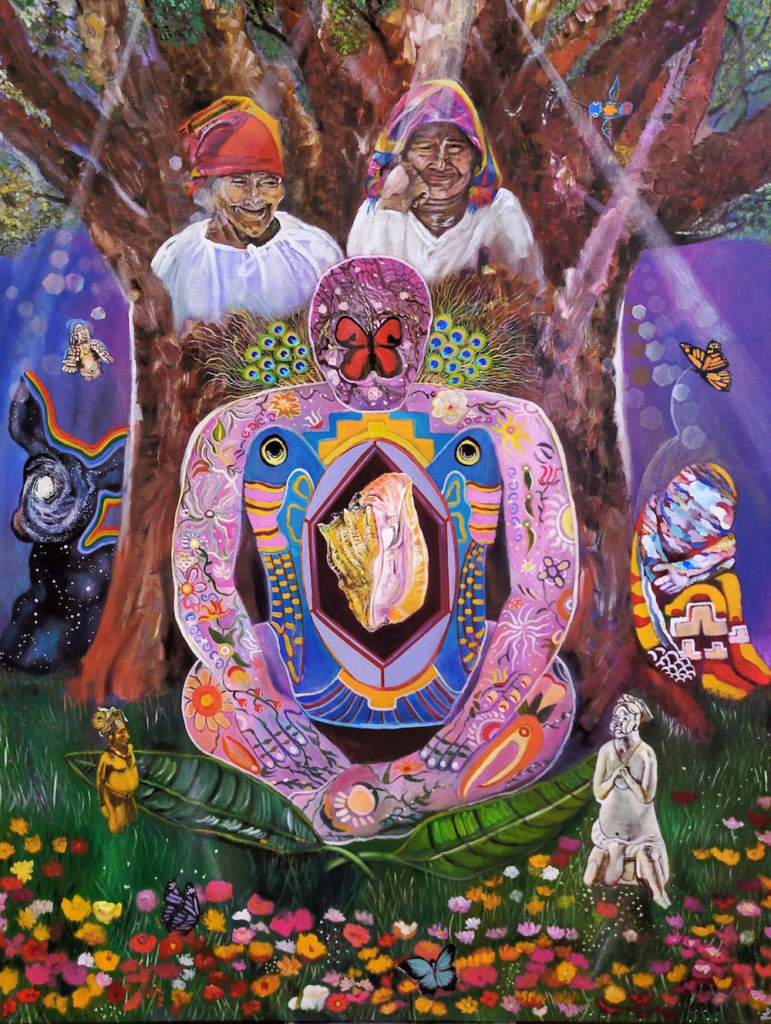
“This was a great learning experience. It really pushed my development as an artist and helped me grow my visual voice,” he said.
In 2020, Garcia both curated a Latinx exhibition at the museum and was invited to show in the de Young Open. Since then, he has exhibited his work at the David Brower Center in Berkeley, the Museum of Northern California Art (MONCA) in Chico, Triton Museum of Art in Santa Clara, the Mission Cultural Center for Latino Arts in San Francisco, and had a solo exhibition at the Richmond Art Center in the East Bay in 2025.
Garcia has been in multiple group exhibitions at the art gallery of Belvedere Tiburon Library over the past five years. He was recently included in Indigenous Intersectionality at The Cultural Conservancy, as well as the Sanctuary exhibit at The Drawing Room, both in San Francisco.
Garcia will be included in two upcoming group shows; Remembrance, Reflection, and Connection, at Solano Community College in Fairfield through November 7 and Richmond Art Center’s 90th Anniversary Exhibition through November 19. In March and April 2027, he will have a solo show at American River College’s Kaneko Gallery in Sacramento.
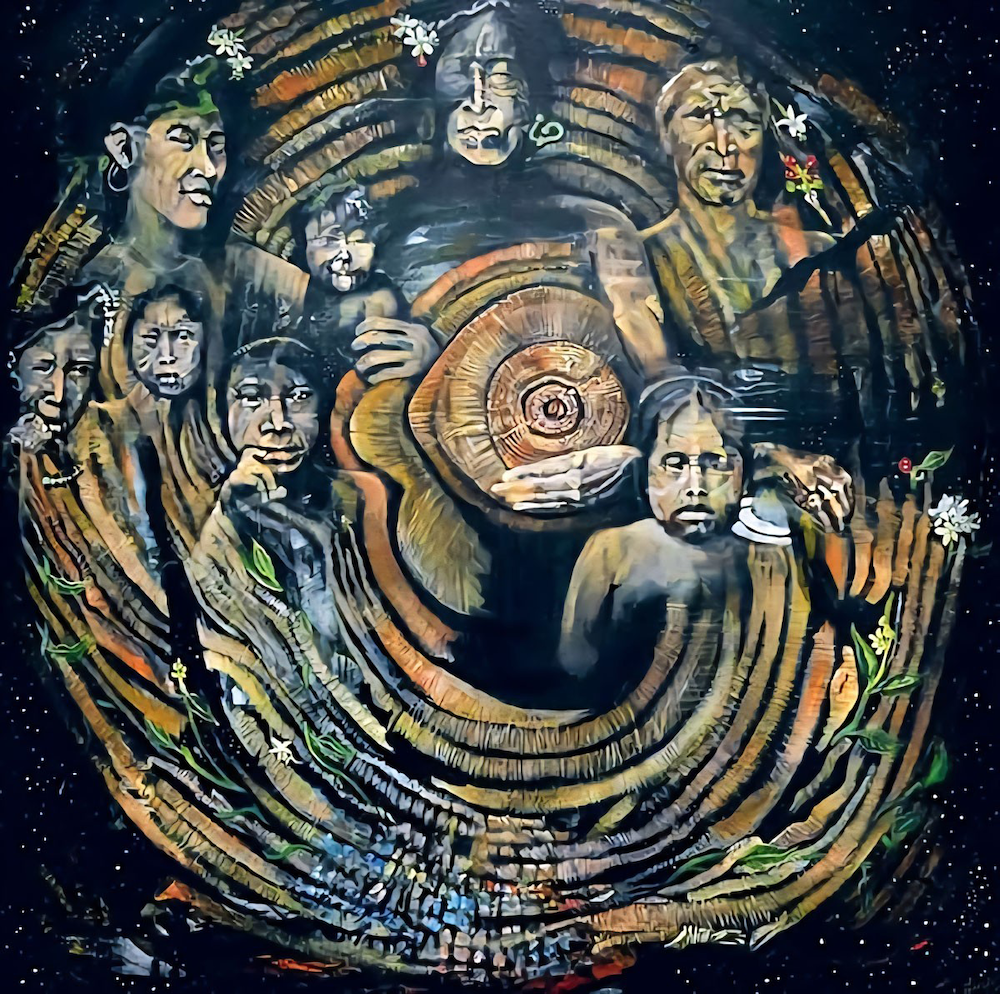
Additionally, his poem Grace will be included in the anthology United We Stand, to be published by the Revolutionary Poets Brigade. His painting, also titled Grace, will be featured on the back cover. A book party launch will take place on September 24 at 7pm at San Francisco’s Bird and Becket Books and Records.
While Garcia’s current work is grounded in specific ideals that have been present throughout his career, he says it is undergoing a metamorphosis towards deeper commentary on social issues relevant to today’s world.
“Artists, in my opinion, are the bellwether, the observers and visual oracles of society. There have been so many events in the last ten years; the inception of BLM, the rise of MAGA, the pandemic, that have played a role in the direction of my work. I try to find a balance between tackling heavy social issues while carrying an aesthetic perspective that is inviting to the viewer. I think of this ideal as having an iron fist with a velvet touch,” Garcia said.
Going forward, Garcia wants to tackle work with a more sculptural quality by turning recycled urban objects into armatures made from chicken wire, carboard, papier-mâché, and discarded plastic, while also introducing natural materials like corn husks, earth, feathers, and dried beans. In this process, Garcia aspires to bring his work to a new, multidimensional realm, while asking himself many questions: Is he growing as an artist, pushing himself, his craft? How does his work contribute to driving ideas forward about representation today?
“I also wonder,” he continued. “Is the work vital, is it necessary and does it provide answers and lay groundwork for new questions, ideas, and perspectives?”
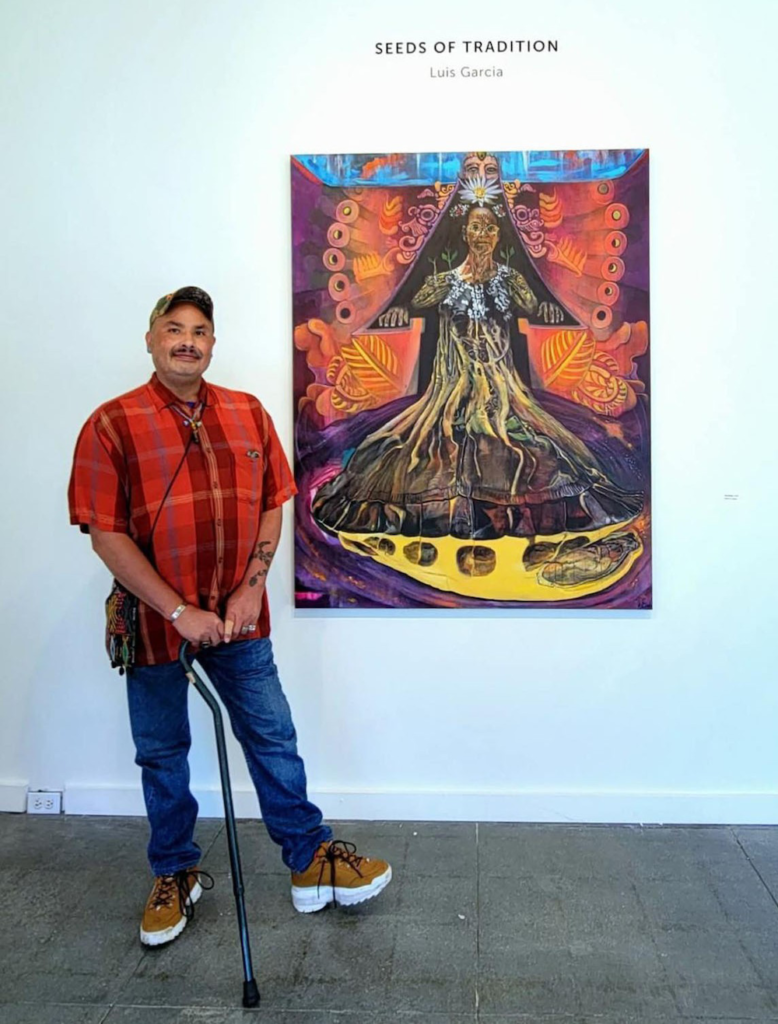
Garcia spends a lot of time in nature to find solace and to reconnect with spirit and personal history. Though he recognizes relatable threads in his work, because it arises from such personal origins it’s a challenge to know how others will receive it.
“We each carry our own unique experiences, but within those experiences, there is a universality that bonds us all. I have heard many times how people see themselves, their culture, their ancestors, and nature’s spiritual essence in my paintings. That they feel they are woven, interconnected, and moved by my work. This is how I hope everyone who views my work feels,” he said.
Garcia says he has become increasingly aware that we are living in a time where self-expression and knowledge of personal heritage is being diminished, erased, or rewritten.
“I feel that each of us, as torchbearers, stand on the shoulders of our ancestors. It is important, now more than ever, to keep the wisdom, the voices, and the stories that create the fabric of our communities at the forefront,” Garcia said. “Art, in all its forms, has this potential. Go out and create with your own unique voice. Share your stories, tell them the way you know are true.”
For more information, visit his website at luismayanman.wixsite.com and on Instagram.