More than 100 anti-AI demonstrators marched two miles across San Francisco Saturday afternoon to call for President Trump and Chinese Premier Xi Jinping to broker a treaty regulating AI development at the upcoming APEC forum in China.
The march was organized by Stop The AI Race, a Bay Area-based organization advocating for a slowdown in the competition to create more advanced AI systems and members of other anti-AI groups including Pause AI and Berkeley-based Stop AI attended. Similar marches were organized by Stop The AI Race across the country and the world.
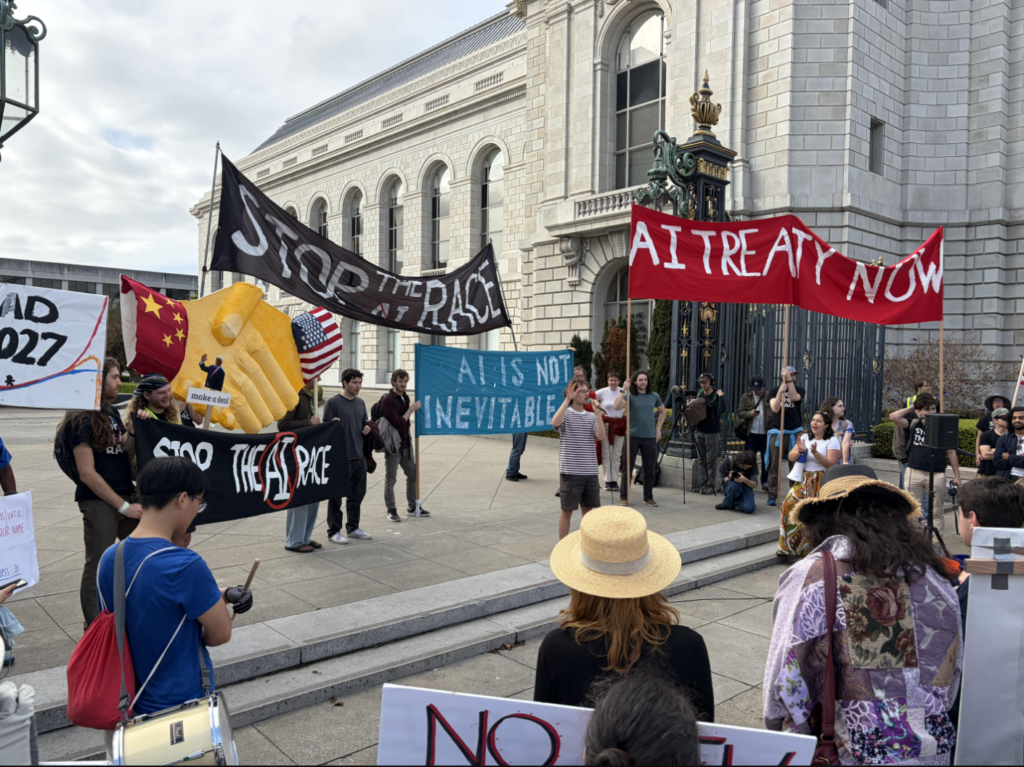
The march took place in the shadow of major upheaval in the global AI industry. Jensen Huang, CEO of processor giant Nvidia and industry poster boy, just stepped down from his post amid a sex scandal with a woman believed to be a Chinese spy. Anthropic, the corporation behind Claude AI, is preparing for an IPO that some predict will break records. The world’s two AI superpowers are set to convene in an unprecedented joint meeting between the leaders of China, the US, and Russia.
The crowd began to gather in front of OpenAI’s offices on Third Street at noon. Signs displaying ominous warnings about the near future of AI development were on the sidewalk for attendees to grab. A member of the Brass Liberation Orchestra, the local band hired to fill the space between speeches and chants, sounded somber notes from a trombone. Organizers spoke with police about the impending march. A group of stoic middle-aged men silently watched the setup from a few feet away, declining to share their affiliations beyond being there to “make sure nothing happens.”
While demonstrators filtered in, a few members of Stop The AI Race hoisted large banners displaying the organization’s name and the message “AI TREATY NOW.” Other members held up a large papier-mache model of two hands shaking—one decorated with the U.S. flag and the other with the Chinese flag—to symbolize the treaty they were seeking.
Gregory John Ward, Bay Area coordinator for Pause AI, said while his organization advocates for an international treaty to pause the development of advanced AI without rolling back existing models, he believes more correction is necessary.
“My personal view is that we would need to roll back some of the models that have been released because … if a model is not provably safe, it should not be out there in the world,” Ward said. “My view is that society is built on trust. AI, the way it’s been done, is inherently untrustworthy. If you let AI run important institutions, we’re going to lose trust in everything, and that will break society.”
Speakers began taking the stage around 12:30. Mark Schlosberg, managing director of the sustainability advocacy group Food and Water Watch, spoke out against data center construction.
“The people have spoken and their message was change,” Schlosberg said. “People do not want AI and do not want AI data centers controlling their lives. … Gubernatorial candidates won (nationwide) because they said they were going to put a moratorium on data centers which are driving the advanced AI, and we need to make it happen.”
Schlosberg said the acceleration of AI development and data center construction was polluting waterways, replacing jobs, allowing dangerous data leaks and hacks, and working towards an unwanted AI superintelligence. “We need to put the brakes on this right away,” he said.
In an interview, Stop The AI Race volunteer Thomas White explained the message of the march was to put an end to the “arms race dynamics” fueling AI development.
“We believe that the right move is for our whole society to pace the frontier of AI development in a broad international treaty,” White said, “in order to make sure the outcomes can realize the utopian future that we’d all like to hope for, rather than the existential risks that people have been floating in and outside the labs.”
Around 1:30, the group began to march. Organizers including Michael Trazzi, founder of Stop The AI Race, led protestors in chants rebuking AI replacement and calling for slower development and stronger government oversight. A police escort guided the march away from the OpenAI offices along Mission Bay Boulevard, up the length of Seventh Street, and finally onto McAllister towards the Veterans Building.
After almost an hour of marching, chanting, and music, the crowd settled in front of the Veterans Memorial where Trazzi, who conducted a hunger strike last year to protest against AI development, began to speak. Almost immediately he encouraged every attendee to undertake their own hunger strike in order to pressure AI companies to slow development. “I know it’s really hard, but I think it’s something that could change things,” Trazzi said.
Jeremy Ornstein, an attendee affiliated with Stop The AI Race, spoke about holding recently elected politicians accountable for promises to curb AI development and told fellow protestors to go out and spread the word.
“In the next couple months, we have to confront these politicians, the people who are supposed to represent us, and ask them which side they’re on,” Ornstein said.
In an interview, Ornstein railed against tech CEOs and compared the threat of superintelligence to a military occupation.
“(AI is) being controlled by a few oligarchs who are racing ahead for their own power and profit,” Ornstein said, “a force that we couldn’t fight back against the same way that if the military wanted to take over your city it’d be hard to fight back against it. … If we regulate AI, it could be good for all of us, we could all share in a better future.”
He compared the race between China and the US to the Cold War nuclear arms race and said a treaty would be possible if each power could verify the other was slowing down development of AI models.
At this point, the APEC forum in Shenzhen, China is ongoing and it is yet unclear if Trump and Xi have discussed regulating their respective AI industries.