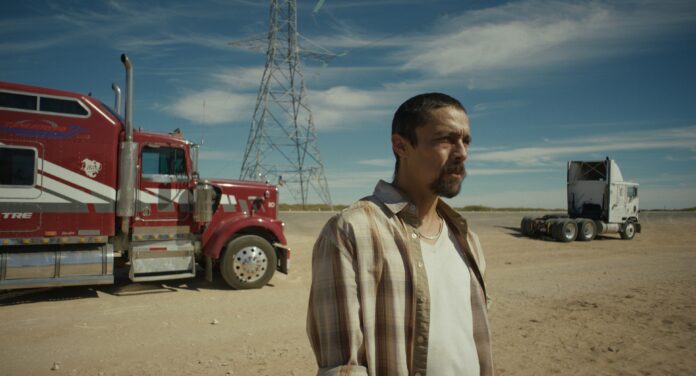
Two decades ago Hollywood famously rejected Brokeback Mountain for the melodramatic claptrap of Crash in awarding the Best Picture—because, it was widely rumored, too many Academy voters didn’t want to watch a “gay cowboy movie.” (Yes, I know… they were shepherds.) Apparently no such timorousness is at work in Mexico at the moment, since David Pablos’ On the Road both swept the Ariel Awards—that country’s Oscars—last month, and was picked as its entry in Oscar’s Best International Feature competition for this year.
The two films are very different (as are the many gay-focused films célèbre coming out this year, from La Bola Negra and Club Kid to this week’s Elsinore). But they’re both working-class, closeted gay love stories in which larger forces make the probability of any happy ending remote. Indeed, On the Road, which has no connection to Kerouac, is the tougher joint, as its protagonists are angry misfits in a world they don’t try very hard to fit into, with ultimate results that are grim, violent, and ironic. Yet if that description sounds like a major downer, it does a disservice to what Pablos achieves here.
His last feature, Dance of the 41 (which we reviewed here), dramatized a notorious fin de siecle scandal in which a number of Mexico City’s most privileged men were caught in cross-dressing revelry by a police raid. The writer-director’s latest, however, takes place today, and at the bottom end of the social ladder.
Eduardo (Osvaldo Sanchez) is a long-distance truck driver with a wife and children—though we eventually realize he’s estranged himself from them with his long absences and problematic habits. Younger Veneno (Victor Prieto) is introduced getting ditched in a diner by a different trucker, one who’s just banged him in the restroom. For lack of other options, the next morning he asks Eduardo for a ride, which gets a curt rejection until Venemo throws some marching powder into the mix.
Once they’ve become an uneasy partnership of sorts, the older man suggests they formalize it—he’ll introduce Venemo to “cool” people who might want his services (without arresting or beating him up) at roadside establishments. In return for a percentage of the take, of course.
This strictly transactional relationship soon turns into something else. However, whatever genuine attachment might take root is constantly imperiled: by the threat of cartel violence, by Eduardo’s drug dependencies (at one point he notes he hasn’t slept for a week), by a recent past Venemo is fleeing from, then by a newly urgent cause for fugitive status after he defends himself from a blackmailing john’s assault.
There’s an almost pulp-noir fatalism to the narrative here, with characters whose fates seem almost certainly doomed from the start. Still, it’s surprising how much emotional depth Pablos and his actors eke from it—perhaps even more surprising in a movie suffused with so much taboo sexiness, which often gets expressed in quite graphic ways. (If you found Brokeback’s fully-clothed tent action shocking, you might not want to risk the erect full-frontalism of Road.)
It manages to become a heartfelt tragic romance even as we realize these hard-luck lives can’t accommodate anything so soft. Extremely well-crafted, both gritty and stylized, On the Road is the work of a filmmaker-storyteller firing on all cylinders. It opens at SF’s Roxie Theater on Fri/20.
Elsewhere this week:
What’s The Big Idea?: ‘Gentle Monster,’ ‘The North,’ ‘Trauma’
Three interesting if mixed-bag movies approach some big themes with variable success. In Austrian writer-director (Corsage) Marie Kreutzer’s new Gentle Monster, which begins streaming on Netflix Wed/18, Lea Seydoux plays Lucy, a French wife, mother, and musician living outside Munich. She and her husband are both good parents to son Johnny (Malo Blanchet), but Philip (Laurence Rupp) also seems sulky, mercurial, patience-testing—perhaps in part because his filmmaking career has gone in a less fulfilling direction than hers as a concert hall pianist-chanteuse whose repertoire is an “examination and deconstruction of pop music.” (If that sounds like pretentious tosh… well, that’s just how it comes off.)
The marriage clearly has problems, but Lucy is willing to shoulder them. Until, that is, city police raid their country home, claiming Philip is in possession of some highly illegal materials. Lucy refuses to believe (or Philip to admit) it at first. But as the title rather crudely suggests, this is a movie about realizing the person you thought you knew, and whose vulnerabilities indeed seemed their main characteristic, might indeed be hiding an inexcusable predatory streak.
Gentle Monster is well-cast and crafted. But its subplots feel under-realized—including a major one with Jella Haase as a police detective who’s got her own family issues, and a waste of Catherine Deneuve as Lucy’s own mother. The main thread isn’t all that satisfying, either. We spend a lot of time watching Seydoux’s heroine come to grips with a horrible circumstance, yet the script really doesn’t provide any insight into what made Philip who or what he is—or even to what extent he’s violated a universal taboo. (Well, maybe universal outside Epstein circles.) As intelligently observed as this drama is, it ultimately doesn’t observe or explicate enough.
Likewise, there’s more form than substance to writer-director Bart Schrijver’s The North, in which two male friends reunite for a holiday whose challenge they’re both ripe for: backpacking the entire western length of Scotland, from bottom to top. Both are about 30, but since whenever they first met, the duo have gone in different directions.
Dutch Chris (Bart Harder) now has a demanding job he’s hard-pressed to take time off from, as well as a serious girlfriend he’ll probably soon be starting a family with. In contrast, Spaniard Lluis (Carles Pulido) appears to be drifting like a recent college graduate, unwilling or unable to settle on a profession or partner. He seems irked Chris isn’t in that same boat anymore—and since we find out so little about Lluis, the petulance that triggers their fights does not generate much sympathy or interest.
Schrijver’s 2022 prior feature Human Nature was also a “road movie” about a long hike. It, too, apparently had spectacular scenery (in that case, Norwegian)… and not enough narrative or character depth. The Scottish Highlands look stunning in Twan Peeters’ widescreen cinematography, and their depiction is true to my own long-ago hiking experience there (i.e. very windy, very wet). As eye candy, The North is first-rate. In human terms, however, it offers pretty thin gruel stretched over 138 minutes. The film begins streaming on digital platforms Mon/23.
Arriving likewise the next day, Larry Fessenden’s Trauma, or Monsters All is in a different fix: Rather than failing to fully develop one or two core ideas, it takes on way too many ideas, which then get barely developed at all. An actor, writer, director and producer who founded the company Glass Eye Pix—which has generated a lot of interesting movies beyond his own—Fessenden has long enjoyed toying with tropes of the horror genre. His best such features (2001’s Wendigo, 2006’s The Last Winter) deployed Native American mythology to ends that were equal parts supernatural and psychological thriller.
More recently Depraved (2019) and Blackout (2023) poked the bones of Frankenstein and werewolf lore, lending them a distinctly modern, neurotic spin—as his Habit did for Dracula almost 30 years ago. (In it, Fessenden himself played a rudderless Manhattanite whose fling with a mystery woman might’ve set him on the path to being a vampire… or a junkie, we’re never quite sure which.)
Those last-named three movies are corralled (and excerpted) as backstory for Trauma, a “monster mash” in which an upstate NY rural burg turns out to be chockfull of strange occurrences and personnel. A young woman (Laetitia Holland) working on a book about George Washington Carver comes here to focus on that work. But she finds herself distracted by phenomena that include a ghoulish neighbor (Alex Breaux) apparently keeping someone (Alex Hurt) locked in the cellar—a relationship that turns out a mutually-cooperative take on the classic 1943 Universal title Frankenstein Meets the Wolf Man. Her curiosity about the town’s many unresolved mysteries and murders draws resentment from angry townies. But soon they’ve got worse things to worry about, particularly once a stranger in town (Fessenden) commences fanging necks.
Trauma is fun, but like the director’s other recent work, it’s best taken as a playful meditation on horror movies than as the “real thing”—it doesn’t expend much energy on scares or suspense. It’s not a sendup, however, even if its treatment of more real-world issues (like coping with trauma, or racial divisions) often seems too superficial to be taken very seriously. Indeed, these two hours feel like a grab-bag of themes Fessenden tosses in with little intention of fully exploring. It all hangs together entertainingly, albeit without much in the way of conclusive impact or meaning. Still, it’s an always-interesting filmmaker’s personal best in several years.
You Had To Be There
Every once in a while some specific cultural event turns out to be the wellspring from which umpteen high-profile careers are launched, and one unlikely example was the 1972 Toronto production of Godspell. Stephen Schwartz and John-Michael Tebelak’s musical had already successfully gone from university to experimental theater to 1971 off-Broadway, where it ran for five years. Also in 1971 there was a London production, David Essex as Jesus and Jeremy Irons as John/the Baptist/Judas.
Still, even that starry pair paled next to the collective luminosity of the Toronto cast, which included future comedy supernovas Gilda Radner, Andrea Martin, Eugene Levy and Martin Short, as well as the more dramatically inclined Victor Garber and David Letterman’s subsequent music director Paul Shaffer. Even their eventual replacements were stellar, among them pre-Kids in the Hall Dave Thomas and multimedia actor-director Don Scardino. The production was a huge critical and popular hit, despite local conservative Christians protesting the very idea of a pop-rock musical with clown faced hippies acting out The Gospel of St. Matthew.
From that seed improbably sprouted offshoots like Saturday Night Live, SCTV, and more. This particular Godspell was considered the funniest staging, attracting natural comic talents and encouraging improvisational elements. Its formative experience kept much of the cast bonded over ensuing decades, as survivors interviewed here attest. They lament that there is no audiovisual record of the show… but then, it turns out, there is some surreptitiously recorded material.
Directed by Nick Davis, You Had to Be There (which sports the groansome subtitle “How the Toronto ‘Godspell’ Ignited the Comedy Revolution, Spread Love & Overalls, and Created a Community That Changed the World [In a Canadian Kind of Way]”) somewhat belabors its own hour’s-worth of material to nearly 100 minutes. By the time we get to a self-congratulatory reunion, with aging hams bellowing out songs they can no longer sing well, it’s become a little too much of a good thing. The film’s over-attention to marquee names is underlined by the scant attention paid to the original production’s sole non-white member and arguable best singer, Rudy Webb.
There’s one powerful late sequence when another less-remembered participant, Valda Aviks, reveals why—cast in a short-lived 1974 US TV variety show, she experienced such persistent sexual harassment on the job that she “lost my joy of the business.” Otherwise, this is a pleasant if overextended footnote. For fans of the personalities involved (and Godspell, which remains pretty much the perfect song score in its category), it’s worth a look. The documentary releases to On Demand platforms Nov. 24.
Dr. Goldfoot and the Bikini Machine
If you’re in the mood for something old and very silly, Alamo Drafthouse New Mission has your back this Wed/18. In 1965, established drive-in exploitation-monger American International Pictures was in a quandary. Their cycle of “beach party” movies with Annette Funicello and Frankie Avalon had run its commercial course; a fresh vogue for violent motorcycle gang flicks wouldn’t commence until the next year, with The Wild Angels.
So they took a gamble on this relatively expensive (by this studio’s standards) spy spoof, ridiculing—among other things—the then-current mania for 007 and his imitators. Vincent Price plays the titular nefarious mastermind who manufactures comely honeytraps in shiny gold bikinis to seduce wealthy men and strip them of their (ahem) assets. Susan Hart, wife of AIP co-founder James H. Nicholson, plays the sexbot who targets millionaire Dwayne Hickman (from The Many Loves of Dobie Gillis), but mistakenly hooks intelligence agent Avalon instead.
Partly shot here in SF, the movie is notable for a chase scene incorporating “crooked” Lombard St. three years before Bullitt (albeit with obvious back-projection effects). It also features an original score by lounge-music king Les Baxter, claymation credits from Gumby animator Art Clokey, and an insidious earworm title song sung by no less than The Supremes—imagine shouting out that request at La Ross in concert. Future Streisand paramour and Hollywood producer Jon Peters gets special billing as Hart’s hairdresser.
Complete with numerous celebrity cameos (including Funicello of course) and a climax tipping hat to Price’s prior Edgar Allan Poe-derived AIP vehicles, this energetic exercise in strained wackiness was directed by grizzled veteran Norman Taurog, taking a break from his many Elvis Presley flicks. It got launched with a half-hour promo special on TV’s Shindig! called The Wild Weird World of Dr. Goldfoot, which you can find on YouTube (though having done so, I wouldn’t recommend you do the same). It was successful enough to warrant a sequel, Dr. Goldfoot and the Girl Bombs, that for financing reasons was shot in Italy by horror maestro Mario Bava. No one liked it—including Bava. But Bikini Machine has its nonsensical charms.