This week’s new releases are, like so much of 2025, largely about some very pushy men. (We’d have included one very large coldblooded reptile, too, but unfortunately MUNI fell down on the job of getting us to an Anaconda screening.)
The Safdie Brothers have carved entire careers from fictive studies of variably self-defeating and/or self-destructive dudes—from the failed father of Daddy Longlegs and Heaven Knows What’s heroin addicts to the maniacally hustling antiheroes of Good Time and Uncut Gems. This year saw them split to work on separate projects, both sports-themed stories based on real-life figures. Benny Safdie released the somewhat underwhelming Smashing Machine, with Dwayne Johnson as an MMA fighter. Now Josh Safdie has come up with Marty Supreme, a bigger, better enterprise that’s arguably one of the year’s best—and which I pretty much loathed watching to a point, after which its energy and invention won me over. But yeesh: These Safdies sure do love their overbearing jerks.
Exhibit A in this case being one Marty Mauser, a loose approximation of late ping-pong champion Martin Reisman. He’s an antsy Manhattanite introduced in 1952, working at his uncle’s shoe store. As the saying goes, he could sell snow to an Eskimo. But Marty hates, hates, hates his job, convinced he is destined for “greatness,” no matter how trivial or wrongheaded those ambitions seem to others, like the mother (Fran Drescher) he lives with yet barely speaks to. Marty’s improbable thing is table tennis, a sport almost no one takes seriously at this moment in time. But Marty takes everything very seriously, so long as it pertains to him.
Otherwise, he takes nothing seriously, whether it’s his employment, debts, other obligations, preexisting involvement with a young woman from the neighborhood (Odessa A’zion), or potential affair with a middle-aged former movie star (Gwyneth Paltrow) whose path he crosses. That both women happen to already be married is no concern of Marty’s. He is, in all things, strictly out for #1. He will do whatever it takes to get ahead, which often means finding hustles to reach international racket competitions in Europe or Japan.
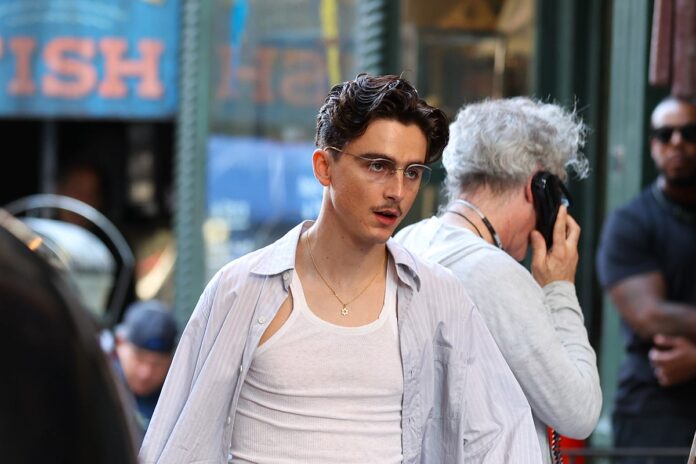
Marty is a whirling Tasmanian Devil of negative energy, exasperating and shameless; he is played by Timothee Chalamet, an actor whose charms I have often found elusive. He isn’t trying to be charming here—he is being an all-too-vividly-convincing noxious little shit. In much the same way I found Adam Sandler hard to take in Gems, this performance may strike some as almost unwatchable, because it so effectively inhabits a character who’s profoundly dislikable. (On the other hand, some people love watching just this kind of motormouthed huckster, and many truly loved Gems.)
Safdie pushes that gambit even farther by lending the 150-minute Marty Supreme a headlong momentum that scarcely slows between dazzlingly staged and edited table-tennis sequences. (Is this sport really THAT showy? I honestly hadn’t noticed.) There’s an eye-catching cast that includes such unexpected personalities as Sandra Bernhard, designer Isaac Mizrahi, playwright David Mamet, magician Penn Jillette, rapper Tyler the Creator, cult director Abel Ferrara, and more. The stylistic stakes are ratcheted yet higher by the conceptually bewildering use of 1980s synthpop tracks by Tears for Fears and such—a complete aberration for the period depicted, yet somehow it works.
Hyperbolic, though controlled in its seeming recklessness, this movie careens from souped-up tenement drama to Tennessee Williams parody (when Paltrow’s figure attempts a Broadway comeback) to crime-thriller violence. It’s perhaps the year’s wildest ride in US cinema, this side of One Battle After Another—a film whose DiCaprio-cast loser protagonist I found infinitely easier to stomach than Chalamet’s pencil-mustached uberweasel. In the end, Marty Supreme will bowl you over, perhaps all the more so for stirring so much initial resistance. It is almost certainly the best movie of 2025 about a person from you’d probably flee to the nearest subway station to avoid off-screen.
Marty doesn’t actually kill anybody to reach his all-important goals, though you suspect he might in a pinch. No such restraint is demonstrated by Man-su (Lee Byung-hun) in No Other Choice, the latest from celebrated South Korean director Park Chan-wook of Sympathy for Mr. Vengeance, Oldboy and The Handmaiden. This black comedy is based on Donald E. Westlake’s 1997 novel The Axe, already adapted by no less than Costa-Garvas in a well-received 2005 French feature that somehow never got released in the US Park stays faithful to the book’s basic premise: His hero is a middle-aged supervisor at an industrial paper factory whose new owners put him—and all his coworkers—out of work. (In the original, this was a matter of shuttering plants and outsourcing. Here, it’s the elimination of human labor via AI-controlled automation.)

His very comfortable life with expansive house, wife, kids and pets is at immediate risk. Upon realizing that the factory still requires a single live person to oversee operations, Man-su makes a tether-snapping leap in logic: To his mind, he has “no choice” but to methodically kill off all other amply-qualified candidates for that post, thus ensuring his own hire. Needless to say, this scheme will run into some hazardous snags. But like Marty Mauser, Man-su is a man driven by a narrow idea of himself that he’ll obsessively pursue, wherever it takes him.
It’s a juicy plot hook that could have been played in any number of keys. Park has treated some outre narratives with exacting control before, but here he throws caution to the wind, perhaps too much so. Choice is flamboyantly jaunty from the get-go. Its high style is entertaining, yet so overblown that there’s never a chance for the satire to do more than reinforce a too-obvious point: That vulture capitalism is becoming a death spiral even for the hitherto best-cushioned proletarians. The relatively nuanced critique of class and economic divides that made fellow countryman Bong Joon Ho’s Parasite memorable is lacking from this more cartoonish exercise. It is fun, and highly accomplished; it’s just simultaneously a more blunt hitting of a simpler target than we might expect from Park.
Both films above open Christmas Day in theaters nationwide. Playing just a single show two days later is a movie I’d never even heard of—or if I had, it suggested nothing worth investigating—but which is being revived because it was the very first feature screened at the Orinda Theatre. Idle curiosity led me to track down Texas, a 1941 western from Columbia Pictures starring its recent contract-player acquisitions, William Holden and Glenn Ford. It is said that they were signed almost simultaneously in order to be “interchangeable,” so one could replace another on any given picture should his colleague become “difficult.” Regardless, the studio struck gold—both men would gradually ascend to become two of the biggest screen names of the 1950s.
They were only 23 and 25, respectively, when they made this generically titled “oater” directed by George Marshall, a journeyman director whose career spanned nearly sixty years—encompassing a few jewels, but also a lot of dross. What a surprise, then, to discover the under-radar wartime feature is an antic delight, just about up there with Marshall’s most famous film, 1939’s Destry Rides Again.
Texas, too, is mostly a comedy western, with the lead actors as two “Johnny Rebs” who drift westward in search of railroad work after the Civil War’s end. Alas, the railroad has already been here and gone. Broke and hungry, they seek any employment they can get, not all of it legal. In the just-recently-minted Lone Star State, corruption is rife, with cattle rustlers sometimes looking like bandits, other times very much like respectable cattle owners. Claire Trevor plays the daughter of one among the few upstanding latter. Courted by both youths, she has plenty of cause to stamp her feet and fume while clad in spotless white ruffles.
Plotwise, Texas is unmemorable if twisty. But it’s well-produced—landing somewhere between “A” and “B”-grade values—with a real comedic esprit that’s almost screwball in tenor. Marshall’s flair for slapstick (he’d directed several Laurel & Hardy joints) really excels in a prolonged early fight scene where a punch-drunk Holden just refuses to stay down. That actor plays the much looser cannon among two BFFs, full of floppy-haired mischief that’s complimented by Ford’s steadier fella, and he is a riot.
You might wonder why such a seemingly unimportant movie got to open one of the last grand art deco movie palaces. But I’ll bet everyone at the Orinda exactly eighty-four years ago had a great time with it, and so will you. It plays Sat/27 11 am with “selected short subjects” and some live-onstage elements. More info here.