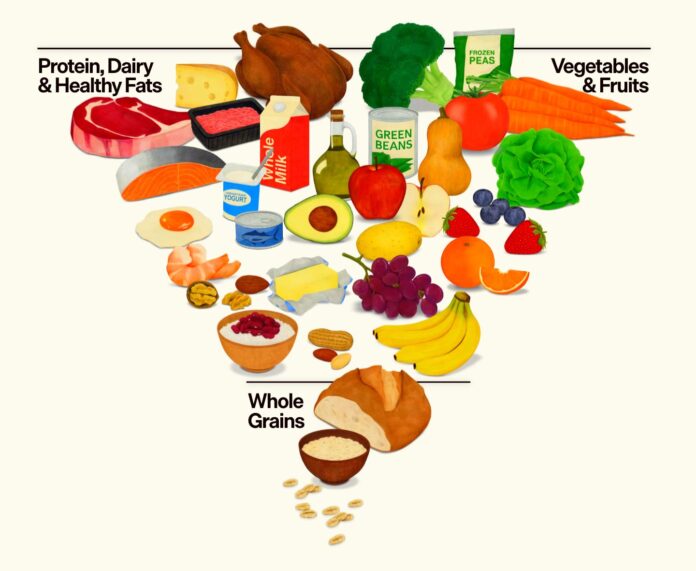
Health and Human Services Secretary Robert F. Kennedy Jr. loves to talk about personal responsibility. In an interview last year, for example, he said, “If you’re smoking three packs of cigarettes a day, should you expect society to pay when you get sick?” He added that while Americans would always have the right to “eat donuts all day,” nevertheless, “should you then expect society to care for you when you predictably get very sick at the same level as somebody who was born with a congenital illness?”
The predictable result of his attitude is policies that, for example, encourage states to bar use of SNAP food assistance benefits for items deemed “junk food.”
But while individual decisions certainly matter, Kennedy never discusses the fact that not everyone has the same ability to make healthy choices. Flipping the food pyramid may cause a social media stir, but the defining factor of health outcomes—one that often overwhelms personal preferences or desires—is something that Kennedy relentlessly avoids. It’s a critical public health concept called the social determinants of health, which the World Health Organization explains this way: “The conditions in which people are born, grow, live, work, and age, and people’s access to power, money and resources—have a powerful influence on health inequities. These are the unfair and avoidable differences in health status seen within and between countries.”
Simply put, everything in your life—your wealth or lack thereof, your job and hours, your housing, your access to healthy food and exercise, etc.—either enhances or restricts your ability to stay healthy. Poverty, which can lead to inadequate nutrition, unsafe and unsanitary (or nonexistent) housing, is the enemy of good health. So is working at multiple low-wage jobs just to pay essential bills, often forcing the worker to either rely on fast food or convenience-store junk or go hungry. Low-income neighborhoods often have inadequate access to fresh food, and parks and other facilities for safe, healthy exercise.
Poverty and lack of resources are not distributed equally. Black, Latino, Native American, and Alaska Native incomes all lag well behind the overall national average. Women’s incomes are lower than those of men. Trans and nonbinary people as well as LGBTQ women of color also suffer from lower earnings. And no, these entire demographics—which between them account for a huge number of people—are not lazier and less hard-working. They face discrimination in hiring, promotions and more
Thus, it’s no surprise that these groups are generally at the wrong end of all sorts of health disparities. Black, Latino, Native American and Alaska Native US residents lag behind whites and Asian Americans in life expectancy. Blacks, Native American and Alaska Natives, as well as Native Hawaiians/Pacific Islanders have higher rates of diabetes and some other chronic illnesses. The starkest difference is in pregnancy-related deaths: Black childbirth deaths exceed whites by more than three to one. Transgender Americans have lower incomes, higher rates of employment, and more days where they report being in poor health than their cisgender counterparts.
Bigots will imagine that these groups are simply lazy and make poor choices, but the more logical and evidence-backed conclusion is that discrimination and poverty, including systemic racism throughout society (including in healthcare) play the dominant role. Sadly, systemic racism in healthcare remains a real and serious problem.
Trump and RFK Jr. don’t want to know about such things. Indeed, one of the administration’s first moves was a sweeping cut-off of funding for a dozens of studies into these very disparities and related health equity issues. Research that was abruptly defunded in this war on so-called “DEI” included studies on Black maternal and fetal health, HIV risks and prevention in adolescents and gay and bisexual men, and autism in girls. Anything that looks at the root causes of health disparities or ways to correct them has been relentlessly attacked, and that attack continues.

That applies as well to the recently issued Dietary Guidelines for Americans. As my colleagues at Defend Public Health explained in a recent report on the DGA, the Dietary Guidelines Advisory Committee—the scientific body that assembles and analyzes the data used to prepare the actual guidelines—determined early in the process that the new DGA needed to address health equity. They wrote, “Ensuring that everyone has the resources and knowledge needed to make informed choices about nutrition is essential…”
The Trump administration was having none of that. In a March 2025 press release, Secretary of Agriculture Brooke Rollins touted the purge of “leftist ideologies” from the DGA process, which she said would focus on “healthy choices.”
Let me get personal for a minute. I mostly make healthy choices with regard to my diet because I can. While not rich, I can afford to buy fresh, healthy food, and I have time to cook it from scratch. And that results directly from my having been born into a white, upper-middle-class family in an era when racial discrimination was even more overt than today. That fortunate birth ensured my financial security even when my insane career choices got me in trouble, and resulted in a significant inheritance when my parents passed on. I have the luxury of choice that tens of millions of Americans don’t.
The purge of “leftist ideologies” seems to have worked, with any references to social and health inequities purged from the new DGA released in early January. A search for words like disparities, poverty or income turns up not one mention amid all the document’s lecturing of individuals about what to eat or not to eat.
The Trump administration has a narrative: Everything in your life revolves around personal choice and responsibility, and discrimination isn’t real. That narrative flies in the face of reality, but it’s now governing nearly everything the US government does.