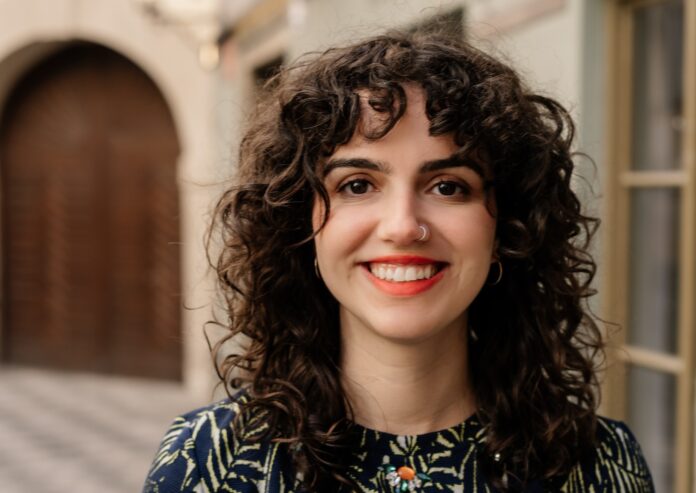
“I learned that consent isn’t always black and white; I learned to view consent as a spectrum,” says nightlife activist Elizabeth Dreeson, after researching sexual and gender-based violence in clubs, something unfortunately very much still with us. Navigating consent is part of most nightlife experiences, but the gray areas that sometimes arise—not to mention flat-out violations—can lead to even more confusion. When something seems not right or crosses the line, we often question ourselves rather than find safety—especially when no clear plan of action is available. There’s often a lot going on! Who can you talk to? What can you do?
Or, as Dreeson put it in a recent op-ed for KALW:
Does the following scenario feel familiar? You’re at a concert with friends, grabbing a drink at the bar when all of a sudden, a stranger puts their hands on your hips to get your attention. It’s unwanted. As the bartender hands you your drink, you lean in and say, “The guy behind me is getting a little handsy. Can you help me get someone to keep an eye on him?”
Your heart drops as the bartender replies, “That’s not my problem, go find a security guard.” But security is nowhere to be found. Startled, your thoughts start looping: Am I safe here? Is it safe to go to the bathroom by myself? Would security take me seriously? We better keep an eye on our drinks.
To help both patrons and bar staff open more lines of safe communication and plans of action, Dreeson founded The Night’s Watch with fellow activist Amanda Leal, a new org aiming to “empower the nightlife community to challenge the culture of sexual and gender-based violence through outreach, education, and advocacy, particularly in spaces where harmful behaviors such as drug-facilitated sexual assault have too often been normalized as part of nightlife culture.”
To that end, The Night’s Watch is hosting a free launch party at the Stud on February 26, 6pm-8pm, demonstrating how they’re taking a proactive, productive approach to the problem. The org plans to transform the SoMa bar into a vision of how nightlife can be safer for everyone, explaining innovative staff training techniques, handing out items like practical drink covers and SOS cards to hand to staff in case speaking is impossible, even ways to make club bathrooms feel more welcoming.
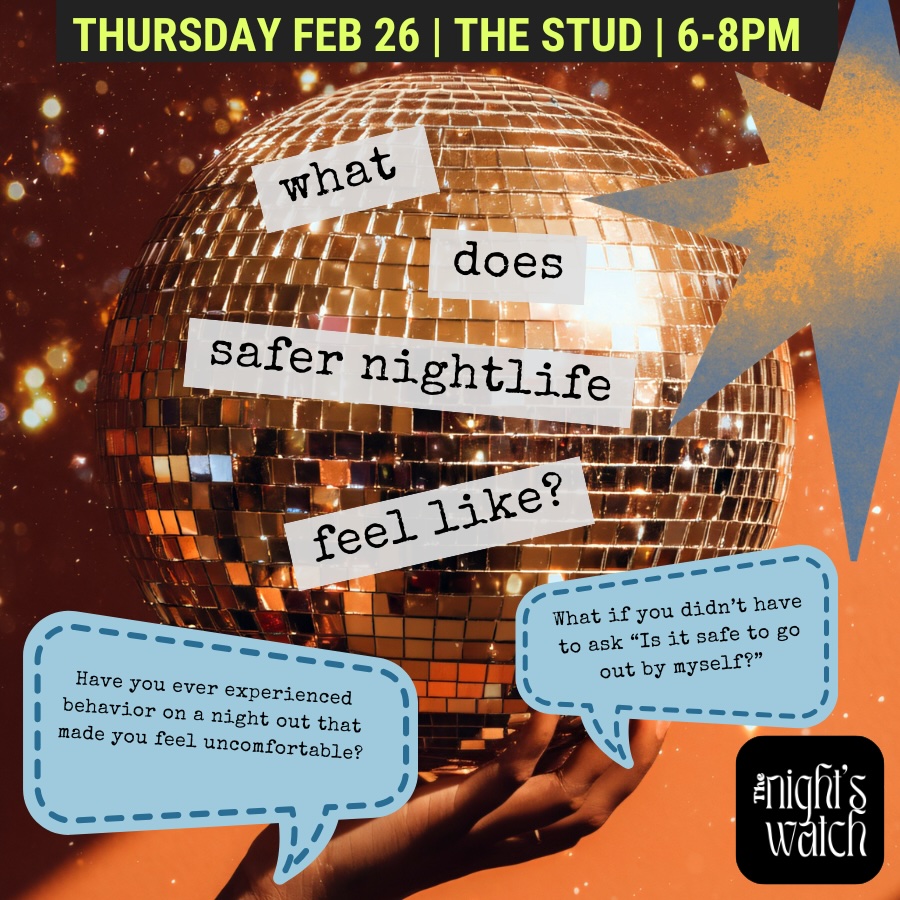
Of course it’s a party, too, that’s the important part! Music, bites, and drink specials will be on tap. (Full disclosure: I’m proud to be on the Night’s Watch advisory board, and am part of the Stud Collective that owns the bar.) I spoke with Dreeson about what the Night’s Watch is up to.
48 HILLS It always feels like we’re making progress on the issue of sexual and gender based-violence in night clubs, but then you see the statistics and personal stories and they make your heart drop. What spurred you specifically to launch the Night’s Watch project?
ELIZABETH DREESON I had a really tough night out at a nightclub here in San Francisco in 2019 with a friend that was visiting, where we couldn’t escape what felt like constant and persistent harassment. Eventually we gave up and left because we didn’t feel safe. It was devastating, and I was so disappointed that this was her impression of San Francisco nightlife.
I realized that I had normalized this behavior as a part of my nightlife experience until I witnessed how it impacted my friend. I found tons of posts on Reddit that confirmed this wasn’t an isolated incident. I felt helpless and started doing some research to see if anyone was addressing this. I came across an organization called Good Night Out. My friends and I collaborated on a letter to the venue where the incidents took place, and its DJ, to share our experience, and to share the resources we had found in the hopes that they would take our experience seriously. While the venue blew me off, the DJ’s assistant reached out to me and advocated on our behalf, and the venue actually made some changes.
I was so inspired by the experience that I wrote an article on my personal blog with a call to action to venues to integrate Good Night Out’s best practices. The article made its way to the founder of Good Night Out’s Vancouver chapter, Stacey Forrester. I knew San Francisco needed something like this, so I started doing everything I could to learn about their program—from taking workshops to supporting and eventually leading outreach teams at events around the country—and Stacey ultimately became a mentor to me. Stacey and Good Night Out Vancouver have generously given me the necessary resources, opportunities, and guidance to launch The Night’s Watch here in San Francisco.
48 HILLS What are some productive ways the Night’s Watch is advocating facing down this seemingly intractable problem?
ELIZABETH DREESON We shifted away from event-based harm reduction efforts to focusing on long-term sustainable solutions related to California’s drink-spiking laws that started going into effect July 1, 2025. We spent most of 2024 doing research and outreach to successful organizations with similar missions around the world to learn from their model. I met with Mirik Milan—Amsterdam’s first night mayor and the co-founder of VibeLab, a pioneering nightlife consultancy agency—and followed his suggestions: “building awareness, educating people, and getting access to decision makers.” Since 2025, we have been working with an advisory committee made up of longtime nightlife advocates with backgrounds in event-based harm reduction, venue operations, and city planning and nightlife management to help us figure out how we fit into San Francisco’s nightlife ecosystem.
Empowering venue staff to recognize, respond to, and ultimately prevent sexual violence is fundamental to challenging how it has been normalized in nightlife spaces, but it is difficult to incentivize venues to participate in our workshops without any data to demonstrate that participation positively impacts revenue. We are proactively building relationships with regulatory bodies in San Francisco and legislators at the state level to advocate for related policies and legislation so that sexual violence prevention is baked into the fabric of nightlife operations.
48 HILLS Tell us about your plans to transform the Stud. I love that there’s particular attention being paid to the bathrooms …
ELIZABETH DREESON Our plan is to simulate the standards and care practices a patron might experience if a venue were to be trained by The Night’s Watch—where they are primed for safety before they walk through the door. We’ll share some examples on social media of nightclubs in New York that have statements about culture and safer spaces on their websites such as House of Yes and Nowadays.
When guests enter The Stud, they’ll be greeted by a “bouncer” who will share brief remarks around the values and intentions of the event—another strategy inspired by Nowadays. We’ll have an activation where guests can learn about the different bystander intervention strategies, one of which will be a “SOS card” that we’ll have at the bar and in the bathrooms. It’s a tool for patrons to discreetly ask staff for help if someone is making them uncomfortable. And speaking of bathrooms, one of our advisory committee members, Alicia Scholer, shared her research around how bathrooms can inform a patron’s perception of safety on a night out. So we’ll be making sure to stock the bathroom with a variety of supplies to help facilitate a safer night out.
While we are framing this as a “launch,” it’s more of an invitation for patrons and staff to contribute to a collective vision of a safer nightlife scene. We’ll have a couple boards with prompts like “What do you need to feel safer on a night out?” and “What would be on your nighttime manifesto?” And we’ll bring examples of safety charters and manifestos from the organizations that have inspired us from around the world. And speaking of our inspirations, we’ll also have a map that shows our global allies and how they have informed our model.
48 HILLS How can we clubgoers do our part to make spaces safer for everyone?
ELIZABETH DREESON I think it’s important for clubgoers to reflect on their understanding of consent and to learn how to be an active bystander. I can speak for myself and share that I used to think that consent was black and white because of how I was socialized. When I started engaging with Good Night Out Vancouver’s content, I learned to instead view consent as a spectrum. This has completely transformed how I approach consent—in both sexual and platonic dynamics and beyond, and certainly how I invite and respond to bids for connection in nightlife spaces. Connecting is such an important element of nightlife, and improving clubgoers’ understanding of consent can facilitate safer and positive ways to approach and engage the people that interest us on a night out.
Learning about bystander intervention strategies is what will empower patrons to challenge the culture of sexual and gender-based violence as it manifests in nightlife. While we are currently focusing on workshops for staff, one thing my mentor says is that “policy is only as good as the culture it exists in.” Community buy-in is fundamental to the culture change that we are trying to achieve. This is another reason why I want guests to experience this event as an invitation. The Night’s Watch is something you join, it’s something you are a part of, it’s a set of values that you embody as a clubgoer—in the same way that consent is not a moment or transaction, but a way of being.
THE NIGHT’S WATCH LAUNCH PARTY February 26, 6pm-8pm, free. The Stud, SF. More info here.