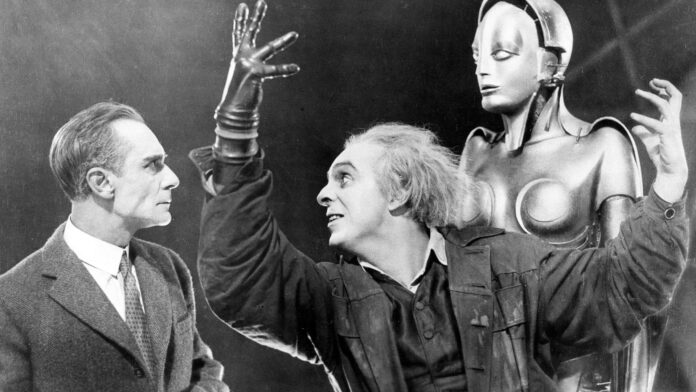
German director Fritz Lang’s still awe-inspiring, sci-fi-spawning Metropolis of 1927—with its indelible Expressionist images of fluorescent-ringed robots, behemoth industrial architecture, and a sadly familiar dystopian society—has perked the antennae of electronic musicians for decades. Kraftwerk claimed direct descendence from the film, referencing its concepts on groundbreaking 1978 album Die Mensch-Maschine, explicitly in track “Metropolis.” Giorgio Moroder took up soundtracking it in 1984, giving the politically charged yet still sentimental story a goofy layer of rock schmaltz (hello, Billy Squier), though one of Moroder’s own contributions, “Machines,” captures some of his classic dance floor spirit.
Detroit techno wizard Jeff Mills took up the Metropolis baton in 2000s, releasing what would be the first of three completely separate scorings of the film to “reintroduce and educate the theories and ideology” of the film to new generations as the new millennium dawned. Metropolis—the tale of an exploited caste of workers breaking free from their oligarchic oppressors by joining together with them to build a new world, as well as an Orpheus-like love story—has famously been in a state of restoration for almost a century, thanks to studio mangling and the ravages of time. As recently as 2010 (the year of Mills’ second score), 25 whole minutes of footage, not seen in 80 years, were rediscovered and integrated.
So successive sonic re-evaluations definitely make sense, especially coming from one of electronic music’s most crucial visionaries. Mills will be in town to perform his latest iteration “Metropolis Metropolis: Cinemix,” Sat/7, 7pm-10pm at the Palace of Fine Arts, SF—live, alongside the film—as part of the awesome Unabridged event series from the As You Like It party crew, bringing Detroit sounds to the Bay Area though next weekend. (The night before he does the film, he’ll be at the 1015 Folsom club to celebrate 30 years of his brilliant “Live at the Liquid Room Tokyo” mix, which turned very, very many people onto his raw, cosmic techno sounds.)
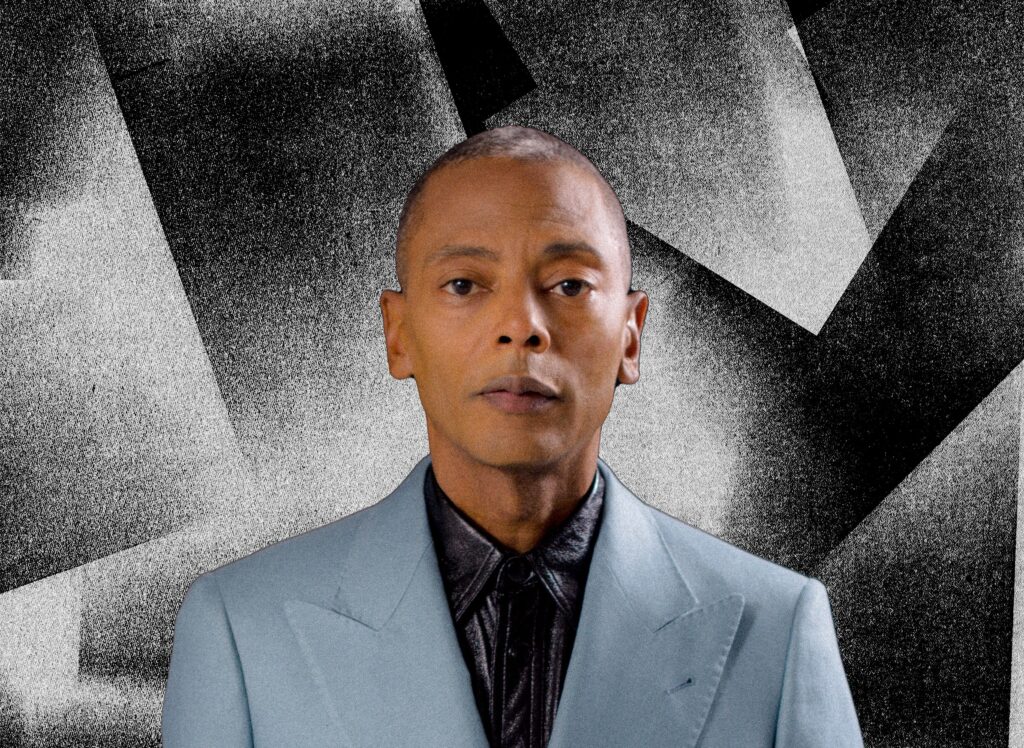
Mills’ 2000 soundtrack was composed “from the perspective of a spectator watching the screen.” The 2010 soundtrack was from the perspective of the characters in the film watching the spectators watching the screen. Now, in an apt twist for our computer-dominated moment, the latest score is taken from the perspective of Metropolis’ machines and technology, and composed as a “symphonic electronic soundtrack”—played by an orchestra of machines presided over by a conductor. I spoke with him over Zoom about how things have changed over time, and how the film sounds now.
48 HILLS Thanks so much for taking the time, Jeff. You’re here for two huge commemorative events back to back—the 30th anniversary of your epic Liquid Room Tokyo set, and then soundtracking Metropolis, something you’ve been doing for more than 25 years. These seem like two very different things in two very different genres. Is it easy for you to toggle between them, or do you see both things overall as part of the continuum of your practice?
JEFF MILLS It’s all connected in my mind. I’m using music to speak to people about particular subjects for certain reasons, even in the club setting. All these efforts are basically pointed in the same direction, so it’s definitely part of a continuum for me, they come from the same space.
48 HILLS What was your first encounter with the movie Metropolis?
JEFF MILLS I faintly remember maybe seeing it on TV, because here in Detroit, when I was a kid, science fiction was all over TV, especially on the weekends. So I probably saw the film as a very young kid. But I think it wasn’t until high school that I really remember actually sitting in the seat and looking at the screen and remembering certain scenes of the film. So maybe 1979, ’80, maybe, somewhere around then.
48 HILLS Was there any particular image that stuck in your head, that really sparked your imagination?
JEFF MILLS Yes. The scene of the flood was quite shocking—all these children actors that were reaching for Maria to save them. I mean, it’s not every day that you see something like that. There were, of course, many other striking things in the movie, like the TV phone.
But as I began to study the film to work on these soundtracks—I’ve watched this film, I don’t know, 50 times, to compose the music—I noticed many other things inside of the film, inside the film set itself: the furniture and the artwork on the wall, even the doorknobs. The lighting, the scale, the position of things. There’s so much detail in how Fritz Lang was setting out these scenes. They really add to the different segments, the conversations that these characters were having in the situation. Every time I look at the film, I discover something different. It’s really interesting.
48 HILLS I love your focus on the architectural details, to me it echoes one of the genius things about techno, especially now: its immersive sound design qualities. What influences did you draw from when it came to setting out on soundtracking the movie the first time, at the end of one century and the beginning of the next?
JEFF MILLS At the time of composing the first sound track, I was living in Berlin. I would work on the film. I would watch the film. I would work on the soundtrack. Then I would go out into the street. There was this very, very strong connection between being there and actually working on this film—going around the city and hearing the language and experiencing the style, the German aesthetics and design, how it was still so much connected to this film. The film was made in Potsdam, which is not very far from Berlin.
48 HILLS And now it’s 25, 26 years later, and you’re on the third iteration of the soundtrack. After nearly three decades, how has the technology you’ve utilized to create the ambience for this film changed ?
JEFF MILLS The first soundtrack was pretty much made without multi-track. I just played a lot of the tracks by hand, not using sequencers or anything. In this most recent version, the longest version—originally almost three hours—editing was the big difference. I could edit really quickly, and I could, in a way, experiment a bit differently.
In the first version, it was mainly just music.cIn the latest, I put more sound effects into the soundtrack. I composed and played the music in a way to not only make rhythm and music. I was more conscious about the atmosphere which would make the listener feel as if there’s music being played in a particular space, and you hear the acoustics of that. I was thinking about trying to make the listener feel as if they were in the film, that they were in the scenes.
There’s a lot of drifting in this new soundtrack, where the rhythm just trails off into something else, but then not really. It’s still there and you still hear something, but it’s not a full-blown composition. Transitional parts, interludes, preludes, breaks—things like that.
48 HILLS Is it different for you to be performing this one live, then? Do you have to tune into a different skill set?
JEFF MILLS To perform it live, I’m going to have all the music that I need to have to fulfill the cinematic experience of it. But I’m going to apply those based on how I feel watching the film. So things are not happening the same every time I do it. I have a lot of freedom to extend certain things, to layer things, to create accents based on what I see on the screen. It’s not quite an improvisational type of approach, but it points in that direction.
48 HILLS You’re performing this in San Francisco, a world capital of technology that’s now being consumed by artificial intelligence. Do you ever utilize artificial intelligence in your compositions, and would you see that as part of a future iteration of the soundtrack?
JEFF MILLS I would use it. I could very clearly see the time when I could just tell my machines to do things, and they just do it. When we have a conversation, me and my machine, we discuss things, and the machine works on it, and then I come back. I can clearly see that, and I would love to be able to have that as an option to be able to produce and record music. But not only just that, not only creations, but also many other things, like the tedious tasks, labeling things and giving things serial numbers. [Laughs.] I need that assistance. I look forward to working with Mr. And Mrs. AI on that part.
48 HILLS Finally, has your view of the message of the film changed over the years, since you’ve been working so closely with it for so long? Its resolution brings both sides together. Maybe we live in a time now where the desired resolution would be revolution: overthrowing the exploitative overlords, rather than coming together with them?
JEFF MILLS I hear that ringing in your voice there! It’s a heavy film with a heavy subject. I’m sure in 1927, when Fritz Lang and his team finished this film and sat back and looked at it, I’m sure a lot of that reflected on the feeling that they were having at that time in Nazi Germany. I wish it weren’t the case now. I wish that we could all just go and watch this film, and not even think about seeing similar things on CNN and things like that.
But yeah, I think Metropolis really says a lot about us and that we tend to, unfortunately, make the same mistakes over and over again. And I think it makes a very important point that really, in the end, for things to really change, we have to work together. There’s just no other way around it. And so the sooner that I think we understand that the distance between us is not great at all, we can all move forward. In fact, we’re all just one organism just crawling across the surface of this tiny little planet, just one little speck of something in the universe.
The reality is that we’re not German, or American, or French, or what have you. I think that if Fritz Lang were in this discussion—on this TV phone—I’m sure he would concur that it just doesn’t matter. It doesn’t matter who we are, or who we think we are. In the end, we’re really not that far apart. We’re really one. We’re really one thing. But it’s something we need to learn over and over again. I’m happy to work on this film and to show this film, but I would not be happy to make another version of it. But if it’s necessary, I will do that.
JEFF MILLS: METROPOLIS METROPOLIS: CINEMIX Sat/7, 7pm-10pm, Palace of Fine Arts, SF. More info here.