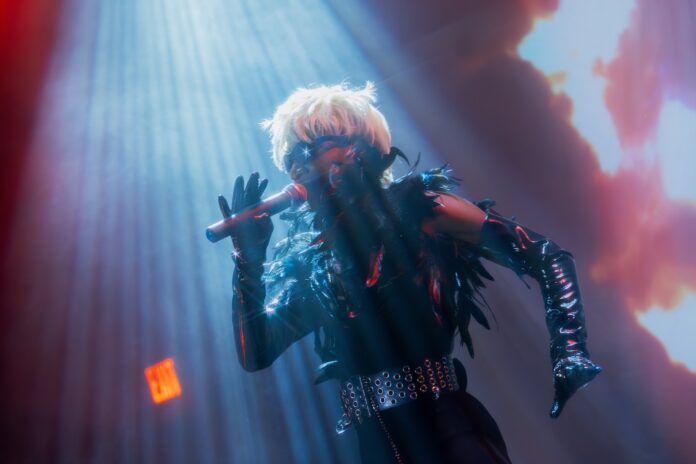
Shortly after moving to the Bay in 2023, I impulsively joined the Free Key Choir, a 100-plus-member conglomeration of local musicians and creatives. Being in the choir has introduced me to dozens of brilliant artists, both within its ranks and without. One such artist is the Oakland-based AroMa, whose headlining show at the Rickshaw Stop I tagged along with a friend to see last year. That show, a vital and thrilling music-meets-performance art piece titled Babylon, was made in collaboration with a coterie of multidisciplinary artists (check out the full list of collaborators here) and instantly turned me into a fan.
This past spring, AroMa released their latest EP, Smitten. The release demonstrates their post-genre approach to music, with eclectic arrangements and multifaceted vocal performances. They’ve followed that up with a spate of performances around the Bay, and have been working on their full-length debut album for release in the near future. Last month, I met up with AroMa in Oakland to learn more about their work ahead of their June 26 MASC4MASCQUERADE appearance at Eli’s Mile High Club. We chatted for over an hour about artistic community, the political dimensions of their work, sobriety, growth, and why they feel like a tornado.
48 HILLS How would you describe your work as a whole?
AROMA It’s very emotional, very melodramatic in sound and in presentation, very eclectic, genre-less. I’m really defiant of categorization. I don’t like things that are too chill. I don’t make easy listening, you know? There is a part of me that really tries to evade capture.
48 HILLS You mention genre, and one of the things that I really like about your music is that it feels so genre-expansive. I hear jazz, I hear hip-hop, I hear rock, I hear new wave. How did you arrive at that sound?
AROMA I had a very non-conventional journey towards music. Growing up, I wanted to be a painter. I used to do surreal portraiture and oil painting. Being a visual artist, I started doing music videos for local, underground artists in Oakland, because my community became a bunch of musicians and rappers. I wanted to work on more long-form work, but I was so familiar [with the] music video space. How do you make a music video long-form? You make it a musical. So I started writing music with the intention of people hearing it for film.
There’s this annoyance that I feel like a lot of artists in the Bay have, where you feel like there’s a lack of resources. So I’m gonna kick the door down, you know what I’m saying? Here’s every genre! Here’s every sound! Especially with my earlier work. The very first little musical I did was this thing called ZoomBug. I didn’t expect for our age of underground, Oakland, weird queer kids to love it as much as they did.
48 HILLS Camp is such a property of ’80s pop music, the whole scene is so big and outsized. You mentioned your voice—you have so many different registers, and you’re playing with different kinds of delivery. When you’re putting a song together, do you think, “On this song I’m going to do this specific voice?” Or does it arise more naturally?

AROMA It’s both. In my writing, I just go for it. I’ll get on the mic and mumble a melody or, if there’s a word, use that word as a motif. The delivery from that point on could change drastically. Like the [Smitten] song “Territory.” That one was killing me, the amount of times I re-sang that. There’s this overzealousness, and it’s brash, but there is some trepidation or unsureness about the character. The music is really big, but the lyrics are like, “I’m new to all this.” What kind of voice is going to capture this character who is confident in presentation but also unsure? Trying to find that middle ground was hard. There are moments where, when I’m thinking about character, I’m like, “No, that’s not how that character would feel.”
I never had a traditional background in singing. I found out I can sing in a really funny way; I was making fun of musicals. I was like, “Musicals suck! It’s just people singing what they would say!” And I was doing [that], and then a friend of mine was like, “Oh, you have a nice voice!” [laughs] I wasn’t super familiar with my voice, so I didn’t have this connected high to middle [range]. All I could really do was go high and go low. But I do think limitation is a medium. It definitely informed how I presented character vocally.
48 HILLS That makes a lot of sense. I do feel like a lot of the time, if you’re working with a limitation, you end up having to get creative in order to move around it. The vocal tone, being genre-expansive—you were talking about being queer earlier, and one of the things that I think is cool about your music is that it expresses that through those techniques. One of the other things that I’m thinking about too, in the contemporary world, is how much a genre or a specific vocal tone is performing a solidity of…
AROMA Like, this is a woman and a man! This is feminine, this is masc.
48 HILLS Exactly, yeah. An enforcement of a rigid power structure on creativity. How much of the way that you’re making your music is an intentional thing, where you do something different because it’s going against strict structure?
AROMA The intentional decision comes when I make the different thing, and then I stand in it. I can make a different thing and pull back, to make it fit into some genre. But the self-aware decision is like, no, fuck it, I’m gonna keep it that way. I think you were right when you said the different registers of voice reinforce a binary in performance. And I think the way that I sing is in defiance of that. I’m doing the high, really feminine, I’m doing the deep, “masculine” voice.
48 HILLS I want to dig into the EP. I saw that this project was three years in the making. What about it made you want to spend that time on it? More broadly, what was the process of making it like?
AROMA That’s just how life worked. It was the first time I had a band, and I did not know how to balance [a] performing schedule with other musicians. And I am a little tornado, like, “We’re gonna do this show! Also here’s a new track!” But how much time did that give us to refine the music? Not so much. Also, my hard drive got stolen, so then that put some of our progress back. We had to completely remake “Eyes.” Then my [second] hard drive crashed. And the songs were transforming a lot in the process of us playing them live.
Also, a lot of those songs were really personal. I think the reasons I was writing them were, like, live dynamics and situations—which is kind of weird to drop a song while I’m processing it. But this year, I’ve been sober, I’ve been processing a lot of the dynamics that inspired the music.
48 HILLS Do you think that putting out the EP helped to move some of that through your system?
AROMA Definitely. I mean, I still have notes. But I’m not beholden to some superstar career where you gotta move on to the next album. If it bothers me that much, I can change it. But I don’t feel the need to nitpick it, the same way I don’t feel the need to obsess over some of the situations around the making of the music. And some of it was beautiful, but I just didn’t wanna let some of it go. Also, releasing music is my least favorite thing to do. Because it feels like, when I’m [performing], it’s a moment I’m sharing with people, and then I get to take back my vulnerability and stuff it in my pocket. When you release it, it’s everyone’s.
48 HILLS Then what makes you keep releasing music?
AROMA That’s what I ask myself. Releasing does have that catharsis. I’m just such a perfectionist that it always feels a little vulnerable, but at the same time, I do want to reach other people. Everything about how I feel is a contradiction. [laughs] Maybe that’s why I have two voices on my songs. Also, with Smitten specifically, it had been so long. So much of my work is collaborative, and I want people to feel appreciation in what they’ve poured emotion and time into. I want to show them that it came to something real and solid.
48 HILLS Getting into the live performance aspect, I saw Babylon at the Rickshaw Stop last year. Thinking of the costume changes, the drag performance, how much of it was both a live musical performance but also performance art—how did you put the show together? And are you planning to bring it back in some capacity?
AROMA I would love to bring Babylon back. The same way that we had drag performer Eartha Kunt and the poetry interludes, I think it’d be really interesting to tour this production in different cities, getting different people to be the interludes.
The concept itself is just being a Black queer person living in the US. How have I survived? What is it like to move through that on a daily basis? In that sense, it’s not that conceptual to me, because a lot of these songs are made while I’m actively surviving the dissonance of being here.
I was writing this concept for Babylon during the first time I have observed Black August, which was developed by and for incarcerated prisoners, revolutionaries. It has three basic principles: observe, learn, and fight. Observe is to give reverence to revolutionaries who have sacrificed their freedom or their lives in the fight against white supremacy. Learn is, throughout the month, actively learning about Black August. Then the last principle was fight. Again, we are honoring and respecting people who have physically engaged in liberatory practice. A lot of it gets whitewashed or sanitized by being like, “Look at the pacifists who marched!” And that is so essential. But those pacifists were working hand-in-hand with people who were engaged physically in ways that are forceful, and sometimes are morally looked down upon by the state. Black August all started with a brother who was in jail, and his brother tried to break him out through violent means. It became this whole standoff between the police, and everybody was killed. George and John Jackson, and their fallen comrades.
I was volunteering at People’s Program Farm, which is a really cool land project out in Berkeley. And sometimes for Black August, they would give you readings or podcasts to listen to. I was listening to this one podcast by Joy James, talking about this concept of the captive maternal, which is basically the stages that somebody goes through within a fascist environment. It starts off with complicity, in the sense that you’re trying to stabilize your environment in order to protect yourself and others. But in stabilizing it, you’re fortifying it. And then it goes to bargaining, but there is no compromise or bargaining with a tyrant, right? It goes from that to protest. Like, now you’re trying to demand change, instead of compromise. And then, eventually, into the form of rebellion—which doesn’t always have to revolve around violent action, but for Black August specifically, there is a lot of honoring more militant revolutionaries of the Black experience. And somehow in that, it paralleled really well what I was writing.
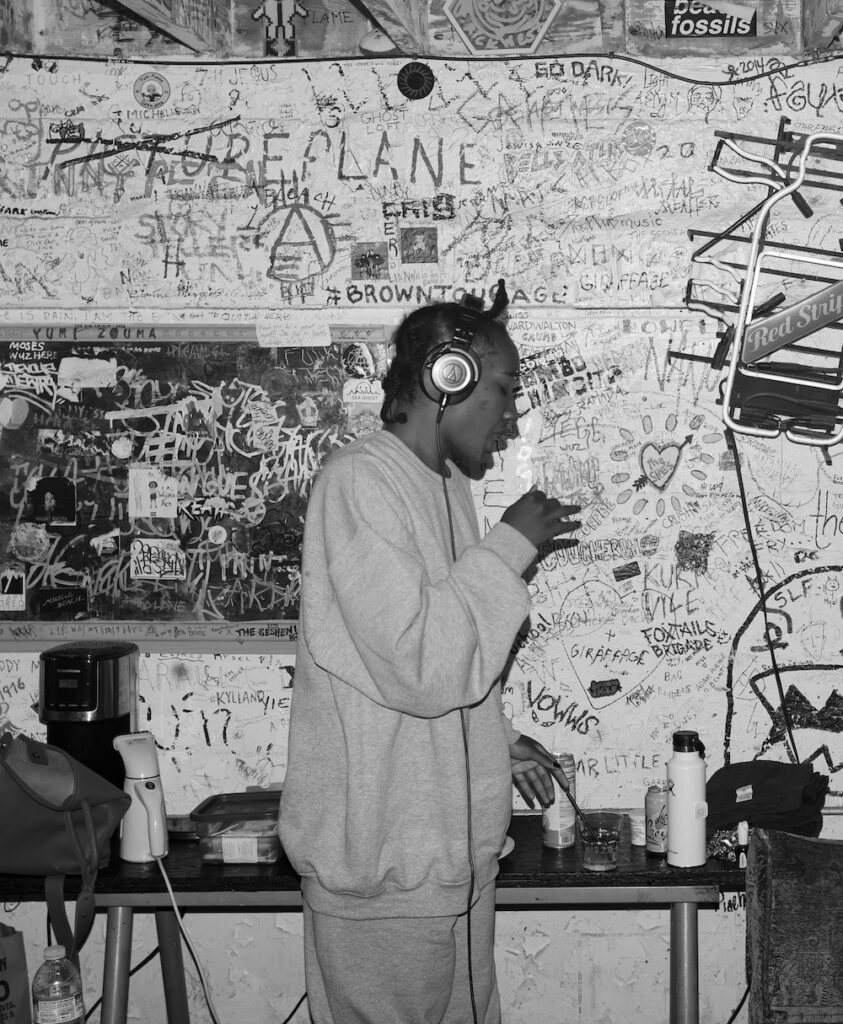
This past year I’ve been trying to change a lot about my life. In addition to sobriety, I felt like I wanted to tap back into my community in an intentional way. Volunteering at the farm seemed like an opportunity to learn more about myself and important history. Both my parents serve imprisoned populations, or formerly incarcerated people. And that seemed like a moment for me to develop my relationship with that in a more personal way. Of course, I don’t believe in the prison-industrial complex, but what have I done to show up or learn more about this?
48 HILLS It sounds very inspiring.
AROMA It was, definitely. And hearing Joy James talk, while I was developing this—it felt very serendipitous and affirming of the direction of the project.
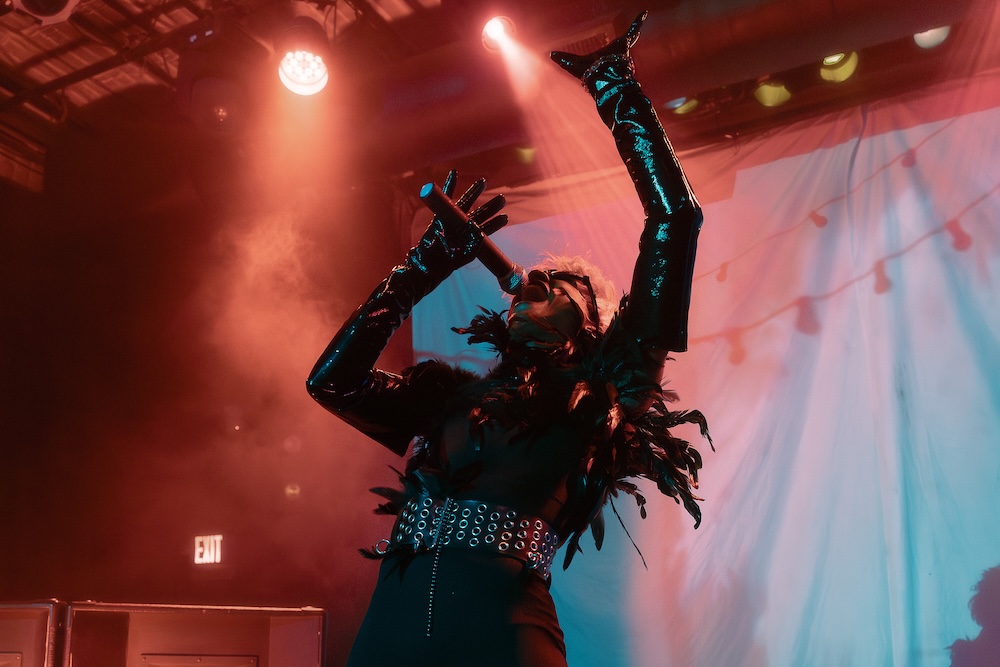
[Getting back to Babylon], it started off with the crow character. When I’m doing live performance, I think a lot about texture—texture of songs and texture of character. And the crow character, a lot of the movements were very sticky, a lot of poses and angles, a lot of spinning, to emulate the character’s disorientation. Like a broken-winged bird falling from the sky. Experiencing the moment where, if you’re talking about the stages of the captive maternal, you acknowledge the fact that this system was never made for you and you’re dying within it.
A lot of the songs were about that. The song ”Babylon,” the lyrics are, “Like a burning weapon in a room of dark smoke. Take just a moment, just to show I care, in the burning building where I got my heart broke.” When I [sing], “Like a burning weapon in a room of dark smoke,” I allude to guns, because of my own experience with trauma related to people passing through gun violence, but also being weaponized yourself. And then it’s like, [sings] “What are we gonna do? What if the sky collapses? What if we just keep on dancing?” Our money is funding our oppression and the death of other people. But at the same time, we’re queer and we’re gonna throw dance parties. There is liberation in that, but also escapism.
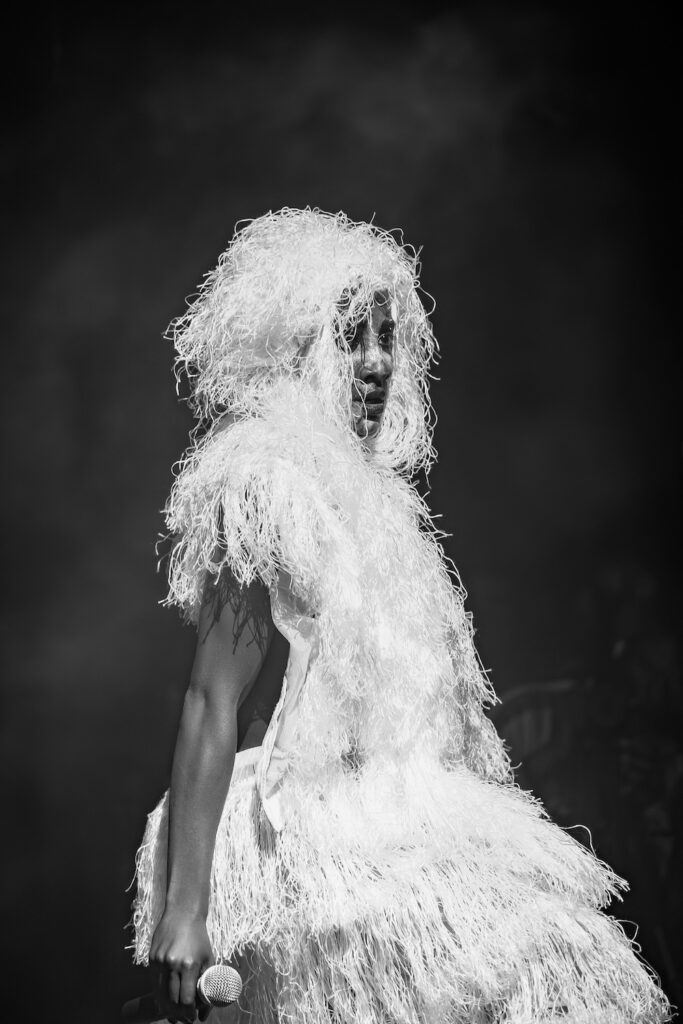
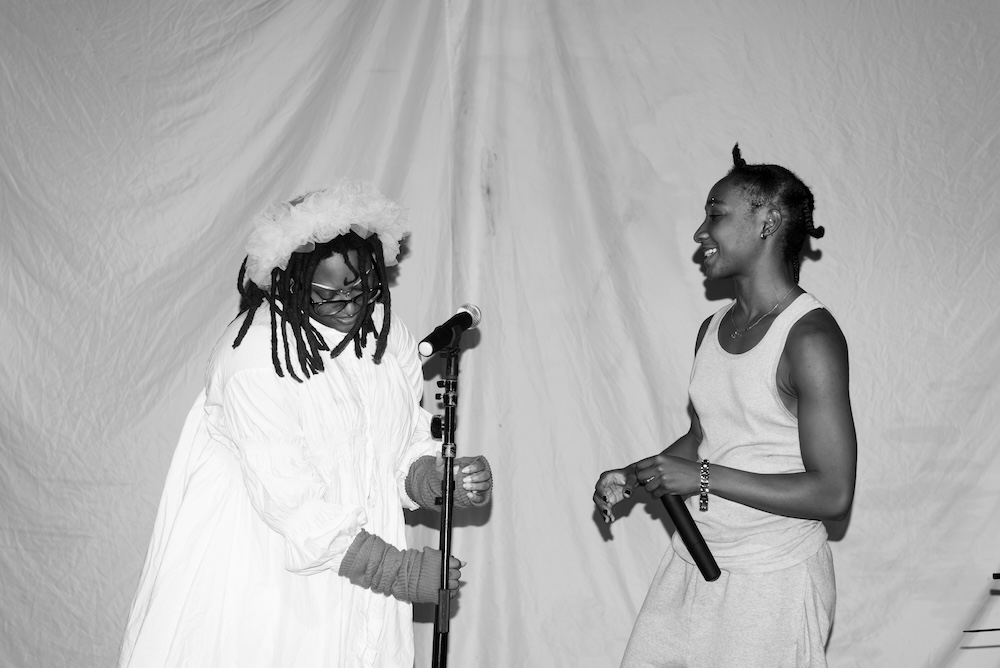
The second character that was all white in that fuzzy thing was an opportunity to commune with ancestors, this moment of waking up. That’s when the song “Eyes” played. [sings] “When I look in your eyes, I belong.” There’s also a track in that section, “Real Life,” where it’s like, [sings] “Take me somewhere I can call home when I’ve been seeking safety, because I can be your lover in real life.” It’s this idea of stepping out of that confusion, out of that disorientation, and finding connection. Now you’re waking up, even though it’s scary.
And then the last character, the last act, becomes the militant, which also parallels the idea of captive maternal, where you have this reckoning and then you become the rebel. A lot of those songs [were] way more active. There were a lot of energetic, really in-your-face [songs], and then the final song goes back to being something softer, which was that song “Wide Open.” Although there was this violence, this necessary violence, there’s something kind of soft and tender [in] why you’re fighting this way in the first place. The poet Nyfe, they were my poetry mentor when I was like 17. They’re also in a band called Closegood. Their poem was about motherhood. We had talked about the captive maternal and what it means to be in the belly of the beast while raising it, in the sense that there’s a lot of labor put on Black women to hold the line.
And then of course it opened with Eartha Kunt sticking the American flag in her ass, which was just perfect! [laughs] The visual artist who was doing projection work, Dil, did their own deep dive on the biblical city of Babylon, and was incorporating their interpretation of those visuals into what they were showing. A lot of this becomes so collaborative. Here’s this inception of this idea, this energy, and then everybody just runs with it in their own direction. Nothing’s too strange.
48 HILLS Do you think that art can affect some kind of political change or political awareness?
AROMA Yes, but not in the sense that art is going to write the policy change. But art can make people care, and I think people need to care in order to save the world. It’s that erosion of apathy, and that erosion of the perceived disconnect between people. You’re feeling something that is evoked by somebody that’s not you. Sometimes that can be odd and unfamiliar, but at the same time, you’re emotionally connecting to this story or these people. I do think that is the role of the artist, to honestly reflect the time, and then to allow yourself to feel in the process of doing or creating.
48 HILLS I think a lot of your art is super-connective with other people. I’m really interested in how you approach creative collaboration—both bringing the community into the work and then also portraying the community in an outward-facing sense.
AROMA There’s a really intimate part of creating with people, depending on the collaboration, which might be a new exploration to be that vulnerable. It has a lot to do with trusting and wanting to know people. I struggle a lot with feeling isolated emotionally. Collaborating with people is also my attempt to know my friends deeper through creating together. You see a whole different side of them.
Also, I like people who like to be pushed, who like when I throw things at them. This is how I’ve learned how to connect with people in a consistent way. And I’m a pretty open person. If people wanna test something out, or if it’s somebody I hadn’t really collaborated with before, OK! It comes about really organically.
48 HILLS Yeah, totally. I know you’re working on the record, and you were talking a little bit about it earlier. I’m curious, what’s inspiring you as you’re putting it together, and what can people expect from it?
AROMA I didn’t realize how up it is. Like, damn, is this my happy era? [I’m] experimenting with breakbeat, some of the songs are dance-y, uptempo. There’s also a lot of soundscape. The last track is seven minutes long, and it’s more like an open, trance-y jazz jam. I’m giving myself time to really breathe and sit with it. I’m not doing all this to subvert expectation, I’m not necessarily on the same tip as like, kick-down-the-door energy. But a lot of the ways I’m producing [are] very nonlinear. Usually I would go in there and structure it, but this time I’m like, “a minute and a half before the beat drops, where it’s just a weird guitar texture? Yeah, we’re just gonna leave it like that.” There’s also a lot of live instruments, but not in the traditional five-part band sense.
The project itself is called Palms, which is about touching and being touched, impact and accountability, acknowledging when you’ve been impacted. I don’t like to tell people when I’ve been hurt or frustrated by things, because it feels like I’m admitting weakness. But the music is processing what it [means] to accept that you’ve been impacted, and come to terms with the fact that you’ve impacted other people, and still find enough love for yourself to continue your journey. There’s a lot of writing about hands, or things that hands do, whether it means hold on or let go, or to harm.
48 HILLS That’s all the questions that I have, but do you have any stray thoughts, anything you wanted to toss in?
AROMA I think it’s strange being so clearheaded now, because it still feels like I’m figuring out how to channel and direct a tornado. But I’m seeing all of it with this piercing clarity, which is fun. And I think the music I’m making now reflects that. It feels like a storm in my mind, but in the best way. It’s a real interesting phase in my life. I’ve never existed like this before.
Also, anyone who wants to let me do Babylon anywhere else, I would love that—venues, art spaces, doesn’t matter!
48 HILLS Yeah! Hopefully someone sees this and is like, “I got you.”
MASC4MASCQUERADE feat. AroMa. June 26. Eli’s Mile High Club. Tickets and more info here.