
The tail-end of summer is typically a time when a lot of movie “leftovers” get released—films that for whatever reason did not have great commercial expectations attached to them, and are being dumped into the market during a relatively fallow period for big openings. (The same thing happens in January, when the Christmas rather than summer blockbusters are still occupying theaters, so new releases tend to be minor.)
Unless you’re exclusively enthused by the latest giant franchise installment, this actually makes things more interesting for a brief spell. Titles that got delayed, shelved, or were just too idiosyncratic for a major push get their moment, and some of those invariably turn out to be not half bad.
The one certifiable “big” movie opening this Friday, Ridley Scott’s dystopian-future adventure The Dog Stars, did not advance-screen in time for deadline. But two more adventurous films that were at least intended for a broad mainstream audience are also arriving, both unfortunately preceded by lengthy, well-publicized offscreen woes.
Coyote vs. Acme became a cause celebre among fans and filmmakers when nearly three years ago Warner Bros. abruptly announced they wouldn’t release the feature—they preferred to use it as a tax writeoff. Since those who’d seen director Dave Green and Samy Burch’s already-completed movie were full of praise, an avalanche of bad publicity soon convinced WB to at least make it available for sale to another distributor.
So…some time later, here we are, with relatively low-profile Ketchup Entertainment having finally acquired CvA for considerably less than the original asking price. Is it a great movie? No. It is fun, though—a mix of live action and animation very much in the vein of Who Framed Roger Rabbit?, and worthy of the comparison.
Will Forte plays an ambulance-chasing Albuquerque lawyer whose firm is hired by one Wile E. Coyote to sue Acme, “the biggest corporation in the world,” as that wolf-adjacent canine has decided its faulty products have perpetually thwarted his attempted captures of the Road Runner. Acme’s smug chief counsel is played by John Cena; other principal roles are filled by Lana Condor and Luis Guzman, plus Foghorn Leghorn, Daffy Duck, Bugs Bunny, the Tazmanian Devil, Elmer Fudd, etc.
Needless to say, this is the most slapstick-oriented ostensible courtroom whistleblower drama you’ll ever see, with an opening setpiece worthy of the original Road Runner cartoons, and a fairly clever if eventually over-earnest screenplay. (Yes, it’s all more or less tongue-in-cheek… still, that inspirational uplift gets a bit cumbersome.) Voice wizard Mel Blanc is missed, though Eric Bauza and others do their best to compensate. You can see why Warners balked: This movie is pure fan service, maybe a little too grownup for kids and not quite grownup enough for those less-than-wholly devoted to Looney Tunes. But it is nimble, good-looking, and consistently amusing if seldom hilarious. It opens in theaters nationwide this Fri/28.
Going straight to US streaming platforms on Tues/25 is The Deb, another movie dragging an unpleasant backstory. Adapted from a well-received Australian stage musical by Megan Washington and Hannah Reilly, performer Rebel Wilson’s directorial debut arrives here two years after its festival premiere. In the interim, and even before, its status was put in limbo by a grisly tangle of accusations and lawsuits between Wilson, her producers, and at least one cast member. The bad vibes no doubt partly resulted in its making back only about one-hundredth of its production cost at the Australian box office.
It’s a pity, really, because The Deb itself is a high-spirited, refreshingly old-fashioned musical, with people who can really sing and dance bursting into song and dance. However, the material they’re selling is more uneven than the talent on display. Sydney high school queen Maeve (Charlotte MacInnes) is expelled after she takes her TikTok “activism”-cum-self-promotion too far, exiled by exasperated parents to dusty outback hamlet Dunburn. There, she’s instantly embraced by sad-sack cousin Taylah (Natalie Abbott), but viewed as competition by local mean-girl rivals. Everyone will have tolerance lessons to learn before the inevitable happy ending.
Borrowing elements of Clueless, Muriel’s Wedding, and myriad other predecessors, The Deb broadly satirizes “woke” and “cancel” culture, as well as rural Oz stereotypes. Like much Aussie humor, it wavers between the energetically off-color and crudely mean-spirited, with Wilson lending indiscriminate equal emphasis to both. (Particularly in her own onscreen role as the chief mean girl’s meaner mum.) The songs are solid 21st-century pop… which is to say more Taylor Swift than Oklahoma! (or even Hair), so a matter of generational taste.
It’s a very lively, colorful package with a lot of swagger, though the charm might’ve worn less thin at a running time much shyer of two full hours. The offscreen conflicts appear to have left everyone’s reputations a tad scorched. Nonetheless, mixed bag as it is, The Deb makes it clear Rebel Wilson can pull off a splashy populist entertainment.
There are numerous other noteworthy features and events landing in the next few days:
American Doctor
One of the year’s most hard-hitting documentaries, Poh Si Teng’s film centers on three US physicians who volunteer to assist desperately understaffed hospitals in Gaza, where such facilities themselves now often appear to be targeted for attack by Israeli military forces. “What surprised me most was how the carnage that was induced really focused on children, healthcare workers and journalists,” Dr. Mark Perlmutter tells CNN—which then frantically tries to backpedal from his statement.
Is acknowledgement of that in itself “anti-Semitic”? Perhaps in the minds of those who think “Palestinians want to destroy us” as one Israeli woman online claims. But the parade of bad-faith governmental moves, media misdirection and bombing footage here suggests a considerably less one-sided truth. Essential viewing for those on all sides of the conflict, Doctor opens Fri/28 at Bay Area venues including SF’s Roxie, Oakland’s New Parkway and the Smith Rafael Film Center.
Idiots
After that grim but educational watch, you may need a good laugh. Probably the funniest movie I’ve seen yet in 2026 is this latest from writer-director Macon Blair, which has changed its title from The Shitheads because…well, I guess they realized they might actually need to advertise. Dave Franco and O’Shea Jackson Jr. play two very different habitual screwups thrown together when each manage to get fired from their already low-end jobs. That lands them in charge of driving rich “troubled youth” Mason Thames to some kind of luxe juvie/rehab faciilty.
They fail to gauge that this seemingly harmless emo saddo is in fact a wee evil genius, who gets them dosed on hallucinogens and neck-deep in trouble asap. Others eventually roped into the escalating road-trip fiasco include Kiernan Shipka as an immigrant stripper and Peter Dinklage as the ringleader of a stupendously dysfunctional would-be criminal trio.
Blair occasionally flirts with content almost too “dark” to be comedic. Yet this collision between The Last Detail and Smiley Face always manages to stop just short of wiping that smile off your face. High tolerance for “bad taste” is required in a movie that is definitely not for everyone. But I’ll admit, I howled out loud more than once. The film opens Fri/28 at Bay Area venues including the Alamo Drafthouse New Mission.
Black & Pink: Retro noir and Nippon sex cinema return
Two color-coded vintage genres with devoted fan bases are back. The Lark Theater in Larkspur is having a relatively short (six days) but packed retrospective showcasing “Film Noir: The Dark Side of Cinema,” starting Wed/2 with Impact—a rock-solid 1949 “B” crime thriller shot right there in Larkspur, as well as SF and Sausalito.
There’s room for well-known classics of the idiom’s late 1940s/early ‘50s peak like The Asphalt Jungle, The Lady from Shanghai and Touch of Evil, plus one proto-noir (Fritz Lang’s 1931 German M), and several more recent neo-noirs (Chinatown, sci-fi Dark City, horror-adjacent Angel Heart, graphic novel-derived Sin City). There are also two prime noir spoofs: The aforementioned 1988 ‘toon/live action hit Who Framed Roger Rabbit?, and 1978’s Neil Simon-penned The Cheap Detective. Not a spoof is the 1947 Lured—which will afford you a prime view of Lucille Ball in the hardboiled-dame mode she frequently assumed before I Love Lucy recast her image as a daffy comedienne. Further details on the entire series, which runs through Mon/7, can be found here.
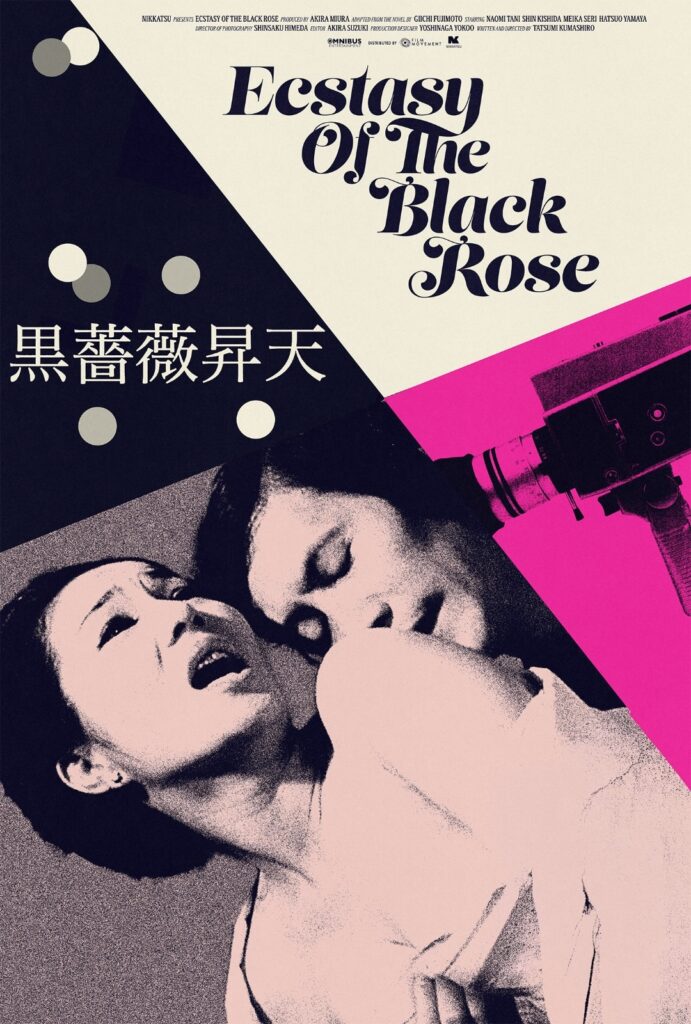
The US golden age for softcore sexploitation was the 1960s, before censorship laws loosened enough to permit hardcore pornography. But those films were usually independent productions made on a shoestring, often amateurish. Equivalent Japanese films usually got made under the auspices of legitimate studios, their modest budgets boosted by experienced crew and above-average technical qualities. Considered an acceptable early career step for promising young directors these pinku eiga (pink film) have retained a place in the industry since the 1960s—in part because they have some artistic or entertainment value beyond straight-up porn, but also because Japan still bans graphic sex (with digital “fog” obscuring genitalia) onscreen.
This genre’s peak was in the 1970s, when Nikkatsu—the nation’s oldest extant studio—dominated with its “Roman Porno” films, which were basically pinku kicked up a notch in quality and creative freedom. Several such 35mm widescreen oldies are getting released to streaming platforms this month. Already available are two by director Tatsumi Kumashiro, 1973’s moody, nihilistic drama Lovers Are Wet and 1975’s Ecstasy of the Black Rose, an eccentric semi-satire of pinku production itself; plus Noboru Tanaka’s 1972 Night of the Felines, a plotty ensemble piece amongst bathhouse workers that wends towards a surprisingly poignant conclusion. Arriving this Fri/28 is Tanaka’s Watcher in the Attic, a stylish tale of myriad perversities within a 1920s Tokyo boarding house that combined several stories by the famous writer Rampo, and was a big box-office hit in 1976. All can be streamed via arthouse site Film Movement, and on other digital outlets.
Out on a Limb: ‘Bouchra,’ ‘The Dollmaker’
Two strikingly imaginative recent features that bypassed Bay Area theaters are arriving on streaming platforms this week. Orian Barki and Meriem Bennani’s Bouchra is a multilingual seriocomedy of rather obviously autobiographical roots. Its protagonist is a 35-year-old Moroccan emigre making her first film project in Manhattan, while simultaneously dealing with cultural gaps, family obligations (notably a mother left behind in Casablanca), and the lesbian dating scene.
That premise is promising enough. But the creators really ratchet their concept up a few notches by having all the characters depicted as animated anthropomorphic animals—our heroine (voiced by Bennani) is a jackal, for starters—and making free use of various cinematic techniques for everything else. Bouchra is complex, nuanced, flip and funny, an exercise in bemused navel-gazing that could hardly be less dully self-indulgent. It launched on Digital and On Demand platforms August 21.
In Jose Maria Cicala’s Argentine The Dollmaker aka Encantator, young women keep disappearing in an otherwise sleepy town where Tomas (Rodrigo Noya) works at both the local medical clinic and inexplicably Boy Scout-themed video store. He still lives at home with his seldom-seen mother…and if you’re getting Norman Bates vibes here, you are not wrong. But then everything in this burg is more than a little “off,” its everyday surrealism humorously macabre in a familiar way underlined our hero’s family name (Lynch).
Many a filmmaker has paid lavish tribute to David Lynch, only to land in a bog of derivative, self-conscious weirdness that’s a poor man’s notion of the late master’s unique style. Cicala does not fully transcend imitation in what feels like a pastiche of many movies and directors’ ideas. But he does combine those elements into a slickly produced, aesthetically accomplished, simultaneously grisly and absurd whole, one that straddles thriller and midnight-movie terrain to intriguing effect. Cinephobia is releasing Dollmaker to VOD and digital platforms on Tues/25.
End Times: Horror in ‘It Ends,’ ‘Colony,’ ‘Penny Lane’
Travel is less broadening than life-threatening in three diverse new horror movies. The US It Ends from writer-director Alex Ullom has four twentysomething longtime friends (Mitchell Cole, Akira Jackson, Noah Toth, Phineas Yoon) reuniting for a late-night drive. They gradually realize the country road they’ve turned onto is some kind of alternative dimension—a time warp, purgatory, whatever. It cannot be escaped, as evidenced by the periodic attacking hordes of people already stranded here. As the central/only characters come to grips with this apparently permanent situation, they adjust… or don’t.
Billed as an “existential road trip,” It Ends has a confident, admirably unfussy approach to its fantastical conceit, one more interested in psychology than jump scares. Yet I didn’t find these still-immature youths terribly interesting, their company as well as the narrative growing repetitious after a while. While the film has gotten some strong reviews, the next time I want something like No Exit, I’ll stick with Sartre. It opens in Bay Area theaters including SF’s Kabuki and Alamo Drafthouse this Fri/28.
A contrastingly large cast plays out the large-scale crisis of the South Korean Colony, which opens the same day at Bay Area venues including SF’s Roxie. Having gotten sacked from academia for ratting on a colleague, Se-jeong (Jun Ji-hyun) is dragged to a biotech conference by her well-meaning ex-husband, who hopes she might snag a new post in her field of expertise there. Unfortunately, also attending is a disgruntled ex-employee of the sponsoring corporation. He (Koo Hyo-hwan) unleashes a virus he’s invented that not only turns people into ravenous de facto “zombies,” but enables them to rapidly evolve through “collective intelligence,” so they fast conquer any obstacle put their way by trapped survivors.
Colony takes place almost entirely in an urban office highrise with its own mall, so Dawn of the Dead is one obvious reference point. But despite the “evolution” gimmick, and director Yeon Sang-ho’s expertise with near-constant action, this ends up feeling like a less-inspired attempt to repeat the success of his biggest hit, 2016’s Train to Busan—among the biggest and best 21st-century zombie movies. It’s an entertaining watch, to be sure, but well short of memorable.
Finally, the proverbial weekend jaunt to an isolated vacation home naturally turns out to be a huge mistake in the Australian Penny Lane Is Dead, which begins streaming on genre platform Shudder Fri/28. Partly an ode to that land’s scrappy vintage thrillers like Wake in Fright and Razorback, it’s set in 1986, when recent high school graduate Penny (Bailey Spalding) invites BFFs Toni (Tahlee Fereday) and Amy (Alexandra Jensen) to a family beach house for a last hurrah before uni. Also invited as an olive branch—though no one thought she’d actually show up—is Penny’s cousin Kat (Sophia Wright-Mendelsohn), a deep-dyed bad girl who alienated them all some time back.
Kat arrives full of resentment, insults and malevolence, soon getting herself thrown out. But she’s retrieved by her “boyfriend” Angus (Ben O’Toole), a much older ex-con, and his criminal associates (Fletcher Humphrys, Steve Le Marquand). Once they join the “party,” things go from bad to much, much worse. Well-crafted and vigorous (not least in its sky-high violence), writer-direcctor Mia Kate Russell’s debut feature is the kind of movie that’s borderline—“good,” but almost too nasty to be enjoyed, like the gnarliest of retro exploitation films it lends a not-entirely-redeeming Grrr Power spin to.