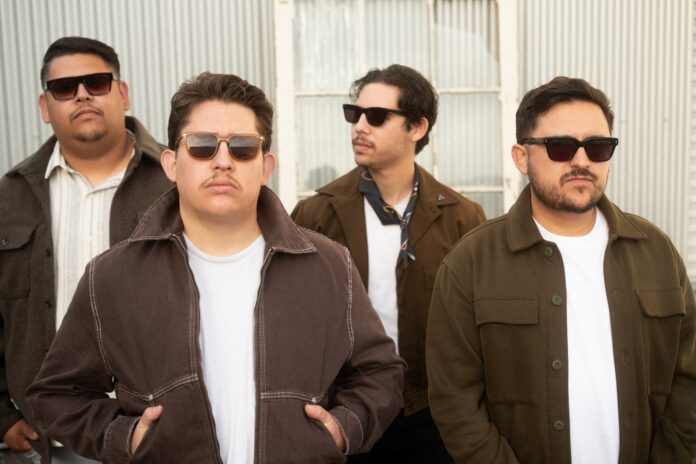
It’s not often, if ever, that rock en español is coming out of the Bay Area. Even less likely is that it’s written and locally recorded by a family of Mexican brothers from Cherryland—a small, unincorporated community just north of Hayward.
But for The Cires (an acronym of member names Cessar, Isaac, Ruben, Edwin, and Shannon Soto), making bops that reflects their bilingual upbringing and dual heritage is all they know.
Isaac, the eldest of the brothers, and their father, Ruben, were born in Mexico before immigrating from Zapopan, Jalisco, to California. The rest of the brothers were born in the Bay Area; as young children, they formed a band to perform at family parties and neighborhood events. Initially, their father played in the band with them, but as the boys grew, he became a fan and supporter in the crowd.
Decades later, they’re still at it. With “surf rock meets Spanish rock meets indie rock” vibes, The Cires are now showcasing their evolution of music as a family group. Latest album Danza de Soles, which releases on September 18, is a testament to their diverse inspirations and long journey.
The 10-track, 34-minute project, which took nearly two years to record, due to juggling work schedules and booking studio time for the four brothers, is poised to bring attention to the Bay’s overlooked and perhaps oversimplified rock en español scene. They hope to put Spanish-language rock back on Northern California’s radar, reaching beyond the popular Mexican regional sounds that most think of when considering contemporary Mexican genres.
“There are other Latino artists in the Bay, but not as many as [a larger region like] Los Angeles,” says Isaac, the group’s lead-singing guitarist. “Part of our decision for this album is to represent the Bay Area Latino rock en español community. We also made a decision to write the majority of songs in Spanish to lean further into our roots and try to show that Mexican music is much more than regional or urbano; there is a very rich rock alternativo movement in Mexico and Latino America.”
Eight of the album’s songs were composed and performed entirely in Spanish (the remaining two tracks, “Alone” and “Going the Distance,” are in English, but were recorded separately and are formerly unreleased songs). It’s an intentional move from the bilingual brothers—who are known for covering everyone from The Beatles and Creedence Clearwater Revival to Angeles Azules and Tigres del Norte—in order to assert their own place on the evolving continuum of Spanish rock, particularly in the Bay.
There was once a wave of Latin rock artists in the region from the late ’60s to the ’90s, when artists like Carlos Santana and Los Mocosos were crucial in pioneering California’s Latin rock elements. But that has mostly fizzled out. The Cires are aiming to revive it: with their own Jalisco twist.
Having performed for the decades at parties and weddings (full disclosure: The Cires played a live cover set at this writer’s wedding), they’ve developed their own unique aesthetic, with an appreciation for the varied, multicultural tapestry of Cali-Mexicano influences that have shaped them as a family and band.
“This represents the music we grew up playing,” Isaac told 48 Hills. “We have a double identity as a band, where we get hired at parties to play our eclectic mix of music, which then funds our other identity where we write and record our original music.”
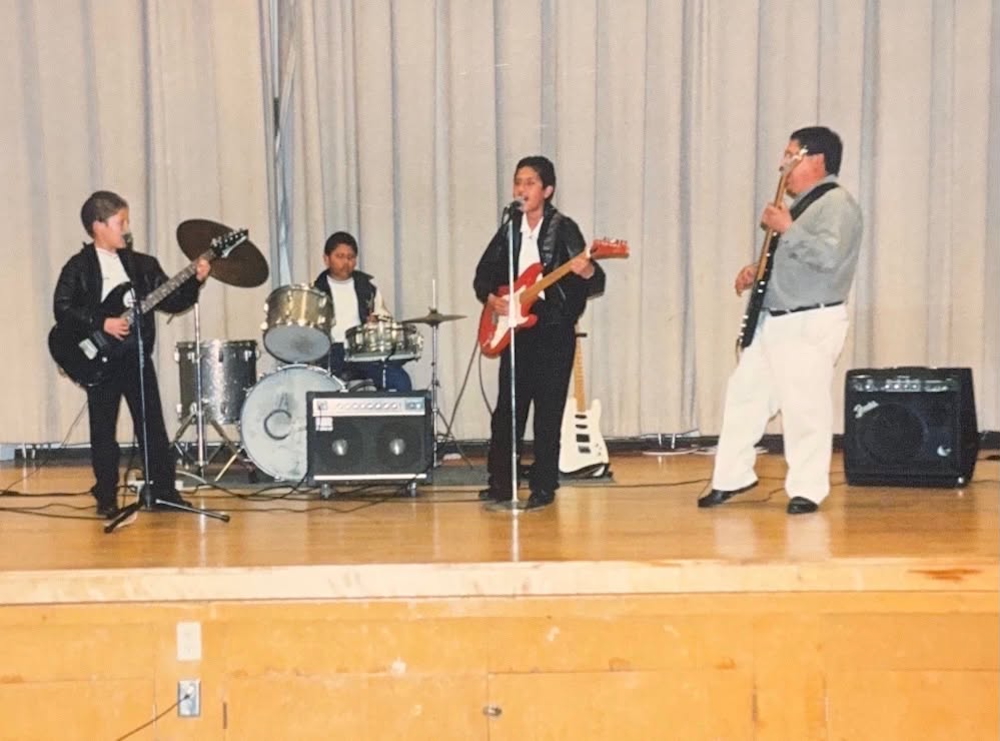
In addition to Isaac, the band consists of Edwin (second oldest, bassist), Shannon (third oldest, drummer), and Cessar (youngest, keys). Having been raised together in a house of seven family members—including their father, mother, and sister, Arleene, who made her musical debut on the album as a guest vocalist on “Lluvia Lenta en Zapopan”—their bond is organically tight, with the fun-loving, jesting dynamic of brothers who grew up doing everything together: riding bikes and playing soccer, then tuning their instruments and harmonizing.
At its core, Danza de Soles is an ode to the romantic Mexican rock ballads these brothers grew up listening to in their home. Songs like “Hace Tiempo” call upon the romanticas and boleros of their childhood, made popular by groups like Los Freddy’s (a ’60s rock en espanol group from Guadalajara). Gentle ballads like the aforementioned “Lluvia Lenta en Zapopan,” recalling the soft rainfall and singing birds that can be heard from their abuela’s patio in Zapopan, a city that is part of metropolitan Guadalajara, also tap into the American folk song tradition with an unadorned, Bob Dylan-esque directness and poetic softness that is stripped down to the acoustics and tender vocals.
“Lluvia Lenta en Zapopan,” in particular, emphasizes the group’s yearning for Mexico and their family on that side of the border. As the album’s final installment, it directs the listener’s attention towards Mexico as well, rather than the chaos of the Bay Area. It’s a feeling that many Mexican American and Mexican-born Americans who live in the United States can relate to, one of romanticizing and desiring the calmer, family-centric lifestyle in the places that their loved ones, or they themselves, originated from.
In the case of The Cires, their relationship to Zapopan runs deep, and more than any of their past albums, they’ve tapped further into it.
“This project has truly been a family affair,” Isaac says. “That last song on the album is a reflection on our abuelita Lupe’s home in Zapopan. It was magical because we wrote that song in the studio on the last day of recording and Arleene happened to be there and we asked her if she was down to sing.”
Beyond Mexico and family, the album explores themes of cosmic exploration, and discovery—as the celestial title (translated roughly as “the dancing of suns” suggests). It’s used as a metaphor for the ways in which romantic encounters occur: a process that the musicians have likened to the cycles and rotations of planets.
In reflecting on the album, which was recorded on spare weekends at Holly Grim Records, a storage facility-turned-studio in Fremont, Isaac admits that making music as a working family isn’t easy. For them, it’s a craft of passion, rather than of commerce. They do it knowing that their parents sacrificed everything to provide a life of comfort for them in the Bay Area. They do it knowing that nothing is guaranteed: Isaac was once separated from his family and deported back to Mexico as a child, before his parents took legal action and brought him home.
Music is their conduit for connection, their soundtrack for resilience and joy. Danza de Soles is proof of their endurance and growth—in a radical lineage of Spanish rock that spans from Zapopan to the Bay, and beyond.
THE CIRES: DANZA DE SOLES releases Fri/18. The Cires will be headlining that night at Spats in Berkeley alongside Sore Thumb and Dear Banshee. Doors open at 7pm, $15 entry.