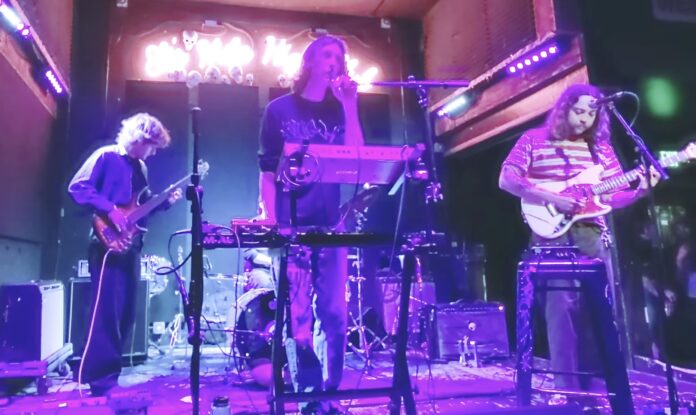
When word got out last week that Eli’s Mile High Club, the East Bay staple for live music, would be closing down at the end of October, regular performing bands and patrons of the venue alike were triggered.
Here we go again, another vital music venue in the Bay Area, shutting down.
The news came on the heels of a series of venue closings over the past 13 months that includes Bottom of the Hill, Thee Parkside, and Edinburgh Castle.
This one cut deeper than most, though—opened in 1974 by Eli Thornton, the Oakland club became an epicenter for the Western blues movement and a hub for Black music, hosting luminaries like Big Mama Thornton, Etta James, and James Brown, as well as more than a few Black Panthers legends.
Then it transitioned into more of a scrappy, DIY punk and indie venue, continuing its underground vibe and streak of musical brilliance. In 2024, the city red-tagged the club’s famous patio, forcing it to face an uncertain future.
On Saturday, the club announced that it would not close its doors for good, but would shut temporarily. Whether it reopens fully is an open question, but at least there’s a glimmer of hope in sight. The club has raised more than $90,000 with a GoFundMe that launched in March, with a stated goal of $150,000. Owner Mathew Patane says that the money will go toward the necessary upgrades to keep Eli’s viable as a venue.
We at Under The Stars reached out to East Bay performers who not only play Eli’s, but also consider the venue part of their community. We’re thankful for the time and thoughtfulness of Danny Snyder, guitar and organ player from the Oakland-based cumbia outfit Combo Tezeta, as well as Elihu Knowles, vocalist and musician from the Richmond-based fusion quartet Pateka.
Here is what they had to say…

48 HILLS What was your initial reaction to the news that Eli’s may finally have called it quits?
DANNY SNYDER We were saddened by the loss of another venue. Live music needs to be cherished as a precious part of our local culture, and there needs to be a variety of small venues where musicians can find their audiences and themselves.
ELIHU KNOWLES I was devastated—Eli’s is hands down one of my favorite venues in the Bay. I’m holding on to hope that they’ll be able to bring it back, but chances feel slimmer, with the trajectory of local venues these days.
48 HILLS Can you explain how it feels to perform at Eli’s, and what the space sounds like for a performer?
DANNY SNYDER We love playing there; all our shows were well attended, and the audience is there to have a good time. Especially during its recent heyday, when the back patio was open, it was a highlight of our year to play there. We consider ourselves Oakland-based, and that club is peak Oakland.
ELIHU KNOWLES Eli’s was one of my favorite rooms to play. They had a super-nice green room, decent hospitality for artists, a good soundsystem, and every sound engineer I worked with there was very skilled. The location was great too, nicely central in the East Bay and easy to get people out to. We knew shows we’d play there would have decent sound, and we’d feel comfortable, which made it our go-to venue for shows we really wanted to do well.
48 HILLS For bands coming up, especially in the East Bay, how do they move forward and survive?
DANNY SNYDER That’s a hard one. It’s not enough to want to play somewhere; you have to be able to convince a booker that you’re worth having on the bill. As we have fewer places to play, there are more bands competing for fewer slots. Bands need to concentrate on several things: having good stage presence (which can be achieved in a multitude of ways); playing and hopefully writing music that can at least potentially appeal to an audience; realizing that you’re part of an artistic ecosystem and engaging with other creatives, as well as frequenting the venues that you want to perform in.
ELIHU KNOWLES It’s tough. As I said to you when we talked about Bottom of the Hill, every venue that disappears tightens up the competition for [a performer booking] a night at the ones that remain. I think that hurts the smaller, less established bands the most. I think with every venue closure, things are moving [towards being] more DIY. I’ve been seeing a lot more house venues and alternative spaces hosting shows over the past few years, which is the only silver lining in this situation. I don’t think people are going to stop performing, or the scene is going to stop evolving, even if every traditional venue in the Bay shuts down.
48 HILLS Why is the Bay Area losing so many venues right now?
DANNY SNYDER It’s part of a broader trend of restaurants and breweries and bookstores, etc., closing down. The economic realities of smaller, low-margin businesses are getting very difficult to cope with. Add in the enticement of over-inflated real estate values, the lack of municipal support, the trend of younger people drinking less alcohol, and the seemingly endless (and mindless) entertainment of scrolling on your phone, and you have a very poor climate for building a healthy music scene.
ELIHU KNOWLES I think it’s just a numbers game. People are drinking less, the economy is bad, and everything costs more than it used to. Venues that used to make great profit on food and drinks are no longer seeing the same amount of money. The stakes on every show are higher when the margins are tighter. Prices on everything are through the roof, so nobody has extra money to spend on going out, even for a relatively cheap local show. This kinda ties into my previous answer too: with venues needing each show to perform really well, they are less likely to take a chance on a weirder, more left-field bill. A lot of newer local bands are playing more DIY and house shows, where they can charge less or no money and cater to a wider audience (not 21+, etc.). Nobody can afford shit.
48HILLS Final question. For a region known for setting music trends globally, how do these venue closings make sense?
DANNY SNYDER It only makes sense in a society that doesn’t value culture and in-person human interaction, but that seems to be the course for now. It used to be that if you were inclined to put yourself out there and express yourself in an artistic way, it required a public forum where the presenters and receivers can meet. Now it seems a large majority of people think their everyday lives (albeit curated versions) are interesting enough to share with the public, without having any artistic value, and can do so from the comfort of their own phones. One can only hope that people wake up and realize the value of being in a room full of people experiencing something in real time and with each other.
ELIHU KNOWLES I mean, they don’t make sense. As I was kinda saying before, I think a scene can happen anywhere there’s a meeting place for like-minded people, from a traditional venue to a house to a weird back alley. The thing that the venues really do is help connect younger generations of musicians to what’s come before. Older heads who were part of the scene a few decades ago get to interact with what’s going on now, and potentially pass some knowledge on. DIYs are great, but they frequently come and go really fast, so there isn’t much of a throughline between multiple generations of musicians.
I feel like I learned a lot about the Bay’s experimental rock tradition from talking to staff and longtime patrons of some of the venues we played. It helped me understand more of the context of the place we were making music in, and really showed me that the scene we have today is part of a longer continuum of music exploration. I think that sort of thing happens in every city, but I have known it best here in the Bay. I love it when all the Mills College freaks, the noise rockers, the hippies, and the younger punk kids can all come together for a multigenerational bill of weird music.
BALTHVS AT THE INDEPENDENT, OCTOBER 25
The trio that is BALTHVS is still cranking out the psychedelic dreamcast. Like “Fuckin’ Quintana” from The Big Lebowski, they can roll, man. With Balthazar Aguirre on guitar, Johanna Mercuriana on bass, and Santiago Lizcano on drums, this balletic combo with Deadhead adoration, originally from Bogotá, recently set up camp in San Diego. I call what they’re doing comedy. When I caught them at Rickshaw Stop a couple years ago, my first thought was, “If these cats move to the Bay Area, they’d clean up.” Well, San Diego is not Cloud City, but it would seem the band had a similar idea.
Transmutations, their 36 minutes of groove, spiritual jazz improvisations, and numerous other ethereal seasonings of an album from early 2026, only built on the sorcery that ran amok on that 2025 tour. Their upcoming album Manifest, due out in early October, sees the trio expand the vibe, adding vaporwave and Ethiopian-influenced charts to their already swirly bouillabaisse of ideas.
For example, its lead track “Liminal Stages” takes their root psychedelic mood music and slaps it on a drum and bass formula. And buddy? It takes flight.
BALTHVS continues to expand the bandwidth of roots blues music with every new release, but it’s the fearlessness to try it all that makes their approach exciting, even if sometimes it doesn’t work. In most cases it does. You get something that was not on your Ouija board, and that’s their strength and your ongoing journey.
Expect a honking good time as they blow down The Independent.
Grab tix here and pre-order Manifest here.
PERENNIAL, MODERNISM (ERNEST JENNING RECORD CO.)
An attacking, super-svelte, rowdy punk trio who decided fuzz bass and an organ was needed for their celebratory upstart version of rock ‘n’ roll.
Perennial’s songwriting? Not a second wasted. On the eponymous track of album Modernism, they speak of the explosion about to overtake your ears, while simultaneously performing it in your podhole, with shark-like forward movement.
Take heed: ‘I Heard a Rumor, It Sounds True, Baby, Modernism’s Coming For You, It’s Not Fiction, We Got Proof, Baby, Modernism’s Coming For You.”
It’s righteous and assertive—sung, it feels as if it’s all caps—and it’s riff-tastic, with bleeps, fading radar signals, flutes, attitudinal backbeat drumming, and blaring lyrics that hit like amplified edicts. It’s some of the most wisely used 79 seconds on an album opener I’ve heard, besting classic “we are here” album introduction tunes like “Blitzkrieg Bop” by The Ramones and The Pixies’ “Debaser.”
Formed in 2015 in Connecticut by Chad Jewett (electric guitar and vocals), Chelsey Hahn (electric organ and vocals), and Ceej Wolf (drums), Perennial is dead set on freak-beating the bloody bejesus out of you. The group is packing the ghosts of Elvis Costello and The Attractions, The Who, Otis Redding, Stereolab, peak (late ’70s/early ’80s) B-52’s, MC5, Wilson Pickett, Le Tigre, and some other baptized-by-the-beat rockers.
This fantastic rhythm, with angry-happy guitar bursts and dignified organ let free in a rock setup—you can cut to the punchy rippers “The Shadow,” “Baby Are You Abstract?” and “Ready! Steady! Go!” to get a whiff of Perennial going off full tilt. It’s a whole thing, babe. Sheeit. I dare you to buy and play this back to back with the new Sweeping Promises—both confirm that there’s a riot going on. Sorry to bite a Sly album title, but you’re picking up what I’m putting down.
Perennial already played Bottom of the Hill (of course) earlier this year, so we’re going to have to wait for a post-album release performance of the band to pop up in The Bay.
But glory be, when they do… wear your trainers.
Grab Modernism here.