The eccentric narratives of artist John Yoyogi Fortes have evolved over the span of his career into an opportunity to explore culture, psyche, and identity. As a multidisciplinary artist mining the territory of pop surrealism, Fortes gravitates to painting and drawing for their immediacy but integrates video, sculpture, printmaking, and installation for layering, dimensionality, and storytelling potential.
Fortes’ father immigrated to America from the Philippines in 1927 when he was 17 years old. When WWII broke out, he joined the US Army and married.
“Eventually, he was stationed in Tokyo, Japan, where I was born in a taxi on Yoyogi Street, on the way to the hospital. That’s why I have a Japanese middle name. People often assume one of my parents is Japanese, but they’re both from the Philippines,” Fortes said.
The family arrived in San Francisco on a military transport ship while his father went on to Europe, where he was stationed. Fortes recalls his earliest memory, at age five, as looking out a porthole and seeing a barge in the San Francisco Bay.
“We lived in the projects at Hunters Point on Kiska Road and I remember seeing the lights at Candlestick Park from our second-story bedroom window. I also remember that I was the only non-African American student in my kindergarten class that year,” Fortes shared.
Reflecting on early creative influences, Fortes spoke about being part of the 1960s Saturday morning cartoon generation, having spent hours on the carpet watching TV.
“My brother was a car geek so I frequently saw Ed ‘Big Daddy’ Roth’s Rat Fink and other cartoonish monster characters in hot rod magazines. As I grew older, I gravitated toward the raw art and storytelling of underground comics, which opened my mind to where imagination could take me,” Fortes said.
In the mid-1960s, the family moved to Lathrop, a small agricultural town in the Central Valley. Fortes attended San Joaquin Delta College, did a stint in the Air Force, and then attended California State University-Fresno, majoring in studio art.

Fortes says his views were shaped by artists Charles Gaines and Terry Allen who he studied with at CSU, transforming how he navigates, defines, and interprets the world. And he attributes his use of text and wordplay as a direct influence of Terry Allen. Though Fortes left college before graduating, he made a conscious choice to continue evolving as an artist.
Acknowledging the mainstream focus of study on white male artists in college, he sought out the work of Sue Coe, Joan Brown, Nancy Spero, and Kiki Smith. But Fortes says that being exposed to artists of color is what had the greatest impact on his work.
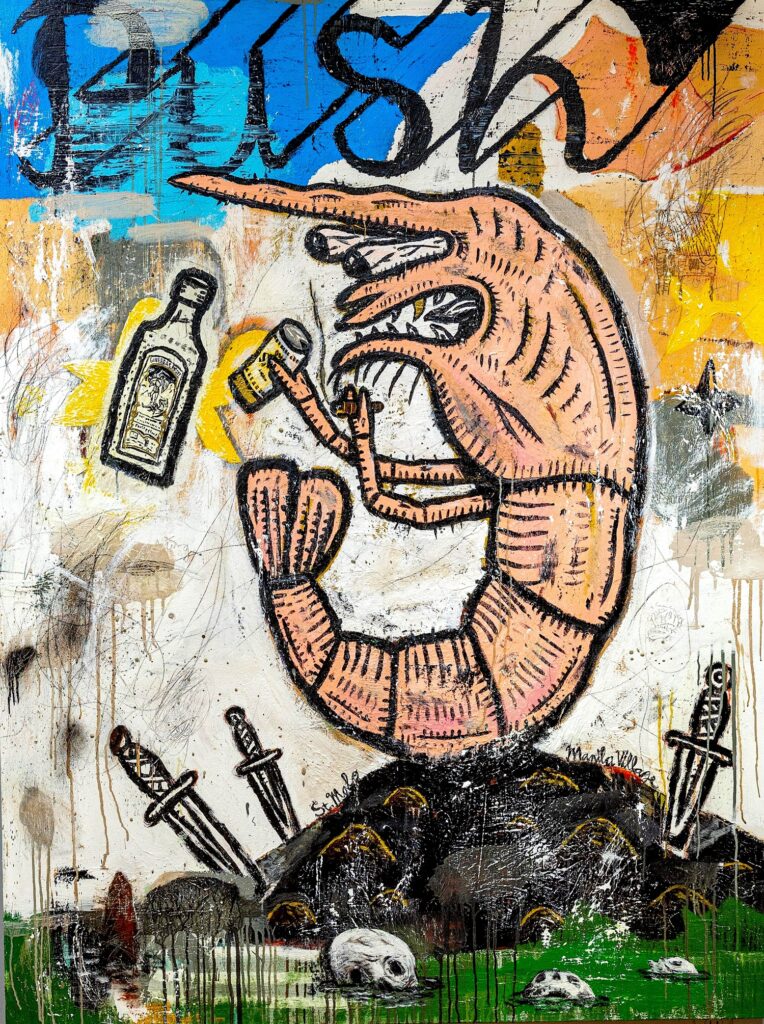
“At the time, I hadn’t yet considered looking into my own Filipino heritage for content or iconography. Meeting Filipino artists Carlos Villa, Manuel Ocampo, Santiago Bose, and others from the Bay Area changed everything, prompting me to examine my own hybrid identity and sense of belonging,” Fortes told 48hills.
At the cusp of the new millennium, the passing of his grandmother in the Philippines and his father’s emerging battle with dementia had a profound effect on Fortes, as seen in his painting, Mental Picture, (2000).
“I made a painting of my grandmother to honor her when she passed away. That was the first time I brought culture into my work, using hundreds of little raised houses on stilts called nipa huts as a backdrop.
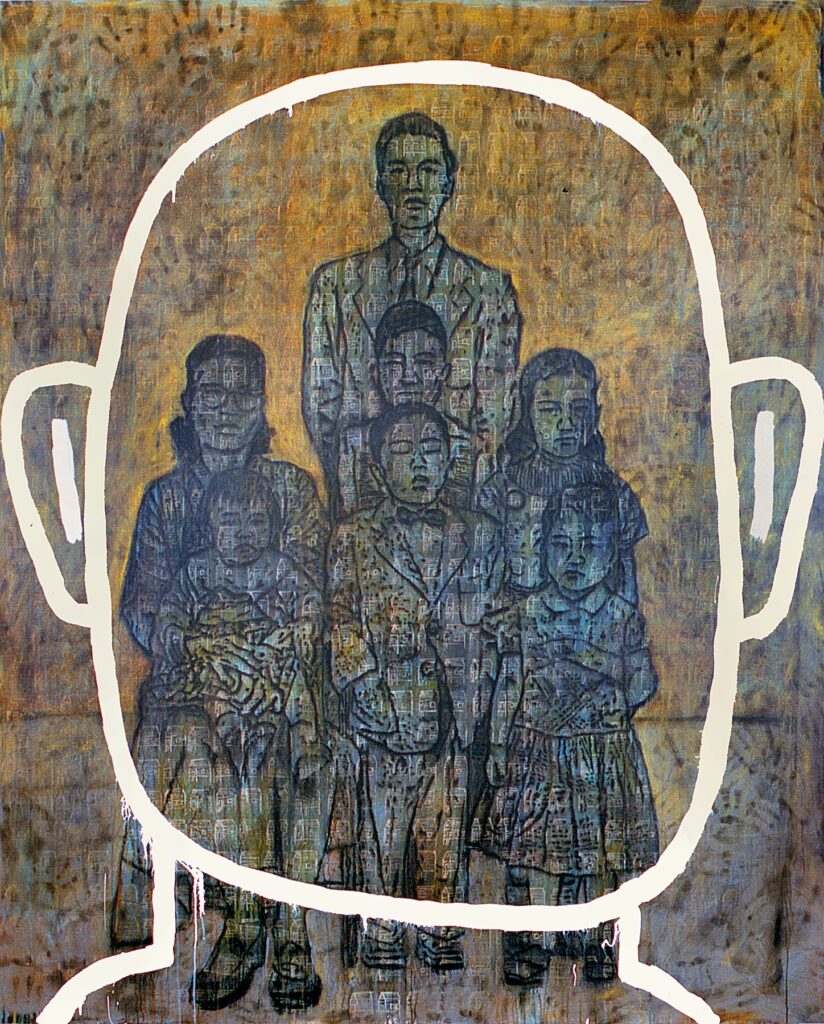
“With my father, making art about his dementia was a way to deal with witnessing his mental decline. The nonsense he spoke became poetry for me. Objects that I remembered in our home became metaphors to form personal narratives. A water buffalo head hanging in the hall became my father, a beast of burden of sorts, providing for his family. I see this period as a time spent building my own iconography; I had something to say about what was happening and my feelings about it,” he said.
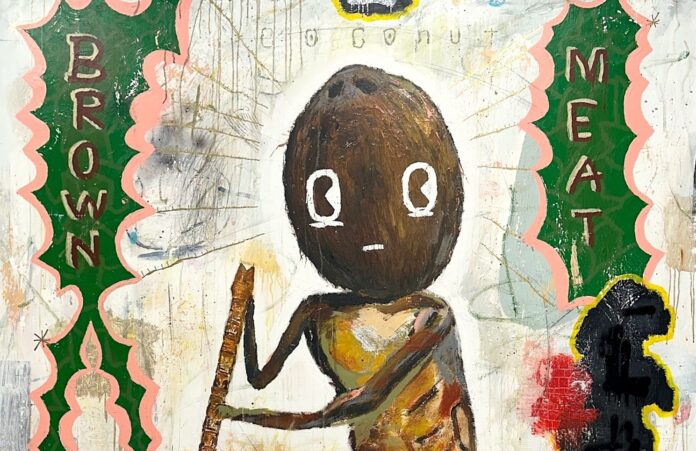
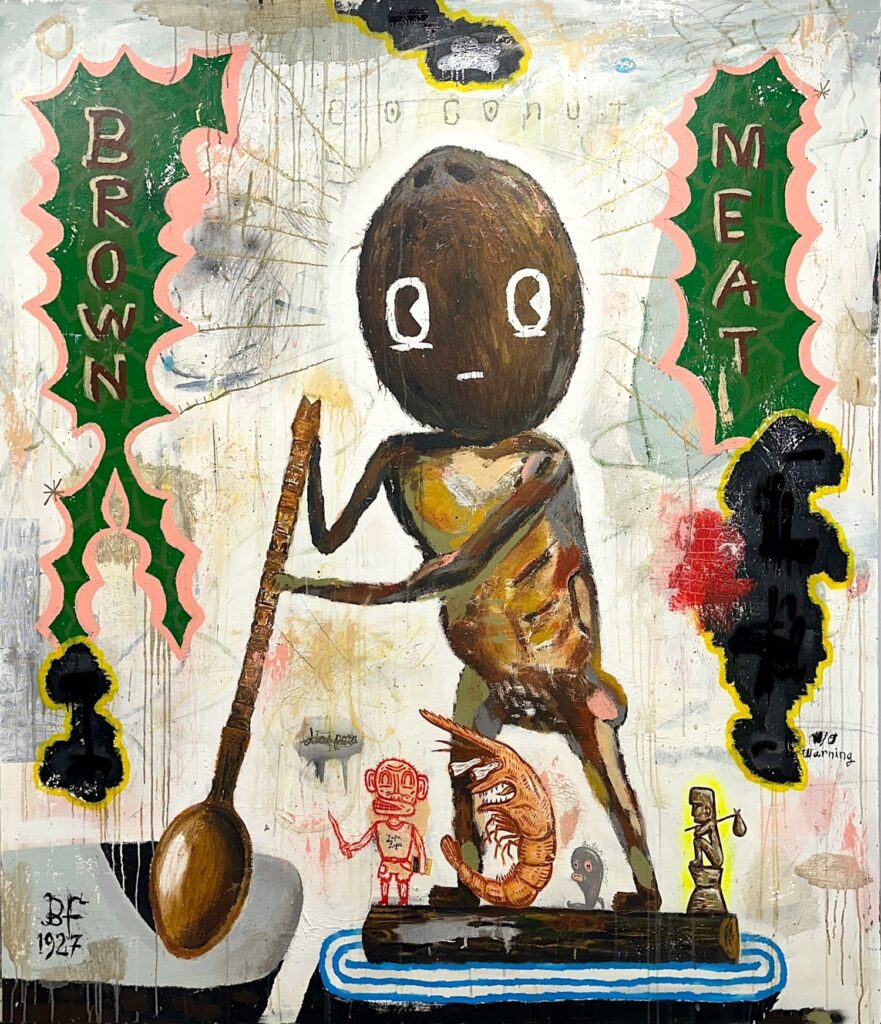
As an avid kayaker and birder, Fortes says his time on the water and documenting migratory birds not only bring a deep connection to something ancestral, but have crept into his art practice as well, serving as powerful metaphor for the Filipino diaspora, family, survival, and his own journey. With a primary focus of traversing the ambiguous space between his dual identities, his painting, Coconut/Brown Meat, is a large canvas with deep personal meaning for the artist, becoming a reflection of his identity, populated by characters representing critical points in Filipino culture and history.
“During the COVID pandemic, I wanted to bring my experience kayaking on the water into my artwork. Initially, I painted a character on a kayak-like vessel using a giant wooden Filipino spoon as an oar. In the Philippines, these spoons are mass-produced for the tourist trade. I ultimately replaced the vessel with a whimsical log, referencing the logs historically used to carve dugout canoes or build rafts, and began making metaphorical connections to the Filipino diaspora and migration.
“The title Coconut reclaims a common slur—‘brown on the outside, white on the inside.’ Pairing it with Brown Meat, however, amplifies my direct objection to the notion that my Filipino identity has been whitewashed,” Fortes said.
Currently living in Sacramento near Tahoe Park and midtown with his wife, a dog, a cat, three water turtles, a desert tortoise named Popeye, and four chickens, Fortes says that though he is not in the center of the Bay Area, he feels fortunate to be close enough to visit often to see art exhibitions, meet with local artist friends, and get re-energized.
“There’s always something going on to pull me there,” he said.
Working from his home studio in a converted two-car garage, Fortes appreciates the intimacy of his workspace but is looking to expand the footprint and raise the ceiling height. Bouncing between multiple works that are either culturally inquisitive narratives or pieces created purely for fun, Fortes generally works in the mornings, balancing his art practice with family time and spending time outdoors.
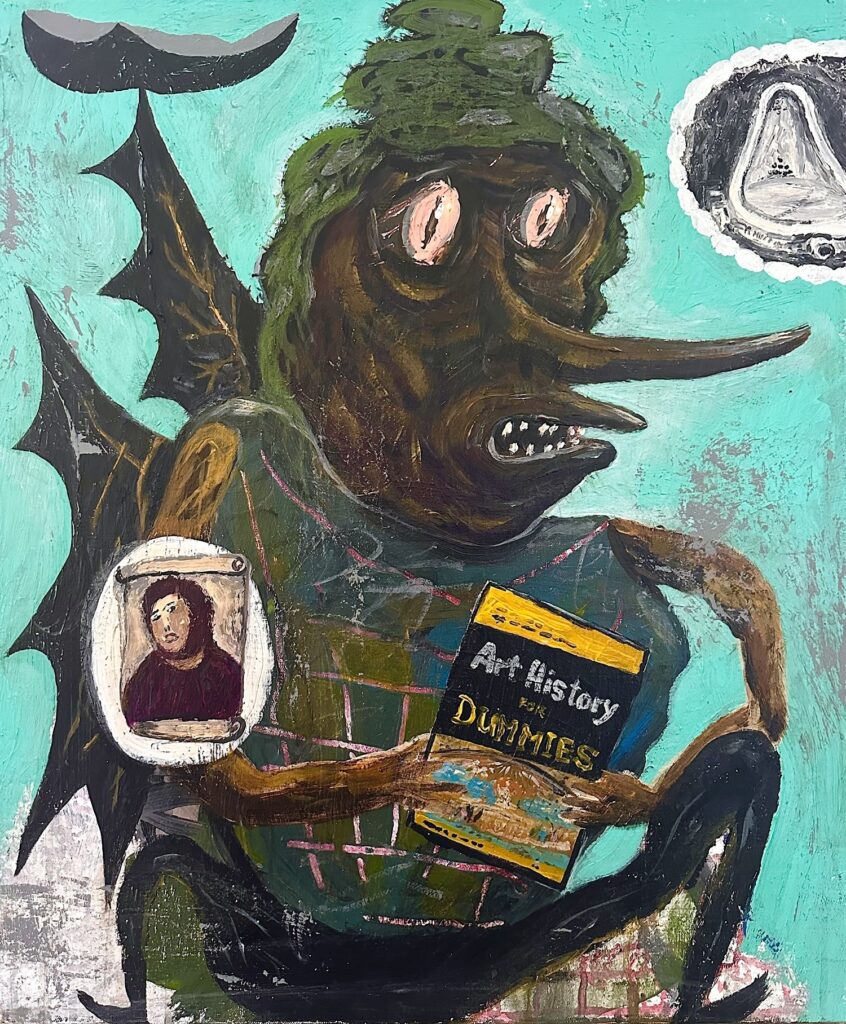
“One small painting I’ve had fun with features a cartoonish vampire-like character holding an Art History for Dummies book. There are two thought bubbles: one contains an image of Marcel Duchamp’s Fountain, and the other shows Monkey Jesus, the failed fresco restoration by Cecilia Giménez in Borja, Spain.
My painting pokes fun at our views on art history and what works get elevated. While Monkey Jesus was a restoration failure, it became a massive cultural phenomenon that has bolstered tourism and brought real revenue to its small town. It’s a playful look at two pieces that were rejected as art but created their own cultural significance,” Fortes said.
Maintaining a daily sketchbook is vital to Fortes’ practice. Jotting down thoughts and drawings, some are carried over conceptually while others are used strictly as raw beginnings.
“They allow me to stay in touch with my intuitive self, to just create and not overthink what I’m doing. I keep the process random, spontaneous, honest, and nonjudgmental, allowing for more freedom,” he said.
Early in his career, Fortes entered juried exhibitions to get his work seen, eventually being invited to group shows in galleries and, later, museums. In the early 2000s, Fortes created a body of work based on the 1904 St. Louis World’s Fair, the largest ethnographic exhibition of people from around the world, which was exhibited at the Triton Museum of Art in Santa Clara.
“About 1,500 indigenous Filipinos were placed in a compound and put on display as colonial propaganda to sway public opinion to keep the Philippines as a colony,” he said.
Fortes applied for his first of many artist residencies at age 65, which he said was accompanied by much self-doubt. His wife provided the necessary mantra that he now repeats whenever he applies for grants or residencies: “Cast a big net and see what you catch!” His first residency was at the Bemis Center for Contemporary Art in 2018 followed by the Joan Mitchell Center in New Orleans.
“Both experiences were deeply transformative for me in how I utilize my time, how place can inform the work, how to introduce new materials, and the interactions and relationships made within the cohort. Much later, a fellowship at the KALA Art Institute in Berkeley got me into printmaking, which I actively explore today,” Fortes said.
Within the context of cumulative accolades, being selected as recipient of a grant from the Joan Mitchell Foundation in 2004 was a milestone for the artist.
“It was a massive surprise to be nominated, then awarded. This meant a lot of things: it validated all my hard work as an artist and it afforded me the means to travel, purchase necessary supplies, and help with studio rent,” he said.
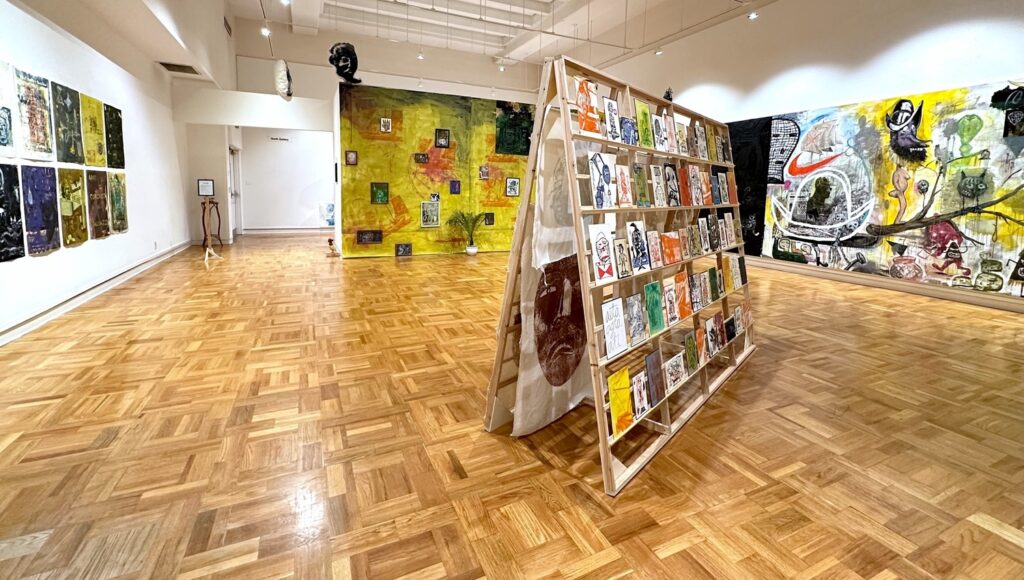
Fortes is part of Tropeycalia Club, a collaborative art group who opened their third exhibition, Título Salvaje ⇄ Salvaged Title, at California State University-Sacramento Library Gallery, on September 1. In addition, his solo show, Conversations from the Rack, will open in mid-October in the same space, featuring pieces from the late 1980s alongside new work.
Currently enrolled in classes, Fortes plans to complete his BFA at Sacramento State University and is considering the MFA program at UC Davis. Having just acquired a Takach etching press, he is excited to dive into making monotypes and explore other printmaking processes, including plans to make a small-edition book of silkscreens. In these times, Fortes acknowledges that making art can feel difficult but reminds himself that creation is an act of resistance.
“Even though I avoid making overtly political work, I’m always thinking about how I can address my feelings around what is going on in the world. Lately, there has been a lot to process, but making art keeps me grounded and connected to myself. Spending time in nature during the pandemic, witnessing the social movements that followed, and watching the ongoing erasure of history for people of color has forced me to reevaluate my focus. I feel these events are pushing my work to become more subversive—even if it’s just one step at a time,” Fortes said.
Though artmaking can be an isolated endeavor, John Yoyogi Fortes encourages artists not to be “studio hermits.” He says he does not think about a viewer’s experience while he is making art but he enjoys sharing it and welcomes the dialogue that his work might instigate.
“I guess I hope there’s something in the work that a viewer can connect with, whether it’s the humor, the text, or a relatable image,” Fortes said. “Maybe from that entry point, they’ll dive deeper into the narrative and find a nugget that they can take away.”
For more information, visit his website at johnyoyogifortes.com and on Instagram.