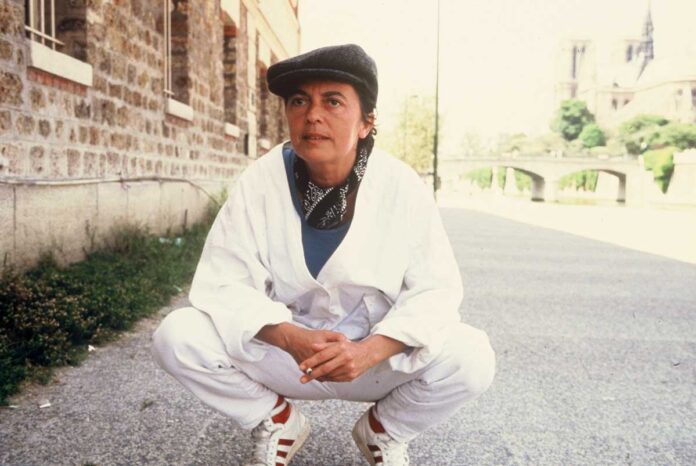
On Fri/20, the Mission’s Et Al./Et Al. Etc. Gallery will transform into a time portal to 1970s lesbian feminist San Francisco. San Francisco’s poetry stalwart Small Press Traffic (SPT) is partnering with the Oakland based Bay Area Lesbian Archives (BALA) for a multidisciplinary evening celebrating the legacy of the late French lesbian feminist writer Monique Wittig.
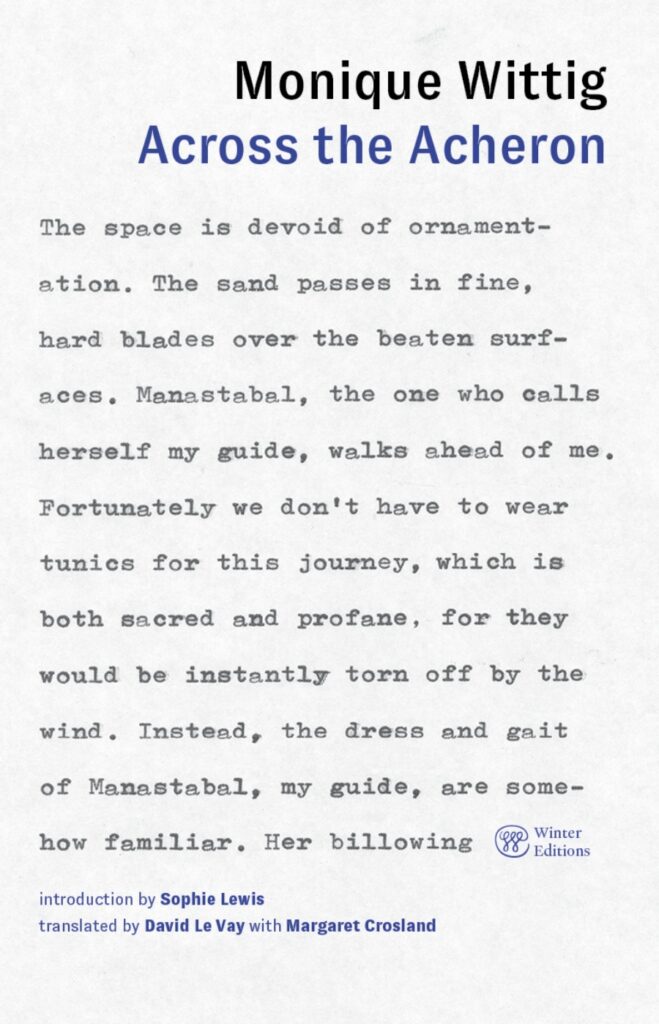
SPT’s director Maxe Crandell was first inspired to put on “Monique Wittig in California” in 2025, when New York based publisher Winter Editions republished two of Wittig’s most lauded and long out of print novels: The Lesbian Body and Across the Acheron. The latter novel is being published in the US for the first time 40 years after its publication in French.
Crandell told 48 Hills, “We were really interested in organizing an event around these reissues because of all the experimental approach Wittig takes as a multi-genre writer. What makes me most excited is that we are looking at this lesbian feminist icon from the perspective of place.”
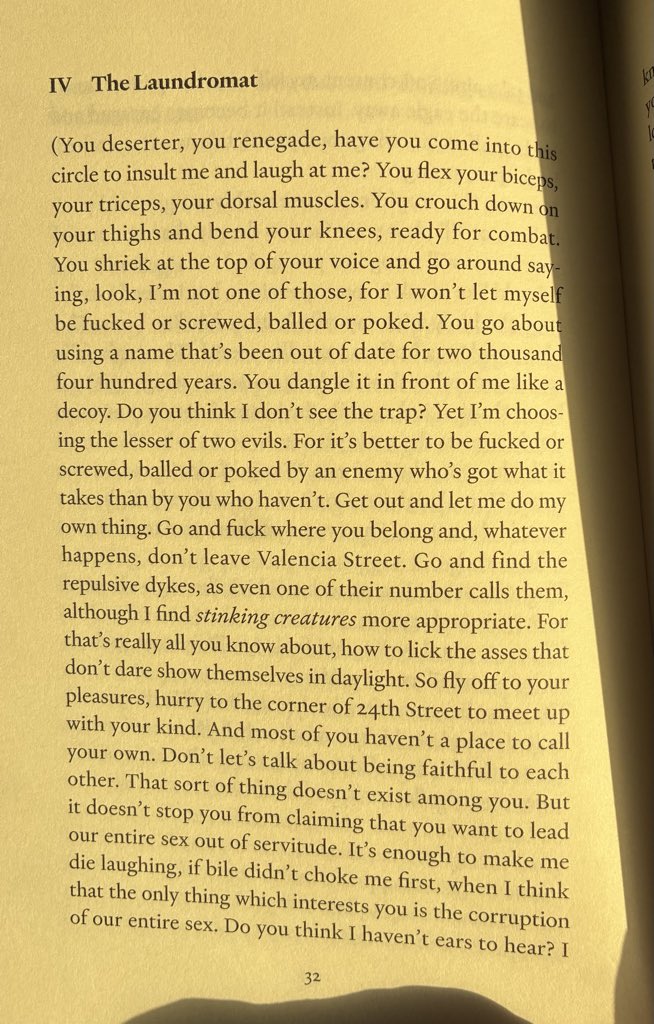
Wittig’s Across the Acheron is a retelling of Dante’s Divine Comedy, though a lesbian lens and with a San Francisco twist. Wittig makes the city Dante’s hell—Acheron is the first of Dante’s “informal rivers” in his metaphysical epic—a gambit whose interests were too good for Crandell to pass up, and which will surely make for a celebratory and provocative evening.
To capture California’s impact on Wittig, SPT and BALA’s event brings together a multidisciplinary group of artists and scholars to reflect the dynamism of Wittig’s writing. Writers such as New Narrative icon Dodie Bellamy, poet and archivist Trinh Lȇ, literary editor and translator Alice Centamore, BALA’s director and UC Berkeley feminist scholar Poaola Bacchetta, and filmmaker Sande Zeig, who was Wittig’s partner for almost 30 years, are contributing to the event’s happenings. One of the most exciting offerings of the night will be short segments of Zeig’s documentary Wittig, Yes! (a play on Across the Acheron’s French title, Virgile, Non!).
Zeig recounted how Wittig’s perhaps most challenging theoretical intervention for readers. “There is no sex. There’s sex that is oppressed, and sex that oppresses. And I think that really actually lines it up. But people can’t imagine that you’re not a woman, that you’re not a man. They cannot get their minds around it.”
Wittig’s vast writings on lesbianism, gender, and sex are salient today even if people aren’t aware of her contributions to feminism and queer theory. If one has ever shared an Instagram slide that quotes RuPaul’s riff on being born naked and the rest is drag, or Judith Butler’s articulations of performativity and illusions of sex and gender, one is touching the boundaries of Wittig’s passionate assertions.
Such easily digested sound bites are tiny afterlives of Wittig’s body of work. It is a framework that sees a world where heterosexuality operates as a kind of political regime. This viewpoint is also central to her novels; a part of her literary legacy largely overlooked in the US in comparison to her theoretical writing. Wittig greatly influenced some of the greatest queer and feminist theorists and artists such as Butler and Adrienne Rich. With these recent republications, her work is finding her way to younger readers, artists, and academics who are invested in the politics Wittig espoused.
Wittig had gained a substantial public profile when Zeig first met her in Paris in 1975. Wittig had been awarded the prestigious Prix Medicis for her first novel, L’Opoponax, when she was 21. She went on to produce her classic feminist novel Les Guérrillères, written at the height of the May ‘68 uprisings in Paris, and then groundbreaking text The Lesbian Body in 1972, with its then infamous dashes through the “I” of a sentence and “m/y” or “J/e” in French.
Zeig, a theater and mime artist originally from New York, had come to Paris from the US in 1975, to study with Marcel Marceau’s mentor. She sought community with various feminist groups and even taught Karate self defense classes to women. It was after one of these classes she first encountered Wittig at a feminist event, deep in a fiery debate with other attendees. Shortly thereafter they began their decades-long creative and intimate partnership.
Zeig and Wittig collaborated on the play The Constant Journey, a retelling of Don Quixote, and the film The Girl. But when Wittig was invited to teach at UC Berkeley by future queer theorist Leo Bersani in 1977 year, she and Zeig began a life-long exile from France in search of a different political and cultural climate.
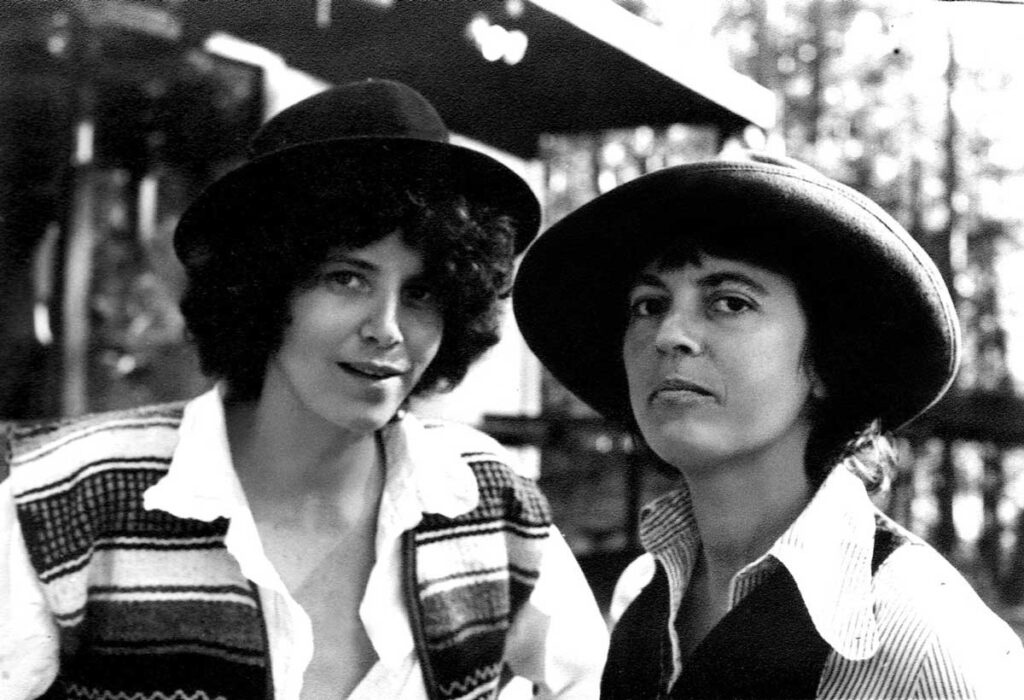
In 1976, they settled in Northern California, living for many years in Gualala. It is this time period that informs Wittig’s revision of Dante’s Divine Comedy and San Francisco the landscape for Dante’s hell in her novel Across the Acheron, the grounding text for this Friday’s event. It was one of Wittig’s favorite novels, as well as Zeig’s favorite. “I loved it because it wasn’t really appreciated, if you will. For me, it is also one of my favorite books because I hear Monique Wittig. I hear her voice in it. I actually hear her.”
Zeig also named numerous recognizable sites that Across the Acheron’s narrator, also named Wittig, traverses, including Golden Gate Park, 24th Street and Mission, The Castro, and one of the great late lesbian bars in this city’s history, Amelia’s on Valencia Street. Zeig assured me, “Dykes on Bikes are there.” At one point in our interview, Zeig read to me a portion of an interview with Wittig given at the time of its publication.
“Our non-heterosexual way of seeing the world,” read Zeig, “of seeing the horror, has only rarely been described in literature or elsewhere. For people who are not heterosexual, everything, every aspect, every element of heterosexuality, which is a practice of oppression, is hell. Perhaps not Dante’s hell, but our own.” To say that I, the interviewer casually slipping into my word count [and exceeding it! —Ed.], felt that in my core, is an understatement. Zeig told me, “It’s like every sentence is a kind of bomb.”
The same electricity I felt in my response to Wittig’s language was mirrored in my interviews with Alice Centamore and Trinh Lȇ, the younger contingent of Wittig’s Friday night interlocutors. Lȇ and Centamore’s involvement with “Monique Wittig in California” makes this both a communal archive collaboration and a multigenerational one, which reflects the relevance and urgency of Wittig’s work to our present moment.
Both writers echoed Zeig’s reverence and passion for Wittig’s powerful ideas and unparalleled writing style. For Lȇ, she felt Wittig in her body. “I read Across the Acheron in a single night. I think I stayed up until dawn reading it. It just hits so close to home. It’s set in San Francisco and I feel the way Wittig talks about the Bay there’s this sense of place, even though it was written in 1985. The way she sets San Francisco as the depths of hell… I think we may be even closer. Reading it now feels so necessary.”
Centamore, edited and occasionally translated Wittig’s works, had similar sentiments, though on a different reading schedule. “It’s not a book that you can read at night before you fall asleep, sadly. The Lesbian Body, you’ve got to read it at breakfast with black coffee.” When asked what makes this event a must attend, Lȇ told 48 Hills, “It’s an event about devotion, to Monique’s legacy and the ways she’s really touched us across space and time.
“Being in a younger generation, I truly think there is a lesbian renaissance, and it is as gender expansive as possible. [Wittig] is the one that we should be reading to carry forth.”
Attendees will also get to bring Wittig home with them. Books will be available for purchase on a sliding scale. There’s also a special take home gift: Bacchetta collaborated with Reprographix Print Room of South Berkeley to reprint a special poster from a 1977 performance of Wittig’s Les Guérrillères by the Bay Area’s Mothertongue Feminist Theater Collective, whose archives are housed at BALA.
After this event the Wittig-led lesbian renaissance continues with multiple projects bringing her republished work to a new generation of readers, including Zeig and Wittig’s 1977 book Lesbian Peoples: Material for a Dictionary, out next summer with Nightboat Books, and with continued fundraising for Zeig’s documentary. Small Press Traffic will also continue its work highlighting experimental queer work by hosting queer Palestinian performance artist and writer Fargo Nissim Tbakhi at The Lab on December 12.
“MONIQUE WITTIG IN CALIFORNIA” Fri/20, 7pm, Et Al./Et Al. Etc, SF. More info here.