
We’ve already had our Paleolithic Era. Now we seem to be in a Pathological Era, in which the fate of humanity appears to rest in the hands of people in a better period might have been politely ushered to prison, an asylum, or the stocks in the village square. Their various combinations of delusion, corruption, fanaticism, willful ignorance, malevolence and poker-faced dishonesty—which once might have automatically ousted anyone from the acquisition of serious money and/or power—now get treated as qualifications, even accomplishments. How did we get here? That’s a complicated question that may no longer be particularly important. Maybe the more pressing matter is: Can we even still get out of here?
Three documentaries that kicked up considerable controversy in recent festival premieres are now in theaters, all entirely or at least largely driven by personality types that not long ago we assumed we were “better than”—in the sense that common-sensical Americans couldn’t possibly be fooled by such obvious manipulators and charlatans, could they? Well, that question ceased to have a flattering answer some time back. Now it’s clear: We can be had, by the millions. Whatever the future holds, when others some day wonder “What the hell happened back then?,” this trio of films—totaling a hefty eight hours or so—will provide some substantial clues.
NAZA, which opened in area theaters last weekend, is the British-funded latest by the makers of last year’s Oscar-winning No Other Land. It is about policy, not a person, but there is enough footage of Benjamin Netanyahu (and others) spewing inflammatory rhetoric to make it clear what kind of authoritarian mindset and justifying propaganda is at work here. (A subtext for most viewers will be that alongside Putin, Netanyahu appears the foreign leader who exerts the most influence on our own.)
The Prime Minister himself as already described the film as “global antisemitic incitement,” saying he will pursue having the citizenship of born-and-raised Jewish Israeli directors Yuval Abraham and Rachel Szor revoked, and charges brought against them for alleged defamation, treason, etc. They have also received death threats from the public. Of course, if they are guilty of treason for revealing governmental secrets… that pretty much blows the notion that the film’s claims aren’t true.
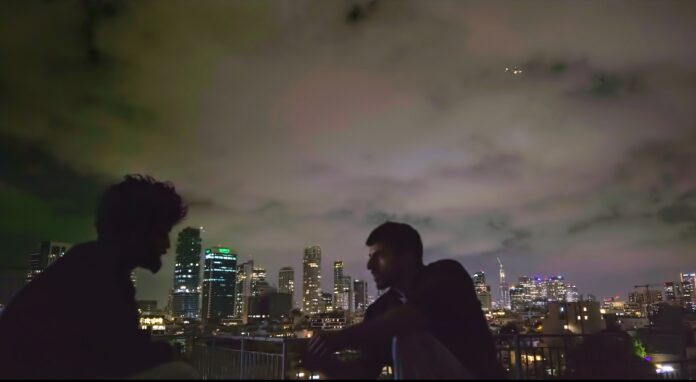
The title is a term Israeli Defense Forces have utilized to render casualties abstract: After a strike, they can say x number of “NAZA” (Nezek Agavi, Hebrew for “collateral damage”) were eliminated, rather than civilians killed, let alone “women and children.” The 24 IDF soldiers and officers interviewed here in identity-obscuring silhouette say their missions were dehumanized, even made “fun,” by its video-game-like qualities, given that they generally used drones to bomb targets far from their control centers.
Those targets were ostensibly Hamas operatives, tracked easily enough because Israel has more or less complete control the over Gaza infrastructure it built—including the entire phone system. They can hack into anyone’s device and determine its whereabouts. But several interviewees here note that there were occasions when a phone was somewhere its owner wasn’t, so a bombing killed not the presumed Hamas person but “only” their entire family, immediate neighbors, etc. This was not ideal, but excused by an understanding that “collateral damage” might involve up to 20 civilian deaths to claim one intended “target.” (We’re also told sometimes that number went as high as 500. As one soldier flatly puts it, “The goal is quantity, not quality.”)

While hardly a big-picture view of the entire historical conflict—for one thing, it’s only 77 minutes long—NAZA does note the horrors of Hamas’ Oct. 7 attacks. But what emerges here is not arguably-righteous payback, but use of those events (and the Holocaust, a constant cultural touchstone as portrayed here) as justification for deliberate genocide, ethnic cleansing, or whatever term you prefer. Private homes at night are typically targeted, never mind the increased toll in innocent lives entailed.
This “mass killing on a huge scale” (to quote one technician who nonetheless protests he’s “just a small cog” in a killing machine) is also tactical, in that entire areas are leveled to decimate or drive out remaining Palestinians, forcing the populace further south—clearing land for an ever-growing Israel whose gleaming Tel Aviv highrises and endless construction are a major visual motif. The actual carnage of war is barely glimpsed, aside from late footage of a panicked father trying to find any surviving children in rubble, and one shot of myriad corpses’ feet protruding from under a collapsed floor.
Very different from the urgently personal No Other Land, in which we got to know some individual subjects quite well, NAZA is almost a coolly poetical abstract, alternating metronomically between borrowed mass-media input (Israeli and international), eerie night cityscapes, and the interviews with anonymous military. The latter are occasionally emotional in what they reveal.
But mostly what strikes us (and sometimes them, too) is the extent to which institutionalized dehumanization and a “general climate [of] hatred” towards Palestinians deadens their ability to feel guilt or horror—despite frequent full knowledge of mistakes made, children killed, and so forth. They are capable of mentioning how people desperate to reach food distribution points get “taken out” by snipers, or bodies left to rot are eaten by dogs, as if these were bland everyday factoids.
They’re aware that peace is not the goal: Or rather, “peace” through eliminating and/or exiling the enemy is now the goal. There is no “two-state solution” or other compromise still on the agenda. Its brief runtime over before you know it, NAZA is a chilling admittance that should be seen, and whose claims the Israeli government (as well as our own complicit one) have denounced without actually disproving.
NAZA is currently playing Bay Area theaters, including SF’s Presidio, Roxie, Alamo New Mission and (starting Fri/16) Opera Plaza.
By contrast, Alex Gibney’s Musk—opening this Fri/16 in area theaters—is almost four hours long, complete with a 10-minute “intermission.” Even so, it feels like a compacted overview of an almost impossibly complicated and far-reaching subject. It’s not that Elon Musk himself is so complex. It’s just that he seems to have had his hands in everything, so driven and shameless and monomaniacal is he—not to mention so unreliable a fact source, obscuring his real-world achievements in constant revisionism and hyperbole.
After this whirlwind survey, I was surprised to realize that some aspects of his life and career had been touched on barely, or not at all: The dubious legality of his immigration to the US (via a student visa he never used, instead going directly into Silicon Valley employment), for starters. But those gaps don’t delegitimize Musk so much as underline that it could have been six, even eight hours, and still far from an exhaustive overview of a person who seems compelled to consume and control the whole world. Gibney’s fear, raised in occasional first-person narration, is that he is managing just that.
The documentarian whose prior subjects have included Scientology, Wikileaks, Enron, Putin, Steve Jobs, the FBI, political “dark money,” Russian election interference, clerical sex abuse, the opioid and COVID epidemic, and much more—as with Musk, you have to wonder when he sleeps—is a master of the methodical, evidence-heavy expose. So of course Musk himself refused cooperation with what he assumed would be a “hit piece.” To make up for that lack, Gibney drew on Musk’s own voluminous public utterances, “spoken” onscreen by a CGI avatar that is, really, rather flattering. (It resembles Hugh Grant as much as it does Elon.) That’s not the only thing here that makes Musk look good—some older archival footage shows him in charming form, and credit for his accomplishments is given when due.
But it is also amply chronicled that he has often been in the business of “reward hacking,” whether it’s claiming authorship for other people’s deeds or alleging his cars, rockets etc. have present-tense capabilities that in fact are only theoretical as yet. These things inflate his financial value and control as well as ego, no matter how much they’re built on a foundation of sand. The world’s on-and-off richest man seldom addresses how much of that fortune is from governmental loans, contracts, credits—he is the empress of “welfare queens” in that regard—or how often hyperbole has masked failed ventures and non-profitability. Indeed, he’s been ousted from a couple companies because others involved realized the ideas he insisted on would be financially ruinous…worse, that he did not seem to care.
No doubt that Musk’s sense of personal grandiosity makes money both an object for endless acquisition and a trivial concern. But even more potentially harmful are his statements suggesting limited grasp on reality in general, from the notion that perhaps we’re already living “in a simulation” to his take on empathy as something of a con. The deep weirdness of his relations to myriad female partners and progeny is probed, to which one can only say “Ick.” One woman says “He wanted me to use a surrogate because it was the only way we could raise a legion of children before the civil war.” His first wife says she learned all about gaslighting from him, and that he told her “If you were my employee I would fire you.” Misogyny seems one characteristic inherited (as well as money) from his father, a supportive interviewee here despite their apparent estrangement.
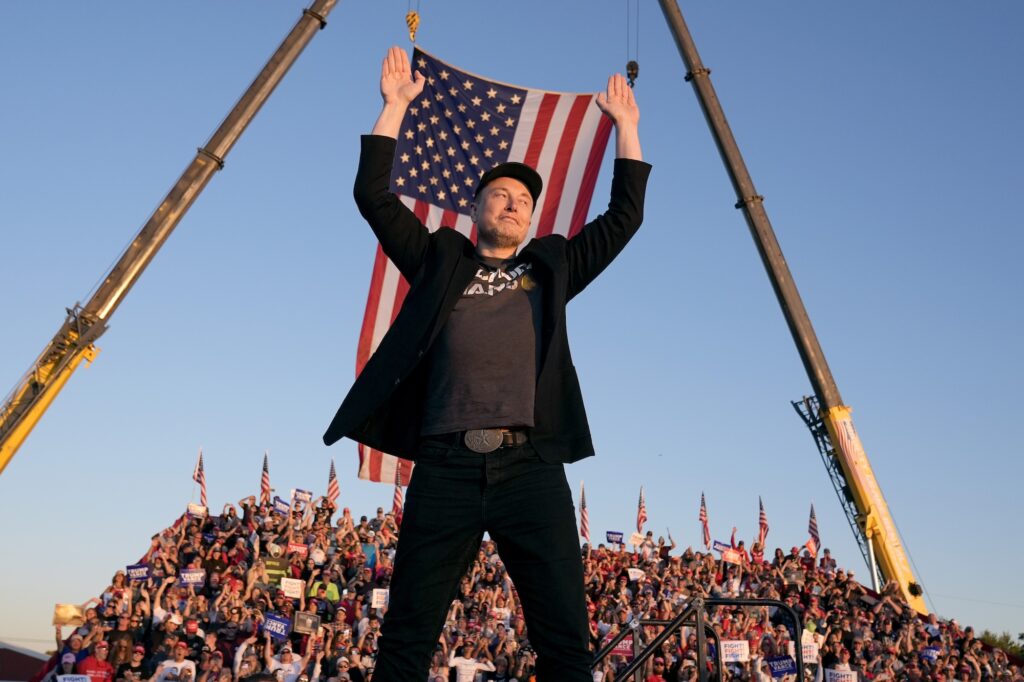
As Elon’s increasingly gone down a rabbit’s hole of embracing fascistic fellow travelers and concepts, a prior “climate savior” image long gone, that casting of himself as an “alpha” who’s the “real-life Iron Man” etc. has become ever more cartoonish. His core worldview seems shaped more by video games, sci-fi, comic books and so forth than any sense of shared humanity. He publicly denounced his own eldest child as “killed by the woke mind virus” once she came out as trans. In the name of “free speech” after censorious blowback to the Jan. 6 insurrection, he acquired Twitter (now X), drove away much of its staff, alienated advertisers, and turned it into a propaganda cesspool aligned with despots around the globe. As the Biden administration circled different investigations of Musk’s activities, he openly told Tucker Carlson “If [Trump] loses, I’m fucked,” ensuring that did not happen in ways we still can’t be entirely sure of.
The film’s most damning section deals with DOGE, a giant boondoggle that would purportedly “cut fraud and waste.” Instead, its barely adult hackers hacked away at government agencies they knew nothing about (often ones regulating concerns like Musk’s), ending vital programs and 86’ing key personnel. DOGE claimed to “save” Americans hundreds of billions in $$. Real-world analysis shows it actually COST us at least 3 billion, while greatly increasing the federal deficit. Who pays for that? Certainly not Elon Musk.
There’s no time for repetition in Gibney’s 235 minutes, which are scary, colorful, bizarre, and enraging by turns. How did a South African emigre, whose titanic self-promotion has so far outstripped the innovations he can honestly lay personal claim to, get so far? That may soon no longer matter: As some parting words here ominously warn, this very special “someone with a fairly limited skill set…[who] operates as if he knows and understands everything” is fundamentally flawed. Yet arguably, “it’s already too late. He has the control.” Musk begins and ends with graphics of the planet exploding. Paranoid fantasy? Maybe—but Musk sells that, too, albeit in versions where somehow only he can rescue us. It’s hard to find anyone or anything that Elon Musk has ever rescued…beyond the seemingly unstoppable wealth and fame Elon Musk of, course.
Musk opens in theaters nationwide this Thu/15, including SF’s AMC Metreon.
One reason Musk’s subject declined to cooperate is no doubt because Alex Gibney has stripped the gift-wrapping from Silicon Valley to reveal some scurvy doings several times before. In 2019 he made The Inventor about Elizabeth Holmes, who had raised billions for her company Theranos on the promise of extraordinary advances in medical blood testing—and was heading to prison after it turned out those claims were little but smoke and mirrors. Press, public, and eventually our legal system had no doubt it was a scam, but the most remarkable aspect was Holmes’ apparently delusional insistence that it wasn’t, despite a giant case of “no ‘there’ there.” The Icarus-like fall from feminist entrepreneurial role model to seeming wackjob was all the more dramatic for her having previously buffaloed so many prominent people who should have known better.
As she and longtime business and domestic partner Ramesh “Sunny” Balwani were investigated, then tried and convicted of fraud on a grand scale, she avoided press contact for years while filing appeals. It was wholly unexpected, then, when she and subsequent spouse Billy Evans (a younger hotel-chain heir) invited Canadian comedian, actor, and filmmaker Nathan Fielder into their lives with near-unlimited access in the weeks leading up to the already long-delayed start of her incarceration. He brought along documentarian Lance Oppenheimer and a full crew, as evidenced by the narrative-cinema-like multicamera flow with which the filmmakers record themselves as well as Holmes, Evans, and their two very young children in You Can See Everything.
The couple continue to insist she is wholly innocent of all charges… even that she has never lied about anything in her entire life. (To the extent that she admittedly any faults in Theranos’ operations, she pretty much claimed those were all Balwani’s doing, which he’s vigorously denied.) But if the idea was to turn around public perception of her, why use Fielder as their medium? Did they find his comedic prior semi-docu projects and slackerish persona endearing? Did they think his fumbling inquiries, as well as lack of medical-scientific knowhow, would somehow distract from any tough questions about Theranos that they clearly don’t want to address? Why do they (in particularly the sometimes visibly displeased Evans) continue to let Fielder & co. camp out when it must be obvious that if the filmmakers still aren’t convinced of her “innocence,” how can the public be?
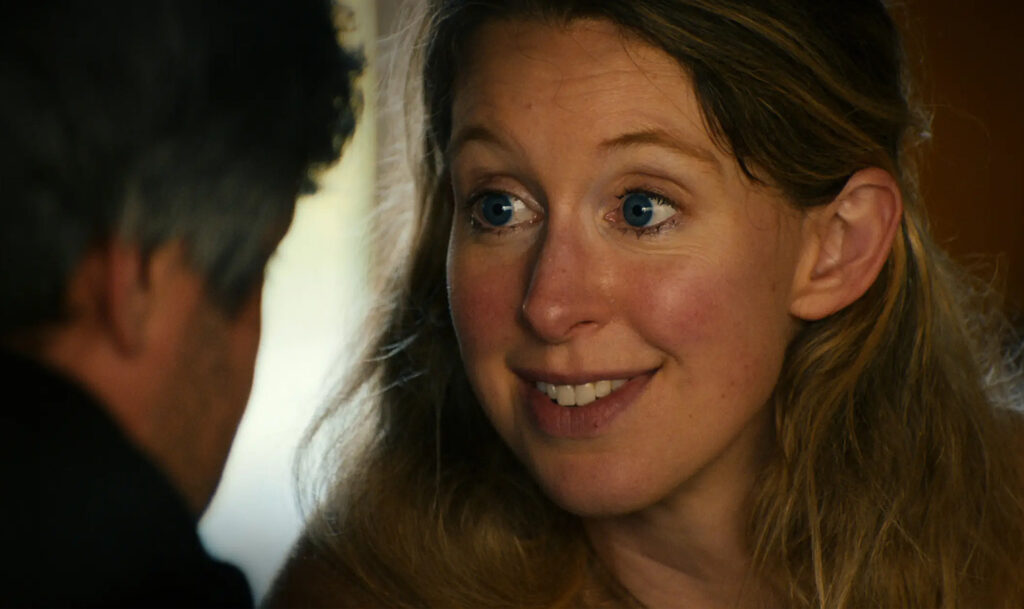
Sometimes a little repetitious and frustrating, the movie’s first half provides perverse fascination if not much insight. All we can figure out is that Holmes seems to truly believe her own dubious logic, even if wouldn’t absolve her in anyone else’s mind. But at a certain point she is delivered to federal prison, leaving the film’s “star” MIA. That is when Everything gets really interesting. I don’t want to provide any spoilers, but suffice it to say that the questions of truth, sanity, manipulation etc. long been applied to Holmes turn out to be quite relevant to her common law husband, too. And the actress Amanda Seyfried, who won an Emmy for playing her in dramatic miniseries The Dropout, becomes entangled in Fielder’s quest to ends that are by turns bizarre, hilarious, and more than a bit flummoxing.
Against all odds, You Can See Everything’s three full hours do the opposite of clarifying Elizabeth Holmes’ actions, motivations and beliefs. Her telling Fielder “I’m always being real” plays evermore like sheer mindfuckery, though we can’t be sure if she’s even conscious of any deception at work. Evans himself says “She’s really weird. She’s not normal”—and he’s defending her. (We eventually realize those terms might also apply to him.)
So meta it’s like the documentary equivalent of an Escher image, an endless snake-eating-self, this movie must be seen to be disbelieved. You may have thought its subject was already an ultimate illustration of our era’s enabling of untrustworthy, attention-needy, world-class self-promoters. But as they saying goes, you ain’t seen nothin’ yet.
You Can See Everything opens around the country Thu/15, including at SF’s Apple Van Ness, Kabuki, Marina, Metreon, Balboa and Alamo New Mission theaters.