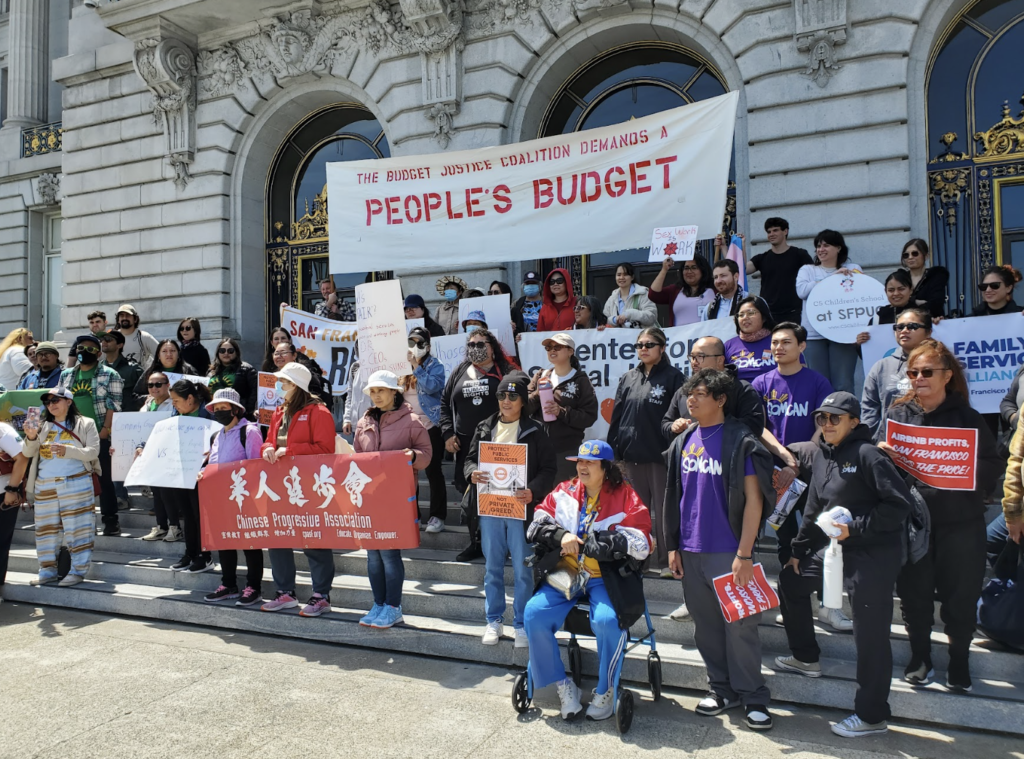
The city’s labor unions and community-based organizations are mounting a full-scale challenge to Mayor Daniel Lurie’s proposed budget cuts, demanding that the mayor push back against big tech companies that are asking for big tax refunds.
Uber, Lyft, and Airbnb are suing the city, asking for a total more than $320 million in refunds. They say city officials put their companies in the wrong classification for tax purposes. That’s a classic Big Tech move: Uber and Lyft say they don’t employ drivers because they’re j8st a platform, so they don’t need to pay minimum wages or benefits. Airbnb says it’s not an administrative or support operation, but just a platform for others to use.
All three of these companies made the founders into billionaires by breaking the law in San Francisco, and the city looked the other way. None of them would exist at the level they do if they weren’t able to use their hometown as a test case, operating illegal hotels and taxi services while the late Mayor Ed Lee ordered his oversight agencies to allow it to happen.
And now they want to screw the city out of tax money that is desperately needed for crucial public services.
A report by public employee unions notes that nearly half the city’s budget deficit would disappear if big corporations stopped trying to get out from paying their fair share of business taxes. In fact, the same companies that are now suing the city already got a big tax break when the voters passed Prop. M, reforming business taxes, last fall:
One of the most significant changes in Prop M was a shift in the formula for determining how much of a firm’s gross receipts can be taxed in San Francisco. Previously, the city’s tax code relied heavily on using the share of a business’s payroll located in the city to determine how much of the company’s total gross receipts could be taxed in San Francisco. Prop M reduced reliance on local payroll, effectively lowering taxes for large corporate headquarters in the city. The intention was to reduce risk for the city’s tax base, but the result was also that the largest corporations received millions in tax breaks. According to one report, Prop M would give nearly $53 million in tax cuts to the largest corporations in the city. Airbnb, Uber and other corporations like Meta, Google and Doordash funded the measure. With $600,000 from Google, $550,000 from Airbnb, $160,000 from Uber and $160,000 from Ron Conway, the business-back Proposition M was passed in November of 2024. But despite passing this reform to the business tax that benefited the corporate sector, a handful of tech companies continued litigation even after receiving tax breaks.
Because of the litigation, the city’s set aside more than $400 million—about half the two-year deficit—in case the courts say we have to pay off the giant corporations and their billionaire owners, one of whom, Airbnb’s Joe Gebbia, is now working with Elon Musk to destroy the US government.
At a Budget and Appropriations Committee hearing today, leaders of nonprofits that use city money to serve some of the most vulnerable people in the community talked about the threat of budget cuts that would in effect put them out of business.
The nonprofits often provide services far cheaper than the city, because nonprofits pay their workers far less than the city pays its employees.
As Celestina Pearl, outreach director for the St. James Infirmary, noted on Facebook:
The sex worker outreach program that I have stewarded for seven and a half years has been denied our grant by the San Francisco Mayor’s Office of Housing and Community Development. We are on the streets of San Francisco late at night serving young Black and Latina women in the mission and trans women in the TL. That grant was created for this program. There is nothing else like this in San Francisco and we cannot lose it!!!
At the hearing, Pearl said that “these humans are not expired even if the grant has.”
That was just one example. Providers of legal services, human services, domestic violence outreach and so many other programs told the committee that the mayor’s approach will have devastating consequences.
A lot of the local news media (and a lot of people who complain on social media) are happy to talk about how the city’s budget has “ballooned” in the past few years.
But much of that increase has come from departments like the airport, which has seen its budget double, from about $1 billion to about $2 billion, over the past decade. The airport is self-supporting, using landing fees from the airlines to cover its operations. It’s still in the city budget, which helps make it appear that San Francisco just spends too much money.
The total city budget is about $16 billion. The General Fund, which the supes and the mayor can adjust, is about $6.8 million. Lurie has asked for across-the-board cuts of 15 percent, from the General Fund—except from public safety agencies, which account for more than $1 billion. So every department that isn’t police or fire has to take a massive hit that will be felt by almost every San Franciscan who isn’t so rich that they don’t use or care about public services.
Let’s put some of this in context.
San Francisco has 85 billionaires, according to the most recent Forbes count. Their combined net worth, as of 2023, was $185 billion. It’s almost certainly much higher now. Nationwide, billionaires have seen their net worth rise 77 percent since the first round of Trump tax cuts.
So let’s just say that, by a very conservative estimate, San Francisco billionaires have seen their wealth increase by $142 billion in the last eight years, and Trump is about to give them even more.
A wealth tax of one half of one percent on the very, very rich would more than cover the city’s entire budget deficit and allow San Francisco to build affordable housing, fund exceptional public education, and do so, so much more.
Just for the record, that is not part of Lurie’s agenda.