The Board of Supes Budget and Appropriations Committee will continue hearings on the mayor’s budget proposal this week—and City Hall will be filled with protesters. The People’s Budget Coalition plans a series of creative actions; here’s a rundown:
Monday/15: Senior and disability advocates will bring a Wizard of Oz-themed action to City Hall, calling on the mayor and supervisors to “have a heart, use their brains, and show some backbone” by rejecting cuts to services that keep seniors, families and people with disabilities safe and stable. 10:30 am. Outside the Mayor’s Office, City Hall, Room 200.
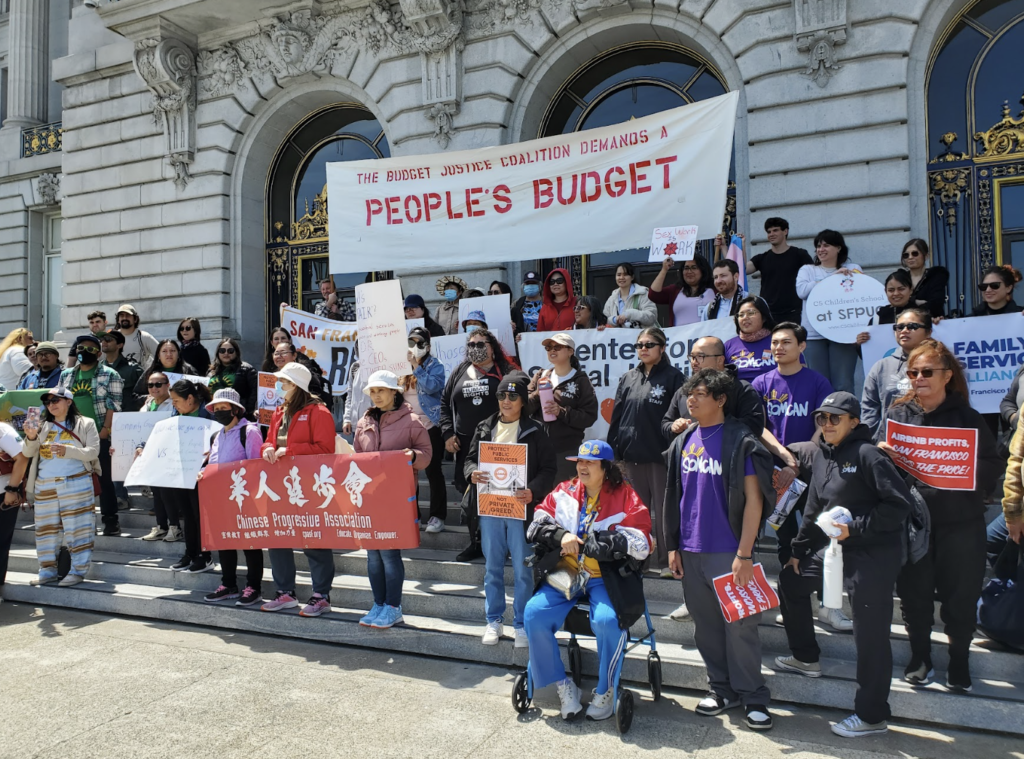
A cultural celebration centering families, elders and domestic workers, featuring the American Indian Cultural Center, SF Latino Parity and Equity Coalition, People’s Budget Coalition and Coro Nueva Era. Noon, City Hall steps
Tuesday/16: Community members and service providers will speak out against cuts to essential HIV, community health, wellness, behavioral health, and maternal health services, including programs serving those living with HIV, transgender, and LGBTQ+ people at the same time the federal administration is targeting these same communities. Board of Supervisors Chambers, 3pm
Wednesday/17: A family-friendly creative action that centers the voices and experiences of children and families who rely on housing and homelessness services. Families from Chinatown, the Tenderloin, the Mission, and across San Francisco will participate in an interactive board-game action game with elected officials, illustrating how budget cuts affect real people and reinforcing the message that every family deserves a safe, stable place to call home. 11 am, City Hall, Room 278
SF Latino Equity and Parity Coalition will hold action on the steps of City Hall and join their silent protest centering immigrant communities, language access, equity and the services that help Latine families remain in San Francisco. 11am.
A combined labor operation will bring the largest rally of the week will bring hundreds of workers and community members for a united labor-community action demanding City Hall restore every cut and every job. The rally will bring together frontline city workers, nonprofit workers, domestic workers, service workers, educators, tenants, immigrants union members from SEIU 1021, SEIU 2015, The SF Labor Council, OPEIU 29, UESF, and community organizations around a shared demand: a San Francisco built by and for the people who make it run. 1:30pm, City Hall steps.
Thursday/18: The People’s Budget Choir will sing carols through City Hall in opposition to budget cuts and in defense of essential services and jobs. 9am, meet on the steps of City Hall.
A full Civic Center spectacle will show what San Francisco looks like when the city funds communities instead of cuts. Community organizations, workers and residents will fill Civic Center Plaza with cultural performances, drag, dance, music, poetry, art-making, popular education, resource sharing, picnic blankets, banners, accessibility areas, pieces of the AIDS Quilt, and political theater calling on City Hall to restore the cuts. 10am, in front of City Hall.
For decades, San Francisco has required large institutions, including universities and hospitals, to submit regular institutional master plans, in essence outlining how and where they plan to expand. That allows the Planning Department to consider where the city will need new infrastructure—and gives neighborhood groups some notice of what, say, the University of California is going to do with its campus on Parnassus Heights, in the middle of a dense residential area.
Now Mayor Daniel Lurie and Sup. Matt Dorsey want to eliminate those requirements for colleges and universities outside of residential neighborhoods. The idea is to attract more schools to areas like downtown.
It would also eliminate the master plan requirements for expansions that are less than 10,000 square feet or 25 percent of the school’s total footage—and would entirely exempt student housing.
For the record: The Academy of Art University expanded madly in the past couple of decades, buying and converting existing rental units into “student housing” that crammed students into bunks in units that were never designed for that level of occupancy.
The legislation contains some language neighborhood groups pushed for:
(B) A PSEI shall not qualify for the exemption in this subsection (b)(1), unless it declares under penalty of perjury, on a form prescribed by the Department, that the institution will not demolish or convert any structure in San Francisco that is used or occupied as housing as of the
effective date of the ordinance in Board File No. 260239, or for which the last legal use was residential. The institution must also declare under penalty of perjury that its development will not result in the elimination of any rent-controlled housing unit.
But there is no language protecting legacy businesses or neighborhood retail.
That goes before the Land Use and Transportation Committee Monday/15. The hearing starts at 1:30 pm.
I got a remarkable email this week from the office of District Attorney Brooke Jenkins. Most of her emails are about the conviction of some violent criminal, a murder or a someone who tried to stab someone else to death; she always talks about how she is making the city safer.
Fair enough, that’s what DAs typically do: Brag about putting dangerous folks behind bars.
This one, though, bragged about the conviction of a retired City College teacher who was protesting the dangers of artificial intelligence by blocking the door to OpenAI’s office.
Wynd Kaufmyn did not throw a firebomb at the founder’s house. She did not break any windows. She just did what thousands of principled protesters have done for generations in this city: She committed an act of peaceful civil disobedience. She blocked a doorway.
Instead of dropping the charges, when Kaufmyn refused a guilty plea, Jenkins took the case to trial. Kaufmyn used a defense of necessity—again, a process that has a long history in CD protests.
Even Sam Altman, who runs OpenAI, admits that the technology could be an existential threat to humanity.
So, for just a few minutes, Kaufmyn made a statement. There was no danger to the public.
But Jenkins pushed the issue, a jury convicted Kaufmyn, and she will be sentenced, maybe to jail, June 22.
Here’s what makes me alarmed, and a bit sick, from the DA’s press release:
he jury’s verdict sends a resounding message rejecting the notion that protesters can endanger public safety as a means to an end. Ensuring public safety is critical to ensuring all of the other rights that we cherish.”
Again: There was never any threat to public safety. None. If this is the standard that Jenkins is going to use for prosecuting protesters, then nobody who stands up against anything, anywhere, is safe.
Kaufmyn told me she has no regrets, and that the case may not be over: “Who knows,” she said, “maybe we will appeal.”