Next year, San Francisco will make a choice. We can accept a future where the working class—the teachers, Muni drivers, nurses, line cooks, and nonprofit staff—live one rent hike, one accident, or one federal budget cut away from losing their homes. Or we can decide that in this city, housing for working people is a public obligation, not a private afterthought—and build the permanent, predictable funding to match that belief.
We are told, over and over, that we “just don’t have the money,” that between a looming $1 billion local deficit, cuts to federal housing programs under the new administration in Washington, and a shaky commercial real estate market, this simply isn’t the year to be bold.
But when you strip away the spin, the story isn’t about scarcity. It’s about priorities and power.
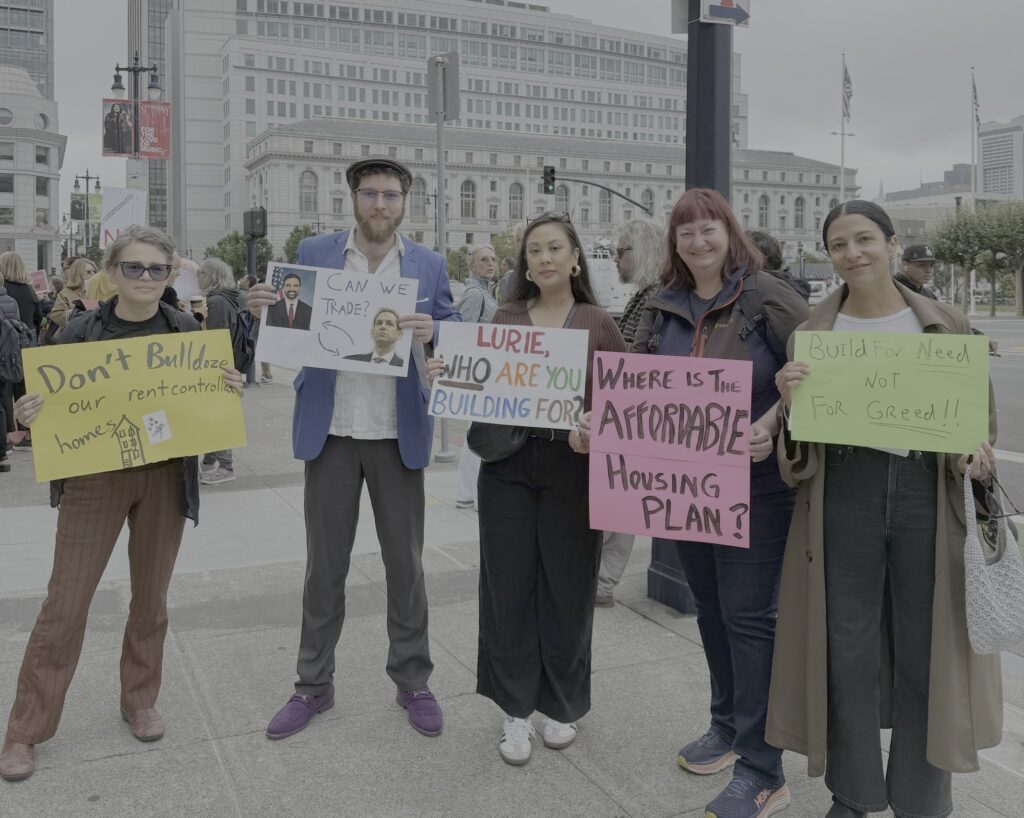
While City Hall debates budget line items and “incentives” for capital, the human crisis on our streets is accelerating at a terrifying speed.
According to a shocking new report released just last month from Tipping Point, the Bay Area’s poverty rate soared from 12.2 percent to 16.3 percent in less than a year. That statistic represents a human catastrophe: more than 245,000 additional neighbors fell into poverty in a single calendar year.
Today, 1.02 million Bay Area residents live in poverty. Another 790,000 hover on the brink. Together, nearly three in 10 people in this region struggle to meet their basic needs.
And the epicenter of this collapse? It isn’t a remote suburb. San Francisco saw the sharpest rise in the region, now holding the highest poverty rate at 17.5 percent.
Crucially, this is a crisis of the working poor. Half of all families living in poverty have at least one full-time worker. These are the people serving our coffee, cleaning our office towers, and teaching our children—working full-time jobs that no longer guarantee a roof over their heads.

The housing market is only tightening the screws. As Mission Local reported in September, the AI boom is driving a fresh wave of displacement: Eviction notices have nearly doubled as landlords rush to clear out low-income tenants to make way for a new class of high-earners.
The geography of this displacement reveals its cruelty. Looking at 2024 alone, eviction notices remain concentrated in the Financial District, South Beach, the Tenderloin, the Mission, and South of Market. These neighborhoods have consistently had high eviction rates, with little change since 2022. It’s no coincidence that these are the neighborhoods with the highest density of low-income residents, the highest density of tenants, and the highest concentration of individuals facing mental health and substance-use challenges.
This is not random market fluctuation; it is the targeted removal of the city’s most vulnerable residents from the only neighborhoods they can still afford.
When city leaders speak of “tightening our belts,” we must ask: whose belts?
Inside City Hall, the narrative is that we must cut services to balance the books. This logic has already translated into proposed cuts to homelessness and supportive housing programs. But for the working class, particularly Black and Brown San Franciscans, there are no notches left on the belt.
The “crisis” is not abstract; it is racialized, and the numbers are damning.
- In San Francisco, Black residents make up less than 6 percent of the general population, yet they comprise nearly 37 percent of the homeless population.
- As overall poverty spikes, the disparities widen: poverty among Black residents jumped from 15.8 percent to 22.1 percent in the last year alone.
- While the city’s overall wealth has skyrocketed, it has overseen the systematic expulsion of its Black community. Between 2000 and 2015, the city lost nearly 3,000 low-income Black households—a 17 percent decrease.
To say we “cannot afford” to fund affordable housing is to ratify the logic of this expulsion. It is a decision to let the market finish what redlining began.
We are living through another cycle: the AI boom. Billions in venture capital are flowing into San Francisco. Thousands of engineers are clustering downtown. On the surface, it looks like revival. But beneath it, the old gears of extraction are turning. Rents are climbing, land costs are rising, and workers outside the AI economy are being squeezed. Once again, growth is not translating into prosperity; it is translating into displacement.
And yet, City Hall is responding with the same reflex it always has: giving away public resources in the desperate hope of capturing the boom.
- The Giveaway: The Board of Supervisors voted this fall to waive $81 million in impact fees for developers in the Market and Octavia area. Fees designed to ensure that new development contributes fairly to the transit, child care, open space, traffic mitigation, and affordable housing necessary to support increased density.
- The Threat: Now, a moderate faction of the Board and the Mayor’s office are exploring a repeal of Proposition I—the 2020 voter-approved transfer tax on properties over $10 million.
This is the height of cynicism. Prop I has generated $324 million since 2021. It is projected to generate $229 million next year. To repeal it now is to strip the city of its most powerful tool for equity just as the cost of living explodes.
Critics will immediately point to the mechanics of our revenue. They will quote the Controller’s Office, noting that transfer taxes are “notoriously volatile” because they depend on a small number of high-value sales. They will argue that because the market is “wobbly,” we cannot rely on this money for long-term housing commitments. They will argue we need to remove city barriers to construction.
This is a technical truth used to justify a political failure.
Yes, transfer taxes fluctuate. But human needs do not. A family cannot “pause” their need for shelter because interest rates shifted.
Volatility is not an excuse to do nothing; it is a reason to build a dedicated reserve. When we dump transfer tax revenue into the General Fund, it disappears into the limitless appetite of the city bureaucracy. If we dedicate Prop I for housing, we can smooth out the boom-and-bust cycle—saving the windfalls of good years to sustain construction during the lean ones.
Look at Muni. Facing its own fiscal cliff, our transit system isn’t waiting for a bailout; it is pursuing a parcel tax to save itself. It is taking its survival into its own hands. Housing advocates must do the same. We cannot be the only sector of civic life that apologizes for needing money.
While San Francisco contemplates repealing its best funding tool, our neighbors are proving that scarcity is a myth. They are choosing solidarity.
Seattle: Taxing Million-Dollar Salaries for Social Housing. In February, roughly two-thirds of Seattle voters approved a new payroll tax on compensation of more than $1 million.
- The result: An estimated $52 million per year dedicated to a new public social housing developer.
- The goal: Building permanently affordable homes insulated from speculation, funded by those who have gained the most from the regional economy.
Los Angeles: The “Mansion Tax.” Los Angeles voters passed Measure ULA, a progressive transfer tax on high-value real estate sales (more than $5 million).
- The revenue: Despite the real estate lobby’s attempt to crush it, Measure ULA is generating roughly $270 million annually for housing solutions.
- The impact: That is hundreds of millions of dollars every single year that are legally locked in to keep tenants in their homes and fund new construction. It is not a promise; it is a paycheck for the public good.
- Philadelphia isn’t waiting for a perfect economy; Mayor Cherelle Parker is marshaling the full weight of city government—land banking, bonds, and city budgets—to deploy $2 billion toward preserving and building homes.
These cities realized that you cannot solve a crisis caused by the market with more market. You solve it with public power. This is the role of government.
San Francisco is already halfway there. We have the mechanism: Proposition I.
- The revenue: Recent projections estimate this tax will generate roughly $229 million in the coming fiscal year.
- The problem: Currently, this money sits in the “General Fund,” vulnerable to being raided or repealed.
The Solution: Dedicate Prop I revenue to a permanent, sustainable affordable housing fund. We don’t need a new tax; we need a new commitment.
We need to lock this funding in to:
- Build deeply affordable homes for low-income workers.
- Preserve rent-controlled buildings before speculators buy them.
- Protect tenants through anti-displacement and community land trusts.
“We can’t afford it” is a political story, not a mathematical one. We found the votes to protect police litigation reserves. We offer tax breaks to attract businesses downtown. These are choices.
So is the decision to leave our housing funding to chance.
A budget that protects everything except secure housing for working people is not a neutral spreadsheet. It is a moral document that says: We can live with more people on the street. We just can’t live with challenging the wealthiest among us.
We can choose differently.
We can be the city that decides, in the middle of federal cuts and rising poverty, not to shrink our imagination, but to enlarge it.
We can decide that the people who make San Francisco work—the cooks, the janitors, the caregivers, the teachers, the artists—get to live here.
Let’s build the San Francisco we keep saying is possible—by funding it.
Quintin Mecke is the director of the Council of Community Housing Organizations