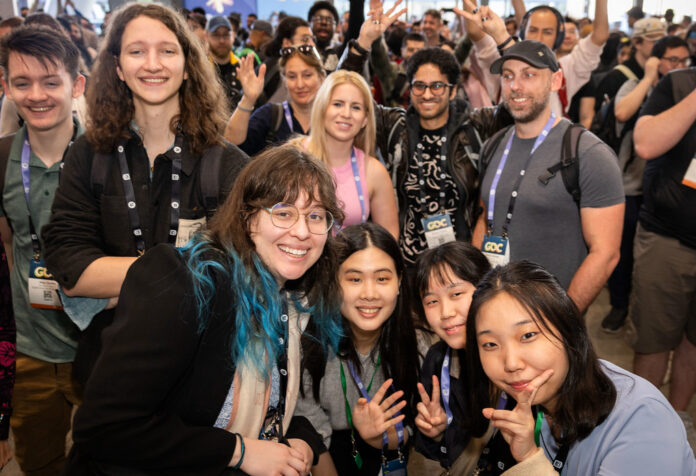
In late September, my social media feeds lit up with rumors that the annual Game Developers Conference, held every spring at the Moscone Center, was going to change drastically in its 2026 iteration. One source for this speculation was an official slide deck that promised a rebrand to the “Festival of Gaming,” a simplified and more affordable ticket pricing structure, official events spread out across the city, and new talk formats and opportunities for attendees March 9-13. “The industry is changing,” promises one of the slides, “and so are we.”
Many of the reactions I saw were bemused and cynical. Developers wondered if the rebrand meant that the industry-only conference would become open to consumers, like Seattle’s PAX West, or if it meant that technologies like NFTs or cryptocurrency would have an increased presence. Over the following days, as the conference’s official social media accounts posted CGI videos showing the old branding being destroyed by robots and aliens, many commenters assumed the videos were made with generative AI—which, given many gaming executives’ open pro-AI stance, is perhaps an understandable assumption to make.

The conference did indeed rebrand to “GDC Festival of Gaming.” Yet underlying all this discussion was, to me, a set of interesting questions. Many of the reactions to the conference’s rebrand seemed to reflect that the industry is indeed changing. So how is it changing, and how do the organizers behind GDC hope to reflect those shifts? In an industry buffeted by seemingly endless layoffs, controversial emerging technologies, and unprecedented events like Jared Kushner and the Saudi Arabian government’s $55 billion acquisition of EA, what is the role of an expensive, large-scale conference? In 2026, what is GDC’s purpose?
To get answers to these questions, I decided to start by speaking with Mark DeLoura, the conference’s newly appointed executive director of innovation and growth. DeLoura is an industry veteran; he played a major role at Nintendo of America during the launch of the Nintendo 64, served as editor-in-chief of Game Developer magazine, and was a senior advisor at the White House Office of Science and Technology Policy during the Obama administration. After spending over a decade on GDC’s advisory board, he was brought into his new role in mid-July, just before the conference’s rebrand was announced.
According to DeLoura, the various changes coming to the conference this year represent an optimization of the attendee experience. The rebranding to “festival” isn’t about accommodating consumers, but rather “emphasizing the community aspects of it… When we say ‘festival,’ what we’re trying to say is that we are leaning into the aspects of the show around networking,” he tells me.
The lower base-tier ticket price, called the “festival pass”, is meant, he continues, to “get more people showing up in the room,” addressing concerns around affordability and access. Meanwhile, for the executive class, a pricier “Game Changer” pass offers access to the “Luminaries Speaker Series,” exclusive lounge spaces, daily lunches, and conference-facilitated meetings.
“We’re trying to recognize that we haven’t always done a great job for executives,” DeLoura explains. “Executives have an interesting, different set of problems that we can help out with.”
Of course, one problem that executives have is maximizing profit. Many industry higher-ups have looked towards tools like generative AI as a path towards that goal, encouraging and, in some cases, mandating that their employees use AI to complete certain tasks, regardless of workers’ concerns. Given how controversial the use of AI has been in the industry—and given the online theorizing about GDC’s official promo videos—I wanted to ask DeLoura about it directly.

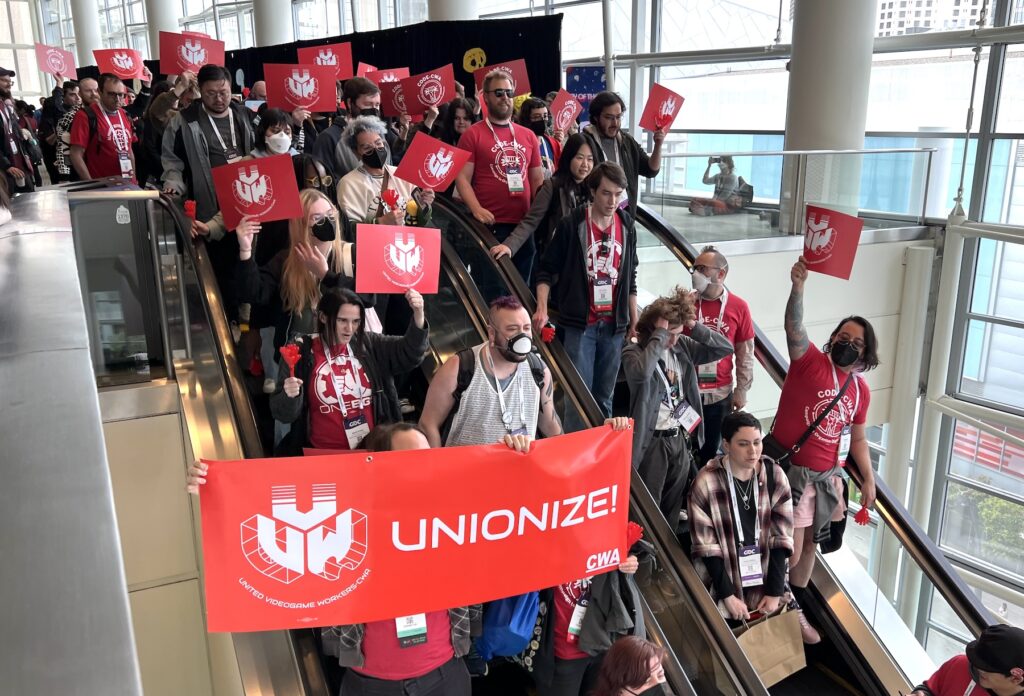
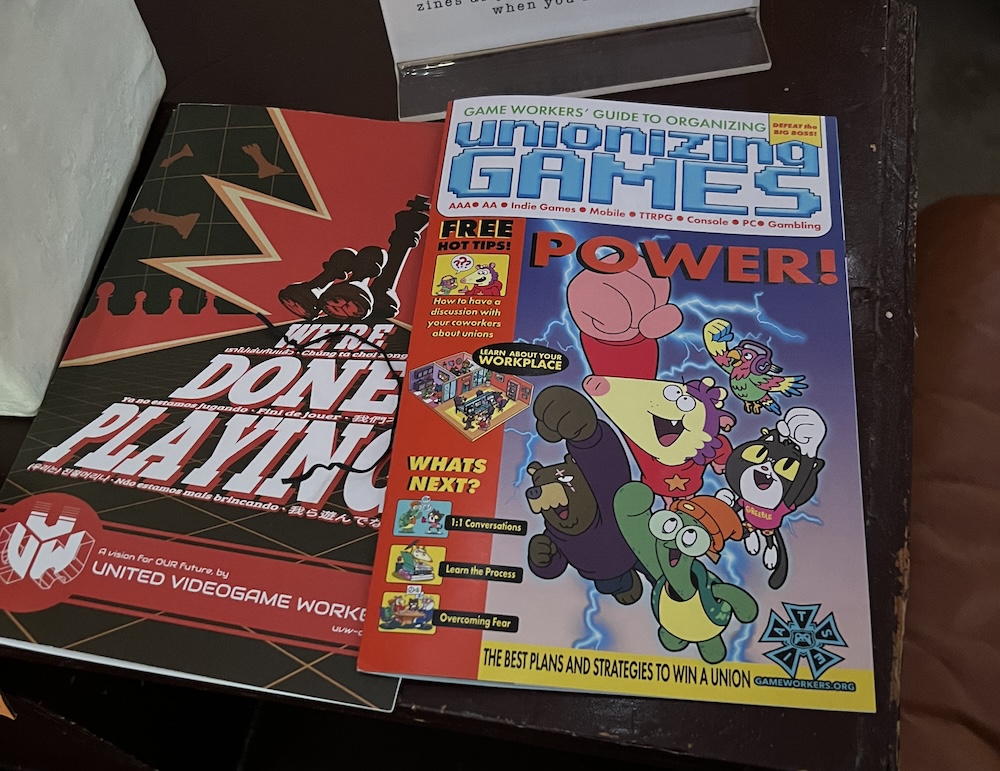
On the subject of the promo videos, he was straightforward: “As I understand it, those were not made with AI,” he says. But on the broader subject of AI he was more even-handed. He compared the conference’s role in facilitating conversation around AI to its role in facilitating discussion around unions—“Every year, we have a talk, or two or three, and we have groups come in and talk about unions. It’s a conversation we should be having actively”—before concluding, “I wouldn’t want to dictate to anybody one direction or the other, but making sure we talk about it [AI] is what’s important.”
DeLoura says that this conversation between different sectors of the industry is the defining feature of the conference. “It’s pretty much the single show that tries to address everybody who’s involved with making games,” he tells me. “Like, when there was a period of time at which the industry was using art outsourcers in China, that was contentious, but we talked about it at GDC. That’s where you go to talk about it.”
A few days after my conversation with DeLoura, I spoke with Sebastian Gioseffi and Liz Ryerson, who help to put together the Experimental Games Showcase at GDC each year. When I attended the showcase at GDC last spring, I found its focus on clever, playful, scrappy interactive experiences refreshing after a week surrounded by advertisements for AI dating sims and blockchain initiatives. Given that they interact with the conference’s organization so directly, I wanted to learn if the process of putting the showcase together had changed, and what they thought about GDC overall.
Logistically, Gioseffi says, “Most things continue to be the same, at least for our session.” When I ask about the ways that the conference is attempting to address a shifting industry, both he and Ryerson are hesitant to make predictions, given that next year’s conference is still months away; however, Gioseffi expresses cautious optimism that the new ticketing structure would allow more people to access the showcase. “Before this, you needed to have a specific pass from a track, or have an all-access pass to access the session. Now [that] everyone who has a pass is going to be able to attend the showcase, that may have an impact on the attendance,” Gioseffi says.
This dovetailed nicely with what Ryerson says about the showcase’s goals. Earlier in our conversation, she shares, “I think some of the importance of doing this is there just aren’t very many big-tent things in the world anymore… The audience is fragmenting, and it feels important to have some kind of space where things are shown on the same stage.” When I ask about what GDC provides to the showcase, she says, “It’s just about being exposed to a bunch of different things, and that people are doing this, and that it’s okay to do that, and that you can potentially meet or interact with the person who is doing that thing. And maybe it’ll help you go in your own direction.”
A big-tent event making its offerings more accessible means that more developers can have encounters with people and work that inspires them to follow their own muse; from this perspective, GDC could still be a useful experience for smaller and more artistically-minded developers, for whom the lower ticket price would make the experience more accessible.
Still, Ryerson thinks that GDC doesn’t have to be the end-all be-all of developer networking. “I would hope that someone who is interested in things like the Experimental Games Showcase, and maybe can’t afford to come to GDC every year, or doesn’t want to travel to the US or can’t afford to for various reasons, they make their own version of that,” she says.
Schera Wyss, an Oakland-based indie developer who’s worked on games like last year’s buzzy indie RPG Dread Delusion, has in essence done just that. Alongside her development work, she runs Slug World, a free “community meetup for punks and queers in games and art” that’s occurred across the bridge from GDC since 2022. She says that she started Slug World after noticing a myriad of problems with the conference, citing safety concerns for marginalized people, the high cost for attendees, and the presence of spurious tech fads like NFTs and, this past year, an “AI Snoop Dogg with unrigged braids that were just floating like little antennas” on the show floor. “It’s like, industry-industry, but it’s too industry for the fucking industry itself,” she says.
Slug World, by contrast, is meant to offer a more holistic and community-oriented alternative to the conference. “What I’m promising is a thing where clout is not that fucking important and we’re all just hanging out and making friends,” she explains. “This is run by a woman, this is run by a trans person, this is for the queers, this is for minorities… Part of my thinking is, kind of having a mutual aid thinking about things. Like, if people make friends, then they will have more people who can potentially help them when they need help. And that’s actually foundational to people being able to exchange resources, [even beyond] game dev-specific resources.”
For Wyss, GDC is less valuable for what it offers intrinsically, and more because it provides a “convergence point” for developers to come together; she says that she generally recommends that people hang out in Yerba Buena Gardens rather than spend money to enter the conference. And while she thinks that lowering the base ticket price is “a good change,” it still doesn’t solve the conference’s deeper problems.

“I think that what I would like to see from GDC would be, like, more of a focus on making sure that developers of small to mid-sizes can get value out of their trip and the money that they spent, networking value,” she says. Wyss recounts a story of attending an official queer-friendly networking event at a past GDC to illustrate her point: “I go in, and they’re like, ‘Oh yeah, go grab some free swag.’ I look at it, it’s all like Amazon-smile-with-a-rainbow-flag kind of shit… I’ve never been able to do any good networking at any of these, like, big sponsored events.”
For her, the official experience of GDC isn’t one where smaller developers and marginalized workers can easily find community; it’s one where corporate interests with the money to put on large events or afford booth space are prioritized. But ultimately, what Wyss hopes to do with Slug World sounds similar to what DeLoura said drew him to working with the conference. “I thoroughly believe that GDC was based in people getting together,” she says. “Sharing information, sharing passion, sharing resources, and knowing each other so that they could give each other opportunities. Like, that is what GDC needs to be offering, you know? And that’s what I’m trying to offer with Slug World.”
Wyss’ hope to provide what she feels GDC can’t reminded me of something that Ryerson had said during our earlier conversation: “I think a lot of people feel like, ‘The industry doesn’t want me, I don’t fit in.’ The industry only exists insofar as the people who make it up exist,” she had explained. “They have a space, and they can do it within their own context and spaces, and it doesn’t necessarily have to be at GDC.”