In recent years “Based on a true story” and its variants have appeared at the beginning of so many films—including some ludicrously obvious complete fictions—that the claim has gone from being a cliche to a kind of punchline. This week’s new movies, however, truly are derived in one way or another from real events, whether general historical chapters, sad news stories, or memoirs full of gory personal details.
Two of them deal with occupied Palestine, one in an expansive, decades-spanning fashion, the other as a claustrophobic crisis reenactment played out more or less in real time. (Both were also recently announced as making it to the shortlist for current Best International Feature Oscar consideration—along with a third title, Palestine 36, which does not yet have a firm US release date.)
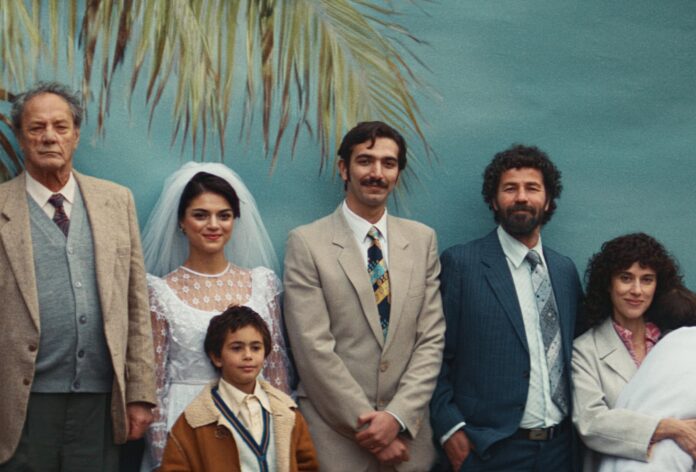
The first is Cherien Dabis’ All That’s Left Of You, an ambitious torch-passing narrative that keeps leaping years forward between successive episodes. In 1948, Sharif (Adam Bakri) is running his family’s longtime orange grove and export business in the countryside near Jaffa. But holding onto that prosperous lifestyle proves impossible amidst the upheavals of that year’s First Arab-Israeli War. While other locals reluctantly move elsewhere, and indeed Sharif packs his wife and children off for what’s meant to be a temporary flight after shelling gets dangerously close, he stays on in the hopes of protecting their home and land. That effort not only proves futile, for a while it lands him in a prison labor camp.
Thirty years later, a widowed Sharif (now played by Mohammad Bakri) is living in much diminished circumstances with schoolteacher son Salim (Saleh Bakri), his wife Hanan (Dabis) and their child Noor in the West Bank. All cling to some hope of living to see their rights restored some day, yet the situation only seems to get steadily worse. Later a tragedy occurs that underlines the embittering cruelty and arbitrariness of the occupation, when a family member is severely wounded by soldiers breaking up a protest, and bureaucratic hurdles needlessly delay access to emergency medical treatment. Still time marches on, even up to nearly the present day, with protagonists now forcibly scattered around the globe. When two return on a bittersweet “vacation,” they find sites of their youth seized so long ago are no longer recognizable—the past has been very nearly erased.
Dabis’ film (a multinational coproduction shot in Cyprus, Jordan, and Greece) does suffer a bit from the fact that much of its most dramatic material is early on, getting quieter and quieter overall as it proceeds. Nonetheless, it does render vivid a sense of historical and cultural loss. There’s no justice to the neverending displacement this family is subjected to; things get systematically taken from them until almost nothing but memory is left. While this 145-minute saga can be a bit uneven in pacing and impact, it offers compelling performances, some powerful sequences, and a lot of food for thought that amply reward the viewer’s investment. All That’s Left Of Youopens at SF’s Roxie Theater Fri/9.
Contrastingly compressed, and as high-decibel as a particularly in-ya-face stage production, is Kaouther Ben Habia’s The Voice of Hind Rajab. It is set in a Ramallah call center for the Red Cross-affiliated humanitarian organization Red Crescent on January 29, 2024. Volunteers receive an emergency call from the titular figure—a 5-year-old girl whose family was fleeing a Gaza City under fire when their stalled-out car got shelled by an Israeli tank. She was the only person still alive (or at least conscious), and understandably terrified, particularly as the tank continued to threaten the vehicle. It was excruciating for those Red Crescent personnel to try calming her pleas for help, while rescue efforts were thwarted. (Paramedics who eventually dared to approach were also killed—and none of the corpses could be recovered for almost two weeks afterward.)
Tunisian production Voice uses the actual recording of the little girl’s panicked cellphone call over the course of three hours, before that connection was terminated—yes, exactly in the way you’d fear. It’s squirm-inducing to hear that actual audio file, and a bit queasy to see professional actors respond to it, running through a gamut of angry and desperate histrionics. We can relate to the emotions they express in these circumstances. Yet there’s also a sense in which the film feels like tragic karaoke, awkwardly turning real-life horror into a showcase for showy, high-voltage performance.
The director, whose prior Four Daughters also laid a questionable theatricality onto nonfiction subject matter, avoids letting this single-setting tale become stagey. Still, at times the hyperbolic approach threatens to overpower empathy. Voice of Hind Rajab (which opens at Bay Area theaters TBA on Fri/9) can hardly help making a powerful impact due to its wrenching content. But I’m not sure I wouldn’t have found a straight documentary at least as poignant, and less problematic.

Three more new films veer from the issue-oriented to the biographical, all depicting characters based on real-life people at the end of their tether. The most low-key (comparatively speaking) and probably best of them is Eric Lin’s directorial debut feature Rosemead, whose screenplay by Marilyn Fu is based on a 2017 Los Angeles Times article about a domestic tragedy in the San Gabriel Valley. Lucy Liu plays Irene Chao, a Chinese emigre and widow thrown into crisis when she learns her cancer has come back—and this time there is little chance of a remission.
That is particularly worrying because she’s the sole support for son Joe (Lawrence Shou), a formerly high-achieving, socially outgoing high schooler who’s grown steadily more withdrawn—something that would be inexplicable if not for his recent diagnosis of schizophrenia. As that condition worsens, she begins to fear he’ll become a danger to himself and others. Without other immediate family hereabouts, she can find scant understanding or help from her own immigrant community, which largely retains an old-school attitude towards mental illness as something scandalous and shameful.
In real life, this did not end well. But rather than turn it into some kind of lurid torn-from-headlines thriller, the filmmakers have admirably emphasized the nuances of cultural gaps, and the desperation of a mother-son bond insidiously eroded by a disorder outside their control. Liu is very good in a largely Chinese-language role, and Rosemead impresses with its understanding treatment of both schizophrenia and well-intentioned if not always astute family coping mechanisms. It’s not an exceptional movie, but one that realizes its modest ambitions with moving, detailed care. It opens Fri/9 at SF’s AMC Metreon and other Bay Area theaters.
Such restraint is far from the emotional-fireworks terrain of The Chronology of Water, an adaptation of Lidia Yuknavitch’s 2011 memoir. That tome is very much an anatomy of a trainwreck, as she chronicles her own childhood under the thumb of an abusive (sexually and otherwise) father, escape on a swimming scholarship to college, inability to quell her demons with drugs, sex, and alcohol there, and gradual stabilization through a career of writing and teaching. I’ll admit I disliked the book—its author is very much enamored with gonzo style and content (Kathy Acker is a major literary hero for her) that often seems to spring less out of pain than a kind of braggy pride in her own self-destructive excesses. She only seems to notice other people if their personalities are likewise dialed up to 11, using almost as many hyperbolic superlatives to describe anything she likes as you’d find in a Trump speech. Yet for the most part she doesn’t seem to notice, let alone care about, those whom her mercurial antics left burned.
Still, it’s exactly the kind of book that excites readers looking for a voice that distills their own yearnings to experience the maximum in any situation. Actor Kristin Stewart makes her feature writing-directing debut here, and while she tamps down on some of the author’s more strenuous and repetitive tendencies, she also deploys some borderline-experimental techniques that do a fair job of approximating Yuknavitch’s internal and external disarray. Imogen Poots throws herself into the leading role, to potent effect; there are solid supporting performances from Michael Epp as the disturbed father, Thora Birch as Lidia’s sister, Tom Sturridge as one of the bisexual protagonist’s three significant male partners, and Jim Belushi (!) as Cuckoo’s Nest author Ken Kesey, who for a time became her drunken writing mentor.
Everyone involved does good work, Stewart most of all. Yet as obviously enamored as she is with the material, its careening nature still feels short on narrative shape, growing more exhausting than insightful over two full hours’ course. While she does Chronology of Water justice, I’m not sure it entirely deserved the attention. Others, however, may well find the results just as electrifying as they did the book. It opens at the Roxie Theater on Fri/9.
Finally, a movie that’s maybe not crazy enough to fully capture its lead character’s torment is Dead Man’s Wire, which is based on events that happened nearly a half-century ago in Indianapolis. There, a man named Tony Kiritis (portrayed here by Bill Skarsgard) reached the “mad as hell and not gonna take it anymore” state over a property he owned, and was at risk of losing—because, he believed, the mortgage company had swindled him. They ultimately supported a major development elsewhere, rather than the one he’d already gotten approval for, leaving him in serious financial straits. He decided to kidnap the company’s owner (played as a remorseless, high-living fatcat by Al Pacino), but upon discovering that personage has skipped their scheduled meeting to go on vacation, settled for the chief’s more mild-mannered son (Dacre Montgomery as Richard Hall).
The enraged Tony only wants justice for himself, and admittance of corporate malfeasance. But even as his plight generates some public support, he renders it more grotesque by wiring a shotgun to the hostage’s neck, ensuring a bloody denouement should any escape or police rescue get attempted. Not unlike the bungled bank robbery dramatized in vintage Pacino vehicle Dog Day Afternoon, this crisis attracted a particular sort of ambulance-chasing media attention—particularly as Kiritis utilized a local radio personality (essayed by Colman Domingo) he admired as a sort of negotiating liaison.
Dead Man is Gus Van Sant’s first feature film in several years, though he was just hired for the project, not its originator. Perhaps unsurprisingly, then, it emerges as one of his least characteristic works, more in the generic-competency realm of Finding Forrester and Promised Land than his many more personal, idiosyncratic works. The story is inevitably attention-grabbing, but Austin Kolodney’s script feels formulaic, and tonally things never quite gel: The cartoonishly addled Skarsgard and earnestly suffering Montgomery seem to be in different movies, while elements of 1970s nostalgia, drama, cop thriller, social commentary, broad comedy, etc. fail to mesh. It’s an entertaining-enough watch, but given the talent involved, the results should have been more memorable. It opens in limited theaters this Fri/9, then expands Fri/16.