A friend recently asked me: What do you think of the Marina Safeway?
Depends on the question, I answered.
So are you in favor or opposed? he insisted.
That’s the wrong question.
When we have a crisis of housing affordability, of evictions, of homelessness, the media and politicians throw shiny objects at us as the answers, more fodder for the Yimbys and their detractors to engage in endless diatribe on social media and in the comments sections of the papers.
What’s better than shiny baubles? I paid my way through Berkeley undergraduate working for an architectural illustrator (thanks Mr. Kim!), rendering malls and office parks and housing towers into shiny objects. I know shiny objects.
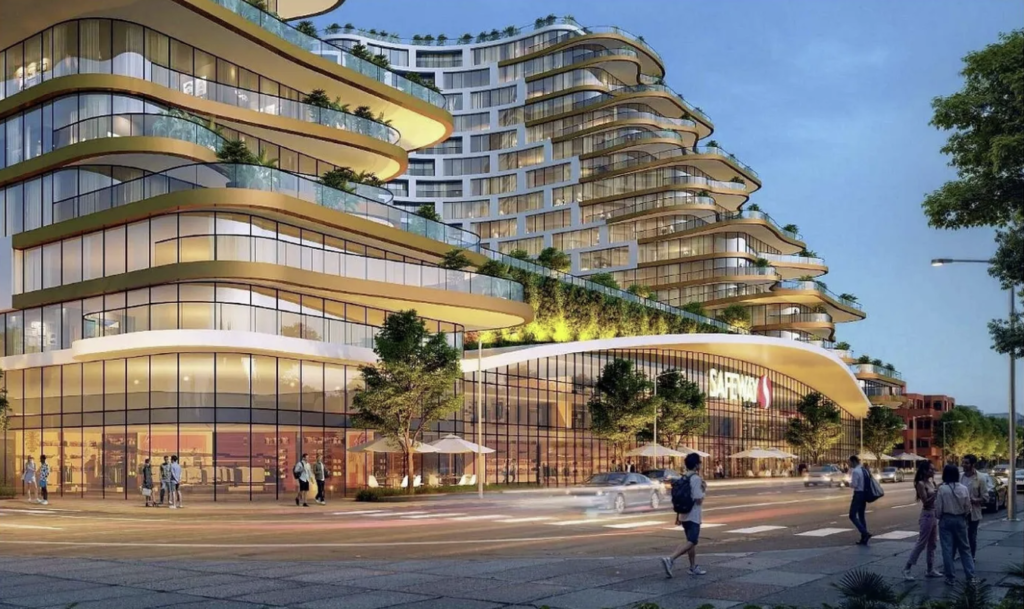
Shiny objects are thrown at us to distract from the real issues. In the weeks that this story was getting all the ink in the local papers, there were other, less noticed, stories about how the city was failing RV dwellers and pushing them to the brink of homelessness, and stories about actual workforce housing — stories that should have been central to the public discussion on housing and development.
I will say, it was really fun to watch the Yimby mayor squirm and do a Nimby about-face. Scratch a Yimby, and there’s a Nimby under the surface. It’s the same class interests: YIYBYs, Yes In Your Back Yard, Not In My Back Yard.

So let’s ask some more relevant questions: Who could afford to live here? Will it provide affordable units? Who would live here? Is it even housing? Would it have any impact on affordability for you and me? And will it even get built?
Let’s take them one at a time.
Who could afford to live here?
The average price for a San Francisco high-rise condo in 2025 was between $1 million and $1.5 million. Here’s a comp in the vicinity: new construction in an 8-story mid-rise, one-bedroom, no views, $1.425 million.
For $1 million one-bedroom, you need an annual income of around $250,000 to support a 30-year mortgage with a 20 percent down payment (assuming you’ve got $200,000 in the bank for down payment). So that’s who we’re talking about.
Will it provide affordable units?
The proposal includes 86 inclusionary “affordable” units out of 790, which is 10.8 percent, far lower than most large projects in San Francisco — or many other Bay Area cities. This is the secret to the so-called “State Density Bonus.” It was a policy created in the 1980s to incentivize developers to build in suburban parking lots with low land values, giving them a bonus of market-rate units in exchange for a small amount of affordable units. But in cities like San Francisco, with enormous land values, development could and has supported significant amounts of on-site affordable units. Developers and the political hacks who depend on their donations have discovered how to use the density bonus as a loophole to actually lower their inclusionary responsibilities and inflate their profits.
Not families. Three quarters of the units are tiny studios and one-bedrooms, geared for singles. This is a complex for the techie crowd to go flirt at the Marina Safeway, a pit stop on their way to Danville or wherever.
Is it even housing?
The City’s Budget and Legislative Analyst studied vacancies in San Francisco, using pre-COVID data, and found that the city had over 30,000 vacant units — at the height of the market (rounding down after removing the 7,200 vacant units on the market for rent or sale). These vacant units likely include units purchased for investment purposes, second homes, timeshares, and corporate rentals.
What is interesting is that a majority of the vacant units are concentrated in areas with a high degree of new multifamily construction; The new construction units are the ones that are vacant. So, yeah, let’s assume that a quarter to a third of those 790 supposed “housing” units are just parking lots for someone’s money.
Would it have any impact on affordability for you and me?
But like many of these supply and demand models that YIMBYs love to quote, it looks at price elasticities over the aggregate and assumes that all those “units” built are actually used as “housing.”
People don’t look for just any type of housing. The condos costing between $1 million and $8 million at the Infinity Tower downtown are not my market, or the market for any teacher that I know of. Housing operates in submarkets.
As Harlo Peppinger points out in a recent story, it is the price effects of luxury housing on these submarkets that we need to analyze: in a Minneapolis study, researchers found “that low-rent buildings saw a rent increase of around 6 percent with new market rate construction nearby, while higher-rent buildings saw a decrease of 1.5 percent.” There’s your answer: the wealthy will benefit (a little) from more supply of luxury housing, and the rest of us will be more screwed.
Will it even get built?
At $1,000 a square foot for high-rise residential construction, the Marina Safeway probably gets built around the time this happens:

The Marina project would be just below the “S” in Starfleet. Except that in the Star Trek world, capitalism has been eliminated and everyone has a place to live.
If the AI bubble lasts that long.
The Marina is one place where they might be able to get the necessary sales prices/rents to pencil. But if they can’t finance $1,000 a square foot for construction, what do you think happens to the price of those assets when they are “entitled” for 25-story towers? What do you think Park Merced was all about? This is as much about gaining “entitlements” and inflating the worth of real estate assets, as it is about building something. It’s all speculation. It’s about land. Land is always the game.
So let’s reframe that original question: What do I think of a proposal for $1.5 million studios for tech bro singles with minimum $250,000 salaries, that will remain one-third vacant, that will likely increase rents for lower income renters, and might never even get built?
Well, if we were actually following the city’s Housing Element, and ensuring that 57 percent of the new housing in the city is affordable to low and middle-income folks, I’d say, hell yeah: Build it for 50 stories if you want.
But no, this is just a shiny bauble to distract us from what we really need to be doing.
Let’s talk about some real things, things that might have a real impact on regular people’s lives. How about talking about how to get low-income housing built, or workforce housing like the one the Sophie Maxwell project that opened the week this story blew up, or how about talking about what’s going to happen to those RV dwellers that Mayor Lurie has abandoned?