
The defining social media moment of the Wednesday night Congressional forum was a photo of State Sen. Scott Wiener refusing to take a position on whether Israel is committing genocide in Gaza.
The question came during the “lightning round” at the end of the debate, when the candidates had to hold up signs saying “yes” or “no” to questions. When the moderators asked “is Israel committing genocide in Gaza,” Saikat Chakrabarti and Sup. Connie Chan held up “yes” signs.
Wiener put his sign down, and refused to take a stand.
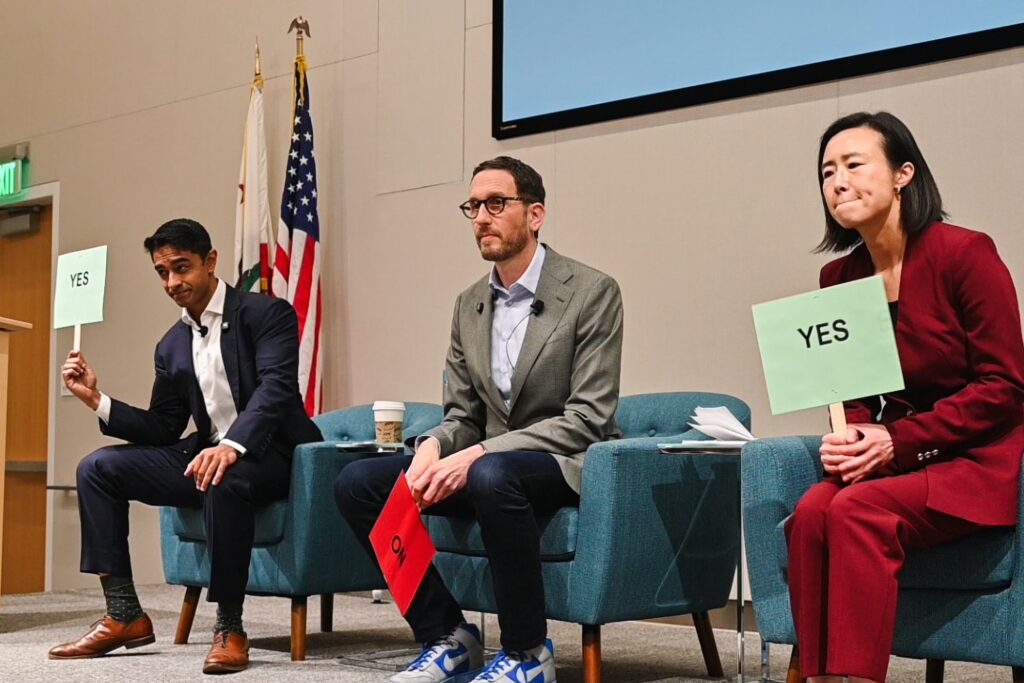
A lot of people in the audience were outraged.
Wiener later told reporters that he wished he’d had time to describe his more nuanced position on Isreael and Gaza: He said he opposes any sale of US offensive weapons to Israel, opposed the invasion of Gaza, finds the Netanyahu Administration terrible, and supports a two-state solution.
But the picture of him refusing to take a stand will linger throughout the campaign.
There was much, much more at the debate, though, and we got a good picture of how this will evolve over the next 150 days.
Here are a few takeaways:

Scott Wiener is running as a mainstream Democrat whose message is “I can get things done.”
Over and over, Wiener talked about how he’s found ways to get bills passed. He spent much of his closing remarks praising Rep. Nancy Pelosi, saying she “woke up every day thinking about how to help San Francisco.” (I don’t know what Pelosi thinks, but I suspect that for much of her career as speaker, she thought about what she could do not for San Francisco but for the national Democratic Party.)
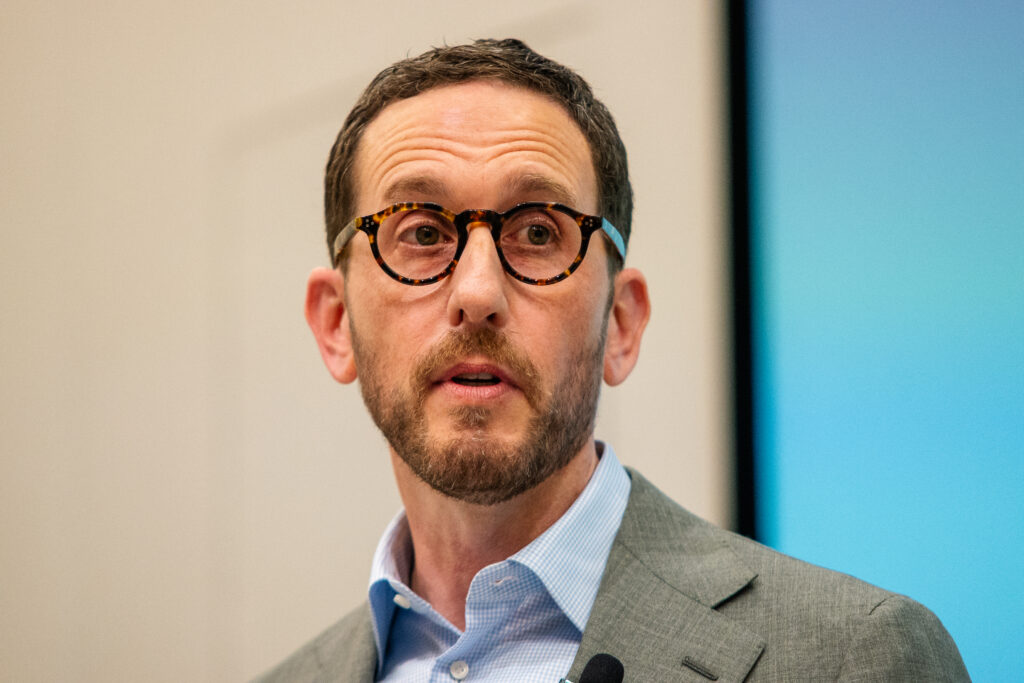
He dismissed some of Chakrabarti’s ideas as unrealistic (“I don’t just talk, I deliver”) and said that he was “not running to make promises.” He is presenting himself as the heir to Pelosi, not someone who is looking for far-reaching change in the Democratic Party.
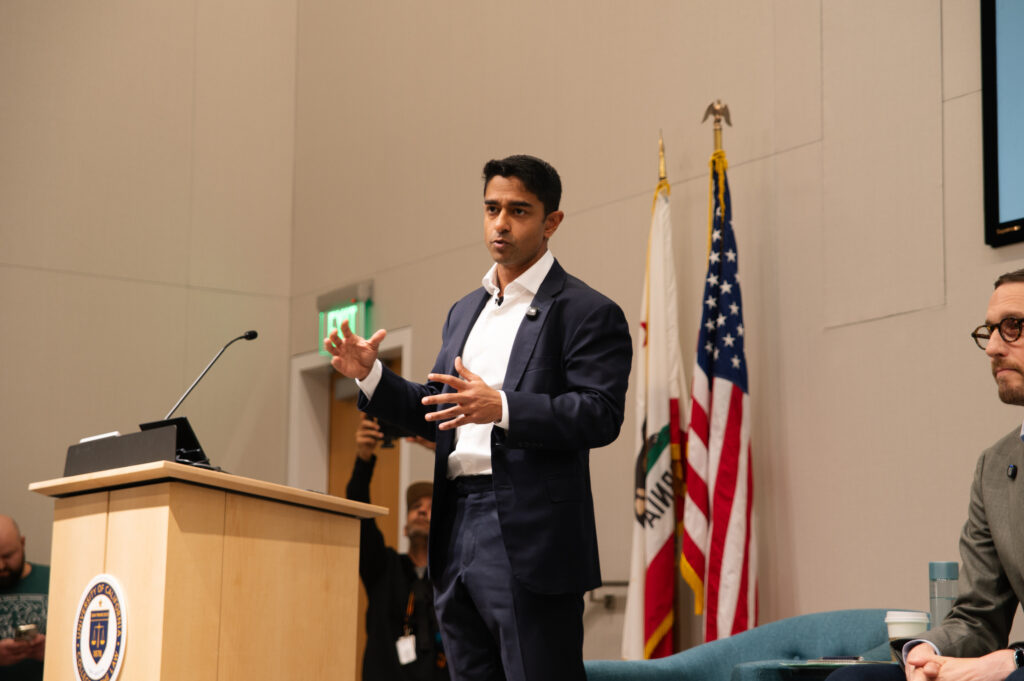
Chakrabarti is running against the entire Democratic Party leadership. He said the Democratic establishment has failed, and “we have to completely change the leadership of the Democratic Party.”
Wiener and Chakrabarti are happy to attack each other. Wiener kept saying Chakrabarti was unrealistic; Chakrabarti kept saying that “we don’t need career politicians.” The contrast between the two was obvious from the start.
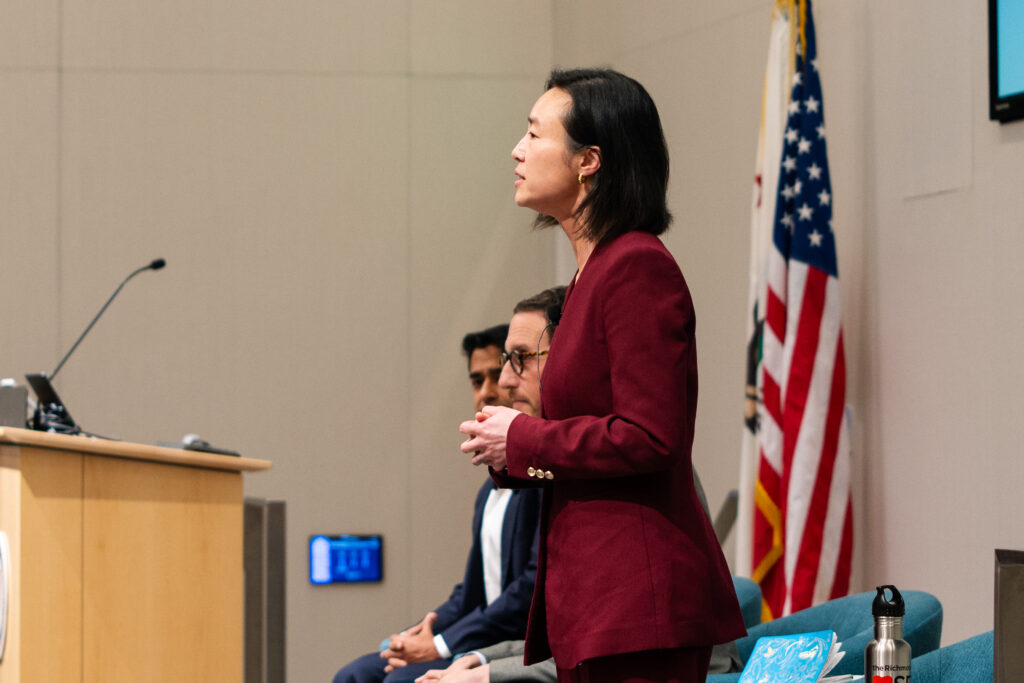
Chan is running as someone with deep roots in the city, an immigrant and a mom who is a lot more like most voters than either of the other candidates. Chan talked about how she arrived in San Francisco at 13, speaking no English. She talked about her kid. She talked about working San Franciscans. She talked repeatedly about being the next “Congresswoman” while the two guys were sniping at each other.
There were few issue differences between Chakrabarti and Chan—but a lot of differences between both of them and Wiener.
The national press can say these are three liberal Democrats, but Wiener and Chan have very different political histories and records. Every elected official in this city is a Democrat, and everyone agrees on most social issues, but there are two very clear and distinct opposing groups.
The so-called “moderates” are economic conservatives who support market-based solutions to problems like housing, and who often oppose higher taxes on the rich and regulations on industry, particularly housing and tech. They are backed by several powerful tech billionaires who want to impose their will on the city.
The “progressives” are more likely to be backed by labor (excepting some building trades) and are opposed by the billionaires. They favor higher taxes on the rich and more regulation of businesses.
Wiener is part of the “moderate” bloc. Chan is a progressive.
Chakrabarti has limited history in SF politics, and while he is running on a left-wing platform, he has donated money to the billionaire bloc candidates and helped “moderate” Bilal Mahmood defeat the only democratic socialist on the Board of Supes, Dean Preston, who spent much of his time in office looking for ways to tax the rich to fund affordable housing.
When the moderators asked whether the candidates supported a tax on billionaires, Chakrabarti and Chan immediately said yes. “I am the only candidate here who has run twice against the billionaires, and won,” Chan said. Chakrabarti said that “inequality in itself is a serious problem” and that “inequality creates an unaffordable society.”
Wiener refused to say if he would support the tax measure. When I asked him about it later, he said that he generally supports “progressive taxes” but wanted to see the details. That’s the same thing he said when I asked about Sen. Elizabeth Warren’s proposal for a wealth tax; he said he didn’t know enough about it.
One could argue that a candidate for US Congress who said he supports “progressive taxes” would have taken ten minutes to review this one.
Wiener also said he opposed Prop. C, the 2018 ballot measure (backed by Preston) that raised taxes on the biggest businesses in town to bring in money to address homelessness. Even the downtown group SPUR supported it.
Wiener said he thinks the measure has not been good for San Francisco, although it has raised hundreds of millions of dollars that have helped get thousands of people off the streets. He said later that it was too much of a burden on fin-tech companies.
Chan and Chakrabarti said the measure has been good for the city.
Housing played a minor role in the debate, although it could be a defining issue in the election. Chan talked about preserving existing housing, including rent-controlled housing, which is the most important affordable housing in a crisis. Chakrabarti talked about recreating a New Deal era federal finance agency that could offer low-interest loans for housing.
Wiener talked about his bills that make it easier for market-rate developers to build luxury housing, and touted the new project in West Portal as an example.
Wiener’s bills to limit local oversight of housing will not be popular on the West Side.
This was the first major forum, and more than 1,000 people lined up around the block to watch. But it gave us a sense of how the race is going to shape up over the next 150 days.
Full disclosure: My daughter works on the Chan for Congress campaign.