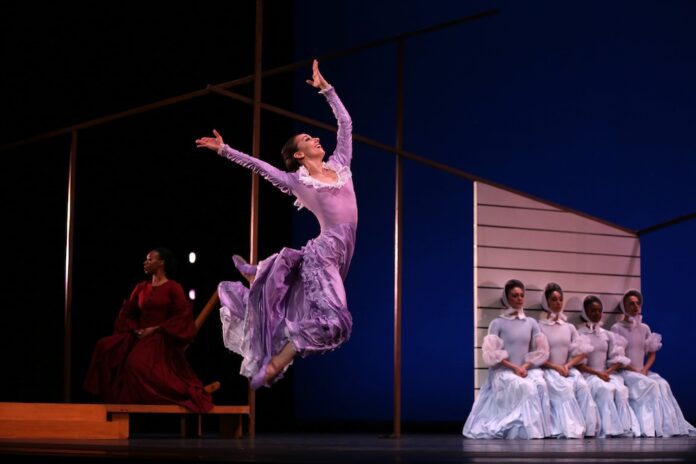
At Martha Graham Dance Company’s matinee performance on February 15, a diverse program and impeccable dancing went beyond expectation. Presented by Cal Performances at Zellerbach Hall on the UC Berkeley campus, the 100-year-old dance company displayed complete command of the afternoon’s repertoire: Graham’s iconic Appalachian Spring, which had its premiere in 1944; Jamar Roberts’ We the People; the Bay Area premiere of En Mass; and Immediate Tragedy, a work based on original choreography by Graham and reimagined by artistic director Janet Eilber.
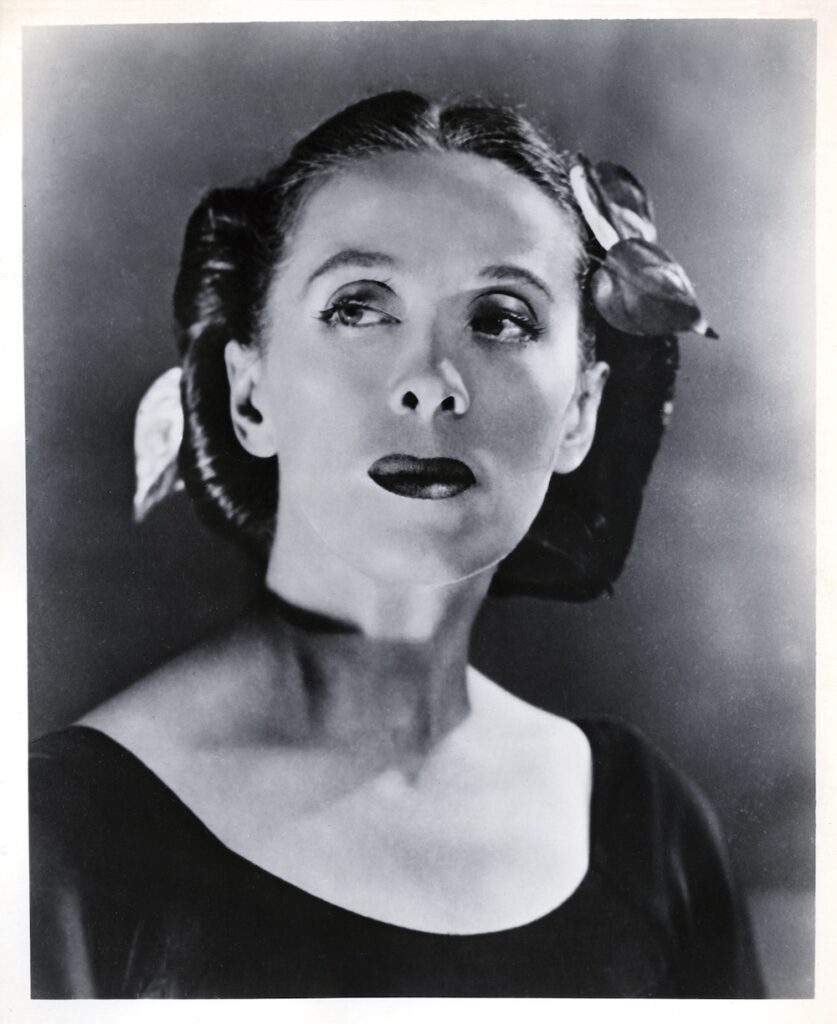
In warm front-of-curtain comments, Eilber said each work was “inspired by the American conversation.” Indeed, the next two hours presented distinct voices that in their totality created a symphony of sound, from the sweetly nostalgic to the powerful and futuristic. Astonishing not only due to the dancers’ dynamic range and ability to capture each choreographer’s style and technique, in every dance music changed how movement is perceived, and vice versa.
Appalachian Spring, with its well-known music by Aaron Copland and a brilliantly spare Shaker-style set by Isamu Noguchi, presented a long-gone world. A woman and a man are establishing their first post-World War II home in a place and a relationship that to them is uncharted territory. The bride (Laurel Dalley Smith) and the husbandman (Ethan Palma), are joined on what is their wedding day by a pioneering woman (Leslie Andrea Williams), a preacher (Antonio Leone), and his four followers, (Meagan King, Devin Loh, Amanda Moreira, Isabella Pagano).
I’ve seen this dance performed live roughly eight times prior, and the quality and authenticity of this cast was equal to the best of the rest. Smith and Palma captured completely the girl-woman and boy-man energies of their respective roles. From Smith, there was the sense of a firefly, a body lit up and able to spring effortlessly into the air. Palma performed buoyant coupé jetés and double-attitude barrel leaps, eating up the ground in grand strides and lunges, and stretching tall and wide in arabesques and wide-leg stances, as if owning not only the family plot but the entire landscape.
Counterpointing the couple’s youthful determination, Williams embodied dignity born from simplicity; a bent leg lifted to the side, a wide relevé held in fourth position, a majestic turn or run was all she needed to express a lifetime’s worth of stories. With streamlined vigor, Leone’s preacher was also a storyteller: pointing his two fingers, rocketing into jumps out of deep squats, and posing in stern profiles with his jawline in a display Puritan condemnation regarding earthly bodily pleasures. The four followers fawned and fussed around him, managing to avoid silliness and adding an essential dose of levity and humanity to the ballet.
Ultimately, Appalachian Spring is a tribute to things we struggle in contemporary times to believe in, such as love, hope, truth, and an America united despite differences.
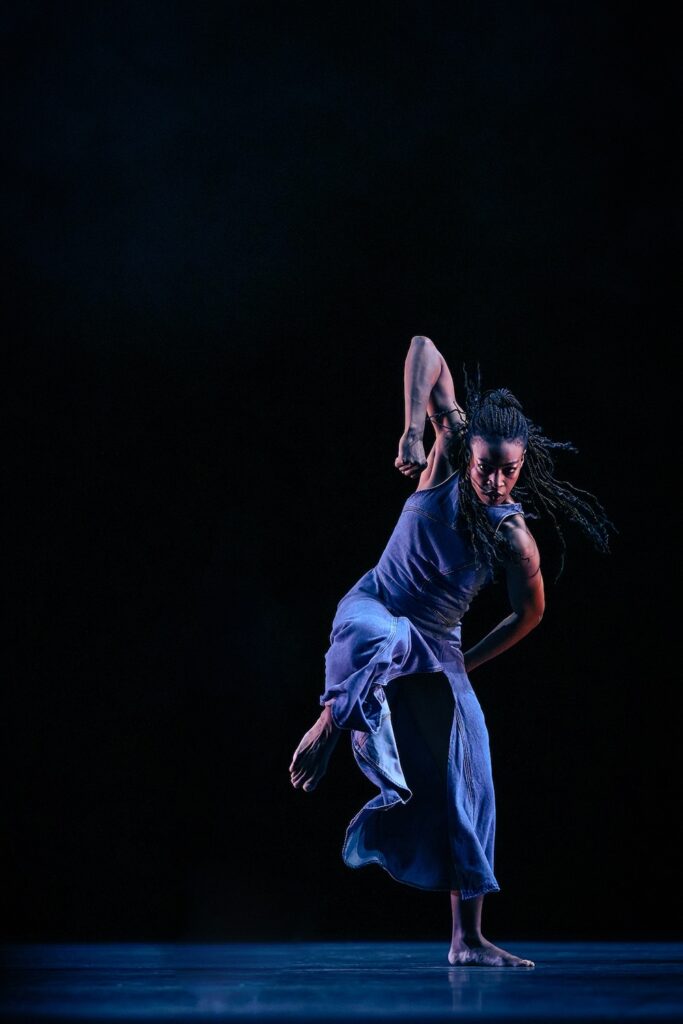
We the People continued the program’s mind-blowing trajectory. In this viewer’s perspective, it was the show’s strongest work; highlighting the dancers’ spot-on control of every gesture. Three solos and one small group of women performed in silence to introduce each of the work’s four sections. They lay the groundwork for large ensemble dances that were never subsumed by extraordinary music from Rhiannon Giddens, arranged by Gabe Witcher in an original score.
Dancers in Roberts’ well-structured, we-are-one groupings never lost or hid their individual impulse. It was as if each person’s skin was something holding the body together and also, existing in a state of constant rupture and decay. The message was to listen to the forcefulness of a life born; growing, learning, collapsing, vanishing, returning, surviving, dying.

After intermission, dancer Yi-Chung Chen took the stage alone. Music inspired by Henry Cowell’s hand-written score was created by composer Christopher Rountree, and a costume designed by Graham drew upon archival photos of the 1937 solo she made in response to the Spanish Civil War. After Graham—who famously despised being filmed—stopped performing the work, its choreography was considered lost. Eilber’s rendition arose from archival notes Graham made that placed resilience and “staying upright at all costs” as the piece’s central themes.
Judging by the audience response (extended applause and enthusiastic cheering), this reimagined solo was a success. Unfortunately, this viewer was reminded of a conundrum: Can a dance be so well-executed it loses its edge, its luster, its potency? Chen achieved an agonizingly slow backward hinge with ease, as if less crushed by an unavoidable, heavy weight than folding before any harm could be inflicted on her body. In another section, she appeared to duck without flinching; moving before, not after, receiving blows from invisible sources. In other dances, Chen proves capable of expressing intense emotions and nuanced artistry. But missing in her perfect command of every aspect of this dance was the raggedness, the wrenching resistance a person must make to recover from tragedy.
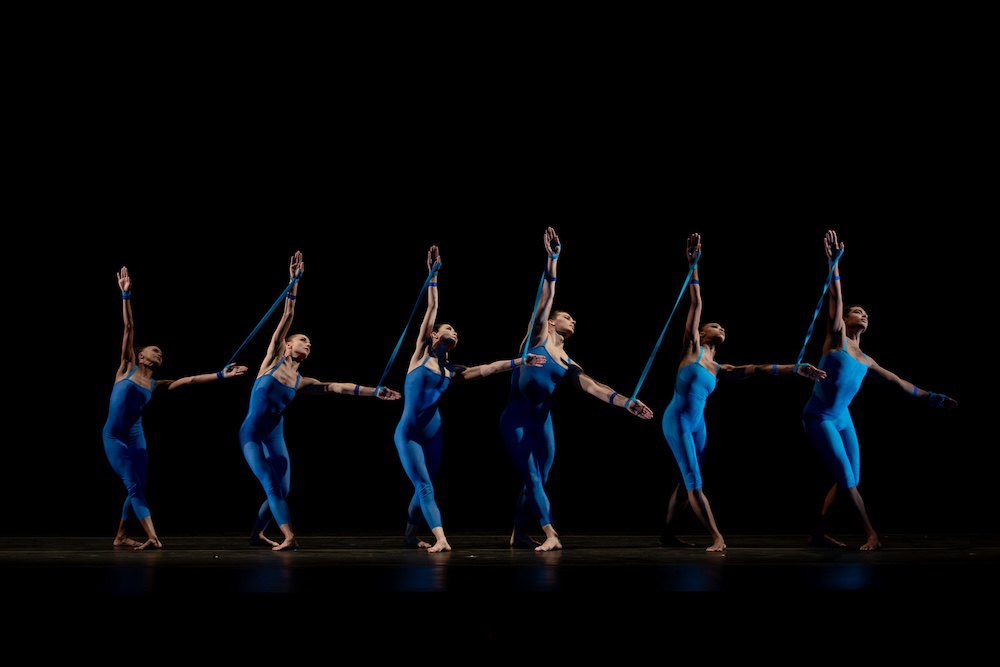
The program closed with Boykin’s En Masse, a work commissioned in 2025 to celebrate the company’s 100th anniversary. Again, music was a fundamental influencer. A short work by Leonard Bernstein, Vivace, that archivists believed had been written for Graham, was expanded by Christopher Rountree.
This dance began with the elegantly marvelous Lloyd Knight, soon joined by the work’s other six dancers. Costume designer Karen Young rendered the dancers’ loose trousers and tops in various shades of blue, from aqua to cerulean. The colors illuminated by Al Crawford’s sculptural lighting were instantly uplifting, the choreography suggestive of hope. While short sections offered enticing demonstration of how these dancers can shift in a blink from peaceful to pained, the sum was slightly less impressive than the parts. Perhaps Boykin can add to the work.
All other matters aside, the takeaway from the performance is that 100 looks pretty good on Martha Graham, and that the future for dance is in mighty fine hands with companies such as this one.