If the title of this piece seems impolite, I’m in good company. When Bette Davis learned that her arch-nemesis Joan Crawford had died, she famously said, “You should never say bad things about the dead, only good. Joan Crawford is dead. Good.” At least Joan Crawford never killed anyone, so far as I know. That’s better than you can say for Peter Duesberg.
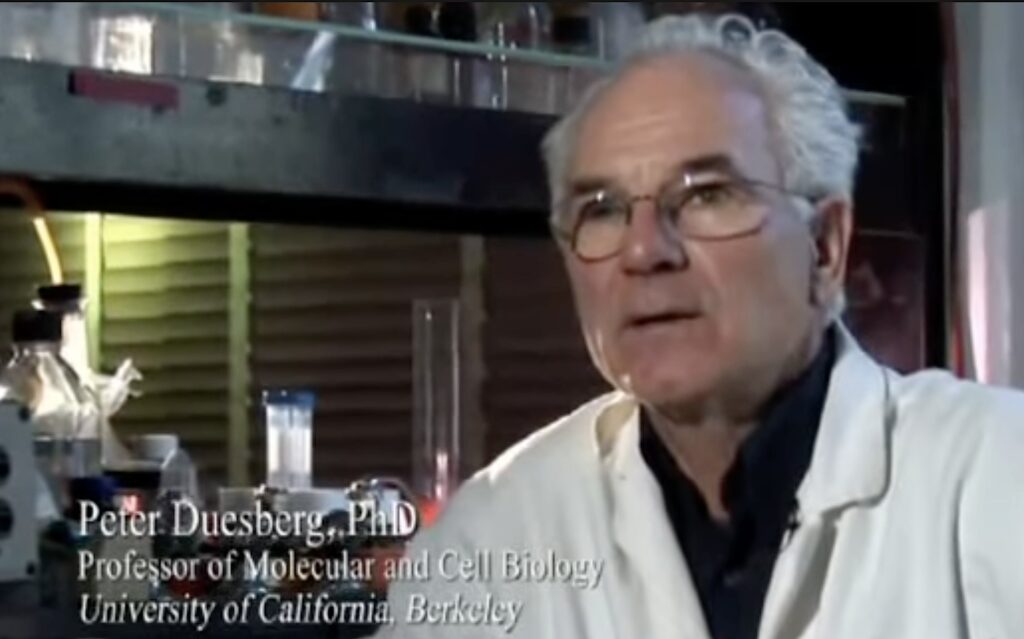
Beyond question, Peter Duesberg left a trail of death—not with bullets or knives, but with lies about AIDS, HIV and the treatments that still keep many of my friends alive. As outlined in his 1995 book, “Inventing the AIDS Virus,” he insisted that HIV was harmless and AIDS was caused by use of drugs—both recreational drugs and the pharmaceuticals used to treat HIV, like the early anti-HIV drug AZT.
I first began paying serious attention to Duesberg when Spin, the music magazine that for years was enthralled by AIDS denialism, published a bizarre interview with him in its September 1993 issue. In it—which I wrote about in a column for the gay press—he claimed that gay men couldn’t possibly have as much sex as they do without heavy drug use. In denouncing AZT, which he called “AIDS by design,” he got both the dose and the then-current recommendations for its use wrong. He offered no data to prove that the drug caused illness or death, just a couple of anecdotes about people who took it and eventually died. As a real scientist once told me, “The plural of anecdote is not data.”
Duesberg also claimed that the much higher number of US AIDS cases among gay and bisexual men than among women proved it couldn’t be sexually transmitted, and when confronted with the fact that cases were indeed rising among women, he simply lied and said they weren’t. He seemed unable to grasp, or maybe acknowledge, that a sexually transmitted disease that first took root in the gay male community would likely spread primarily among gay men. He lied again when asked about data showing that safer sex campaigns were reducing AIDS incidence among gay and bi men. He lied yet again when asked about research indicating that certain HIV mutations led to more virulent and damaging strains of the virus.
And so it went. He dismissed Kaposi’s sarcoma, a once-rare type of skin cancer that became vastly more common with AIDS, as an indicator for an AIDS diagnosis, claiming, “Cancer has nothing to do with immune deficiency.” That’s nonsense, as research even then was beginning to show. The role of the immune system in fighting cancer has become even clearer in recent years, and a whole class of immunotherapy treatments for cancer has emerged, as scientists have learned how to enhance helpful immune responses.
A recurring them in Duesberg’s book boils down to, “We’ve never seen a virus that does what they say HIV does, therefore HIV can’t possibly be doing it.” That’s about as baldly unscientific as you can get. Science discovers new, previously unknown stuff every day. In 1600, no one had ever seen a microbe, much less knew that they caused disease, and yet they existed and caused disease. In 1900, no one had ever seen a drug that could quickly cure an infectious disease, but a few decades later penicillin was doing just that. Can you imagine the reaction if you showed a smartphone to someone in 1940? To treat “we’ve never seen this before” as meaning “this can’t exist” is plain dumb, but that’s where Duesberg dropped his rhetorical anchor.
Actions have consequences, and Duesberg’s hypothesis proved fatally attractive to many, including gay men who at times had good reason to be wary of what the government told them. After all, this avuncular, German-accented scientist was telling them they didn’t have to worry about safer sex, even if they were HIV-positive, and certainly didn’t have to take expensive and sometimes unpleasant anti-HIV drugs, which in fact might kill you. He and other “AIDS dissidents” who echoed his views grew a considerable following in San Francisco and elsewhere.
Many of those who were HIV-positive did not survive, choosing to shun the new and effective combination therapies that began to be available in the mid-1990s.

As I’ve written before, the movement developed a decidedly cult-like quality. I spent a lot of time observing and talking to denialists, and their ability to dismiss any facts that challenged their belief system was astonishing. I vividly remember hearing a member of the denialist clique that took over and eventually destroyed ACT UP San Francisco responding to a question about the “Lazarus syndrome”–people who had been desperately ill with AIDS starting the new drugs, recovering their health and returning to work–by saying that the new drugs must be magically undoing the toxicity of AZT. He had no data supporting that theory nor an explanation for why such people’s rebounding health corresponded directly with the drop in the level of HIV circulating within them.
It continues today. When I wrote in these pages a while back that half a dozen people I knew who had fallen into the denialist trap had subsequently died of AIDS, a reader wrote in to claim that one of them had actually been killed by having been given a brief course of AZT while hospitalized and too ill to refuse treatment. Even Duesberg didn’t claim that a few days of AZT would kill you, but accepting the reality of HIV—and the reality that they’d been duped—was and is too much for some.
Did Duesberg know what he was doing? Did he intentionally mislead people, knowing he was leading them to a likely death? I can’t prove it, of course, not being privy to his private thoughts. But I watched him speak in person and interviewed him once at length. He was many things, but he was not stupid and did have real scientific training. To not have understood that he’d gotten it wrong, especially by the late 1990s and beyond, would require a staggering level of delusion.
So goodbye, Peter Duesberg, and good riddance. Rot in hell.
Bruce Mirken is a longtime health journalist who specializes in HIV coverage.