A lot of special film events are taking place this weekend around the Bay Area, making for some tough choices amongst those who ideally would like to fit them all into their schedule. Sat/21 the AMC Kabuki in Japantown is hosting the 15th annual “Films of Remembrance”, which gathers together 10 titles (in five programs, starting at 11am) taking different approaches to the forced incarceration of over 120,000 Japanese Americans during World War II—a historical chapter that seems to grow more disturbingly relevant by the day. They are primarily shorts, including documentaries, experimental works, animation, and narratives.
The final, 5:30pm show, which will be followed by a filmmakers’ reception, is Tadashi Nakamura’s recent nonfiction feature Third Act. It chronicles the life of his now-elderly father Robert, who was interned at Manzanar with his family as a child, then went on to become “the godfather of Asian-American media” as both a director and organizational founder. The day’s programming will be repeated the next day at San Jose’s Buddhist Church Betsiun Annex, then travel to Southern California dates the following weekend.
Playing twice on Sat/21 only at SF’s Marina Theater is Right in the Eye, a “live movie concert” by Alcolea & Cie. Composer Jean-Francois Alcolea and two fellow musicians—playing over two dozen instruments, including aquaphone, glockenspiel, and spoons—accompany 11 original shorts by Georges Melies, the French film pioneer. While most of his contemporaries in the earliest years of cinema remained mired in stage conventions, Melies embraced the new medium’s possibilities in full, utilizing a full array of “trick photography” devices to create fantastical miniatures.
He remains best known for 1902’s sci-fi whimsy A Trip to the Moon (which is not in this program), but as early as 1896, he began crafting illusion-focused shorts that grew ever more elaborate, including impressive sets and hand-coloration. A good example is the lavish 1903 Kingdom of the Fairies; other self-explanatory titles on the bill are The Lilliputians and the Giants and An Impossible Balancing Feat. By 1910, he’d fallen out of fashion, with less than half of his enormous screen output surviving today. But his art remains a timeless delight that doubtless will be enhanced by this “live” presentation. Coming towards the end of a U.S. tour, the 75-minute Marina shows are at 3pm and 7pm.
Leaping 12 decades or so to the present day, one good sampler of the state of cinema is provided annually by the Oscar Nominated Shorts collections, which release in theaters nationwide this Fri/20. Works that made it to the final five in the Academy’s 98th edition fill the usual three categories—Animated, Documentary and Live Action—with contributions from the U.K., France, Ireland, Canada, Chile, Israel, and the United States, including those from a number of Bay Area filmmakers. The trio of programs, featuring an onscreen presenter in actor-director Taika Waititi, will open at various local venues TBA.
Over in Orinda, the weekend will take on a more end-of-days tenor with the Fear and Faith Horror Film Festival, which explores the intersection between religion, occult superstition, and genre thrills via eight features and a half-dozen shorts culled from the last seven decades. They include vintage evangelical Christian warnings against the coming Satanic apocalypse (1981’s Image of the Beast), mainstream witchcraft thrillers like the 1966 Eye of the Devil (featuring Sharon Tate), examples of “Turkish Theological Horror,” actor James Bond III’s sole directorial exercise Def by Temptation (1991), and a recent adaptation of an 1894 novel by Welsh author Arthur Machen (The Return of the Great God Pan).
There are also several outré visions treasured by knowing cult-film collectors: Larry Cohen’s memorably berserk 1976 God Told Me To; Juan Lopez Moctezuma’s hysteria-driven Mexican Alucarda from the next year, a tale of demonic possession in a nunnery; offbeat 1983 U.S. folk-horror tale Eyes of Fire, set in pre-Revolutionary War colonial days; and Nobuo Nakagawa’s 1960 Jigoku aka Sinners of Hell, a Japanese depiction of souls’ unhappy fate in the afterlife that’s got some eye-popping widescreen color imagery. It’s a thematically linked schedule with a lot of diversity (not to mention entertainment value) in style and content. Plus, you’ll get to spend hours in the splendidly restored art deco Orinda Theater. The festival runs Fri/20 in the evening (from 5pm) then occupies about 12 hours on Sat/21, starting at noon.
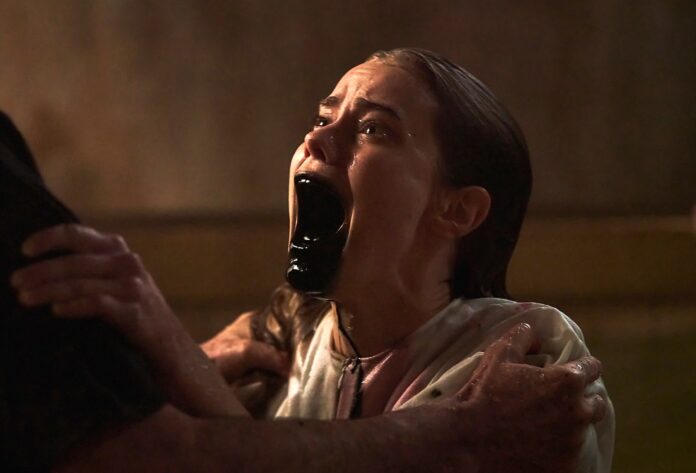
Religion and terror terror further entwine in several interesting new films releasing to streaming platforms. In Daniel J. Phillips’ Diabolic, a young woman (Elizabeth Cullen) who’s repressed much of her upbringing in a Fundamentalist Latterday Saints community—the kind that in real life practices “plural marriage” and has been accused of child abuse, among other things—now finds buried trauma taking over her life. Plagued by disturbing behavior during blackouts, she reluctantly accepts a psychiatrist’s advice that she confront her demons. Ergo she, her husband (John Kim) and BFF (Mia Challis) travel to perform a ritual with “healer” from the sect she grew up with. Needless to say, this turns out to be a big mistake for all concerned.

Though I imagine Mormons would find this story exploitative, Diabolic (which was made in Australia with Australian talent, though you wouldn’t guess) is an effective slow-burn horror that takes its time escalating—but it does get there. I found the character psychology kind of pat, and one late revelation ridiculous. But this is otherwise a decent, sober-sided possession tale that resists the more obvious cliches and devices. It’s available via U.S. On Demand outlets on Fri/20.
Likewise imperfect but effective is Natahsa Kermani’s The Dreadful, which is based on a Shin Buddhist parable (also the inspiration for classic 1964 Japanese horror film Onibaba) but set in 15th-century England. Anne (Sophie Turner) and mother-in-law Morwen (Marcia Gay Harden) live in a seaside hamlet, waiting for their respective husband and son to return from fighting in the War of the Roses. Alas, only fellow fisherman Jago (Kit Harrington) comes back alive—bearing news of his friend’s death. While this only sinks devout Anne deeper into piety, it seems to snap Morwen’s tether. Her grieving madness takes a curiously greedy, violent form, as she now finds reasons to justify killing passers-by in order to rob them. Meanwhile, a frightening, fully armored “Knight of Hell” keeps appearing like a phantom in the surrounding landscape.
Harden is very good in a role that might recall her holy-roller villainess from The Mist, and Harington is also quite fine. The Dreadful doesn’t have the sustained intensity of some prior period-rural-hardship horrors, like The Witch or Hagazussa, and it lacks a strong resolution. But it pulls you along nonetheless, thanks in large part to cinematography by Julia Swain that is often flat-out gorgeous. It opens in limited theaters as well as launching on VOD and Digital platforms Fri/20.
In some ways the most satisfying of this trio is a documentary recently added to genre streamer Shudder, Rupert Russell’s The Last Sacrifice. In 1945, arthritic 74-year-old farm laborer Charles Walton was found grotesquely slain, a pitchfork still stuck in his corpse. Why this “harmless old man” got stabbed and battered to death was anyone’s guess—yet investigators found fellow residents of his rural Cotswolds village strangely uncooperative, even indifferent. Was there some sort of occult mischief afoot? Among various theories was one in which Walton himself was a witch himself.
The case was never solved. But it stirred great public interest, and over a long term, as counterculture trends of the 1960s and ’70s revived widespread interest in the occult. Heavy on delectable archival materials, Sacrifice especially emphasizes the British horror-movie wave of that same era, in particular The Wicker Man—a fiction purportedly inspired by Walton’s murder that is also available on Shudder. There are also excerpts from a surprising surplus of TV documentaries made back then, each taking a lurid looky-loo at latterday British practitioners of the “dark arts.” You really need to stick around for the end, when this nonfiction feature ends in the least predictable fashion imaginable: With a hidden tie revealed between the Walton killing and “Teletubbies”.
New movies opening in theaters this Fri/20:
Sirat
I thought the best movie of 2016 was Les Cowboys, a first feature from Thomas Bidegain about a father and son’s endless, epic, eventually tragic and touching search for a runaway daughter. Despite some critical acclaim, the French/Belgian feature didn’t catch on in U.S. release, and few people saw it. I wish it had gotten a fraction of the attention already given this new feature by another French director, Oliver Laxe, which has a very similar starting premise. Some people think it one of last year’s best movies (it’s just opening in the Bay Area this week). I found it impressive in many ways, but was left thoroughly ambivalent.
Sixty-ish Luis (Spanish actor Sergi Lopez) and grade school-aged son Esteban (Bruno Nunez Arjona) are on the road looking for runaway daughter Mar. They’ve heard she was seen at a rave in the desert, so they travel to Morocco, trying to find any trace of her. No leads are found, but it’s possible Mar is now a camp follower of these events, like a quintet of middle-aged itinerant drifters the two become acquainted with. So father and son ask to tag along with the others, driving their van into increasingly remote areas behind the more substantial vehicles.
Counting Pedro Almodovar among its producers, Sirat is bold and confident in its stylistic choices. Eventually there are some incidences of accidental violence that are as jolting to us as they are to the people onscreen. But their vivid shock value doesn’t really translate into wrenching emotional impact, because Laxe (using mostly nonprofessional actors) seems content to present intriguing personalities, without giving them any fleshed-out backstories or other forms of writing depth. We never find out why some of these travelers have missing limbs, or quite suss their relationships to each other. For that matter, we learn nothing about why Mar might have left her family and home.
A more abstract, parabolic narrative might have gotten away with such gaps, but arresting as it is aesthetically, Sirat asks to be taken literally in narrative terms that it fails to fully realize. It’s a striking film, albeit one that for me ultimately lacked any tangible meaning. Nonetheless, it is a singular enough experience to warrant recommendation. It opens Fri/20 at SF’s AMC Kabuki, then expands to theaters throughout the Bay Area in coming weeks.
EPiC: Elvis Presley in Concert
As name directors go, Baz Luhrmann is not a personal favorite, for many of the same reasons others love him: I find his surfeit of “style” garishly decorative, and his content usually consists of the assumption that compacting surface cliches in bulk will somehow make them new. In fact, I haven’t seen a while film of his since 2008’s Australia (which was torture). I dipped toe into both Moulin Rouge and Elvis, but found it hard to swim in creme brulee; then couldn’t bear even the thought of what he might wreak upon The Great Gatsby. Still, it seemed worth checking out EPiC: Elvis Presley in Concert, a new documentary drawing on nearly 60 hours of previously-unseen performance and backstage footage he became aware of while making his biopic. How badly can you mess up newly accessed archival materials?
Those materials, all from Elvis’ “comeback” period from 1968 (when he quit making mostly-disposable Hollywood movies) to his 1977 death, are a visual treat. They reflect the richer color processing of another filmic era, accentuating the flamboyant period fashions of his audience, band and the man himself, in his gaudy, bejeweled jumpsuits. After a seven-year layoff, he roared back into live concerts with an unprecedentedly large number of instrumentalists and backing singers, initially wowing patrons during an extended Vegas casino run.
Of all the films to date about Elvis, none that I can think of has touched on how that distinctive live big-band sound came to be. Its comingled elements of rock, gospel, R&B, country, and sheer showmanship sometimes came across in hit records, too, like “Suspicious Minds” or “Burning Love.” But here we get nothing about that, how songs (here including recent hits by the Beatles and Simon & Garfunkel) were chosen for him, or anything else about the music itself. No one in the huge concert or studio ensembles seen is ever identified onscreen, reinforcing a notion that Elvis was some sort of magical alchemist who made everything happen by sheer proximity. (I doubt he did his own arrangements, though.)
Yet Luhrmann can’t resist cramming into the film’s 90-odd minutes familiar, unnecessary intel about the superstar’s background, rise to fame, domestic life, fanatical fanbase, etc., mostly in stand-alone montages of additional archival clips. Presumably this is for the sake of younger viewers who might need the Elvis 101 education. But it interrupts the flow of a project that promises, but never achieves, the arc of a full concert. In fact, we rarely even get to hear an entire song. There’s too much attention given to Presley goofing on- or offstage, as if we should be awed that sometimes he acted like a reg’lar guy (albeit an incredibly sweaty one) rather than a living deity. There’s not enough attention given to his musicality—a handful of performances here remind you that, above all, he was a unique, frequently inspired and spontaneous vocal stylist.
Which is not to say EPiC isn’t colorful, fun, and sometimes thrilling. It’s just that the editorial and other fussing more often gets in the way of the pure “in concert” experience anticipated than it aids that cause. I enjoyed Luhrmann’s doc, but let’s hope those 60 hours of largely untapped footage get exposed further in the future, ideally by a different director. EPiC plays for a week on IMAX screens starting this Fri/20, then opens in general theaters nationwide February 27.