We would like to wish everyone a very happy and healthy Black History Month.
Here at Under The Stars, we celebrate Black History every year, every month, every week, every day, every hour, and every minute. Peace and salutations to all.
Thanks for rocking with us.
Now for a special celebration… let’s go.
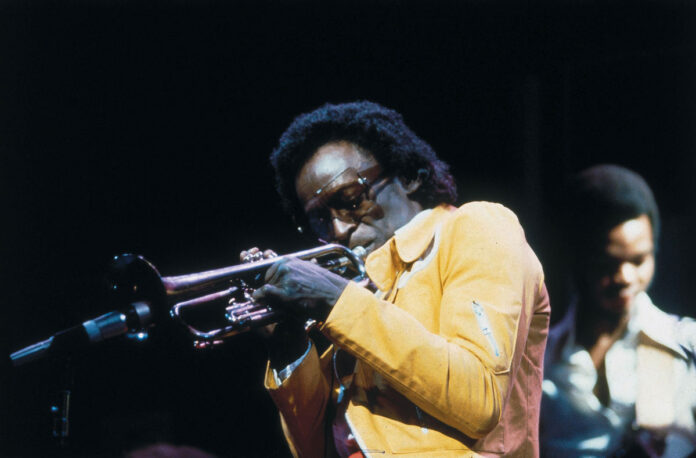
While living in Malibu in the mid-1980s, Davis’ nephew Vince Wilburn Jr. played drums in his uncle’s band, and MTV was constantly on the jazz legend’s television screen.
Rubberband captures a series of recording sessions that took place during this period, when Miles moved from Columbia Records to Warner Bros. in the summer of 1985, reflecting the legend’s Reagan era of shiny pop-funk. Still searching for the sound of the street, he chose to reinterpret a diverse range of contemporary styles—jazz, funk, rock, calypso, Latin, and soul—in his own way. Was it good? More like, interesting. Released in 2019, way after the fact, it’s an occasionally awkward collection of trial-and-error decisions that aims to resonate with modern sensibilities. Not necessarily the future, but definitely not the past.
It was a concrete choice by one of the most influential figures in 20th-century music to evolve with the culture, opting not to rehash “classics” but to create arrangements that reflect the “voodoo economics” of the era he was living in.
Naturally, the man who repeatedly changed the course of jazz and commercial music refused to fade into the background. Davis wanted to be on the radio in the 1980s. This lion, in his winter, was completely assured as to his place in modern American music—and still yearned to keep that throne hot.

You are about to be bombarded with this fact, and rightly so: 2026 marks the centennial of Miles Davis.
He was born on May 26, 1926, and his legacy will be celebrated internationally, and locally with Miles Davis Century of Cool at SFJAZZ, March 5 through 26, at the lively Joe Henderson Lab (still one of the best-sounding venues in the city.)
Across town, the Unlimited Miles: Miles Davis at 100 All-Star Jazz Centennial Celebration will take place on May 14 at the Presidio Theatre, which was remodeled in 2019.
Why does Davis still matter? His tinkering with jazz and music at large is still influencing how we hear composition.
Starting with his recordings from the 1950s, featuring a lineup that included tenor saxophonist John Coltrane, pianist Red Garland, bassist Paul Chambers, and drummer Philly Joe Jones, Davis evolved through various musical styles.
In the 1960s, he embraced fusion, collaborating with artists like Wayne Shorter and Chick Corea. He also ventured into the innovative rock-funk sounds on albums On the Corner and Dark Magus. Throughout his career, he understood that when culture changes, so does the music. He was never afraid or intimidated to “play where the ears were at.”
So today, when Grammy-nominated harpist and composer Brandee Younger chooses to perform with producer, DJ, and hip-hop royalty himself Pete Rock, it calls back to a proven tactic in bridging genres, decades, and generations. Add to it all of those Dorothy Ashby samples/references in the music?
That blending of textures and styles created a unique presence, one that captured the spirit of the heavens, intertwined with soul, world music, and a powerful rhythm; it’s both innovative and familiar. This modern approach, exemplified by Younger, shows her ability to expand the jazz foundation and collectively propel culture forward.
That affinity? It’s Miles.
Like when drummer, producer, and “beat scientist” Makaya McCraven, SFJAZZ resident artistic director for the 2025-’26 season, employs his self-described signature “organic beat music” approach, building from live recordings, reshaping the composition via extensive editing, overdubs, and post-production at his home studio. That’s a glowed-up, advanced application of the cut-and-tape technology that Teo Macero used during the sessions for Miles Davis’s Bitches Brew.
Thank you, Miles Davis, and happy birthday!
CALIBRE, they want you (SIGNATURE RECORDS)
It’s been a really long time since I wandered over to the Dogs on Acid message board. But I was curious to see what the dedicated flock would be chatting about, concerning the very quietly rolled-out Calibre release from December.
If you follow this column, or catch just a smidge of what I choose to blabber about, you already know about my love for drum and bass. In some ways, it has grown exponentially since I stopped DJing it. Maybe it’s nostalgia or excitement to see how a new generation raised on that beautiful dark-grumble, heads in SF and around the world, have advanced the music. I dunno. It still gets me in the heart. I guess that’s what really matters.
Dominick Martin a.k.a. Calibre, the Belfast-based artist, remains a steadfast drum and bass producer, who has chosen to explore a wide range of sounds. Two decades in the game, true heads, OGs, young bucks, and bass music aficionados of all kinds still check for him, and rightly so. When he started, his tendency for sampling house records put him in great standing within the genre and outside of it. Soulful energy that spoke to all electronic music fans.
His recent 12-track release they want you feels a bit kitchen-sink variety. Not quality-wise, just in stylistic choice. It’s a bit scattered, like these are things that have been lying around and he finally released them. According to the message board, Calibre played a number of these newly released tunes at the venue Outernet in London sometime in November. And I bet they sounded untouched by a specific era. Why? Calibre puts a certain spell on his tracks; they may sound different, but still feel like something beyond now.
There are vocal tracks on this release that hum like darts hitting the bullseye. That compression, that rumble. The album’s titular track, according to said message board, is from 15 years ago, but oh my gush, it’s dance-floor-colorful, vivid. Then there are tracks like “Bit Broken Stream’ that have that introspective two-step cadence and all those atmospheric chord progressions that project melancholy bubbles, soundwaves if you will.
It still would do damage on said dance floor. It’s remorsefully pretty, with an air of extreme wonder. Even the closing track “Low Hanging” features modal piano accompaniment dancing alongside that driving jungle beat. These elements flow, align, and explore deeper arrangements that go beyond just dance floor ideas. It’s still easy to get caught up in the repetitive and hypnotic vibe he’s created, but the levels are worthy of repeated listens.
Listen, I may suffer from recency bias, but I think anyone who enjoyed that Herbert/Momoko album Clay from 2025 will find that those sparse/bare ideas about electronic music are in conversation with this end-of-the-year release. On they want you, Calibre doesn’t have to overcompensate. While it may be one of his more modest releases, featuring old tracks on it that sound Ziplocked from time, it still reflects all the innovation he’s perfected in an emblematic career.
Contemporaries are still catching up.
Grab it here.
DJ HARRISON, ELECTROSOUL
The last time we heard from the Richmond, Virginia native, he was covering songs by the likes of Donald Fagen and Vince Guaraldi on his 2024 Shades of Yesterday, which paid homage to his musical heroes and most treasured childhood memories. See, it’s always time well spent when you check out a new project from DJ Harrison. This son of a radio DJ, a multi-instrumentalist, singer-songwriter, and producer, he has also taken up residence as a member of the jazz quintet Butcher Brown (who was recently namechecked by Emma-Jean Thackray in DJ Mag).
But for his current project Electrosoul, he’s working quite nicely with the likes of Pink Siifu, Yazmin Lacey, Kiefer, and Yaya Bey. None too shabby, eh?
Link up with it here.
THE NECESSARIES, COMPLETELY NECESSARY [ANTHOLOGY 1978-1982] (OMNIVORE RECORDINGS)
Money left on the table. Opportunities squandered. That’s why the legacy of this band, featuring dance music innovator Arthur Russell on the keyboard, keeps getting peeked into, absorbed, lamented over, because the what-if looms so large, before you let out that long, sad sigh.
That teeth-sucking sound when you hear Ed Tomney, Modern Lovers’ Ernie Brooks, Jesse Chamberlain, and said Russell collapse like Voltron and make that joyful noise on “Driving and Talking At The Same Time”, with that over-the-top obvious summation? You murmur, “ohh this is Television and Talking Heads all at once.” You understand why Seymour Stein of Sire Records insisted that their 1981 debut album Big Sky be a quickly dropped collection of unfinished tracks, against the band’s wishes.
Russell, soon to be downtown New York dance producer wizard, was driving this alt-rock college band into soon-to-be profitable waters. The foursome had Big Sky withdrawn and replaced with Event Horizon, released in 1982, which included half the original tracks from Big Sky and continued to record throughout the year, aiming for a follow-up that was not to be. Their final studio sessions remained unissued until now on Completely Necessary.
With the muffled spoken-like presence on “Driving and Talking At The Same Time” pushing the forlorn lyrical mood, Russell summons his exact inner metronome to build this infectious sway that is set impeccably within a searing power pop/new wave casing. Glimmering constructs such as these, unfortunately, fell on deaf ears. Sire Records had Talking Heads, Blondie, The Pretenders, Soft Cell, The Cure, and all those Madonna 12-inches (and for a time, tried to convince NYC that the latter was Black by neglecting to put her picture on the sleeve.)
But Sire’s fans didn’t have enough bandwidth to absorb this future. It’s a shame. The Necessaries encapsulated pure gold, Ponyboy.
With “More Real”, “Detroit Tonight”, “On The Run”, “The Finish Line”, and the aforementioned “Driving And Talking At The Same Time”, it’s as if Russell peaked through a portal. Saw The Strokes, Yeah Yeah Yeahs, The Rapture, and LCD Soundsystem. Introduced those sullen tones to his own moody post-punk DNA and brought it all back to the early ’80s. As to say, “I don’t have time to wait. Death comes at you fast”.
Sure, a couple tracks represent the current musical trends at that time. “State Of The Art” is a dark-sparkle hat-tip to the emerging presence of Gary Numan, while “Rage” is stellar, The Replacements meets The Minutemen punch-up with Russell’s avant-garde cello giving off dark embellishments.
“More Real” is a mid-tempo lament that garners placement on a mix tape just before “When You Were Mine” by Prince. And “Sahara” is a wonky “good type of cheesy” statement that reflects the post-disco repositioning of mainstream rock that was embodied by the band Kiss.
These dalliances with established and upcoming new sounds were not cheap Radio Shack rip-offs. Most of them were worthy of The Necessaries, making an appearance on Dick Clark’s “American Bandstand”. They were on to something. Desperately trying to balance all these ideas and sounds they saw coming on the horizon, The Necessaries assessed what the fast-approaching decade had in store for the indie rock format.
Russell quit the band by jumping out of a van at the mouth of the Holland Tunnel in New York while on the way to an important gig. He went on to score massive underground hits under the aliases of Dinosaur L and Loose Joints. He passed away in 1992 from AIDS-related complications, still in relative obscurity and poverty. So many unfinished projects remained on the table. His work in the alt-rock idiom, before all of the other Arthur Russell works he’s known for, just adds to the reservoir of musical hats this one polymath possessed.
The value of staying alive can never be disputed.
Pick up the album here.