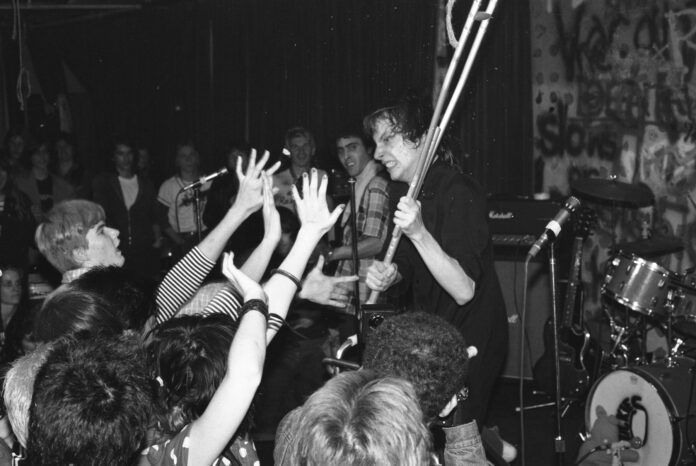
At the legendary Mabuhay on North Beach’s neon-lit stretch of Broadway, the punk past still announces itself.
It lingers in sun-faded flyers that once plastered brick walls, in grainy Super 8 footage of bodies colliding in a blur of sound, and in the electrical hum of amplifiers warming a cramped back room that was the site of 11 unruly years of noise and defiance.
It’s been nearly four decades since the original club, known at the time as Mabuhay Gardens, closed in 1987. One year has passed since the historic space reopened a concert venue, hosting funk bands and piano bar karaoke alike. And now, the Fab Mab will once again serve as both shrine and living room for San Francisco’s underground.
On Sat/28, Mabuhay and neighboring On Broadway will host a celebration of 50 years of punk in San Francisco, a day-long convergence of history, performance, and community marking the half-century since punk first detonated in the city.
Few people have watched that lineage unfold as closely or for as long as RE/Search founder and Search & Destroy publisher V. Vale, who still lives just steps from the club, and has spent nearly half a century documenting underground culture.
Born in Texas and educated at UC Berkeley, Vale launched the influential punk zine Search & Destroy in 1977 before founding RE/Search Publications, whose books chronicled industrial music, performance art, body modification, and countercultural movements largely ignored by mainstream media.
His work helped frame punk not merely as music—it was also a living anthropology of resistance.
He remembers when Ness Aquino’s Filipino supper club at 435 Broadway opened its back room to early punk and New Wave shows in 1976, and Mabuhay Gardens was born.

“It started as the only punk rock club in town, and for two to three years, it was the only place you could go, which was good because you’d see everyone you knew,” Vale says.
The arrangement was practical and symbiotic: the restaurant profited from food and drinks, while door receipts went to promoters and bands. “It’s not exactly a prosperous economy,” Vale remembers, “but good enough to survive.”
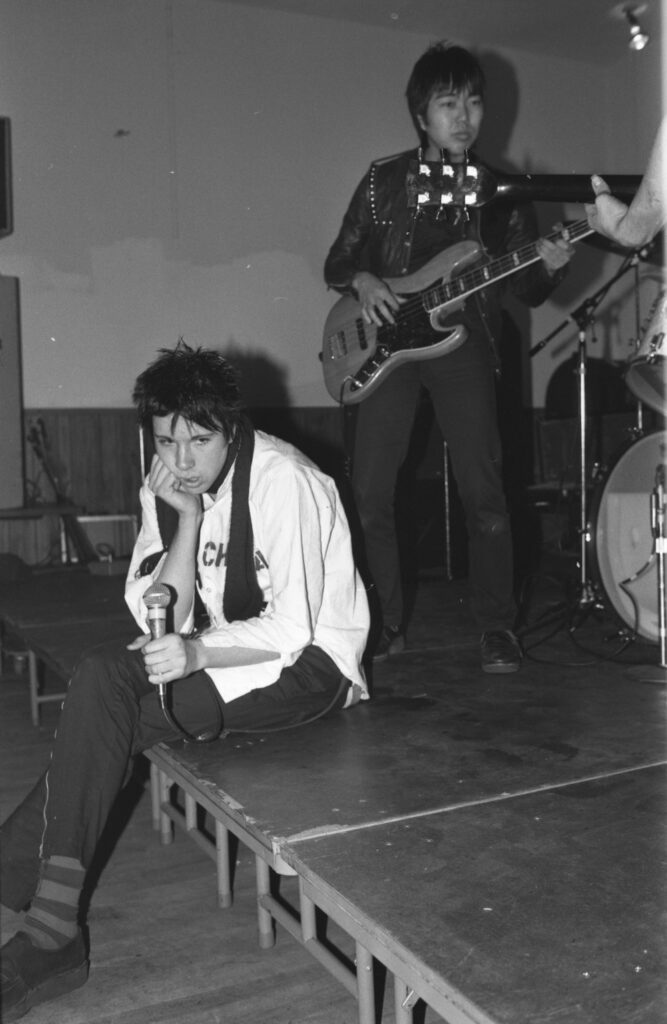
From its modest Broadway address, Mabuhay Gardens became ground zero for a cultural explosion that reverberated worldwide. Under promoter and ringmaster Dirk Dirksen—whose irreverent emcee style turned every show into a laboratory for rebellion—the venue nurtured a confrontational, artistic, defiantly independent scene. Bands including Dead Kennedys, The Avengers, Crime, The Nuns, Negative Trend, and Flipper forged a distinctly San Francisco sound steeped in radical politics, satire, and noise.
Asked about the anniversary tribute, Vale shrugs off nostalgia in favor of continuity.
“Well, someone organized that, and they gave it a fancy name,” says Vale.
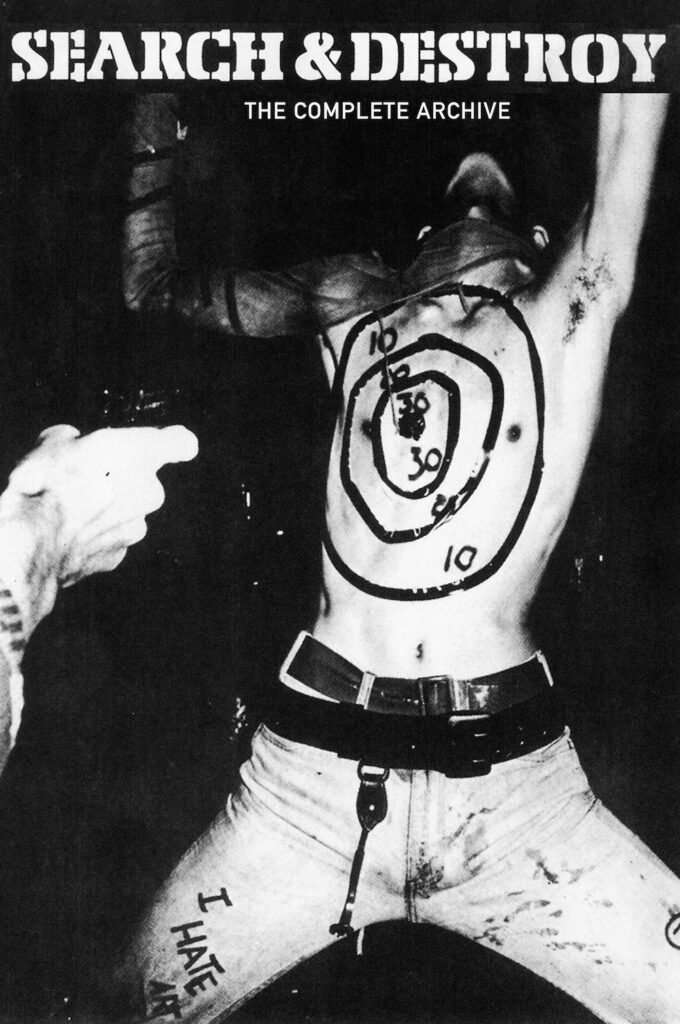
He’ll be selling copies of Search & Destroy: The Complete Archive at the event, a volume containing reprints of all 11 issues of the short-lived, deeply influential zine. “It’s the original punk magazine in San Francisco, and practically all the photos in the book were taken at the Mabuhay Gardens. So it’s still contemporaneous, and the club doesn’t look much different. So it just continues,” says Vale.
According to the punk archivist, Dirksen’s open-door philosophy helped define the Mabuhay ethos.
“He was a gay guy from Germany, and somehow he got the idea of putting on punk shows at the Mabuhay—and it worked,” Vale says. “And all he asked to play there was a cassette tape and a group photo. If you could [come up with] those two things, you could get one show. If you did well, you could get more.”
If CBGB defined New York punk, the Fab Mab grew from the local genre’s distinctly North Beach ecosystem.
“I’ve never been to CBGB,” Vale says, “but The Mab was very well located in North Beach, next to a whole bunch of strip clubs, video game arcades, and cheap restaurants like Clown Alley. So many young punk rock women who wanted to make money started working at local strip clubs. It was a very compact, self-perpetuating economy.”
The anniversary celebration unfolds in two movements at Mabuhay, both guided by host Tom Watson. An afternoon devoted to memory and media followed by an evening of sonic assault, the daytime program runs from 2–7pm, opening with a zine and record swap that echoes the DIY economies that sustained the original scene. Vale and other local vendors (including SF punk music store I Hate Records) anchor the marketplace.
A gallery installation of rare photographs, flyers, and video projections honors the era’s bands and fallen figures, including Dirksen, D.H. Peligro, Bruce Loose, and Howie Klein.
At 3pm, rock historian Richie Unterberger presents archival performance footage spanning 1976 to 1987, followed by a Q&A. At 4:30pm, Unterberger moderates a rare oral history panel featuring Vale, DePace, Penelope Houston (The Avengers), Henry Rosenthal (Crime), and Joe Rees, founder of Target Video. The Mutants perform afterward, bridging memory and momentum.
For Vale, punk was never just a sound; it was a framework.
“It was obvious that this was the next big thing after the hippies,” he says. “And it couldn’t get much simpler than do-it-yourself—and that perpetuates, with new people coming along and doing it themselves. It was also a very feminist movement. Most of the movement’s leaders were either women or gay.”
San Francisco’s character remains deeply tied to that spirit. As Vale puts it, the city has long been seen as a gay mecca, a place where independent presses thrive, and waves of people continue to arrive, leave, and relocate. Some move to other places in the Bay, yet remain culturally linked to San Francisco. Within this setting, his anthropological instincts shaped how punk and every subsequent scene he amplified were documented and disseminated.
“If you ever go to a place where everything seems ancient, your first job is to find the most intelligent people you can trust,” he says. “Then they’ll be your guides, and you’ll interview them to death about their culture. Then you write it down accurately and publish it.”
The evening program begins at 6:30pm at On Broadway, where the celebration shifts from reflection to full-volume communion. Running from 7:30 to 11:30pm, the all-ages lineup is headlined by Flipper and Friends and features Fang and The Freak Accident, alongside younger bands False Flag and Bitchfit who are ample evidence of punk’s continuing lineage.
Members of the Avengers and Dead Kennedys will join Flipper onstage, while Radio Valencia DJs spin classic punk between sets. A livestream will be available from Mabuhay for those watching from home.
As punk’s first wave continues to age into archive and mythology, Vale remains amused by the passage of time.
“Well, you just go, ‘50 years went by that fast?’” he says. “Unbelievable. And I’m still alive. It’s amazing.”
Now 82 and still attending shows most nights of the week, he finds renewal in every new wave.
“Well, I’m always surprised when I see new people performing,” he says. “It’s always fun because you’ve never seen them before. They all sing a little differently, use different body language, and wear different clothes. So there’s a lot to see that you’ve never seen or heard before.”
Even if shock has lost its edge in an age of constant overload, what persists is San Francisco’s stubborn resistance to becoming uniform.
“It’s never going to be homogenized because it’s full of individuals,” the publisher says. That plurality and the human urge to gather, amplify, and bear witness continue to draw him out into the night.
Half a century after the first feedback shriek bounced off the Fab Mab’s walls, the anniversary celebration will be less a memorial than an evolving archive, a reaffirmation of punk as a living practice, and a stubborn civic heartbeat.
AFTERNOON AT MABUHAY GARDENS Sat/28, 2pm. Mabuhay, SF. Tickets and more info here.
50 YEARS OF PUNK ROCK featuring Flipper, Fang, False Flag, The Freak Accident, and Bitchfit. Sat/28, 6:30 p.m. Mabuhay, SF. Tickets and more info here.