It’s impossible to separate the Grateful Dead from San Francisco. The improvisational rock band’s story is written into the city’s landscape.
It begins at 710 Ashbury St., the Queen Anne Victorian row house painted in deep shades of purple, plum, and lavender, where Jerry Garcia, Bob Weir, Phil Lesh, Ron “Pigpen” McKernan, and Bill Kreutzmann lived and rehearsed during 1967’s Summer of Love.
Elsewhere, Hyde Street Studios hosted the recording of American Beauty (1970), while Pacific High Recording gave rise to Aoxomoxoa (1969) and Workingman’s Dead (1970). At McLaren Lodge and Robin Williams Meadow in Golden Gate Park, the band’s free concerts helped define the city’s counterculture.
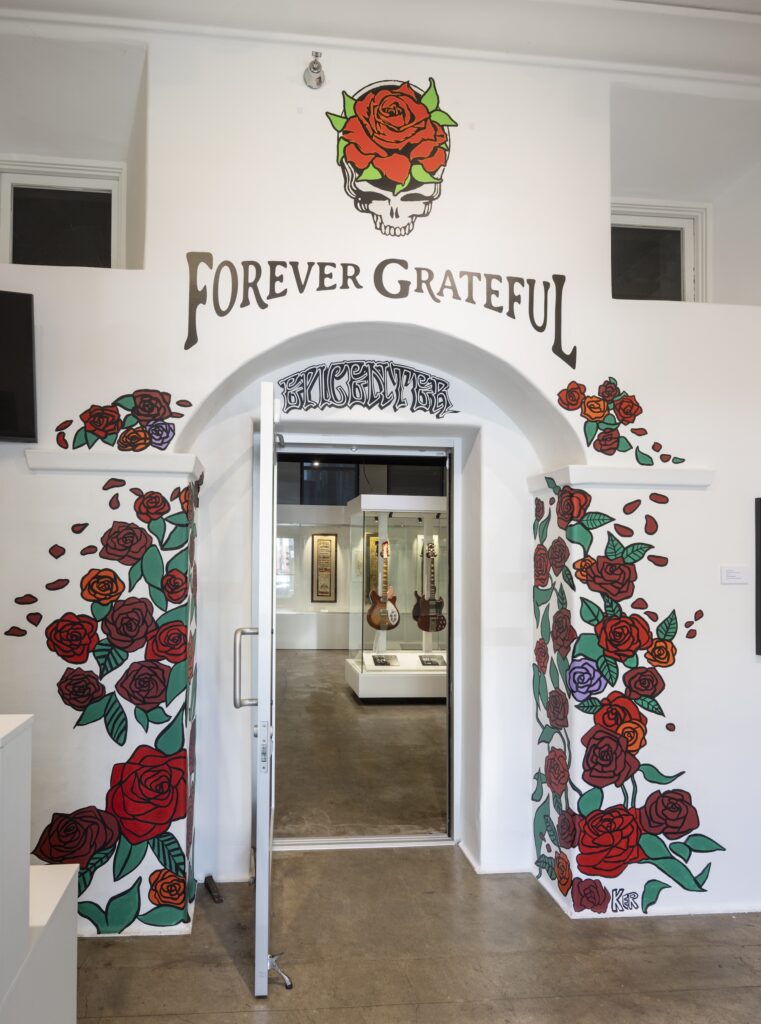
Today, another chapter is being written with Forever Grateful, the Haight Street Art Center‘s ambitious exhibition celebrating the Grateful Dead’s music, art, and cultural legacy.
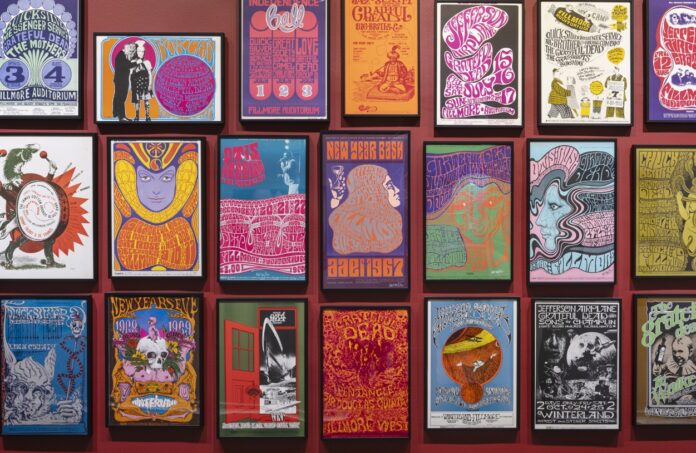
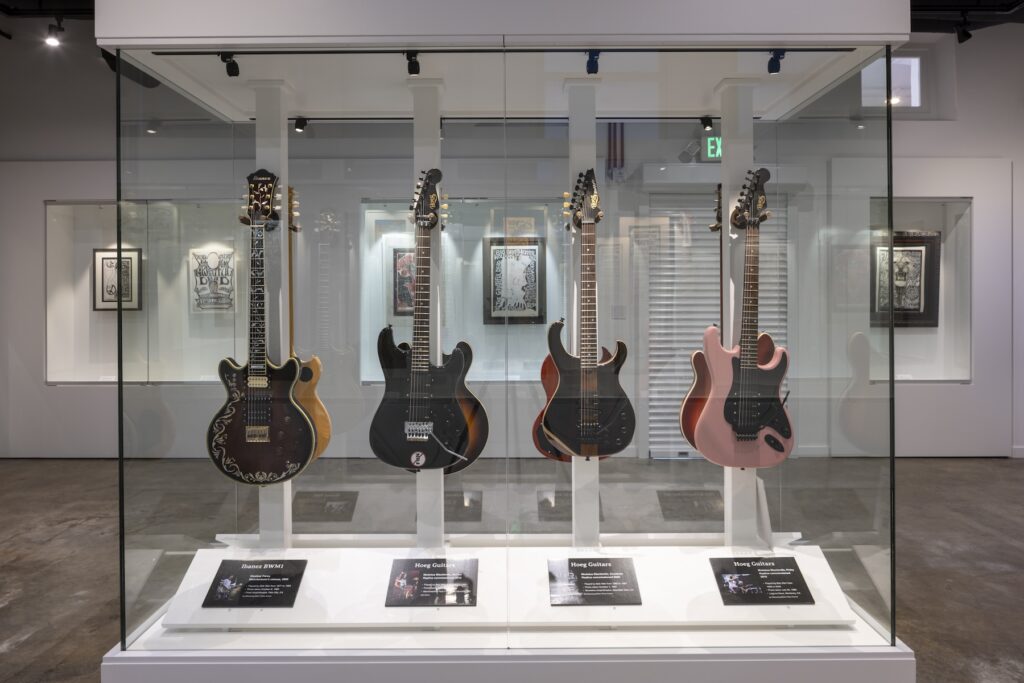
On view through Sept. 20 as part of the Haight Street Art Center’s 10th anniversary, Forever Grateful showcases more than 400 objects spanning three decades, from original concert posters, paintings, photographs, instruments, vinyl records, and rare memorabilia to a remarkable recreation of the Grateful Dead’s legendary live experience.
The celebration continues Sep. 5 through Oct. 25 with Forever Grateful, Golden Gate Park at the Hall of Flowers, where visitors can also experience Ken Kesey and the Merry Pranksters’ iconic Furthur bus, Garcia’s BMW, multimedia installations, live performances, and a free Grahame Lesh and Friends concert during opening weekend.
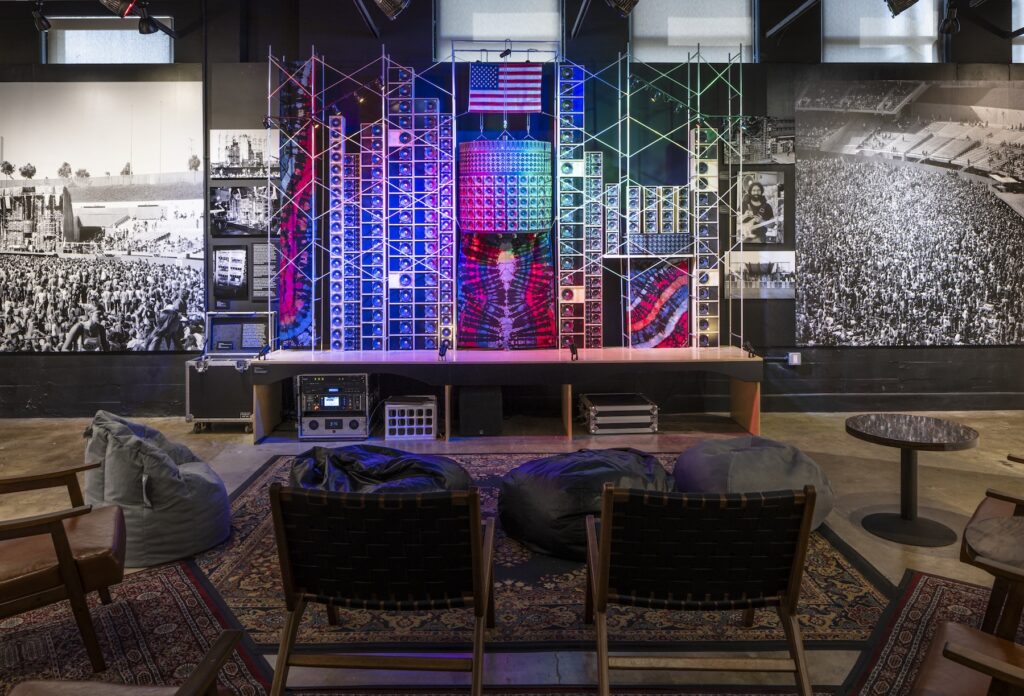
Forever Grateful, curated by Ben Marks and presented by the Haight Street Art Center under Executive Director Kelly Harris, is anchored by a fully functioning scale replica of the Grateful Dead’s iconic 1974 Wall of Sound speaker setup. Built by Anthony Coscia, with tie-dye speaker covers created by Jamie Levin, the installation pumps live Grateful Dead recordings through 500 speakers, inviting visitors to linger.
For exhibition advisors Dennis McNally and Susana Millman, who spent decades documenting the band, the replica of the groundbreaking Wall of Sound—which delivered a level of volume and sonic clarity unlike anything before—became the emotional heart of the exhibition.
“It was the Wall of Sound, and the way it was set up as an interactive living room space for people to gather and listen to the music,” Millman, longtime Grateful Dead photographer, says.
“The presentation was brilliant,” adds McNally, Grateful Dead historian and author of A Long Strange Trip, pointing to the giant blow-up photographs of the original 75-ton sound system, which famously stood three stories tall and stretched 100 feet wide, on each side of the model. “That’s the most dramatic thing. But there are a million things to look at.”
Among the exhibition’s treasures is an artifact that longtime Deadheads immediately recognize as the origin of the band’s visual mythology.
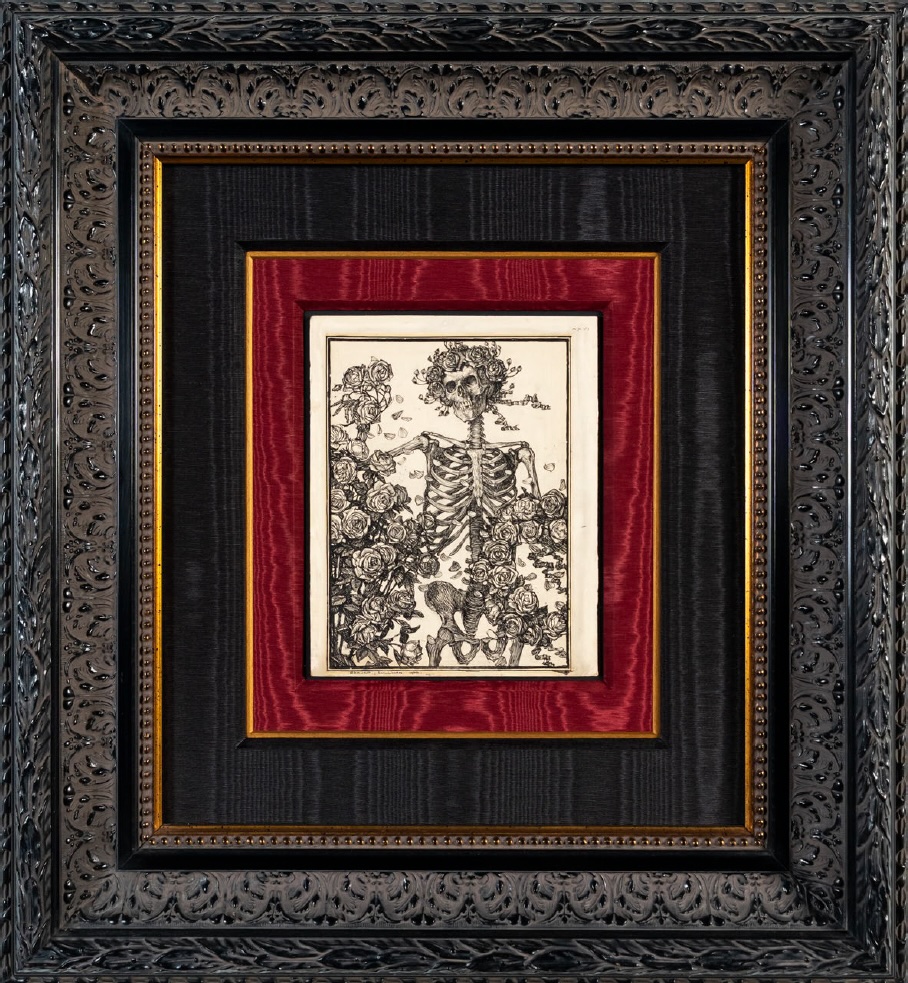
In 1966, poster artists Alton Kelley and Stanley Mouse discovered Edmund Joseph Sullivan’s illustration “A Skeleton Amid Roses” in a 1913 edition of The Rubáiyát of Omar Khayyám at the San Francisco Public Library. According to Dead lore, the image was cut from the book, taken with them, and adapted into a Grateful Dead poster for an Avalon Ballroom show, eventually evolving into the famous Skull and Roses artwork that became synonymous with the band.
“And bad boys, stealing from the library is a sin,” McNally jokes. “But you look at it, and you think, ‘Really?’ It’s astonishing.”
Millman points to another favorite, a custom-designed dispenser created by Mouse that dispenses art prints, stickers, and other limited-edition items.
“The Mouse vending machine is pretty cool,” says Millman. “What a hoot.”
While the art center is filled with rare objects, both advisors insist its greatest achievement is capturing the sense of community that made the Grateful Dead unlike any other band.
McNally points to the giant reproduction of the famous 1980 San Francisco Chronicle advertisement for the band’s Warfield Theatre run. Featuring two skeletons leaning over a theater balcony and the tagline, “They’re not the best at what they do. They’re the only ones who do what they do,” the artwork eventually inspired the familiar Rock & Nikki skeleton characters and became one of the defining images of the Dead.
“It’s really important to me because it’s what led me to work with the Grateful Dead,” he says. “To me, the Dead is about two things: improvisational music where there’s a possibility of magic or a complete collapse and community.”
The exhibition reinforces that sense of care, particularly for the “Touch of Grey” generation of fans.
“I noticed there are more benches scattered around than almost any museum I’ve ever been in,” says McNally. “As a person with bad knees, I was like, ‘Wow, somebody is actually thinking about the people who are here.'”
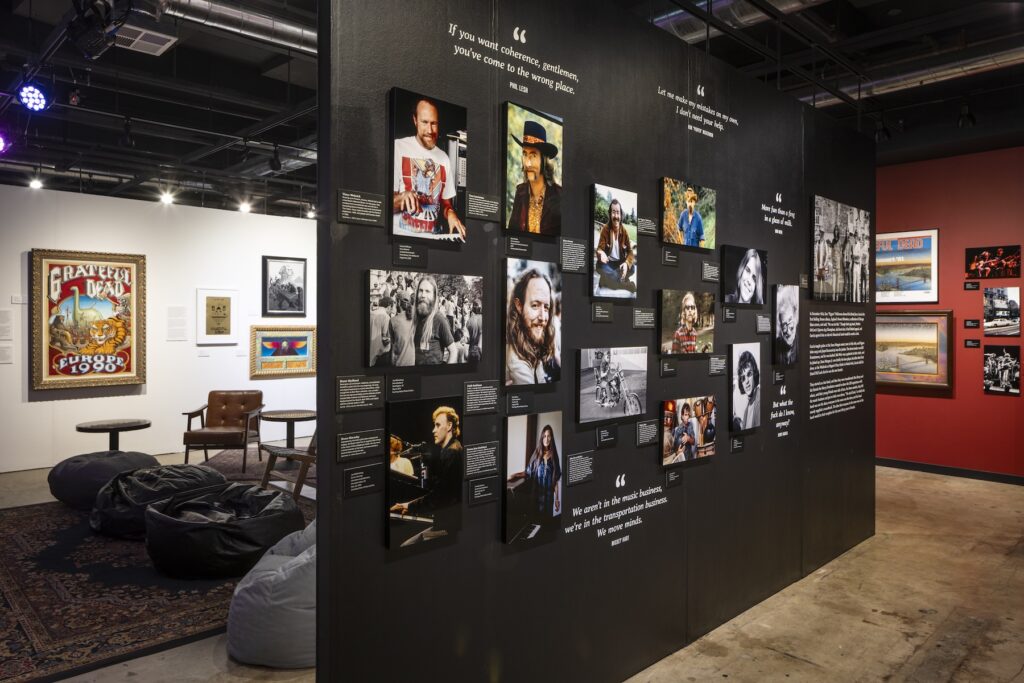
The exhibition doesn’t just preserve artifacts, it also preserves the stories of the people behind them. McNally and Millman knew many of those people during their decades alongside the Dead.
After writing a biography of Jack Kerouac, McNally sent a copy to Garcia, who encouraged him to write what became A Long Strange Trip. Around the same time, the band’s archivist, Dick Latvala, introduced him to Millman. “It all just fell together,” McNally says. “Susana took the pictures, and I took notes.”
Millman’s photographs capture the Grateful Dead offstage, revealing the ordinary moments of these extraordinary characters. “I was in a position to relate to them as human beings, and that’s what I really wanted to show in the photographs,” she says. “I was very fortunate to be a fly on the wall with a camera.”
Their stories about Garcia are equally revealing.
McNally recalls helping arrange a backstage meeting between Garcia and a young Make-A-Wish recipient in a wheelchair who was so overwhelmed he could barely breathe.
“So I looked him in the eye, and said, ‘I have to tell you, Jerry farts, burps, and is a human being,'” McNally recalls. “If you don’t take a deep breath and relax a little, you’re going to make him nervous.”
The advice worked. The child laughed, centered himself, and spent nearly 20 minutes talking to Garcia.
Millman remembers Garcia’s warmth in quieter moments.
On a tour stop in New York, she and Garcia stepped out of a van when an associate rushed over, calling her name instead of his.
“Jerry just cracked up and kept walking into the hotel,” says Millman. “He was just delighted that she was not bothering him.”
If people approached him naturally, the photographer claims, Garcia even welcomed conversation.
“You just couldn’t treat him like Jerry Garcia,” she says. “If you kept your cool, then the conversation would flow.”
Garcia became more than a collaborator, eventually walking Millman down the aisle at her 1985 wedding to McNally at the Oasis Club. Dead drummer Bill Kreutzmann served as best man at the ceremony.
“It’s my claim to fame this time on the planet,” says the photographer. “After all, Jerry was essentially our matchmaker.”
Both advisors hope younger visitors leave Forever Grateful with a deeper appreciation not only of the music but also of the community that grew around it.
McNally believes many younger Deadheads understand the spirit of the community, but not always its history.
“What they’ll get from this is a sense of where it all came from,” he says, pointing to displays that include the decorated mail-order ticket envelopes fans once sent with checks to buy concert tickets.
Millman’s hope is even simpler—that younger generations will embrace the Grateful Dead’s singular energy.
“Kids will come away with the idea that you can be yourself, that you can express your creativity in your own way,” she says.
That community also includes many people who worked behind the scenes, such as longtime lighting director Candace Brightman, whose contributions have often been overlooked.
“Candace was unflappable and kept up with the technology,” Millman says, recalling how Brightman once rented mannequins resembling the band members to perfect a new lighting design before a tour.
Ultimately, the Grateful Dead’s greatest legacy isn’t a song or an album, but a community that continues to grow nearly 60 years after it began.
FOREVER GRATEFUL runs through Sep. 20 at Haight Street Art Center, SF. More info here.
FOREVER GRATEFUL, GOLDEN GATE PARK runs from Sep. 5 to Oct. 25 at the Hall of Flowers, SF. More info here.