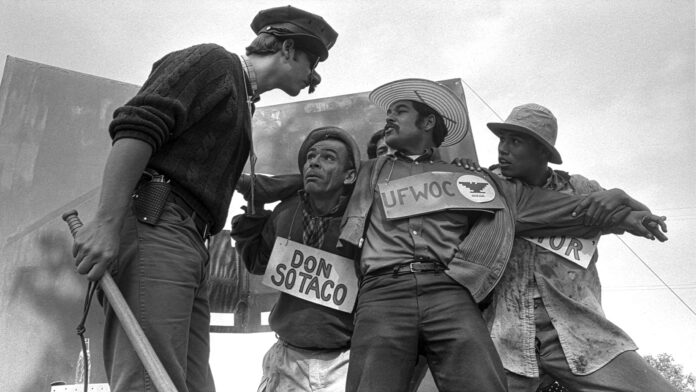
A couple long-term indictors and parodists of racial and cultural stereotypes are getting overdue appreciation onscreen and off over the next week. David Alvarado’s American Pachuco: The Legend of Luis Valdez is a documentary overview of a career whose pioneering influence cannot be overstated. Variously described as “the Shakespeare of Chicano theater” and a “social arsonist,” among other things, Valdez hewed that path from scratch—his parents were Mexican migrant farmworkers, and as the second of 10 children, he began working in the California agricultural fields at age six. But despite the family’s poor, itinerant lifestyle in one labor camp after another, they instilled a belief that their kids’ horizons could be much wider. Luis began writing and staging puppet shows, acted in high school plays, then won a playwriting contest at San Jose State University.
He’d already written his first full-length stage work, the characteristically absurdist and politically pointed The Shrunken Head of Pancho Villa, when he began working with the San Francisco Mime Troupe in the early 1960s. The mix of agitprop and commedia dell’arte further instilled there were carried over once he formed El Teatro Campesino (which is still operating out of San Juan Baptista), initially in answer to the call for “workers’ theater…to activate a picket line in the middle of a strike,” as leaders struggled to unionize field labor against fierce owner resistance. Eventually the company’s focus turned to other issues, including the proliferation of US minority youth drafted as “cannon fodder” in the Vietnam War.
Within Campesino and beyond, Valdez’s contribution to the general Chicano Movement was indelible, scoring a number of “firsts” and performance records. When he wanted to communicate to a broader audience, the resulting musical Zoot Suit—about a notorious WW2-era instance of LAPD hostility towards the Latino community that led to a dozen youths’ wrongful convictions for murder—was a huge hit in Los Angeles, then a modest one in its 1981 film version. (It did not, however, succeed on Broadway—like the prior Rocky Horror Show, which got its own documentary Strange Journey recently, high expectations of repeat success got strangled by NYC critics.)
Aiming for an even bigger mainstream, Valdez scored another smash with major-studio feature La Bamba, a biopic of Chicano rocker Ritchie Valens, who died at 17 in the same plane crash that claimed Buddy Holly and The Big Bopper. Nearly 40 years later, it remains purportedly the highest-grossing US Latino film ever.
American Pachuco—which is “narrated” by the titular zoot-suited character, originally essayed and reprised by Edward James Olmos—features input from longtime collaborators, allies (Linda Ronstadt, Cheech Marin, Dolores Huerta, etc.), spouse Lupe Trujillo-Valdez, Olmos and La Bamba star Lou Diamond Phillips. Plus of course the very-spry-at-86 subject himself. So much screentime is given over to Valdez’s two greatest hits, however understandably, that you might wish for more attention paid to his myriad other influential stage works, including Corridos and I Don’t Have To Show You No Stinkin’ Badges. There is a rich array of archival footage, affording at least glimpses of those other achievements (some of which were videotaped for television).
Ending with him getting a National Medal of Arts from President Obama—hard to imagine that honor being bestowed now—Pachuco is an engrossing bird’s-eye view of one hugely impactful artistic resume. It opens this Fri/31 at several Bay Area venues, with Valdez and/or filmmakers expected to attend specific shows for post-screening Q&A’s: At Berkeley’s Elmwood (Sat/1, 4pm; Sun/2, 7pm), Marin’s Smith Rafael Film Center (Sat/1, 7pm) and SF’s Roxie Theater (Sun/2, 3:30pm).
Also getting paid tribute as CinemaSFbay’s inaugural artist-in-residence is Robert Townsend, who’ll curate, introduce and discuss nine films at the Balboa and 4-Star theaters next Wed/5 through Sun/9. Four are his own vehicles, another five ones he’s viewed as major inspirations. The series kicks off with a 35mm print of 1987’s Hollywood Shuffle, the spoof he famously funded via credit cards, personal savings, and pulling favors. It’s a very meta mix of autobiography, indictment, genre satire and sketch comedy. The director, producer, writer, and star plays a Los Angeles actor stuck working at a fast-food joint while trying to score meaningful work—or any work at all—in his chosen profession.
A la advertising satire Putney Swope before it, Shuffle skewers the racist stereotypes of an entire industry, slipping in and out of fantasies, mock trailers, commercials, and so forth. En route, we get sendups of everything from Mandingo-type slavery melodramas and retro noir (Death of a Breakdancer) to ’80s white-man machismo (Dirty Larry, Rambro). Meanwhile, our hero’s auditions are a never-ending cycle of degradation in which he and other hopefuls are constantly told they’re “not Black enough” or instructed to “be like Eddie Murphy” while reading for parts that are inflammatory at best. When Townsend’s alter ego finally gets that big break, he must decide whether the career leg-up is worth the inherent humiliation of enacting Jivetime Jimmy’s Revenge.
Though he’d already had some roles in mainstream films, Hollywood Shuffle put this multitalent on the mat. It also enabled cowriter Keenan Ivory Wayans to make his own directorial debut with the next year’s parody feature I’m Gonna Get You Sucka, then launch the entire Wayans family empire in earnest via Fox sketch series In Living Color.
Townsend will also show his 1991 fictive doo-wop musical drama The Five Heartbeats, starry 1993 superhero spoof The Meteor Man, and 1997’s female buddy comedy B.A.P.S., the sole film among these four that he didn’t write. The additional films he’s programmed mix classic indictments of corrupted and corrupting American media (A Face in the Crowd, Network), and equally esteemed Hollywood breaks from reductive African-American depiction (In the Heat of the Night, The Great White Hope, Claudine). While not all of Townsend’s own projects were well-received, some of them also suffered from some of the obstacles thrown their way that he nailed in Shuffle, so his in-person insights should be particularly enlightening. Schedule and more info for the entire program is here.
None of the movies noted above are particularly swollen with sex appeal, but never mind: This week’s cinema events have those needs well in hand, too. There’s the arrival of reliable provocateur Gregg Araki’s first feature in twelve years, “erotic comedy thriller” I Want Your Sex—see 48 Hills’ interview with the director here. Our pals at Movies For Maniacs are also attempting to bring sexy back in a different way with a 25th anniversary Castro Theater revival of Vondie Curtis-Hall’s Glitter, the movie that did not make a movie star of Mariah Carey…perhaps in part because it opened just 10 days after 9/11. Its rags-to-riches-to-tears-to-triumph saga manages to mash elements of the Streisand A Star Is Born, Cool As Ice, Showgirls, and more into one whopping hot mess of backstage showbiz cliches. Being shown in a widescreen 35mm print on Fri/31, it may or may not satisfy the claim of being “immensely under-appreciated,” but will surely leave your jaw dropped. Info here.
Then there’s the return of Blush, the San Francisco Porn Film Festival, which will have two days of in-person programming at the Roxie this Fri/31-Sat/1, plus online components, some accessible through August 16. There are conversations with visiting artists, a filmmaker workshop, an afterparty, features (narrative Chronique d’un ete, documentary The Heart of a Dominatrix, both French and streaming-only), and a compilation paying tribute to “Hole Foods: 10 Years of Buttermilk Films.” But mostly there are bills of shorts running a global gamut of erotic exploration, humor, explicitness, fetish, fantasy and fun under such thematic umbrellas as “Art/Smut,” “Power/Play” and even “Sexual/Sci-Fi.” Wipe off that seat when you leave, please! See our feature on the festival here, and full info here.
Also of note:
Sheep in the Box
Probably the most esteemed Japanese director alive (at least internationally), Hirokazu Koreeda is best known for his often-superb films about children and dysfunctional families, among them Still Walking, Nobody Knows and Like Father, Like Son. But he’s also made a few odd digressions from that terrain, like the offbeat whimsies Air Doll and After Life. Those two fields combine in his latest, set in a “not too distant future” where a corporation called ReBirth offers “complimentary rental” of its very high-grade, battery-charged humanoids to those who’ve recently lost a loved one through crime or accident.
That queasy prospect is seized upon by architect Oto (Haruka Ayase), who still hasn’t begun to get over the loss of seven-year-old son Kakeru two years ago. Husband Kensuke (Daigo Yamamoto) is much less enthused, calling the company “hyenas” who prey on grief. Nonetheless, even he eventually eases his resistance after the arrival of a lifesized ‘bot (Rimu Kuwaki) that answers to their son’s name, is his eerie doppelganger, and calls them “mom” and “dad.” Still, the question remains: Is this artificial substitute a means of working through some of the most difficult issues life can offer? Or does it simply provide an addictive placebo to distract from them?
Gracefully made, Sheep pokes at those concerns with the writer-director’s customary gentle, observational warmth. But it also echoes the problems it raises: Ultimately more sentimental comfort-food than anything else, the movie is adept, yet nowhere near Koreeda’s best work. Fans will be glad to see it regardless, but neophytes ought to start sampling his oeuvre elsewhere. It opens this Fri/31 at SF’s AMC Kabuki and at the Alamo Drafthouse Mountain View.
Made in Berkeley: The House that Zaentz Built
When the late Saul Zaentz expanded jazz label Fantasy Records (whose staff he joined in 1955) into other genres and media, those eventually encompassed film productions. The high-profile ones were such Oscar-laden enterprises as One Flew Over the Cuckoo’s Nest, Amadeus and The English Patient. But the company’s West Berkeley compound also provided support for the Bay Area’s stellar nonfiction filmmaking community.
This month-long retrospective at BAMPFA begins Sat/1 with Vivien’s Wild Ride, editor Vivien Hillgrove’s recent documentary about her own career (encompassing some of the above titles) and recent struggle with impaired vision…which we wrote about when it played the Roxie last week (link here). There’s also a screening on Sun/9 of Philip Kaufman’s sterling 1988 Milan Kundera adaptation, The Unbearable Lightness of Being, on which she worked.
The rest of the series provides a diverse doc sampler spanning several decades: Steven Okazaki’s 2007 atomic bomb excavation White Light/Black Rain; Promises, a 2001 look at the conflict between Israelis and Palestinians from children’s viewpoint; No Straight Lines, Vivien Kleiman’s survey of queer comix creators; Marlon Riggs’ controversial, poetic manifesto of gay Black brotherhood, the 1989 Tongues Untied; and Denise Smekhol’s more recent Skin of Glass, a meditation on her architect father’s legacy, and the fate of the Sao Paolo skyscraper he designed sixty years prior. Filmmakers will be present for Q&A sessions at many of these screenings, which run through August 30. Full info here.