William Greaves was a prolific documentarian for several decades, but since he passed away 12 years ago at age 87, he’s become best-known for works that were seen barely or not at all during his lifetime. The experimental feature Symbiopsychotaxiplasm: Take One was shot in 1968, blurring lines between fiction and nonfiction as it depicted a director (played by himself) losing control of a project filmed in Central Park. At the time, no one knew what to make of this quasi-verite, semi-improvised, relentlessly self-questioning objet d’art. So it basically vanished—until much later, it attracted fans including Steve Buscemi and Steven Soderbergh, who not only secured a belated release but helped Greaves secure means for a 2005 “sequel” called Symbiopsychotaxiplasm: Take 2 1/2.
Still, those were avant-garde endeavors destined for limited audiences. Now, however, the late Greaves has a “new” movie likely to be seen by more people than anything since the days when his portraits of African-American historical figures like Ralph Bunche, Ida B. Wells, and Frederick Douglass were regularly shown on PBS.
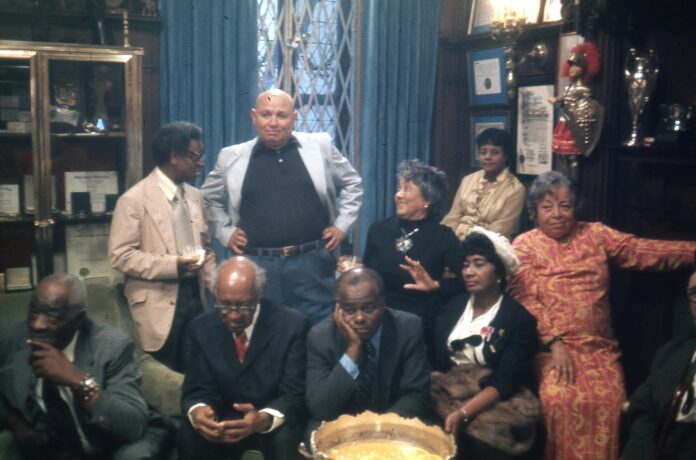
The erstwhile “secret documentary” Once Upon a Time in Harlem, completed by his son David and granddaughter Liani, consists primarily of footage the senior Greaves shot in 1972, of a party held at Duke Ellington’s Harlem townhouse. But it was really the filmmaker’s affair: He’d sought out and invited every surviving luminary he could find from the Harlem Renaissance half a century earlier. Most hadn’t seen each other, or enjoyed much public acclimation, for long years. Yet for whatever reason, that footage of an instantly historic event then itself sat unseen for another half-century.
When he orchestrated the gathering—which an ailing Ellington himself did not attend—Greaves was a leading audiovisual chronicler of the Civil Rights and Black Power movements, including through the initial years of groundbreaking TV public affairs program Black Journal. (As executive producer and host, he won an Emmy for it in 1969.) But that focus on a then-roiling present in the middle of a “youthquake” made him concerned a still-living past within plain sight was being allowed to fade out of existence. Contemporary African American culture was so vivid, its politics so active, that many felt there was little point dwelling on a long-ago epoch whose participants had existed in a strictly segregated world as second-class citizens.
What’s most striking about Once Upon a Time is that at times those figures practically elbow each other out of the way in their impatience to finally be heard again. These greyed talking heads were the best and brightest of their milieu, but the world then spun such that latter-day shakers thought them irrelevant… if they thought of them at all.
This “gathering of artists and intellectuals”—among them musicians (Eubie Blake), historians (John Henrik Clarke), activists (Richard B. Moore, Louise Thompson Patterson), poets (Arna Bontemps), painters (Aaron Douglas), journalists (Gerri Major, Ted Poston George Schuyler), photographers (James Van Der Zee), playwrights (Abram Hill, Regina Andrews), actors (Irvin C. Miller), and more—vibrates with personalities born to occupy center stage. Their reunion isn’t a sentimental hugfest so much as it immediately sparks debates, arguments and “I’m talking now” moments, as if a fervent conversation had been interrupted four minutes rather than four decades or so prior.
It’s startling to hear just how far back these attendees’ experience stretches into U.S. history (“My mother and father were slaves,” Blake casually mentions.) They discuss their own erstwhile stabs at integration, reminisce about fellow travelers now long gone (Langston Hughes, Zora Neale Hurston, Paul Robeson), the leaders of yesteryear (Marcus Garvey, W.E.B. DuBois), the reality of lynchings, and landmarks like 1921’s Shuffle Along—the first “all-Black” Broadway musical hit.
But despite these verbal flashbacks, and the archival materials that sometimes accompany them, the film’s participants seem most urgently desirous of involvement in African-American culture now. When they express opinions about youth-driven politics, you can hear the plaintive demand beneath, that they be treated not as fogeys but as knowledgable veterans. Once Upon a Time in Harlem is billed as a nostalgia-laden party, but it’s obvious most of these people would just as soon be back on the frontlines of change. The documentary opens Fri/30 in Bay Area theaters, with David and Liani Greaves holding post-screening Q&A’s that day (at SF’s Kabuki), Sat/31 (Berkeley’s Elmwood), and Mon/1 (Oakland’s Grand Lake).
A documentary very much about the immediate political landscape is My Undesirable Friends Part II: Exile. It’s a “sequel” to last year’s Part I: Last Air in Moscow, in which the few remaining outposts of independent news media in Russia found themselves declared enemies of the state and their staff “foreign agents” after that nation’s invasion of Ukraine. Here, the mostly young, female television journalists are seen having fled the country (those who stayed got swiftly arrested), then scattering across the globe. They continue to attempt providing non-propaganda-based coverage of the war and other issues. Yet Putin’s strong-arm tactics follow them—including death threats, spies, pressure on other governments, and so forth. Nor is it comforting that some traditional allies in the fight for democratic systems (such as the U.S.) now seem to be launching their own crackdowns on free speech and unbiased reporting.
Shot on iPhones, Julia Loktev and Anna Nemzer’s film certainly doesn’t lack relevancy, given our own rapidly-escalating landscape of regime-friendly media monopolies and institutionalized disinformation (much originating from Russia). But I’ll confess: As admirable as their stance and efforts are, these photogenic broadcast personalities seem a little over-enamored with the drama of being them. How many scenes of people bursting into tears in the back of taxis and limos, or on Zoom calls with each other, do we need to see?
Six hours worth, apparently. Yes: Part II is 355 minutes long. I realize the personal is political, but that doesn’t mean every repetitive quasi-private moment caught on camera is of global political interest. Still, even if I personally could have settled for a 90-minute condensed version, there are plenty of people who think these documents are among the great screen reportorial achievements of our fraught era. Exile plays Fri/30 at SF’s New People Cinema.
Other new releases this week:
Swansongs: ‘Fatherland,’ ‘Only Living Pickpocket’
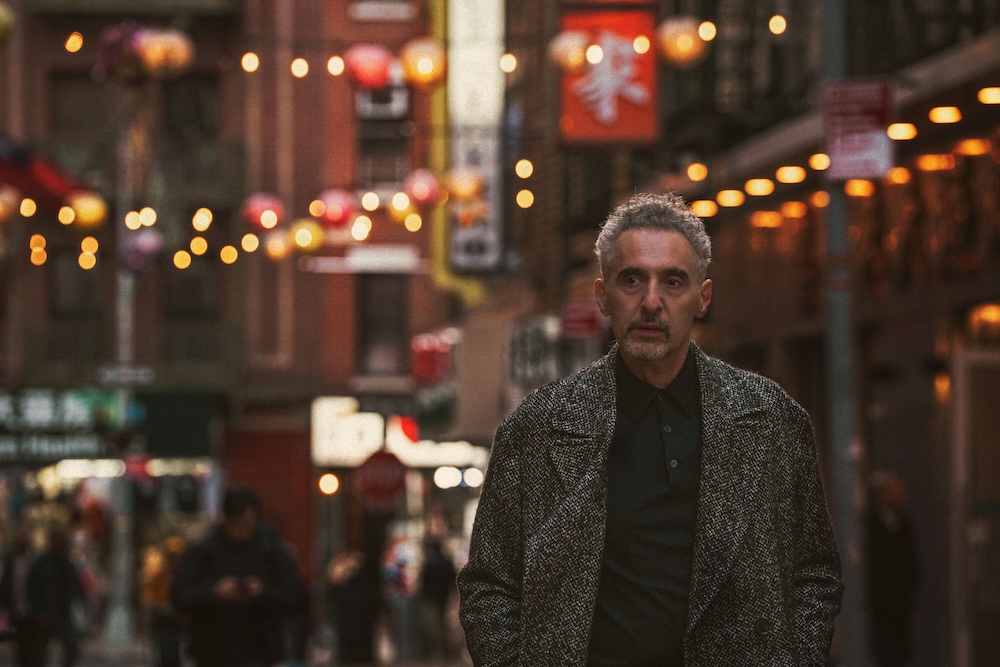
Two rather somber new dramas portray protagonists nearing the end of their careers—one famous, one felonious. In actor-turned-writer/director Noah Segan’s The Only Living Pickpocket in New York, John Turturro plays Harry, who’s scraping by in the titular criminal vocation to support himself and a wife (Karina Arroyave) whom some unnamed illness turned immobile and catatonic years ago in their Bronx apartment. But one day senior Harry hits the wrong mark, a noxious young turk (Will Price) who unfortunately turns to be the scion of a powerful underworld-crime family. He has extensive resources to track down the thief and exact oversized revenge, imperiling everyone in our weary hero’s orbit.
Disliking his city’s slicked-up, overpriced present, Harry lives in the past—specifically, the past of gritty 1970s NYC movies, with their pawnshops, street hustles, bodegas, and Lalo Schifrin-type funky background music. But his own movie’s plot twists and sentimentality feel second-hand, too, despite the apt casting of Turturro and others including Steve Buscemi, Giancarlo Esposito, and erstwhile SF stage actor Kelvin Han Yee. (Jamie Lee Curtis makes a late appearance, too, though she’s miscast.) This homage to the cinema of 50+ years ago is cozy, but feels a bit canned. Pickpocket opens Fri/30 in theaters throughout the Bay Area, including SF’s Metreon.
Born in 1957 like Turturro, Polish native Pawel Pawlikowski spent some years making globe-trotting documentaries, then U.K.-produced narrative features before moving back to his homeland and making two remarkable films: Ida (2017), which won the Foreign Language Feature Oscar, and 2018’s Cold War, which was nominated for three Oscars (including Best Director). Returning cinematographer Lukasz Zak reprises their exacting look of Academy-ratio B&W compositions in Fatherland, a multinational, multilingual production dramatizing famed writer Thomas Mann’s return trip to Germany after a long exile throughout Hitler’s entire regime. It was a tour intended to welcome him back into the fold, and allow postwar Germans to assure themselves that they were still a cultured people… that whole Nazi business was just an aberration, right?
Understandably ambivalent about this is his eldest child Erika (Sandra Huller), an outspoken anti-fascist unwilling to forgive and forget so easily. She is now translator, secretary, barber, driver, and whatnot to the 75-year-old scribe, though arguably even closer to brother Michael (played by August Diehl in a single opening scene here). The latter’s sad fate, and their father’s (Hanns Zischler) coldly dismissive reaction, are among the fissures revealed during this strange journey into so-recently-hostile territory. Everywhere they go, father and daughter are serenaded by patriotic local choirs and so forth, salutes that the author of Death in Venice, The Magic Mountain etc. accepts as his due. But Erika can’t help noting the hypocrisies that surround them, or pointing out how little her parent seems to care about anything but his own “legacy.” “You’re not the only person in the world, dammit,” she cries in a rare outburst.
Shorn of its lengthy end-credits, Fatherland would be barely over 70 minutes. It’s a finely acted and crafted study, with the same nuanced approach towards Big Themes and striking, wordless lyrical passages that Ida and Cold War had. But it seems slight by comparison, an astute historical footnote rather than the major statement we might have hoped for from a major director after nearly a decade’s absence. It opens Fri/30 in Bay Area theaters including AMC’s Metreon and Mercado.
Saints & Sinners: ‘Los Domingos,’ ‘The Divine Tragedy’
A pair of disparate new Spanish-language features find protagonists’ life paths seeking salvation of one sort of another—well, very different sorts. In Alauda Ruiz de Azua’s Los Domingos aka Sundays, which opens at the Roxie on Tue/3, Ainara (Blanca Sorora) is the teenaged eldest of three daughters to a busily preoccupied Bilbao restauranteur (Miguel Garces as Inaki).
Their mother having died of a sudden illness some years back, Ainara is often stuck with caring for her siblings and the household in general. Still, she’s a well-adjusted adolescent with a normal social life—although perhaps possessing a slightly unfashionable attraction to the Catholic Church the entire family has been nominally raised in. After a short religious retreat that is simply good fun for her peers, she appears to have found her vocation… and requests permission for a longer stay at a convent, to see if that life might be a permanent fit.
Her father is somewhat bewildered. Aunt Maite (Patricia Lopez Arnaiz) freaks out. In her view, Ainara can only have embraced faith through “brainwashing,” and would be making a heinous mistake actually getting herself to a nunnery. These adults are well-intentioned, yet in de Azua’s evenhanded treatment, rather blinded by their own very secular, rather stormy self-interests. (Which include Maite’s difficulty committing to her live-in boyfriend, and squabbling with Inaki over inherited money.) While there is absolutely nothing “preachy” about Sundays, in its quietly insightful way it puts us on Ainara’s side: Young as she is, she seems to be the one person here who truly knows what she wants.
Pretty hapless on that score are the twin leads in Sergio Tovar Velarde’s The Divine Tragedy. Middle-aged Cristian (Artus Chavez) is a very old-school cliche of the fussily femme ‘mo—needy, prissy, controlling—when he throws one hissy-fit too many at long-suffering partner Carlos (Rosendo Gazpel). The latter decides this is just the right time to announce their breakup. Cristian stomps out, then panics; while he once thought of being an actor, he’s never really been anything but a well-pampered househusband.
For lack of anywhere else to go, he lands on the doorstep of nephew Roy (Pablo Gomez), who can’t tell him to get lost because Cristian actually co-owns the apartment. They are queasy flatmates at best, however, even beyond the generation gap. Cristian is a neatnik and prude; Roy a slob who pretty much brings home anybody he finds to shag, online or in the real world. Even meeting a hookup who looks awfully like Mr. Right (Christian Ramos as Esteban) can only momentarily slow the velocity of his slutmobile.
Naturally, this domestic odd couple clashes, then realizes they might actually be able to learn something from each other. The screenplay Velarde cowrote with Orlando Manrique is a dextrous seriocomedy, and the former’s direction has enough offbeat flourishes to sidestep gay-romcom formula. The only thing I disliked was an ending that relies on a supposed theatrical triumph which looked like tedious crap to me. (Imagine Vegas in Space as a fringe-stage monologue.) Otherwise, Divine Tragedy is raunchy, funny, rueful, and touching in ways that all go down quite easily. Cinephobia releases it to On Demand and Digital platforms on November 3.